Morality Police Accuse Married Couple of Being Alone Together
This is one weird story. Saw it in today’s Kuwait Times, but it is not on the online version, so I had to copy it from the Arab News website. The woman’s family and the man’s family all verified that this couple are married, but they are continually harassed by the morality police, saying they are not married.
Vice cops accused of attacking married couple in Madinah
Fatima Sidiya I Arab News
JEDDAH: A 22-year-old Saudi woman told Arab News yesterday that she and her husband of four years were stopped on a road by the religious police of Al-Jurf, west of the holy city of Madinah, accused of being an unrelated man and woman in an illegal state of seclusion (khulwa) at about 1 a.m. on Sunday.
“As we were driving home, my husband and I realized we were being followed by three men in a car,” said the woman, who did not want her name published. “They were coming from both sides of the car and (at one point in the chase) were also in front of our car. I was afraid of having an accident. The whole scene looked just like something in a movie.”
She also said that because no police officer was accompanying the three members of the Commission for the Promotion of Virtue and Prevention of Vice, her husband was afraid to stop. Eventually, the commission vehicle got in front of the car they were pursuing and forced the couple to stop, according to the woman.
Abdullah Al-Zahrani, the head of the Madinah branch of the commission, confirmed to Arab News yesterday that the commission was tailing the couple, but he maintains that the three commission members did not abuse the suspects. He also claims that the two are not married.
“The woman is neither his wife nor his cousin,” said Al-Zahrani.
When asked if the police, in response to the woman’s complaint, had questioned the commission members over what happened early Sunday morning, he said the police did not seek any clarification. “The police did not question the commission members, as they (the commission) are a monitoring body, which hands suspects over to the police for further investigation,” he said.
The couple has filed a complaint and the Commission for Investigation and Prosecution is looking into the case.
Relatives have come out in defense of the commission’s denial that the two are married. According to the woman, a commission member told her husband: “If you bring everybody in your family to tell me she is your wife, I will not believe them. You are lying; she is not your wife.”
According to the woman, she and her husband had been visiting her husband’s family and decided to return home late at night.
After the two were pulled over, said the woman, “one of them pulled my arm and was shouting at me, telling me to get into their car. I was shocked. How could a man from the commission touch a woman when he is not her mahram (a woman’s legal male escort or guardian)? He ordered me to get into the commission car and said they would keep everything secret in order to protect my reputation.”
The commission considers unrelated men and women in cars to be committing the moral crime of khulwa.
The woman said that her husband objected to her treatment, and asked the men to take him in custody instead. At that point, the woman said an older man who happened to be passing by intervened and protested against the commission members touching a woman, “but the commission member told him that I had forced him to do so.”
The woman says that two of the commission members got into her husband’s car with her and accused her of being an immoral woman for being out late at night with an unrelated man. The members of the commission also said that the woman had committed a crime and that she therefore deserved to be punished.
“This is the first time I have seen anything like this,” she said. “One of the members was totally unreasonable and was aggressive from the start. He didn’t want to hear anything that contradicted his set ideas and beliefs. He looked to be in his late 20s. Only one of the three was rational and wanted to talk to us away from the public eye. But he then went and got into their car. The members refused to come to the police during the investigation and said that I had insulted them. I did no such thing; I simply told them over and over: ‘I swear to God that I am this man’s wife.’”
The woman said that after hearing what had happened, her brothers went to the commission branch in Al-Jurf, furious and telling the commission members to stay away from their sister.
She said a commission member then hit one of her brothers and broke his nose.
“My brother became unconscious and an ambulance came and took him to the hospital,” she said.
Then, in anger another brother erroneously went to the wrong commission center to retaliate against the attack on his brother. He was then arrested.
But the police reportedly released the two brothers after confirming their identities. The woman claims that the local police view this particular branch of the commission as problematic.
Maj. Muhsin Al-Radadi, a spokesman for the Madinah police, said that the only reports they received about this incident were about the brother who went to the incorrect commission center.
“The commission members (at Al-Azizia commission branch) were attacked in their offices by a young man,” he said, adding that he wouldn’t comment on hearsay regarding the other events.
“We were not doing anything that was remotely immoral or inappropriate,” said the woman. “Even my eyes were covered. The members shamed us in the area where we live and my husband and I cannot now go out of the house.”
She says that the incident has instilled fear in her about venturing out of the house.
“I will not go to a public place or anywhere in a car unless a lot of my family is with me,” she said.
Imagine That!
Today I am so honored. I received a letter from MR.JOHNSON TSVANGIRAI the son of
MR.MORGAN TSVANGIRAI leader of the MDC(Movement for Democratic Change) in
Zimbabwe. Imagine that! He is writing to me! And . . . he wants to share a LOT of money with me.
It must be because I love Africa so much – do you think? I mean, how did he get my name (Intlxpatr) and why else would he be so generous to me?
But I don’t really have the time right now, so I am passing along this “opportunity” to you. It claims to be from a Zimbabwean, but it sure sounds Nigerian scam to me!
Dear Sir/Madam,
With warm heart I offer my friendship and greetings, and I hope this mail meets
you in good time.I humbly ask that you take due consideration of its importance
and immense benefit and also sincerely seek your confidence, as I make this
proposal to you as a person of integrity.I am MR.JOHNSON TSVANGIRAI the son of
MR.MORGAN TSVANGIRAI leader of the MDC(Movement for Democratic Change) in
Zimbabwe.
I got your contact through Network online in my search for a reliable and
reputable individual to handle a very confidential transaction which involves
the transfer of funds to a foreign account and I decided to write you because
of the present political situation in my country today which forced me to seek
political asylum in the Netherlands as instructed by my father because his life
has been threatened by the present leader of ZANU-PF (Zimbabwe African National
Union ? Patriotic Front) and president of Zimbabwe President Robert Mugabe,My
father who holds a seat in parliament presently in Zimbabwe envisaged this
crisis hence he had transfered most of his liquid funds to Johannesburg – South
Africa to deposit the sum of US$9.5 Million (Nine Million Five Hundred
Thousand United States Dollars)with a Security and Finance Company as if he
foresaw the looming political danger in Zimbabwe.
The money was deposited in a Box as valuables/Antiques to avoid much demurrage
from the Security and Finance Company. These funds where meant for the purchase
of New Machineries and Chemicals for Farms and the establishment of new farms
in Lesotho and Swaziland. The land and political problem arose when President
Robert Mugabe introduced a new land act that wholly affected the Rich White
Farmers and some few black farmers.we vehemently condemned the “Modus Operandi”
adopted by the government. This resulted to mob action by the war veterans and
some political thugs. Heads of governments from the west,especially
Britain,France and United States of America have voiced their condemnation of
Mugabe’s plan. Subsequently, South African Development Community (S.A.D.C) has
continuously supported President Mugabe’s new land act, it is against this
background that I and my family who were residing in South Africa have decided
to transfer my Father’s Estate Funds to the Netherlands.
As the eldest son of my Father, I am saddled with the responsibility of seeking
a genuine foreign partner that will participate in investing these Funds in a
Lucrative Business, These funds have been transferred without the knowledge of
my government who are tactically freezing our family’s wealth and South
Africa’s government seems to be applying the same policies as that of the
present government in Zimbabwe. I am faced with the dilemma of investing this
funds in South Africa for fear of encountering the same experience in future
since both countries have almost the same political history.
For more information concerning the brutality of the Mugabe government please
click this links:
http://www.time.com/time/world/article/0,8599,1833968,00.html
http://allafrica.com/stories/200806240076.html
http://www.america.gov/st/peacesec-
english/2008/June/20080606162832dmslahrellek0.9750025.html
http://www.ambafrance-uk.org/Presidency-communique-on-Zimbabwe.html
More so, the South African Foreign Exchange policy does not allow such
investment hence I have gone to the Netherlands to seek “POLITICAL ASYLUM”.As a
businessman I want to entrust my future and that of my family into your hands,
I must let you know that this transaction is 100% risk free and the nature of
your business does not necessarily matter. For your assistance, we are offering
you 20% of the total sum, 75% for Me and My Family while 5% will be mapped out
for any expenses we may incure during the course of this transaction. We wish
to invest our share of the money on commercial property based on your advice.
Finally, all we demand from you is assurance that you will not sit on this
funds when it finally gets to your personal or company’s account in your
country. If this proposal is acceptable by you, please confirm your interest
via Email and i shall forward for your perusal any documentations to satisfy
you that this project is Legitimate.
Thank you for your Anticipated Co-operation as I await your prompt response.
God bless.
Yours Faithfully,
Mr.Johnson Tsvangirai.
(For the TsvangiraiFamily).
Sunset Someday
Awwwww. . . .I couldn’t resist. Here is the Great Kuwait Sunset Challenge entry from Kuwait Blogger Someday (Red) who actually found a vantage point for a sunset WITH NO STREETLIGHTS!
Woooo Hoooo on you, Someday!
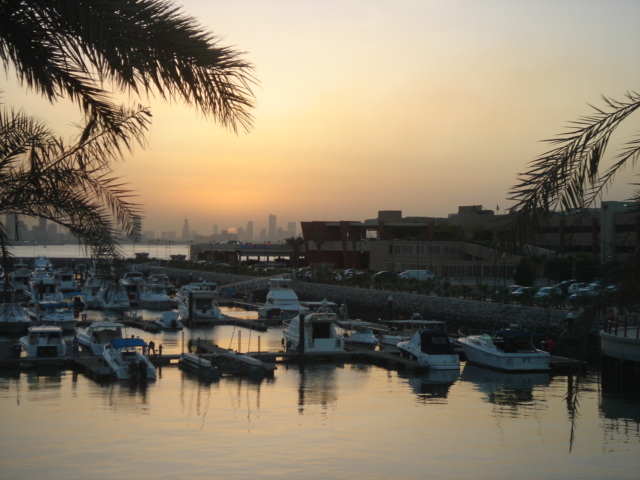
I totally love the way she framed the photo with palm branches, don’t you? She urges you to look closely, there really is a setting sun in the photo!
Seven Day Warning: Blog Action Day October 15
Only one week to go! Today is Wednesday, October 8th – just one short, sweet week before Blog Action Day.
They sent this reminder today:
7 Days to Go – Have you Registered?
Hello Bloggers!
We’ve got just 7 days to go before Blog Action Day 2008 – and we want to make sure everyone who participated in 2007 has had a chance to register their blogs to post up on October 15th and join us once more in shaking the internet!
Register at: BlogActionDay.org
In 2008 we’re discussing Poverty and we’re all set for a huge year with thousands of bloggers registered to participate, including dozens of top bloggers like TechCrunch, LifeHacker and more!
Additionally we have members of both the Spanish and English parliaments planning on participating, a ton of great organisations including the United Nations Millenium Campaign, Friendster, MySpace, Kiva, BlogTV, Blog.de, and lots more.
Head over to BlogActionDay.org for all the updates and news!
We have a lot of material here in Kuwait. I see we already have a lot of Kuwait bloggers registered! Wooo HOOOO on Kuwait! 🙂
“Illusions Driving Market Havok”
A fascinating article in today’s BBC News sheds light on our cascading stock markets. . . it isn’t rational, but it is explainable:
‘Illusions driving market havoc’
City traders may be seeing patterns that ‘aren’t really there’
The mind naturally creates illusions and superstitions at times of stress – and this could be adding to the global financial crisis, say scientists.
US researchers say feeling “out of control” makes us more likely to misinterpret information as we search for signs of order.
The study in the journal Science found investment decisions of volunteers were adversely affected by these feelings.
Simple psychological techniques might improve their performance, they said.
The researchers, from the University of Texas and Northwestern University in Evanston, Illinois, believe that humans cope with feeling out of control by trying to impose order subconsciously – even in situations where there is none.
At a simple level, they demonstrated the principle by asking volunteers to look for images embedded in “snowy pictures”.
Those whose feelings of control had earlier been undermined were more likely to claim to have seen an image, even where none existed.
However, the researchers believe that other kinds of illusion, from conspiracy theories to superstitions, stem from the same basic subconscious problem, and that it may be contributing to the current havoc on the world’s financial markets.
Read the entire article Here.
600 Speeding Tickets Issued over Eid Holidays
600 speeding tickets issued over Eid
From today’s Al Watan staff
KUWAIT: Highway Traffic Police launched a campaign against reckless and speeding drivers during the Eid holidays, which was aimed at eliminating tragic car accidents. According to instructions passed by Major General Mahmoud AlـDousari, Highway Traffic officers set up surprised checkpoints along the King Fahed Expressway.
They succeeded in handing out over 600 speeding tickets and seized 20 violating vehicles.
A reliable source said: “A reckless motorist driving a German car was speeding on the safety shoulder of the highway bypassing all other vehicles, which were lined up at a security check point. Highway patrols pursued the speeding driver before arresting him.”
I wish they had the police out regularly. The roads yesterday were full of people weaving in and out, too fast. We watched one car clip another entering the speedway, neither of them slowed a bit.
Cough! Cough!
I was out enjoying the weather yesterday, when I noticed around noon I had a little tickle in my throat, and I was sneezing a little, too. Thought it was just the dust. By evening, I had a deep-chest cough, the kind that makes you sore after you cough a few times.
I don’t know if I picked something up or if it was just the dust. I am hoping it passes quickly, and inconveniences me very little.
Is there something going around in Kuwait? Is this just the time of year for health challenges?
Good Samaritan
This is from today’s Arab Times, but I think there was a very brief write-up of it before – a Kuwaiti, coming out of mosque during Ramadan, saw her walking naked and dazed down the street, wrapped a “cloth” – I am guessing his gutra – around her and took her to the hospital. I remember thinking what a good, decent man this was, coming from mosque, during Ramadan, having compassion on this poor abused woman. Or maybe that was another, totally separate incident where four young men abduct, gang rape, and dump an Ethiopian maid. (sigh)
Police hunt gang rapists: Police are looking for four young men who allegedly kidnapped and raped an Ethiopian girl, reports Al-Watan Arabic daily.
Police received information about a girl in a semi-naked state in Kabad and rushed to rescue her. The girl said four youths dumped her in the middle of the road after having forced sex with her successively.
I tag this Women’s Issues, but if you read the papers, you will know that young men are as vulnerable to abduction and gang rape as young women.
Excuse Me? Say What?
From today’s Arab Times:
Drunkard creates nuisance: Police have arrested a Kuwaiti man for consuming alcohol and spreading panic in Adan Hospital, reports Al-Watan Arabic daily.
The well-built drunkard, who was visiting his brother in the hospital, caused nuisance and insulted policemen who rushed to the place, say sources.
It was found that the drunkard is wanted by law for insulting an employee on duty.
Don’t you find this write-up a bit strange?
OK, what does being “well-built” have to do with anything??? This is a news story!
6 October 2008 Back to Normal
The sound of early morning traffic humming by the house woke me early this morning, early enough to catch the sun coming up. The truth – as I see it – is that this is a very ho-hum, back to normal kind of morning. People are in the back-to-work mode, focused, not all that happy, after the glorious celebration of Eid, to be heading back to hum-drum normal. The sunrise was also sort of ho-hum, but there is a little wave action going on, and the temperature is only 79°F / 26°C and not expected to go over 98°F / 37°C.

I don’t mean to complain. It is a lovely sunrise. I might have had too much caffein this morning!
Sometimes, in the fall, I feel a little restless. Maybe the inner-Alaskan starts looking for a cave in which to hibernate!
Recent Comments
intlxpatr on Shampoo Ginger tigerbutterya0c5ff1d… on Shampoo Ginger intlxpatr on British Soldier Kidnapped, Esc… John on British Soldier Kidnapped, Esc… intlxpatr on British Soldier Kidnapped, Esc… Wikipedia Donate Button

Amazina


Early Voting in Florida


