Parting the Waters

We all know how Moses parted the Dead Sea to allow passage for the departing Israelites, but in today’s reading from the Old Testament, we are reminded that two other great prophets, Elijah and Elisha, were also able, with God’s help, to part the seas. This is from the Bible; does the Qur’an have a similar reading?
2 Kings 2:1-18
2Now when the Lord was about to take Elijah up to heaven by a whirlwind, Elijah and Elisha were on their way from Gilgal. 2Elijah said to Elisha, ‘Stay here; for the Lord has sent me as far as Bethel.’ But Elisha said, ‘As the Lord lives, and as you yourself live, I will not leave you.’ So they went down to Bethel. 3The company of prophets* who were in Bethel came out to Elisha, and said to him, ‘Do you know that today the Lord will take your master away from you?’ And he said, ‘Yes, I know; keep silent.’
4 Elijah said to him, ‘Elisha, stay here; for the Lord has sent me to Jericho.’ But he said, ‘As the Lord lives, and as you yourself live, I will not leave you.’ So they came to Jericho. 5The company of prophets* who were at Jericho drew near to Elisha, and said to him, ‘Do you know that today the Lord will take your master away from you?’ And he answered, ‘Yes, I know; be silent.’
6 Then Elijah said to him, ‘Stay here; for the Lord has sent me to the Jordan.’ But he said, ‘As the Lord lives, and as you yourself live, I will not leave you.’ So the two of them went on. 7Fifty men of the company of prophets* also went, and stood at some distance from them, as they both were standing by the Jordan. 8Then Elijah took his mantle and rolled it up, and struck the water; the water was parted to the one side and to the other, until the two of them crossed on dry ground.
9 When they had crossed, Elijah said to Elisha, ‘Tell me what I may do for you, before I am taken from you.’ Elisha said, ‘Please let me inherit a double share of your spirit.’ 10He responded, ‘You have asked a hard thing; yet, if you see me as I am being taken from you, it will be granted you; if not, it will not.’ 11As they continued walking and talking, a chariot of fire and horses of fire separated the two of them, and Elijah ascended in a whirlwind into heaven. 12Elisha kept watching and crying out, ‘Father, father! The chariots of Israel and its horsemen!’ But when he could no longer see him, he grasped his own clothes and tore them in two pieces.
13 He picked up the mantle of Elijah that had fallen from him, and went back and stood on the bank of the Jordan. 14He took the mantle of Elijah that had fallen from him, and struck the water, saying, ‘Where is the Lord, the God of Elijah?’ When he had struck the water, the water was parted to the one side and to the other, and Elisha went over.
15 When the company of prophets* who were at Jericho saw him at a distance, they declared, ‘The spirit of Elijah rests on Elisha.’ They came to meet him and bowed to the ground before him. 16They said to him, ‘See now, we have fifty strong men among your servants; please let them go and seek your master; it may be that the spirit of the Lord has caught him up and thrown him down on some mountain or into some valley.’ He responded, ‘No, do not send them.’ 17But when they urged him until he was ashamed, he said, ‘Send them.’ So they sent fifty men who searched for three days but did not find him. 18When they came back to him (he had remained at Jericho), he said to them, ‘Did I not say to you, Do not go?’
Friday Surf Fishing
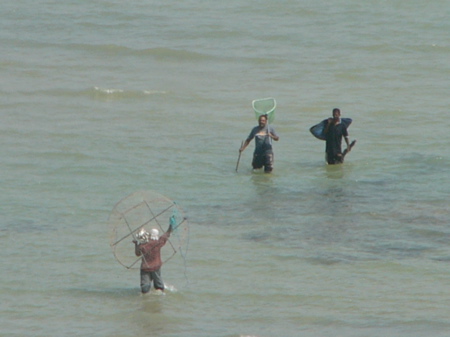
The fishermen brought in a lot of fish, just fishing near the shore. Later, at low tide, they also gathered shell fish. I would love to smell and taste the feast they had after sundown!
Donna Leon: Wilful Behavior
You think Donna Leon is writing about one thing, and then you discover it is about something else entirely. It seems to happen often in that line of work – you see the same thing on Law and Order, and Cold Case, and The Wire – what initially seems like a straightforward crime had depths and switch-backs unfathomable from the initial crime scene.
In Wilful Behavior, Paula, Brunetti’s wife, has just about had it with her university level students. They have no yearning for knowledge and insight, they are rife with materialism, she is feeling burned out and cynical. One student, who bucks the trend, comes to talk with her, and then Brunetti about the possibility of a post-mortem clearing of a person’s name, but she won’t give the name of the person or the crime that person committed. Before Commissario Brunetti has begun to plumb these depths – the student is murdered.
It’s always depressing when a young person dies. You can’t help but think of how treasured they were, how full of potential, and all that is gone now, wasted. A light in the world has gone out, and you grieve for how brightly that light might have shown. Brunetti and his wife only knew the murdered girl briefly, but her murder strikes them deeply.
Here is an excerpt from Brunetti’s discussion with the student before she was killed:
“I didn’t know young people even knew who Il Duce was.” Brunetti said, exaggerating, but not by much, and mindful of the almost total amnesia he had discovered in the minds of anyone, of whatever age, with whom he had attempted to discuss the war or its causes. Or worse, the sort of cock-eyed, retouched history that protrayed the friendly, generously disposed Italians led astray by their wicked Teutonic neighbors to the north.
The girl’s voice drew him back from these reflections. “Most of them don’t. This is old people I’m talking about. You’d think they’d know or remember what things were like then, what he was like.” She shook her head in another sign of exasperation. “But no, all I hear is that nonsense about the trains being on time and no trouble from the Mafia and how happy the Ethiopians were to see our brave soldiers.” She paused as if assessing just how far to go with this conservatively dressed man with the kind eyes; whatever she saw seemed to reassure her, for she continued. “Our brave soldiers come with their poison gas and machine guns to show them the wonders of Fascism.”
So young and yet so cynical, he thought, and how tired she must be already of having people point this out to her. “I’m surprised you aren’t enrolled in the history faculty,” he said.
“Oh, I was, for a year. But I couldn’t stand it, all the lies and dishonest books and the refusal to take a stand about anything that’s happened in the last hundred years.”
“And so?”
“I changed to English Literature. The worst they can do is make us listen to all their idiotic theories about the meaning of literature or whether the text exists or not.” Hearing her, Brunetti had the strange sensation of listening to Paula in one of her wilder moments. “But they can’t change the texts themselves. It’s not like what the people in power do when they remove embarassing documents from the State Archives. They can’t do that to Dante or Manzoni, can they?” she asked speculatively, a question that really asked for an answer.
“No,” Brunetti agreed. “But is suspect that’s only because there are standard editions of the basic texts. Otherwise, I’m sure they’d try, if they thought they could get away with it.” He saw that he had her interest, so he added, “I’ve always been afraid of people in possession of what they believe is the truth. They’ll do anything to see that the facts are changed and whipped into shape to agree with it.”
And, as it turns out, in the persistent corruption of Venetian bureaucracy, that is exactly what this murder is all about – the theft and possession of art during WWII, and how the ramifications are still trickling down today. How people are willing to kill to keep the past safely in the past, and to hang on to their treasured and priceless possessions.
Donna Leon continues to be one of my favorites because she is never formulaic – she has ISSUES, and she uses her Brunetti novels to educate her readers. As we become educated, we continue to experience Venice through all the senses, the smell of the veal cooking for dinner, the taste of the tiny espressos in the corner cafe meeting places, the gruesome murder sites, the sound of the waves in the canals, whipped up by the prevailing winds . . .you read Donna Leon, you become Venetian.
Tuna Tunisienne
I didn’t dare publish this photo before the day’s fast had ended. Doesn’t it look just yummy?

We all know what tuna salad is all about, right? A can of tuna, maybe some pickle, and some mayo, slosh it on the bread and you’re done? If you’re getting fancy, you can grill it?
When I moved to Tunisia, I learned a whole new way to eat tuna – I still add the sweet pickle, but now, I also add a LOT of parsley, a little lemon juice, some finely chopped onion, coarse pepper and salt, and then, just a little mayo.
It has a fresh flavor. You can taste all the individual tastes, but together they are magnificent. If you have any capers, you can throw them in, too. C’est magnifique!

This is how the Tunisians fix their tunafish, in a very common appetizer dish called brik (breek), probably distantly related to the Turkish borek. Sometimes made with just egg, sometimes with tuna and egg, it was the inspiration for my own tuna salad sandwich.
I can actually make brik, but there is no substitute for fresh Tunisian brik, made in Tunisia, with the special very thin brik skins that fry up thin and crisp in the best Tunisian olive oil. The photo is from PromoTunisia.
Qatteri Cat Goes Walking
This is for Maria. No, we are not related, except we are sort of three degrees-of-connection connected. I find her blog so unique and fun to read, AND she loves the Qatteri Cat and asked for more photos.
Most of the time, he sleeps, but because I had just opened a can of tuna, I caught him walking.

Night of Light
Last night I found myself awake around three, and took a walk to my window on the world. Off in the distance is a sight I find very comforting, a band of the old fishing boats, the shoowi, along the horizon, maybe twenty to thirty of them, each with a light on stern and bow, making a twinkling band of light like a necklace twinkling in the dark.
But over the boats was a light. A bright light. I had to look and look, like is it an aircraft coming in? It’s too high to be something off the boats, and it is so bright. What can it be?
Then I notice . . .I can see stars! I’ve always thought I didn’t see the stars because there are so many streetlights nearby, but last night I realized that the sky here is so hazy most of the time, we don’t see the stars. Last night – there were STARS! Lots of stars! And one of the brightest was near the horizon; maybe it was Suhail? (Canopus)
Here is something so cool. You can go to Weather Underground for Kuwait and go down the page below where they show the phases of the moon.
Click on “View the Full Star Chart.” You can put in the time you want; for example, it showed me exactly what I might have seen at 3 a.m. You can tell it you want it to look North, South, East or West, or you can tell it you want to see the whole sky, horizon to horizon. I LOVE this feature!

FYI, it also shows Kuwait cooling down. It won’t go over 109°F / 43°C this week. 😉
Rock Star Parking
Ya’ll know that a lot of this blog is about cross-cultural experiences, but this one is cross-cultural in our own family.
You know, every family, every tribe of us, has its own rituals and ways of doing things, and even when you marry someone you think you know very very well, you are in for some surprises.
One of the surprises in our marriage was that my husband thought I was supposed to fill the gas tank. Hello? Fill the gas tank? That’s MENS stuff, don’t you know? We had some tense moments in our first couple months of marriage working that one out, especially when I would leave him with nearly empty gas tank. My husband was rightfully flummoxed by my ability to be both a feminist and a princess, thinking that filling the tank and fixing car problems was HIS work. I learned *huge sigh* to watch the level of gas, to fill the tank, and to take the car in for services. *another big sigh*
But one thing that drove my husband right up the wall was my thing about parking close to the door. Well, I will give him this, he did not grow up in Alaska or in Seattle, he doesn’t know about freezing cold winds and mounds of snow and driving rain and winds that turn umbrellas inside out. My husband didn’t know that husbands, like daddies, are supposed to find the perfect spot as close to the entry as possible, every single time, or to drop us off and meet us inside. No, given I was a feminist, he expected to just take any old spot and I would just walk with him to wherever we would go. We never got that one worked out.
Not until a couple years ago. I learned that my mistake was all in trying to explain the irrationality of family culture. I learned that it was all about marketing, about positioning, something that normally I am very sensitive to and very good at doing. I was hopelessly blind in my approach and hopelessly single tracked.
It all changed when we were taking a new employee on a sight seeing tour of Kuwait. When we got to the grocery store, suddenly a spot opened up right in front of the store.
“Wooooo Hoooooo!” hooted the new guy, “ROCK STAR PARKING!”
I could see my husband straighten up and preen a little as he thought of himself as a person who got “rock star parking.” The light went on. Once he started thinking of himself as a “rock star parking” kind of guy, I never had to walk a long distance to the entry again.
(Woooo HOOOOOOOOO!)
A Thousand Splendid Suns
Once I picked up Khaled Hosseini’s A Thousand Splendid Suns, I barely put it down again until I was finished. I found myself thoroughly involved in the lives of Mariam and Leila, unwilling even to stop to fix dinner! The author of Kiterunner has hit another home run.
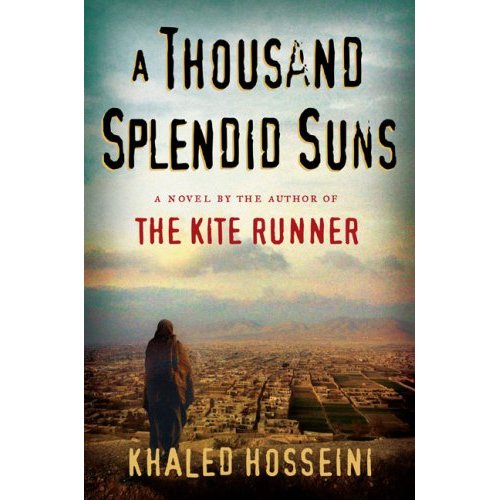
There was a time when we would listen to older state department types talk – with enormous longing – about their tours of duty in Afghanistan, pre-Soviet invasion, pre-Taliban, pre-American occupation. Have you ever read James Michener’s Caravan? There are two countries I long to vist, but the countries they are now are not the countries I heard people talk about – Afghanistan and Ethiopia. Our friends loved their times in these two countries.
A Thousand Splendid Suns opens in a small village outside Herat, and then takes us to Kabul. Mariam is born harami, a bastard, of a village cleaning woman in the house of a very wealthy man. Her father builds a small hut for her mother and herself in a remote part of the small village, and visits Mariam every week. Life is simple, and difficult, but also full of kind people who visit and who are concerned with Mariam’s welfare.
After marrying, Mariam goes to Kabul and learns a new way of life with her husband, Rasheed. What fascinates me with Hosseini is that while Rashid is one of the villians of this novel, he is just a man, doing the best he can given his own upbringing and limitations. In a sense, he is “everyman”, the strutting, domineering, sometimes brutal and abusive husband we find in every culture. But Hosseini also gives him transient bouts of kindness which blow through a little less often than the transient bouts of cruelty.
He also gives us good men, in this book, in the person of Jalil, the father of Mariam, who steps up to the plate in acknowledging Mariam and supporting her and her mother, but fails to nurture in the very real way women need nurturing from their fathers in order to reach their full potential in life. Hosseini also gives us a very strong man in the book, Tariq, who, although he has only one leg, is more wholly a man than any other man in the book. I imagine that this is not unintentional. (How Kissingerian is that for a double negative?!)
Written almost entirely in the Afghan world of women, we see through the eyes of Mariam, and later Leila, the transitions in Afghanistan and their impacts on daily life. We experience happiness with them, and peaceful scenes in quiet moments, raising the children, stepping outside into the garden at night to share a cup of tea and a shared bowl of halwa.
Between the moments of peacefulness, we also experience incoming morter rounds, explosions, marauding bands of warlords, and starvation. We go into a women’s hospital under Taliban control, where there are no medications, no running water, no instruments, and an Afghani female doctor does a C-section with no anaesthesia and is required to keep her burqa on. We watch a mother abandon her role and take to her bed when her two sons are killed fighting the Soviets, we experience betrayal and we experience helplessness, and we experience a Kabul women’s prison. A Thousand Splendid Suns is a rich feast of experiences, juxtaposing the everyday chores of women around the world – cooking, raising children, laundry – with events on the world stage.
(Available from Amazon for $14.27 plus shipping.)
Tattoo Regret
The American Academy of Dermatology reports tattoo regret is common in the United States. Among a group of 18- to 50-year-olds surveyed in 2004, 24 percent reported having a tattoo and 17 percent of those considered getting their tattoo removed.
This is just an excerpt from a much longer article that you can read on CNN Health News.
OJ Simpson Charged Again
And speaking of idiots, if you’ve committed a double murder and gotten away with it, why would you be so arrogant as to keep having run-ins with the cops? No matter how good the lawyers are that you hire, one day your luck runs out. With all my heart, I am hoping that this is the day for OJ Simpson.
God willing, your criminal arrogance will trip you.
The following is from CNN News, where you can read the entire story.
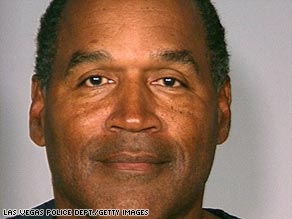
LAS VEGAS, Nevada (CNN) — Prosecutors on Tuesday filed numerous criminal charges against former NFL star O.J. Simpson and three other men in connection with an alleged armed robbery at a Las Vegas hotel last week.
The 11 charges include two counts of first-degree kidnapping with use of a deadly weapon; two counts of robbery with a deadly weapon; and two counts of assault with a deadly weapon.
Prosecutors say Simpson and his co-defendants — Walter Alexander, Clarence Stewart and Michael McClinton — committed kidnapping because they intended to hold or detain the two alleged victims using a weapon.
Recent Comments
intlxpatr on Shampoo Ginger tigerbutterya0c5ff1d… on Shampoo Ginger intlxpatr on British Soldier Kidnapped, Esc… John on British Soldier Kidnapped, Esc… intlxpatr on British Soldier Kidnapped, Esc… Wikipedia Donate Button

Amazina


Early Voting in Florida


