Who Knew? Skimmed Milk Gets Top Post
When I blog, I know what I think is important. I don’t just blog what I think is important, I also blog what I think is funny, what catches my eye, what I want people who don’t live in Kuwait to know about how life here is different from their life, and then.. . things in the news that might be obscure, but interesting.
Every day, the Who Knew? Skimmed Milk Affects Fertility post gets hits. Although I only posted it two weeks ago, it is the leader for the last thirty days, way ahead of the next most popular post.
I never know. Mostly I blog because I have things ( originally wrote “thinks” which must be truly Freudian) I want to say, but in any kind of communication, you need feedback. Feedback, for me, is a combination of what you comment, and what you read – my statistics. It just cracks me up, what you, the reader, find most interesting in my posts as opposed to what I am thinking when I post. Go figure!
Outside My Window
I live a busy life. To bring some order into the enormous potential for chaos, I have routines. Not inviolable routines; I can be flexible when I need to be, but routines that help me take care of the important things so that they don’t get lost in the pressure of other demands.
I start each day with coffee, and sit at my laptop and check all my e-mail. I read my daily readings in the Lectionary (see blogroll). Then I check the blog and respond to comments. Sometimes I write an entry, sometimes I don’t.
So this morning I have just sat down with my coffee, just opened my first e-mail, and suddenly, three men are outside my window, washing the windows. I am still in my nightgown, and had NO warning.

The Qatteri Cat was fascinated, and thought I had arranged this for his special entertainment. I was aghast, and rushed to the back rooms, away from the prying eyes.
I needn’t have worried. As you can see, just as I grabbed my camera, another traffic accident happened and they were very taken with the loud argument that ensued. My friends, the Kuwaiti police showed up about an hour later to sort things out.
Kiss the Kuwaiti Police
In the middle of the night last night, I was wide awake. The Qatteri Cat and I watched a police stop outside our window for about an hour.
I am guessing it was a combination traffic stop and training session. There was one guy who would gather the rest together when there were no cars and give additional techniques to the less-experienced traffic policemen. I am guessing, because there is no way on earth I would go out and ask!
Policeing in Kuwait is SO different. These young men are very professional. They were looking for people without driver’s licenses and / or without registrations. They had very cleverly positioned themselves so once the car was on the road, there was no way out but to go through them. Very strategic, very professional.
“So what is so different?” you might wonder, if you live in France, or Germany, or China or the US. “Isn’t that what police do?”
Yes. And no. One of the last people caught in the web was an old man traditionally dressed in thobe and gutra and egal, and he tried to get through by pretending he didn’t see the police. He didn’t have the right papers.
In my country, just trying to get through would get him into trouble.
He had to park, and get out of the car. Then, he went to each policeman and reached out with his right hand to take the policeman’s left arm, then he kissed them, on the nose or on the right cheek, and greeted them, still holding their arm or hand.
And the police treated the old man with deference, and kindness – and firmness. He still didn’t have the right papers. At one point, he pushed a policeman lightly, and the policeman didn’t go ballistic, but he gently pushed the old man back, out of his face. Finally, it was time to move the traffic stop, and they let him go, but I am guessing that, as the Kuwait Times always says “a case will be filed.” It did not look like he was getting off scot-free; the old man looked very unhappy.
I went back to bed happily, thinking how shocked our police would be, how they would react to someone holding their hand and kissing their nose, and drifted back to sleep with a big grin on my face.
Risk Taking Men Found Less Attractive
Risk-taking men ‘not attractive’ from BBC Health News.
Women are not attracted to dare-devil men, US researchers believe.
Men thought the opposite sex would be attracted by risky stunts such as bungee jumping and fast driving, a study of 48 men and 52 women found.
But in contrast, women said it was a turn-off, claiming they preferred more cautious people for partners.
However, the team from the University of Maine in Orono said those who took risks for the thrill were likely to be respected by fellow men.
Lead researcher Dr William Farthing said: “Men thought women would be impressed by pointless gambles, but women in fact preferred cautious men.”
However, Dr Farthing said women were attracted to men with a high-status, so if the risk-taking meant a man was respected by his friends they could then become attractive.
During the research, reported in New Scientist magazine, the young people were all given a series of scenarios to choose from, including saving someone’s life and fast driving.
The participants were asked to decide which they found more attractive.
The majority of women choose an altruistic action, rather than a thrill-seeking scenario.
Dr David Lewis, a member of the British Psychological Society, said in many ways the findings were not surprising.
“Previous studies have show that women are attracted to someone who acts in an altruistic way. Saving someone’s life shows a degree of empathy and sensitivity, and this is an attractive trait in men.
“On the other hand men see risk-taking as a particularly macho characteristic.
“Social norms are important and our society attaches weight to men expressing their macho qualities.
“But I think what you would find is that as men get older, they become less prepared to take risks.
“When you decide to do something you attach a cost-benefit to it, and when men are older the priorities they place on things change.”
Something in the Way She Moves . . .
From BBC Health News.
Attraction ‘determined by walk’
There really is something in the way she moves, according to researchers.
An hourglass figure has long been perceived to be the ideal figure for a woman to have.
But New York University researchers have found that to be found attractive, a woman had to move in a feminine way – swaying her hips.
Men, the Proceedings of the National Academy of Sciences paper found, were more attractive if they moved with a “shoulder swagger”.
The waist-hip ratio has long been thought to be key to Western perceptions of attractiveness, with a small waist and bigger hips the ideal combination.
Marilyn Monroe, and now Beyonce and Jennifer Lopez are famous examples of women with that figure.
Its popularity may be down to media images, or because Western women do not need to have strong and muscular bodies in order to carry out manual labour, unlike women in developing countries.
But the US research suggests they would never have achieved their sex symbol status if they did not move in the right way.
Not just measurements
The team carried out a series of studies involving over 700 participants who were shown a variety of animations and videos of people moving.
Some showed shadow figures, where it was not possible to see if it was a man or a woman, while others obviously showed a man or a woman.
No matter which format was being used, the participants rated women or “female” figures as more attractive if their hips swayed as they walked, while men were more attractive if they had the characteristic shoulder movement.
The research also confirmed the waist-hip ratio assumption, with women’s attractiveness being rated higher if their waist-hip ratio was small and men’s being higher if their’s was large.
But Kerri Johnson and Louis Tassinary who led the research, say their work shows attractiveness is not as simple as the difference between two measurements.
Writing in PNAS, the researchers said: “The body’s shape and motion provoke basic social perceptions, biological sex and gender – ie masculinity or femininity respectively.
“The compatibility of these basic precepts predicts perceived attractiveness.”
The team say their findings only apply to Western cultures, and other societies will judge attractiveness depending on their most prized feminine and masculine traits.
Dr George Fieldman, principal lecturer in psychology at Buckinghamshire Chilterns University College said: “This is quite plausible.
“It’s the movement which attracts, and not just the waist-hip ratio per se.”
He added: “It would be interesting to see what the ideal combination of measurements and wiggle is.”
McDonald’s Stock Slides As More Consumers Turn To Food
Satire from The Onion.
January 15, 2003 | Issue 39•01
My comment: One of the really good things about living in Kuwait is the enormous availability of REAL food, freshly prepared, with identifiable ingredients. It’s not such a bad thing to have choices, and fast food has it’s purposes, but – in my opinion – nothing beats REAL food – fresh fresh fish, vegetables straight from the farms, local chickens (yep, even with bird flu) and eggs – we live in the midst of unbelievable abundance.
OAK BROOK, IL—The McDonald’s Corporation announced Tuesday that it will close 175 restaurants and cut nearly 600 corporate jobs, responding to a plunge in stock prices blamed on a depressed economy and rising consumer interest in actual food.

“Though still America’s number-one hamburger retailer,” McDonald’s CEO Jim Cantalupo said, “we have entered a brief period of restructuring due to the steady growth of other convenience eateries and, more significantly, growing competition from producers and distributors of demonstrably nutritive matter, i.e. food.”
In the fourth quarter of 2002, McDonald’s posted the first quarterly loss in its 47-year history. Its stock closed Tuesday at $15.78, a seven-year low for the quasi-food giant.
Analysts attribute the bleak financial picture to numerous factors, including the uncertain economy, poor management, eroding market share, and widespread health concerns about beef—a component sometimes used in the construction of McDonald’s hamburger patties.
“Though well-accustomed to weathering recessions and changing tastes, the Golden Arches may be facing its toughest battle ever, given the surging public interest in leading healthy, active lives and consuming objects that taste at least remotely organic,” analyst Carolyn Moss of Lehman Brothers said. “These days, people seem more interested in eating food than hormone-hybrid lab patties.
The world’s leading purveyor of semi-synthetic digestibles, McDonald’s became a franchise in 1955 and quickly expanded across the U.S., thanks to innovative marketing, low prices, and exemption from FDA regulations, given that its products fall outside the scope of the agency. McDonald’s has proven a popular favorite among busy, on-the-go Americans lacking the time for genuine food.
But for all its financial woes, McDonald’s is optimistic for the future.
“This whole non-reconstituted-food craze will pass,” Cantalupo said. “People have enjoyed our meat-flavored pseudo-patties for decades, and we’re not going to be scared by consumers’ passing interest in burgers that actually taste like an animal, served on bread that’s less than a week old and garnished with ve-ge… ve-ge… ve-ge-tables.”
Said McDonald’s COO Charlie Bell: “We don’t see the burgeoning food industry as a threat, but rather as a public fancy with which McDonald’s can happily co-exist.”
Added Bell: “I even enjoy some food myself here and there. I ate some corn just last weekend.”
In spite of McDonald’s outward optimism, rumors abound that the company is pondering some of its most extreme changes ever. McDonald’s famed management-training facility, Oak Brook’s Hamburger University, is reportedly developing an unprecedented “food studies” program. The facility is also rumored to be adding a research wing to teach culinary fundamentals for eventual incorporation into the McDonald’s business plan.
“The bottom line is, we’re doing fine,” Bell said. “Certainly, as a last resort, we could introduce some recognizably food-like items, perhaps a sandwich made with animal matter and vegetables that have not been shredded, condensed, and flash-frozen to remove all possible nutritional content or general appearance of earthly origin. But I honestly don’t think it will ever come to that.”
The Wire
A couple years ago our son started talking to us about The Wire. He always puts us on to really interesting series. The Wire is an HBO series, like Rome
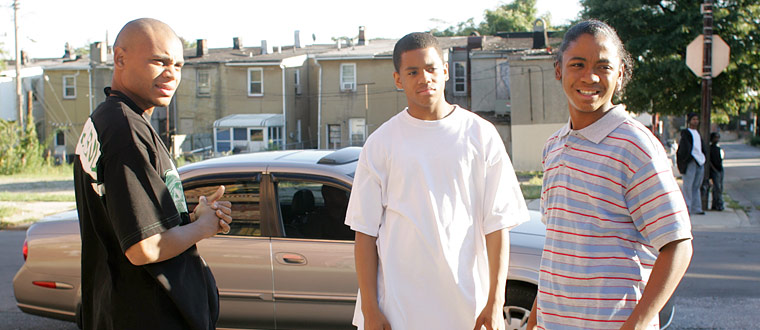
Season 1 starts with a new unit being set up to interdict the drug trade in Baltimore. Season 2 re-unites the team to combat illegal imports and illegal importation of sex slaves out of Eastern Europe and Asia. Season 3, my favorite season of all, is back to the drug trade, but with a difference.
In Season 3, one police district changes the rules. They clean up their neighborhood and send all the drug traders and sex trade workers to one area. The area doesn’t legalize crime – not exactly – but the police leave that area alone. As they explain it to the primary drug dealers, it’s a little like Amsterdam. The homies don’t understand; they call it “Hamsterdam”. I laugh everytime I hear it.
The series doesn’t focus strictly on the police – we get to go inside to watch how the drug dealers organize and divide up the city. We learn how drug lords use big business management modules to streamline their supply and demand, and to stay ahead of the police technology. And they are masters at manipulating the judicial system.
There is brutality. There is sex. There is love and there is betrayal. Sometimes, it isn’t easy to tell who the “good” guys are. There are bad guys who show decent values and there are police and politicians on the take. You get the impression it is probably pretty real stuff. In one season 3 episode, a policeman is shot in the line of duty, and they hold a wake in an Irish pub. They are all very very drunk, and vomiting out in the streets. It isn’t pretty.
And all the same, when each season ends, we can hardly wait for the next one. It is gripping drama, vintage HBO cutting edge production. It keeps you on the edge of your chair. You can read more about The Wire at it’s HBO site, where I just learned that The San Francisco Chronicle calls The Wire “the best television show of the year.”
Tchotchke
I used this word in conversation the other day, and my friend wasn’t familiar with it. I said it is something maybe sparkly, that catches the eye, but isn’t necessarily valuable, like the way Ravens go after a piece of tinfoil. Here is the official version, from Wikipedia.
Tchotchke (originally from Yiddish tshatshke (often spelled in a variety of other ways because there is no standardized transliteration) (trinket), ultimately from a Slavic word for “toys” — Polish: cacka, Russian: цацки) are trinkets, small toys, knickknacks, baubles, or kitsch. The term has a connotation of worthlessness or disposability, as well as tackiness. For example, an overly ostentatious piece of jewelry, valuable or not, might be referred to as a tchotchke.
The word may also refer to swag, in the sense of the logo pens, keychains and other promotional freebies dispensed at trade shows, conventions and similar large events. Also, stores that sell cheap souvenirs in tourist areas like Times Square and Venice Beach are sometimes called tchotchke shops.
The term was long used in the Jewish-American community and in the regional speech of New York City. It achieved more notoriety in mainstream culture during the Monica Lewinsky scandal. In addition, the 1999 movie Office Space features a tacky restaurant called “Chotchkies.”
Leo Rosten, author of The Joys of Yiddish, gives an alternate sense of tchotchke as meaning a desirable young girl, a “pretty young thing”. Less flatteringly, the term could be construed as a more dismissive synonym for “bimbo” or an attractive, but not very intelligent, female. Some consider this usage sexist and it is not widely used outside Jewish circles. The term (in the form tzatzke) is sometimes used in modern Hebrew as a slang word equivalent to “slut.”
Internet Phones Giggle
From a teeny-tiny article on page 2 of today’s Kuwait Times:
‘Phone’ Teams Honored
Kuwait: It is important to reduce charges of international calls to prevent illegal activities, Communication Minister Dr. Maasouma Al-Mubarak stressed yesterday.
In a press conference held on the occasion of honoring the team of the ministry’s telephone control department, Al-Mubarak said the department succeeded in cooperation with the Interior Ministry in locating and stopping illegal international calls dealers praising their efforts that continued despite the dangers they faced.
My comment: I’m sorry. I truly mean no disrespect. And at the same time I am having a very hard time trying to maintain a straight face. Oh, these dangerous telephone callers out there!
• Raiding brothels.
• Chasing drug dealers.
• Dealing with arrogant/immature/drunk/drugged drivers.
• Family disputes involving knives and guns.
• Protecting the borders, land and sea.
All of the above can involve serious dangers. One of the axioms in policing is that your most dangerous call is getting between a fighting husband and wife. But the bravery of raiding telephone call centers? Please. Spare me.
You can’t turn back the clock. Technology has given us a whole new way of making international calls. The MOC can spend its resources fighting a numerous enemy – people who want to make reasonably priced phone calls – or they can become a part of the solution, regulating and encouraging growths of new technologies to the greater good of all.

Lying Hurts the Liar
I came across this post in an old archive. The author was writing to teens about the Monica Lewinski scandal, but as I read through his wise words, I found myself thinking how appropriate the words are for all age groups:
Lying Hurts the Liar
If you lie, it will make things worse for you, too. Oh, you might get away with it once or twice, but you will get caught sooner or later.
How Does Lying Make Things Worse?
Lying makes things worse because it hurts your personal relationships: relationships with friends, brothers and sisters, parents, children, teachers and other adults.
Think of it for a moment. When you lie, it is a burden you have to carry with you. It makes you feel bad inside. You know you hurt your relationship with someone by lying. It violates the trust people have in you. Usually you have to lie again to cover up the first lie, and you feel even worse for doing that.
Have you ever noticed how badly you feel when you discover a friend has told you even a little lie? It hurts a lot. You wonder why a friend would do that to you. You think about it a lot, and you just don’t trust your friend as much after that. It’s not the same.
Then think about how you feel when someone is telling you what a good, good friend he is, and then he goes behind your back and says just the opposite. It destroys all trust.
A Way You Can Understand Lying
When you become a friend to another, you put your life in some small or large way into his cupped hands. You trust the person by putting part of your life in their hands. You want and need your friend to be worthy of that trust. When they lie to you, he lets your life slip through his hands, and is not worthy of your trust. How lonely that feels! How disappointing!
Lying harms not only personal relationships, but business relationships as well. In conducting business we also put ourselves into the hands of others. Our business associates need to be worthy of our trust. Take the simple example of going into a store and buying a box of chocolate chip cookies. The picture of the cookies on the box looks terrific. The chocolate chips look tasty, but you open the box at home and find cookies with no chips. You feel cheated because you believed what you saw. You believed a liar. No wonder you feel cheated. No wonder you’ll probably avoid that brand in the future.
Why Are We Tempted to Lie?
We are tempted to lie because we want something and use a lie to get it . . . That sounds a little selfish, doesn’t it? No wonder lying makes us feel lonely. No wonder the devil is called the father of lies.
We lie because we believe it will make things better. So you shoplift, and when questioned, say: “If I lie I won’t get caught. If I’m caught, they will be mad at me. I want to avoid the pain.”
Once we give into this temptation to lie, we start lying some more by saying: “I want to spare my loved ones the pain of knowing what I did.” So you try to spare them that pain by lying to them. That doesn’t make sense.
It’s like saying: “I’m not going to admit I robbed the bank because it will upset the police.” What kind of nonsense is that?
How Do We Respond When We Are Caught Lying?
Our response is usually to say: “Everybody lies. So what difference does it make?” The trick of a good liar is to attack the accuser. So when another kid accuses you of lying, you say: “Well, I heard you lie once.” It’s the “look who is calling the kettle black.” Attacking the accuser does not make the lie less a lie. It is still a lie. It still hurts relationships.
Your trying to justify lying by saying everybody lies is like saying: “Everybody hurts their loved ones so hurting loved ones must not be so bad.” Do you really believe that since so many people steal, stealing must not be so bad? It’s like saying everyone makes your life miserable so being miserable must not be so bad. This doesn’t make sense.
Why Are These Rationalizations Wrong?
Lies decrease the love we have for one another. They diminish hope. They extinguish trust and belief in one another. Lies are morally wrong.
Why don’t we just say: “Let’s forgive and go on with life?” Forgiveness makes us feel good, and like anything, it can be taken to excess. For example, if a person has no remorse, don’t forgive him just so you can feel good or look good. It mightily confuses the liar. Likewise, don’t forgive someone who has done nothing wrong. It confuses others.
On the other hand, don’t hold onto forgiveness as a form of vengeance. “I won’t forgive you because you need to suffer some more.” That’s like saying until you extract a pound of flesh, the score is not even.
The action of appropriate forgiveness is an action making the situation better . . . it produces a good set of outcomes. Failure to forgive in a situation where forgiveness is warranted makes the situation much worse.
It doesn’t do any good to censure a person who feels no shame, who feels no guilt. He will just make more excuses.
On the other hand, it does a great deal of good to refrain from censuring a person who already has censured himself. This is the person who really feels guilt and tries to make amends. Failure to forgive here is inappropriate.
It’s also good to remember that there is a difference between forgiving and condoning. Condoning diminishes the action. It’s inaccurate and it’s a cop-out. The religious call to forgiveness is not a call to be a sucker. If what was done hurt you, you need to say that, and not pretend it didn’t hurt and it doesn’t matter.
At every point a person has a choice to forgive or not forgive for the right reasons. Conciliatory personalities tend to forgive too much, too quickly. Aggressive personalities tend to forgive too little, too late. We need to strike a balance.
Is it Hard to Forgive After the Lying Has Stopped?
Yes, it is a lot easier to forgive when the person is trying to make up to you for all the lies he told you. Even then, it takes a long time for forgiveness to settle in. Why? Because the hurt is still there.
It is rather easy for a person who lies from time-to-time to quit. It can
be done rather readily if there is determination to do so. What about a person who lies habitually over a period of time and cannot quit easily or without consistent help? A habitual liar will be tempted to believe he just has to say he’s sorry, just as a habitual drinker will tend to believe all he has to say is he’s sorry. It doesn’t work that way. On the other hand, bull throwers, braggarts and exaggerators are a tiresome lot, but they are easier to get along with than habitual liars.
How Is Lying Made Worse?
The bigger the role model, the worse the lie. If someone I hardly know lies to me, it is bad. However, it is much worse if my mother lies to me. She is a much bigger role model in my life. That makes the lie worse.
That’s why the President falls off a mountain when he lies. Yes, he falls a great distance, and if he lies over and over again, he falls an even greater distance.
You may say that if we raise the bar too high, no one will run for public office. Then all we will get is the biggest bully or the guy with the most money. That’s really not our problem. The problem is just the opposite.
We need to raise the bar high enough so better people will run for office. We need to restore the expectation that includes honest behavior. The solution is not to take the bar away. To put it another way, if many people are lying, the solution is not to approve of lying, but rather to rekindle the fires of devotion. Otherwise, human flourishing is diminished.
Every time we see someone shoplifting in the store, we need to cry out: “Thief, thief!” Similarly, every time we see someone lying, we need to call out: “Liar, liar pants on fire!” We will be better off with fewer liars, not more.
These are just some of the reasons why the good Lord tells us not to lie.
Here is the source of the article: Girls and Boys Town.
Recent Comments
Kitchen on Isiais: Winding Down intlxpatr on Shampoo Ginger tigerbutterya0c5ff1d… on Shampoo Ginger intlxpatr on British Soldier Kidnapped, Esc… John on British Soldier Kidnapped, Esc… Wikipedia Donate Button

Amazina


Early Voting in Florida


