From Oppressive Governments
Prayer from today’s Lectionary:
PRAYER (contemporary language)
Almighty God, we thank you for the faith and witness of Paul Sasaki, bishop in the Nippon Sei Ko Kai, tortured and imprisoned by his government, and Philip Tsen, leader of the Chinese Anglican Church, arrested for his faith. We pray that all Church leaders oppressed by hostile governments may be delivered by your mercy, and that by the power of the Holy Spirit we may be faithful to the Gospel of our Savior Jesus Christ; who lives and reigns with you and the Holy Spirit, one God, for ever and ever. Amen.
EUPHROSYNE/SMARAGDUS OF ALEXANDRIA
MONASTIC, 5TH c.
From today’s lectionary, one of my favorite stories of early Saints
Prayer for today: (contemporary language)
Merciful God, who looks not with outward eyes but discerns the heart of each: we confess that those whom we love the most are often strangers to us. Give to all parents and children, we pray, the grace to see one another as they truly are and as you have called them to be. All this we ask in the name of Jesus Christ, our only mediator and advocate. Amen.
“Saint Euphrosyne of Alexandria (fl. 5th century CE) was a female saint who adopted male attire and lived at a local monastery as an ascetic.
Euphrosyne was the beloved only daughter of Paphnutius, a rich man of Alexandria, miraculously born in her parents’ old age in answer to a monk’s prayer. Her loving father desired to marry her to a wealthy youth.
But having already consecrated her life to God and under pressure to break her vow, she dressed as a man and assumed the identity of “Smaragdus” (“emerald”). She then escaped to a nearby men’s monastery, where she made rapid strides toward a perfected ascetic life. She was under the guidance of the abbot, who also happened to be the same monk who had prayed for her birth.
Years later, when Paphnutius appealed to the abbot for comfort in his bereavement, the abbot committed him to the care of Euphrosyne, still under the guise of Smaragdus. Paphnutius received from his own daughter, whom he had failed to recognize, helpful advice and comforting exhortation. Not until she was dying did Euphrosyne reveal herself to him as his lost daughter. After burying her, Paphnutius gave up all his worldly goods, and became a monk in the same monastery. There, he used his daughter’s old cell until his own death ten years after. “
from Wikipedia

A dying Euphrosyne reveals herself to her father
As I read today’s lectionary, I am struck by how very blind we are to the realities of God’s creation, that in every tribe and every nation, there are those who are outside the normal boundaries of gender, and who are, at the same time, the people God created them to be. How cruel we are! We judge, and we call names, we cast out – in every tribe and nation in the world – those who are Other, who do not fit into our tiny human conception of “right.” I can imagine the overwhelming revelation as we transcend into the after life.
Diwali: A Light Sparkles in Dark Times

Today, Labor Day, when dark events are taking place in our country, shutting down the light of liberty and democracy, we got an unexpected invitation – to a Diwali party, coming up in a couple months.
We are so honored. And we know Diwali; we were living in Al Fardan 1, in Doha, Qatar, when an Indian neighbor invited all the residents of Al Fardan to come over for Diwali. We didn’t know what Diwali was, and our internet was dial-up and irregular, but we asked around and were told, with big smiles, to go and find out.
The night of Diwali came, and we walked to our neighbor’s house, along with many of our Al Fardan neighbors. We could see it long before we arrived – thousands of candles set out in patterns in the yard, lining the sidewalk, leading us inside, to more lights and a feast of sweets, platters of sweets, all illuminated by gleaming candlelight.
Such open-hearted hospitality. Such generous sharing. No one was excluded; everyone was welcome, and there was plenty for everyone.
Our neighbors’ beliefs were different from ours, and yet, I believe all such generosity, freely given, springs from the same spirit.
We can’t wait for this upcoming Diwali.
Crime Wave? Another Lie
Today I am sharing a blog post from Robert Reich, about how we can deal with the absurdities we are hearing about crime waves – but only in inconveniently Democratic majority cities:
How to respond to Trump’s lies about a “crime wave”
AUG 28, 2025
Friends,
Trump’s escalating rhetoric of a “crime wave” in America, coupled with threats to occupy Chicago, New York, Baltimore, and many other cities, has put many Democrats in a bind.
They worry if they deny crime is a problem, they could turn off swing voters who always and inevitably worry about crime.
As with immigration, crime is an issue that Trump can demagogue because, while the rate of serious crime his fallen dramatically, most Americans continue to fear crime. That fear has been heightened by expanding homeless encampments and drug overdoses in plain view, no matter what the statistics say.
Crime has also been a racial dog whistle. At least since Richard Nixon emphasized “law and order” and Ronald Reagan said he’d be “tough on crime,” Republicans have used fear of crime as code for white fear of Black people.
So what should Democrats do? My suggestion: Don’t simply give statistics showing that the rate of dangerous has fallen. Say safety is critically important, but local police rather than federal troops are best at dealing with it.
Don’t stop there. Hammer Trump for pardoning the 1,500 criminals who violently attacked the United States capitol and caused the deaths of four police officers — and for then firing the federal prosecutors who held them accountable.
Attack him for opening the floodgates to white-collar crime — hobbling the Consumer Financial Protection Bureau, freezing enforcement of the Foreign Corrupt Practices Act, disbanding the National Cryptocurrency Enforcement Team, and retreating from almost all federal lawsuits involving money laundering, crypto markets, and foreign corruption.
Since retaking the White House, Trump has granted clemency to Lawrence Duran, a health care executive who was convicted of leading a Medicare fraud and money laundering scheme. Trump has commuted the 14-year sentence of Jason Galanis, who defrauded investors, including a Native American tribe and a teachers’ pension fund, of tens of millions of dollars. He has pardoned Julie and Todd Chrisley, the reality TV stars convicted of bank fraud and tax evasion.
In April, the Wall Street Journal reported that Attorney General Pam Bondi was “swapping out and sidelining career supervisors who were responsible for charging crimes such as corruption, price fixing and securities fraud.”
Trump is soft on crime as long as the crime serves his own purposes. People who try to get on Trump’s good side — such as New York City Mayor Eric Adams, who was indicted on bribery charges during the Biden administration — have seen Trump’s Justice Department drop its charges against them.
Before they poured money into Trump’s initiatives and PACs, many Big Tech corporations were facing federal investigations and enforcement actions. Those investigations and lawsuits are now being dropped.
Earlier this year, the Department of Justice dropped its criminal case against Boeing, which involved the company’s role in two plane crashes that killed 346 people — despite Boeing previously agreeing to plead guilty in the case.
Trump is himself a criminal, found guilty on all 34 counts of falsifying business records in the first degree related to payments made to Stormy Daniels before the 2016 presidential election.
Don’t just accuse him of manufacturing a pretext to go into American cities. Hit him hard on his own horrific record of coddling criminals.
History the White House Doesn’t Like: The List of Exhibits Trump Wants Gone
It’s a strange honor to have exhibits selected that the President wants gone. As in Literature, when you read through the list, you learn a lot about the fears and the prejudices of the creator. In recent decades, the United States of America has had a greater tolerance for the idiosyncratic views of artists, appreciating their differing perceptions. The list below is taken word for word from the White House Post called The President is Right About the Smithsonian.
- The National Museum of African American History and Culture debuted a series to educate people on “a society that privileges white people and whiteness” — defining so-called “white dominant culture“ as “ways white people and their traditions, attitudes, and ways of life have been normalized over time” and portraying “the nuclear family,” “work ethic,” and “intellect” as white qualities rooted in racism.
- The campaign featured content from hardcore woke activist Ibram X. Kendi

As part of its campaign to stop being “wealthy, pale, and male,” the National Portrait Gallery featured a choreographed “modern dance performance“ detailing the “ramifications“ of the southern border wall and commissioned an entire series to examine “American portraiture and institutional history… through the lens of historical exclusion.”
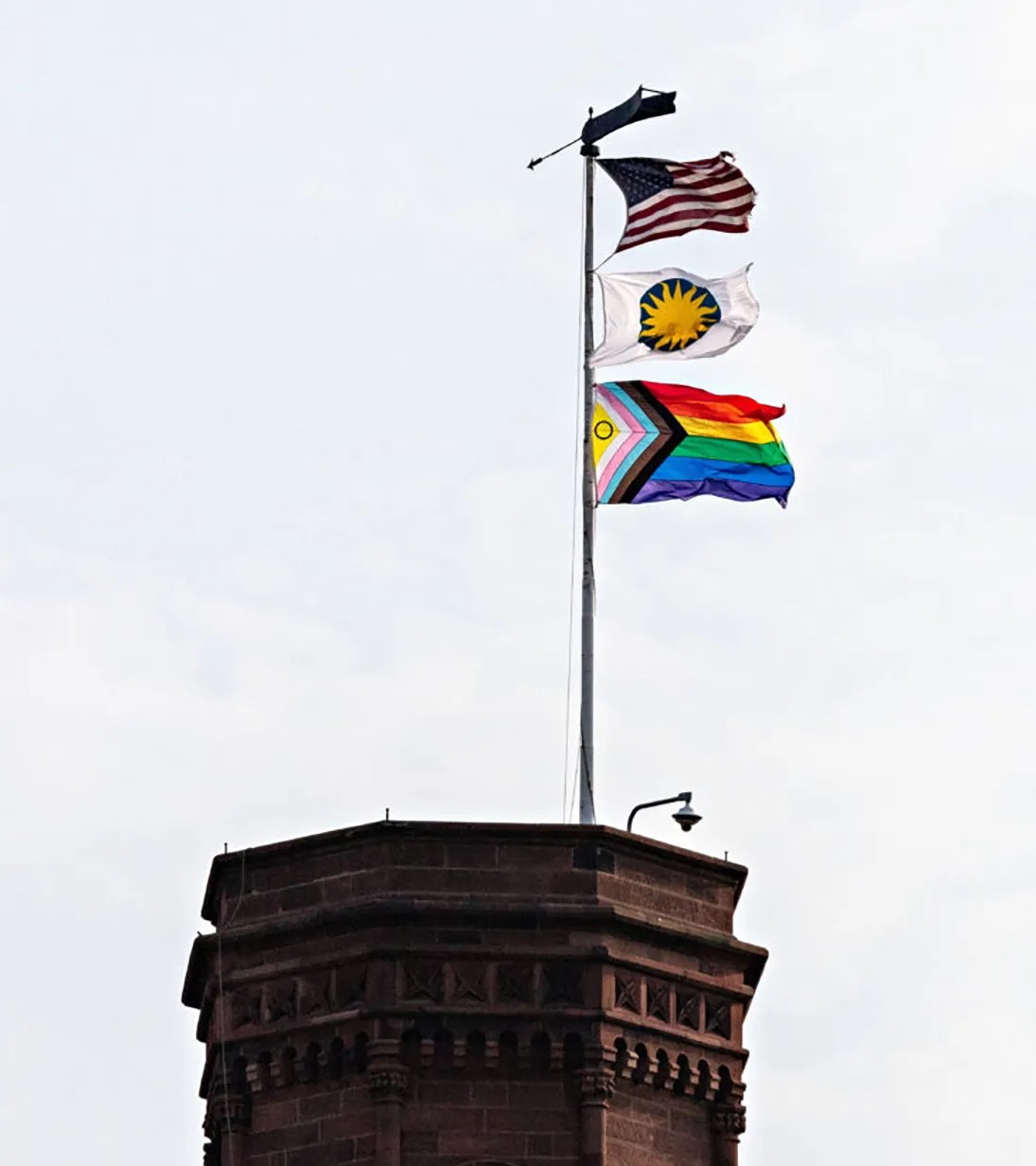
The National Portrait Gallery features art commemorating the act of illegally crossing the “inclusive and exclusionary” southern border — even making it a finalist for one of its awards.
(Intlxpatr comment: This painting reminds me of the painting of Mary, Joseph and the Baby Jesus escaping to Egypt to avoid King Herod’s massacre of the innocents)

The National Museum of African Art displayed an exhibit on “works of speculative fiction that bring to life an immersive, feminist and sacred aquatopia inspired by the legend of Drexciya,” an “underwater kingdom populated by the children of pregnant women who had been thrown overboard or jumped into the ocean during the Middle Passage.”
The American History Museum’s “LGBTQ+ History” exhibit seeks to “understand evolving and overlapping identities such as lesbian, gay, bi-sexual, transgender, queer, transsexual, transvestite, mahu, homosexual, fluid, invert, urning, third sex, two sex, gender-bender, sapphist, hijra, friend of Dorothy, drag queen/king, and many other experiences,” and includes articles on “LGBTQ+ inclusion and skateboarding“ and “the rise of drag ball culture in the 1920s.”
The National Museum of the American Latino features programming highlighting “animated Latinos and Latinas with disabilities” — with content from “a disabled, plus-sized actress” and an “ambulatory wheelchair user” who “educates on their identity being Latinx, LGBTQ+, and disabled.”
The National Museum of the American Latino characterizes the Texas Revolution as a “massive defense of slavery waged by ‘white Anglo Saxon’ settlers against anti-slavery Mexicans fighting for freedom, not a Texan war of independence from Mexico,” and frames the Mexican-American War as “the North American invasion” that was “unprovoked and motivated by pro-slavery politicians.”
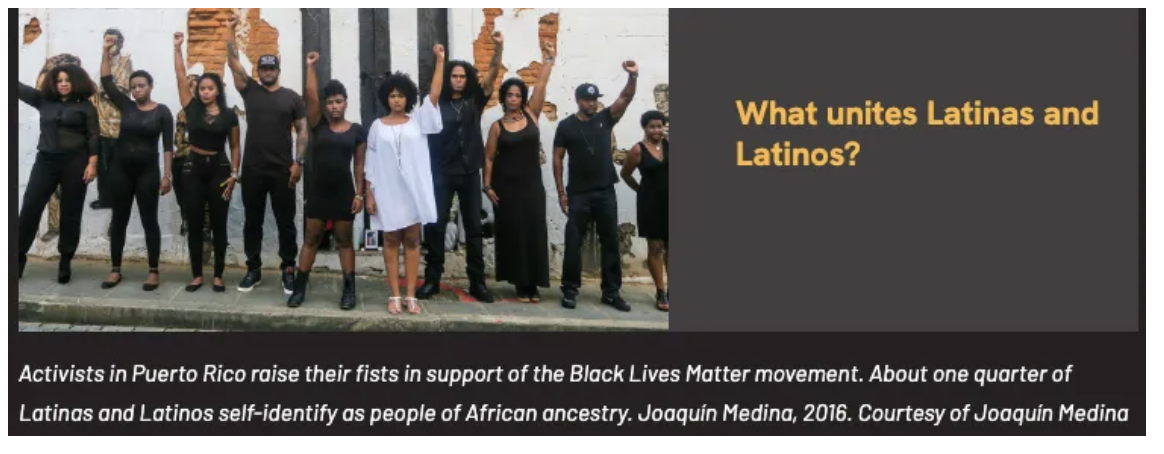
According to the National Museum of the American Latino, “what unites Latinas and Latinos“ is “the Black Lives Matter movement.”
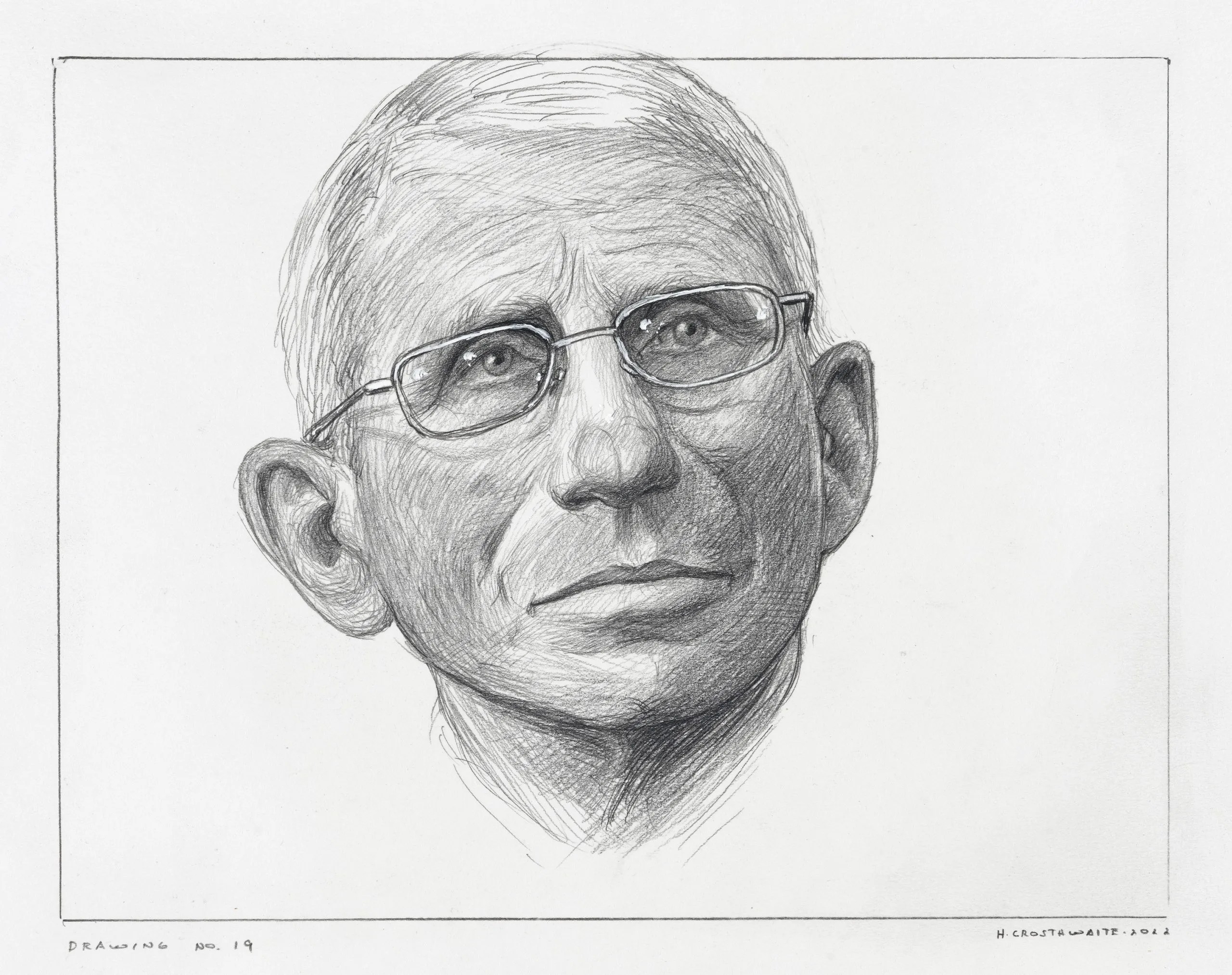
The National Portrait Gallery commissioned a “stop-motion drawing animation” that “examines the career“ of Anthony Fauci.
The American History Museum’s exhibit marking the 50th anniversary of Title IX includesbiological men competing in women’s sports and argues in favor of “transgender” athletes competing in sports against the opposite biological sex.
A exhibit at the American History Museum depicts migrants watching Independence Day fireworks “through an opening in the U.S.-Mexico border wall” and says America’s founders “feared non-White immigration.”

The American History Museum features a display that refers to the founding of America as “a profound unsettling of the continent.”
The American History Museum’s “American Democracy” exhibit claims voter integrity measures are “attempts to minimize the political power” of “new and diverse groups of Americans,” while its section on “demonstrations” includes only leftist causes.
An American History Museum exhibit features a depiction of the Statue of Liberty “holding a tomato in her right hand instead of a torch, and a basket of tomatoes in her left hand instead of a tablet.”

- The National Museum of the American Latino features an anti-American exhibit that defines Latino history as centuries of victimhood and exploitation, suggests the U.S. is stolen land, and characterizes U.S. history as rooted in “colonization.”
- The exhibit features writing from illegal immigrants “fighting to belong.”
- The exhibit displays a quote from Claudia de la Cruz, the socialist nominee for president and a director an anti-American hate group, as well as another quote that reads, “We didn’t cross the border; the border crossed us.”
- The exhibit remains prominently featured on its website alongside a quote from the Communist Party USA’s Angela Davis, who was once among the FBI’s Top 10 Most Wanted Fugitives.

- The National Museum of the American Latino features an anti-American exhibit that defines Latino history as centuries of victimhood and exploitation, suggests the U.S. is stolen land, and characterizes U.S. history as rooted in “colonization.”
- The exhibit features writing from illegal immigrants “fighting to belong.”
- The exhibit displays a quote from Claudia de la Cruz, the socialist nominee for president and a director an anti-American hate group, as well as another quote that reads, “We didn’t cross the border; the border crossed us.”
- The exhibit remains prominently featured on its website alongside a quote from the Communist Party USA’s Angela Davis, who was once among the FBI’s Top 10 Most Wanted Fugitives.

The former interim director of the future Smithsonian American Women’s History Museum declared the museum will be “inclusive” of biological men posing as women.
Commentary from The Hill, August 22, 2025:
White House lists 20 objectionable Smithsonian exhibits, artworks
BY ASHLEIGH FIELDS – 08/22/25 10:34 AM ET
The Trump administration specifically targeted the American history museum’s “LGBTQ+ History” exhibit and condemned a separate display lauding the 50th anniversary of Title IX with a focus on transgender athletes. President Trump signed an executive order in February barring transgender women from competing in women’s sports.
The decision to highlight more than a dozen exhibits and artworks as “woke” comes days after Trump criticized the history museum for its depiction of slavery and its impact on Black Americans.
“The Smithsonian is OUT OF CONTROL, where everything discussed is how horrible our Country is, how bad Slavery was, and how unaccomplished the downtrodden have been — Nothing about Success, nothing about Brightness, nothing about the Future,” the president wrote Tuesday in a Truth Social post.
“We are not going to allow this to happen, and I have instructed my attorneys to go through the Museums, and start the exact same process that has been done with Colleges and Universities where tremendous progress has been made,” he added. “This Country cannot be WOKE, because WOKE IS BROKE.”
During his first term, Trump lauded the opening of the National Museum of African American History and Culture for its portrayal of harsh truths and storied victories for disenfranchised Black citizens.
Trump’s issue with the depiction of slavery in museums has been widely challenged by Black historians and community leaders.
“Just as the Holocaust is remembered in all its brutality, so must America reckon with the truth of chattel slavery, Jim Crow and racial terror,” Toni Draper, publisher of the Afro-American Newspaper — the archives of which were used to help curate the museum — wrote in a recent op-ed for Afro.com. “Anything less is historical erasure, a rewriting of facts to make the nation appear more palatable.”
“But history is not meant to comfort — it is meant to confront. And only in confrontation do we find the lessons that lead us forward,” she added.
When the News is Personal
MARTYRS OF THE SUDANS
(16 May 1983)

Photo From the Episcopal News Service
The Christian bishops, chiefs, commanders, clergy and people of Sudan declared, on May 16, 1983, that they would not abandon God as God had revealed himself to them under threat of Shariah Law imposed by the fundamentalist Islamic government in Khartoum. Until a peace treaty was signed on January 9, 2005, the Episcopal Church of the Province of the Sudan suffered from persecution and devastation through twenty-two years of civil war. Two and a half million people were killed, half of whom were members of this church. Many clergy and lay leaders were singled out because of their religious leadership in their communities. No buildings, including churches and schools, are left standing in an area the size of Alaska. Four million people are internally displaced, and a million are scattered around Africa and beyond in the Sudanese Diaspora. Twenty-two of the twenty-four dioceses exist in exile in Uganda or Kenya, and the majority of the clergy are unpaid. Only 5% of the population of Southern Sudan was Christian in 1983. Today over 85% of that region of six million is now mostly Episcopalian or Roman Catholic. A faith rooted deeply in the mercy of God has renewed their spirits through out the years of strife and sorrow.
From the proposal before the 75th General Convention
We have a friend in South Sudan, Manyan Debid Mayer. We met him with a delegation of African Journalists here in Pensacola looking at Freedom of the Press with Gulf Coast Diplomacy. He came to our house, with two other African delegates, shortly before Christmas, and we had a lovely and memorable evening together sharing our stories.
Manyan Debid told us about his childhood, as the Janjaweed attacked in Sudan, and how very suddenly, often in the middle of the night, an entire village would have to evacuate, carrying only what they could carry on their backs. It was chaotic, terrifying – and deadly. Villages would be burned and razed to the ground.
The villagers would run towards the missions in Uganda for safety. Sometimes families got separated. The children found shelter, and care, at the missions while they waited to be reunited with their desperate parents. At the missions, the priests would teach the children the basics, using a stick, and drawing letters, shapes and numbers on the ground. Manyan Debid, now a journalist, got his start with those very basic lessons at the mission churches.
We Americans know so little. Few even know where South Sudan is, or that it is a separate nation from Sudan, one of the newest nations in the world.
I got caught in a comical situation as I tried to wire funds to Manyan Debid once during continued difficulties in South Sudan. I went to my bank and asked them to wire x amount of money to my friend. They looked at me oddly. They called the bank manager, and had hushed conversations. The manager came in and interrogated me very gently, asking how I know this person, did he contact me over the internet, how often did he ask me for money, questions that were none of his business – except, as it turns out, it was. They thought I was an old lady being scammed by some internet scammer. Did I even know, they asked me, that Sudan was on the restricted countries list?
I explained equally gently and firmly that South Sudan is a separate country from Sudan, and how I knew this man, how we had met in Pensacola through a visit arranged by the Department of State, how he had been a guest in my house and that we had corresponded as friends, on Facebook for years. They didn’t believe me. They didn’t believe there was a separate country called South Sudan. At the end, I finally had to tell them it was MY money, and that I could send him this amount and even if it were a scammer, it would not hurt me. Very reluctantly, they wired the funds to my friend.
Manyan Debid and I are still in touch. Today, he is a working journalist in South Sudan, still bravely facing the forces who would like to take South Sudan, and all its oil wealth, and destroy the existence of South Sudan.
There are still martyrs in South Sudan. And most Americans don’t even know South Sudan exists.

Boasting of Wickedness: Psalm 52
From today’s Lectionary
52 Quid gloriaris?
1 You tyrant, why do you boast of wickedness *
against the godly all day long?
2 You plot ruin;
your tongue is like a sharpened razor, *
O worker of deception.
3 You love evil more than good *
and lying more than speaking the truth.
4 You love all words that hurt, *
O you deceitful tongue.
5 Oh, that God would demolish you utterly, *
topple you, and snatch you from your dwelling,
and root you out of the land of the living!
6 The righteous shall see and tremble, *
and they shall laugh at him, saying,
7 “This is the one who did not take God for a refuge, *
but trusted in great wealth
and relied upon wickedness.”
8 But I am like a green olive tree in the house of God; *
I trust in the mercy of God for ever and ever.
9 I will give you thanks for what you have done *
and declare the goodness of your Name in the presence
of the godly.
The Weather Guesser was Right – 5+ Inches of Snow
Everything looks different when it is covered with snow. Pensacola is having a great time. My grandchildren have experienced rolling in snow, making snow people, trying to sled in snow – shrieking with joy.
A friend sent me a photo of a snowman he made. He has drifts up to his knees – in Pensacola, Florida:

I am seeing my yard with new eyes!
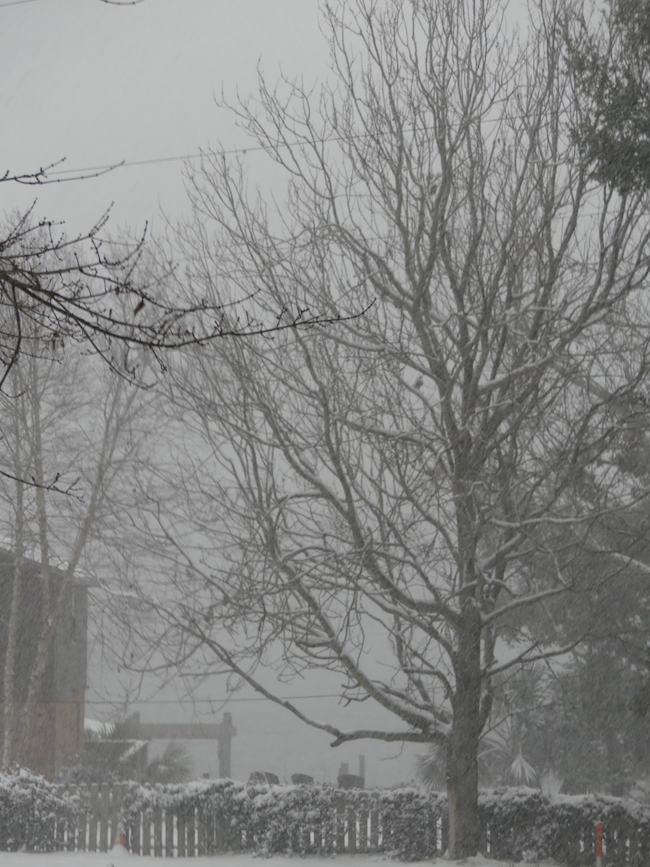


The reason these photos look fuzzy is because it’s still snowing!


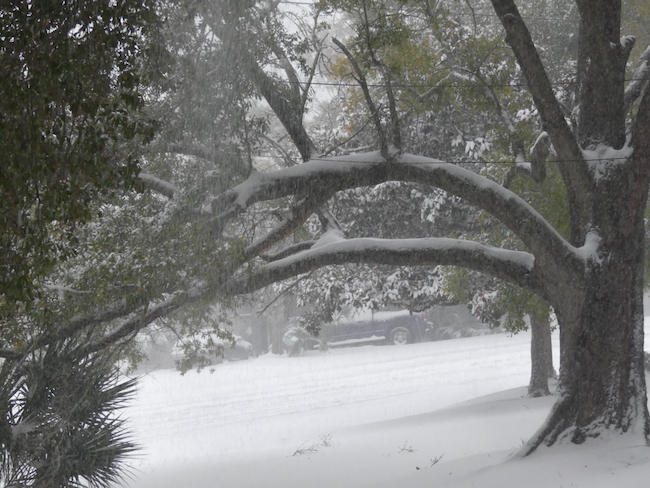


My hydrangeas:




We have spread birdseed all around our yard, and we keep trying to keep the ice broken so outside birds and animals can drink. We have a heating pad in a box of outdoor cats, and our storage door is open for the truly desperate. Tonight’s forecast low is 17 degrees F. All the homeless shelters and cold weather shelters are open to welcome in those without homes, or those without heat, God help them in this weather.

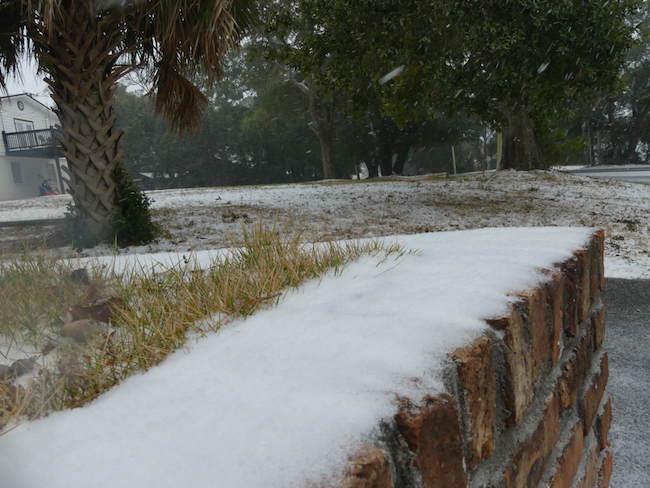
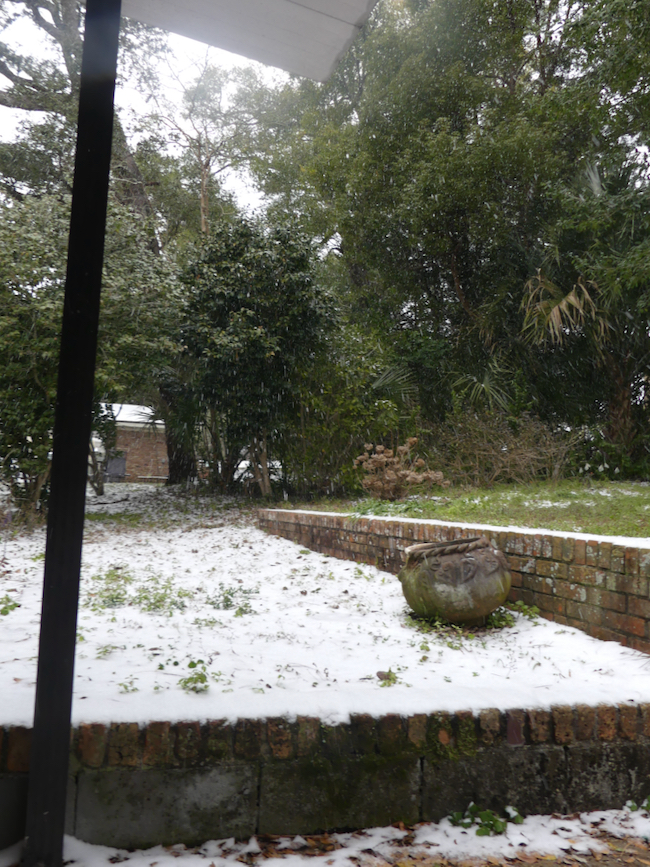
Pensacola Gets the Big Snow – The Flurries Begin
We were excited with the first flurries. Even though it’s very cold, the grandchildren and the grand dogs are out playing in the snow – it is such a novelty. And it keeps coming. I went out to take these photos, but it is also becoming slick, and it’s probably not smart for me to be out trudging around with my camera. Few cars on the road. Pensacola, wisely, is staying inside.





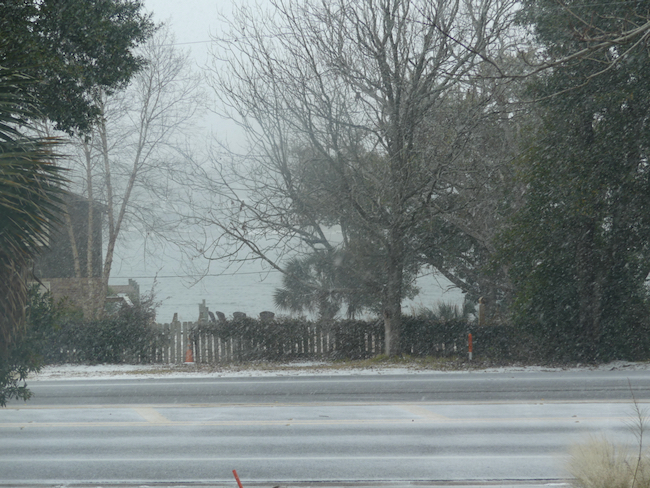
Pensacola Gets the Big Snow

Pensacola is known for its sugar-white beaches, sunny skies, and blue skies with lots of sunshine. Not today. Schools are closed, offices are closed, Pensacolians are hunkering down for the expected three to five inches of snow. First thing this morning I had to break the ice in the birdbath and had my first bird arrive before i was a foot away – more thirsty than afraid, I think.
It is not that severe nor will it last that long, but it’s been a long time since Pensacola has had a good snow. I have seen occasional flurries in the past, but never before an accumulation. People of the South don’t have a lot of experience driving in the snow. I’ve had plenty. We plan to stay close to home!
Recent Comments
ExpatAlien on What Country am I Living … intlxpatr on Yellowstone: Old Faithful to C… Michelle on Yellowstone: Old Faithful to C… Cathy on No Grown-Ups in Charge intlxpatr on Waiting for Snow Wikipedia Donate Button

Amazina


Early Voting in Florida


 Here There and Everywhere