In the category of ‘you can run, but you can’t hide’ is the fact that hundreds, thousands of rape kits have gone untested in police departments all over the United States. Too expensive, or so they say, to process them all, but the force of public opinion is relentless, and the result is that some of these kits are finally producing results and convictions that, at long last, give the rape victims some satisfaction.
I worked with one of the very first Rape Crisis Lines, back in the beginning when it was all new, in, of course, California. We worked with the victims, but we also worked with emergency workers and with police. It was a team. Most of the police I worked with were merciful and compassionate, but there are other places where the police culture is harsh, and rape victims are not well-treated. There are still those people who believe that somehow a victim asked for it in some way.
I learned some surprising things as I worked with the victims. I learned how strong and how smart victims (they’re not all women) can be. They did what they had to do to stay alive, and they memorized everything they could to be able to tell the police. Many made it a point to leave DNA in the car, or to save the rapist’s DNA. It was less about the physical violation than finding oneself in a position of utter powerlessness, and not knowing if you were going to survive. I didn’t pity the victims; I admired their courage and resilience.
JUAN A. LOZANO, Associated Press
HOUSTON (AP) — Evidence from more than 6,600 rape kits that went untested for years in Houston have turned up 850 hits in the FBI’s nationwide database of DNA profiles, marking a major step in the city’s $6 million effort to address the backlog, officials announced Monday.
Charges have been filed against 29 people, six of whom have been convicted, since the city launched an effort in 2013 to test 6,663 rape kits — some of which dated back nearly three decades. Testing was completed in the fall, and the results have now been uploaded to a database used by investigators nationwide to compare DNA profiles of possible suspects, Mayor Annise Parker said.
“This milestone is of special importance to rape survivors and their families and friends because it means their cases are receiving the attention they should have years ago,” Parker said at a news conference, where she joined local law enforcement officials to announce the results.
Police are continuing to review the matches to see if charges can be filed in other cases. In the cases where prosecutors have won convictions, defendants have received sentences ranging from 2 to 45 years in prison. One case was dismissed after the victim decided not to pursue the case.
Rape kits include biological samples and physical evidence gathered from sexual assault victims that are later processed to see if they match a suspect’s DNA. Testing results are uploaded to the FBI’s Combined DNA Index System, or CODIS.
Harris County District Attorney Devon Anderson said there were some cases where suspects committed other crimes while rape kits that could have identified them sat untested.
“Now that the testing of these kits is complete, we know that it’s up to us to finish the job and to seek justice for these victims. The ball is in our court and we will do our best to put the people who are responsible for these heinous crimes behind bars for as long as possible,” she said.
Experts say Houston’s backlog — and similar backlogs in other U.S. cities — are due in part to the high cost of testing which can run from $500 to $1,000 per kit, though advocates argue that the lack of testing signals that sex crimes haven’t always been law enforcement priorities.
More than 12,000 kits went untested for years in Memphis, Tennessee, which is facing a lawsuit from rape victims as it tries to test the kits. In Detroit, prosecutors discovered more than 11,000 rape kits in an abandoned police warehouse in 2009, and Cleveland prosecutors have sent their entire 4,700-kit backlog for testing.
“This is not a Houston problem. It’s not a Texas problem. It’s a nationwide issue that built up over years and years,” Parker said.
We really needed to visit Atlanta; old friends opened a restaurant and we wanted to encourage and applaud their dream come true. When we chose the dates, we didn’t realize it was going to be the coldest days in Atlanta – ever.
As we arrived, I said “Is that what I think it is?” and AdventureMan said “I think it’s from some factory, or blowing off some truck.”
No. No, AdventureMan, you don’t know snow. This was flurry. It’s too tiny to be sleet, it’s just flurry, but I’m really glad we are getting to our hotel quickly. Fortunately for us, the entire very cold time we were there, during their record-breaking cold, it was too cold to snow. We escaped as the temperatures started rising to return to Pensacola.
After we had lunch at 7 Spices (see below) in Mobile, we decided to take a Spring drive – yes, yes, it is spring now and then in FloraBama – and we head down to a place we love, Fairhope, AL, and then through Foley, AL to get to the beach road coming back in through Perdido Key. This route takes us right past a blast-from-the-past, an ice cream parlor so old timey it’s hard to believe it still exists.
Stacey’s Fountain is along highway 98 coming into Foley from Fairhope:
Here is the menu. The sandwiches and the sundaes are old fashioned, in small containers, not all super-sized like today. We each had an ice cream sundae with chocolate sauce and felt like we hadn’t hurt ourselves too badly.
There is a lot to be said for advertising. As we watch the local news at night, we switch to Mobile after the Pensacola news is finished. Mobile has a town nearby called Pritchard, and we always love to hear what has happened in Pritchard – mysterious murders, drug overdoses, family incest – it’s all there, right in Pritchard.
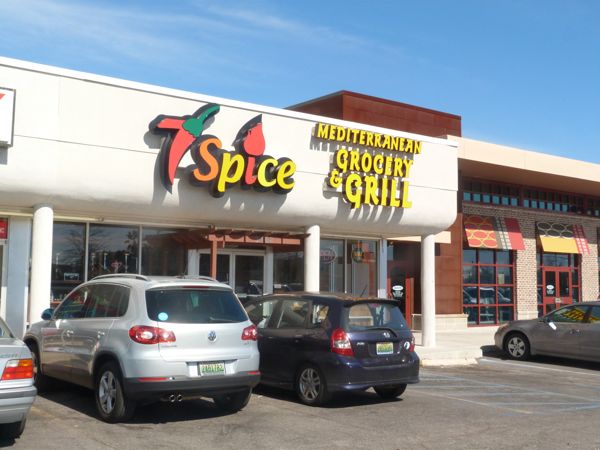
Between stories are the Mobile ads, and some are hilarious. One, however, for 7 Spice Grocery and Grill caught my eye. They show shelves and shelves of Middle Eastern goods, and mention a restaurant, too.
This is what 7 Spice looks like from the roadside:
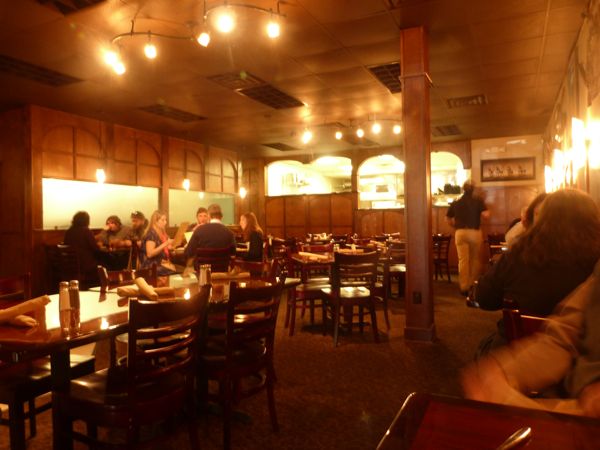
This is the interior. You walk all the way through the grocery, and at the back, it is like entering a Damascus restaurant. Indeed, one of the waiters was from Damascus, and the food is very Syrian
:
The smells are divine. The smells coming from the kitchen are fresh meat being grilled, lamb, chicken, beef.
And we know we are at home. If you have read Walking Old Damascus, you will know we have loved traveling in Syria, and have loved Damascus for 35 – almost 40 years. Near our table is a hanging of the Roman Arch on The Street Called Straight; the last time we stayed in Damascus, at The Talisman, we stayed near this landmark, near Bab Thoma.
With every meal comes a lovely serving of addas – lentil soup. It was silky and lemony, the croutons were thin and crisp, it was so simple, so deliciously prepared:
AdventureMan ordered the Shish Taouk, a chicken shish kabob. It came fresh and hot from the grill, crispy and irresistible:
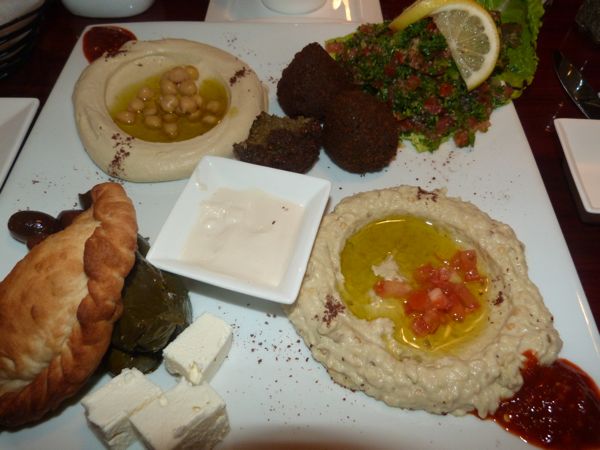
I ordered the appetizer plate; hummous, felafel, tabouli, baba ghannoush, little meat pies, stuffed grape leaves, and olives. Also a wonderful garlic aioli to dip into. AdventureMan shared some chicken with me, and I shared all these delicious tastes with him. They use a really good olive oil; it makes all the difference.
As we roll ourselves out of the restaurant, carrying more than enough for our evening meal, we have to walk past all the shelves in the grocery to get to our car. The prices are very reasonable and there are things I really need, like a whole bag of dried mint (have you ever tried making Middle Eastern food without dried mint? you need a LOT!) and chana dal, wonderful legumes, fig preserves, all kinds of little charcoals for braziers and big bags of henna . . .
There are wonderful Middle East restaurants also in Pensacola, but none like this. Worth a drive to Mobile to find this truly excellent restaurant on Airport Boulevard in Mobile.
Last week, we were in Atlanta, and stayed near a small town called Smyrna. We wondered several times where ancient Smyrna was, guessing Greece or Turkey. We were both right.
Today, the church remembers Polycarp, Bishop and Martyr of Smyrna. It is timely. There is a saying, the more things change, the more they stay the same (“plus ça change, plus c’est la même chose” – Alphonse Kerr) – and today, too, we are seeing people killed for what they believe, when they do not fall into step with the specific style of belief of the crowd. Oh, the things we do in God’s name!
The Liturgical Calendar: The Church Remembers
Today the church remembers Polycarp, Bishop and Martyr of Smyrna, 156.
Polycarp, Bishop of Smyrna in what is now called Turkey, did not seek martyrdom and did not encourage others to do so. When persecution broke out, Polycarp made every honorable effort to protect his flock and himself. He even hid in the country but, eventually, the authorities found him.Since Christians worshiped Jesus Christ, an “unauthorized god,” and since they refused to worship the Roman gods or the “Divine Caesar,” they were considered atheists and subversives.
At a great public festival in the arena in Smyrna, Polycarp was presented to the governor amid cries of “Kill the atheist!” from the excited and unruly mob. The governor admonished Polycarp to swear by Caesar and to revile Christ and thereby save himself. The old bishop’s famous reply was, “For eighty-six years I have been his servant and he has done me no wrong; how can I blaspheme my King who has saved me? . . . You pretend not to know who I am; let me tell you plainly, I am a Christian. If you want to learn the doctrine of Christianity, set a day and hear me.”
Polycarp was publicly burned to death.The Christians in Smyrna who escaped death in this wave of persecution wrote a letter describing the execution of their great bishop and sent it to other churches. We still have this famous letter, “The Martyrdom of Polycarp.”May we always share the tidings of the King who has saved us. Amen.Read the Wikipedia article here.O God, the maker of heaven and earth, you gave your venerable servant, the holy and gentle Polycarp, boldness to confess Jesus Christ as King and Savior, and steadfastness to die for his faith: Give us grace, following his example, to share the cup of Christ and to rise to eternal life; through Jesus Christ our Lord, who lives and reigns with you and the Holy Spirit, one God, now and for ever. Amen.
The good news is that Saudi women know better. They don’t buy this line any more than we do. They visit America, they go to school in America. And oh yes, they DRIVE in America. The second part of the good news is that the younger generation buys this line a whole lot less than our parent’s generation, and change is coming. It’s coming faster than this historian thinks.
Saudi Historian Says U.S. Women Drive Because They Don’t Care If They’re Raped
Saleh al-Saadoon claimed in a recent TV interview that women can be raped when a car breaks down, but unlike other countries, Saudi Arabia protects its women from that risk by not allowing them to drive in the first place, according to a translation posted online by the Middle East Media Research Institute.
“They don’t care if they are raped on the roadside, but we do,” al-Saadoon said on Saudi Rotana Khalijiyya TV.
“Hold on. Who told you they don’t care about getting raped on the roadside?” asked the host, a woman who is not named in the transcript.
“It’s no big deal for them beyond the damage to their morale,” al-Saadoon replied. “In our case, however, the problem is of a social and religious nature.”
Two other guests on the show — a man and a woman — appeared to be in shock over his comments. Al-Saadoon said they were out of touch.
“They should listen to me and get used to what society thinks,” al-Saadoon said.
Since the rape argument didn’t seem to be convincing anyone, al-Saadoon tried another approach, claiming that women are treated “like queens” in Saudi Arabia because they are driven around by the men of the family and male chauffeurs. That led the host to ask if he wasn’t afraid that women might be raped by their chauffeurs.
Al-Saadoon agreed.
“There is a solution, but the government officials and the clerics refuse to hear of it,” he said. “The solution is to bring in female foreign chauffeurs to drive our wives.”
That caused the female host to laugh and cover her face with her palm.
“Female foreign chauffeurs?” she said. “Seriously?”
. . . says AdventureMan, as he takes me to lunch and to a movie on Valentine’s Day.
It’s a perfect stretch, from my birthday to Valentine’s Day. AdventureMan bought the beautiful white roses at Celebrations, a wonderful shop in Pensacola. What I love the most is that the flowers they use last and last. My flowers, more than a week old now, are just beginning to droop, just a tiny bit. They are still unspotted and unstained, glorious in their pristine whiteness, glowing in our foyer. I still feel the glow. 🙂
My sweet son and daughter-in-law invited us for a shared birthday dinner and we had a wonderful, laughter-filled time, talking books, talking kids, laughing, laughing, and the 1 1/2 year old is starting to really talk and to get the convenience of oral communication. She wants to be a part of everything! The birthday boy and I had a wonderful time, tickling and laughing and sharing jokes. It was a great evening.
Lunch was in Gulf Breeze, at Rotolo’s, where they have great salads and thin crust pizzas, and then we went to see the spellbinding (if you are a nerd and love complex thinking) Imitation Game, which we both enjoyed thoroughly. We are so totally geeks; this was the perfect Valentine’s Day movie for us.
Sometimes, out of nowhere, comes a wallop, even a good wallop. Yesterday came such a startling change. The itinerary looked ordinary, do-able, nothing inspirational, but all get-the-job-done.
My group had a great weekend. They got to sleep, they got to walk on the beach, they got to eat a great meal or two. They had fabulous weather, a chance to chill and to integrate all the information we are piling on them, and a chance to walk away for a little while. They love Pensacola. Who wouldn’t, when the weather hits around 70° and the beach is white and the sky is blue?
First, we hit our volunteer experience, working at Manna to sort donations, making sure all the items were within acceptable expiration dates. At first, I wasn’t sure this group was going to “get” volunteering, but in a very short time, they were all focused and working hard, and working efficiently. As they sorted, other volunteers drove up in SUV’s, in big cars, in vans and we all helped unload. By the end of their experience, the warehouse manager said “You have processed enough food for over 1,000 people!” and complimented them. They glowed. None of them are from countries with a tradition of volunteerism, and this was a new – and thrilling – experience for them. It always gives me a thrill to see that light go on, to see oneself as part of something larger, organic, to see how connected we all are and to love being a part of something good, sharing. It thrilled my heart.
We ate lunch together downtown, and talked about events going on in each country, about the weekend, about their experiences. We bought coffee – oh! the universal need for caffein! – and headed on to our next appointment, which featured environmental issues and complex ways governments interact to combat the problems and enforce the regulations. It was a tough slog. These relationships are so complex that most of us don’t even think about it. These delegates have work to do; they are here to solve problems in their own countries, and they are persistent and dogged about getting solutions that they can apply in their own bureaucracies. It is a delight to see people so committed to solving problems that seem . . . almost unsolvable.
It is also inspiring, to me, to learn so much about Pensacola, in this job. When I was working on my Masters, I studied heroism, among other things. What I am loving about these office and field visits is that my education continues, and I see heroes at every level of bureaucracy, holding back the evil forces of laziness, corruption, and cronyism. And, sustaining my initial findings about heroes, heroines and heroism, they don’t even see themselves as heroes. They say, as all heroes do, “I am/was just doing my job.” They think anybody would do it. (They are wrong.)
At our very last appointment, I was thinking I would probably cut the day short. The speaker had given out information, the delegates had bags to pack, and all of a sudden, a spark, and an explosion! The good kind!
One delegate could not believe the head of this agency could maintain an important list with integrity. He kept drilling down on the structure, the details of how things worked (all the delegates were keen on the details of how the structures of organizations and bureaucracies worked to accomplish their missions) and where there were openings for corruption.
She was explaining how her employees were constantly trained, and how the agency was monitored to ensure fairness and an adherence to procedure. The delegates, all from countries where bureaucracies function differently, kept pressing her. Is there never anyone taken out of turn? Never?
“If I did that, I would lose my job,” she replied.
What followed was one of the most exciting hours of discussion I have ever experienced, as delegates from five different countries frankly compared their own challenges and experiences, and with great intensity tried to figure out how bureaucracies could function without corruption.
We tried to explain that we, also, are not immune from corruption, and cronyism, but that the combination of training and monitoring helps keep agencies within the boundaries, as best it can. Transparency doesn’t come overnight; we are still trying to achieve it.
As I listened, I could not stop grinning. These are young leaders, and the leaders of tomorrow. They admire what they see in our country. They want to bring trust into their own governments, but how do you create trust? How do you build trust? How do you maintain trust?
I don’t know those answers. And yet the process is working; the discussion was so inspiring, so heartfelt, and they had built enough trust in one another to share their challenges, without having to maintain that artificial facade that lack-of-trust builds.
Their liaison said “You will each have to find your own path; it won’t look exactly like the US path because it has to be a fit with your own culture.”
When I left the group, I told them “You are the best group I have worked with, ever.” There is a part of me that wanted to be a part of that discussion, because they were still deep in that discussion as we parted. My role had ended; I had done what I do.
And today, I am still grinning. I love this job, I love the people it brings me into contact with, international and local. I feel so blessed.












 Here There and Everywhere