Tena Tena and a Trip to the Salt Pans
When that wake-up call comes, you really need to have everything ready. It’s cold, and while I like colder weather, I find it slows my thinking, especially early in the morning. By the time you load up in the car, you need to be sure you have drinking water with you, your spare camera battery charged, your camera in the backpack, heavier clothing for early in the drive, lighter cover ups for later, when it gets hot. You need sunscreen with you, and insect repellent, and anything else which makes you comfortable, like kleenex tissues, and lip balm (it gets very dry out on the game drives.)
It’s approaching mid-winter, so it is getting colder. If you could see us first thing in the morning, in all our layers, you would laugh, and you would wonder if we are in Africa or Alaska. We are all wrapped up in T-shirts, sweatshirts, sweaters, hats, scarves wrapped around our faces, blankets . . . it is early in the morning, we are in an open vehicle, and it gets COLD in June!
We are on our way out to the salt pans. The last time we did this, four years ago, one of our passengers got really really sick. It was awful. There was nothing we could do for him, except to pretend we didn’t hear him retching in the back, throwing up over the back of the truck. We all felt so sorry for him. We all knew, there but for the grace of God, it could any one of us.
Dawn coming up on the way to the salt pan:

This trip was totally different. We had an unexpected cloud cover much of the morning, which kept things cool. We kept passing villagers, men on bikes coming from the north with baskets of chickens to sell, to buy necessities to take back to their northern villages. Once, we saw an elephant, and warned some of the men on bikes that there was an elephant ahead. We found one man just mounting his bike; he had seen the elephant and had dropped his bike and run. These elephants are massive and if grumpy – or in ‘must’ – they can be lethal, and mean. If the man runs away, the elephant might stomp his basket full of chickens, or his bike, just out of meanness.
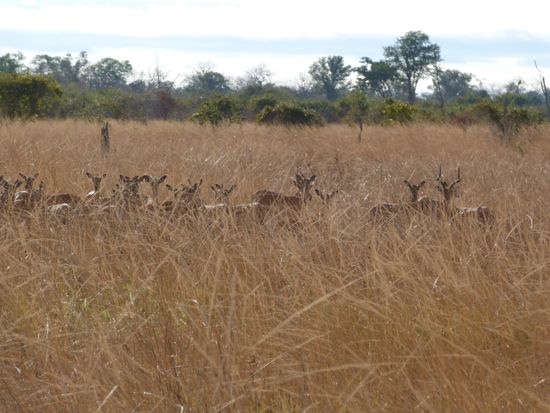
We couldn’t resist shooting this herd of impala, just their heads peeking up over the tall golden grass:
As we near the salt pans, we spot lion on the road ahead of us. We can see a mother and her cub.

Julius knows a way around, so we go around to the other side, where we can see four lion – and then six lions! They are all young males, females and cubs, and are resting.
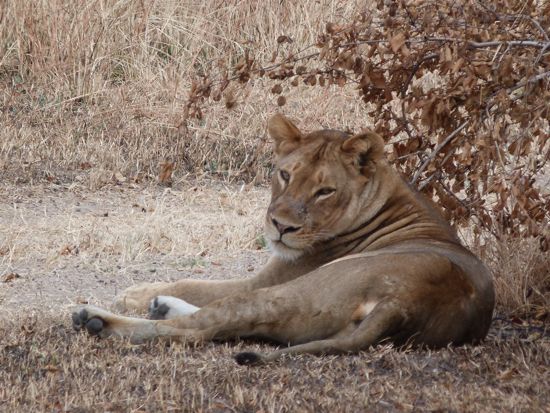
Julius tells us not to be fooled by their sleepy expressions; the lions are actually taking in everything, the sounds we make, the way we smell, and the way we move. Did you know male lions are “tri lobal?”

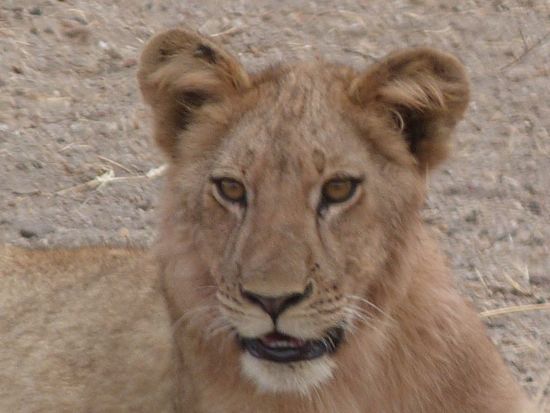
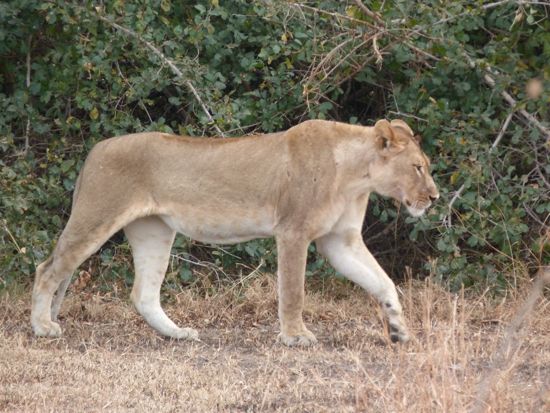
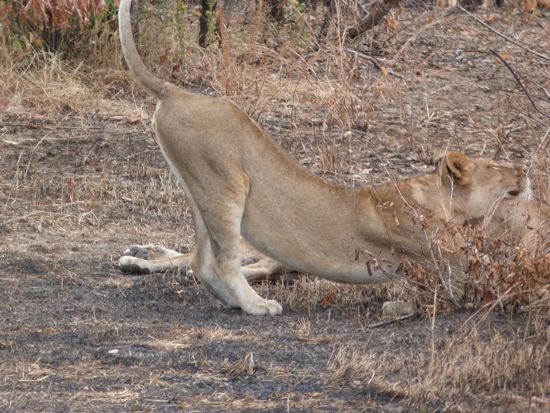
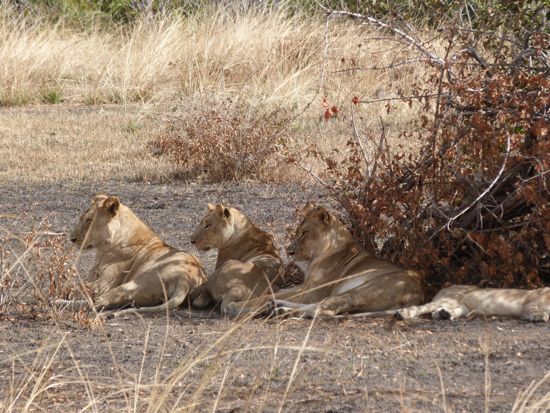
Then the lions decide to hunt, they stand, stretch, and walk off into the tall grass – and we love the way they just disappear, their golden color matching nearly the color of the golden grass:

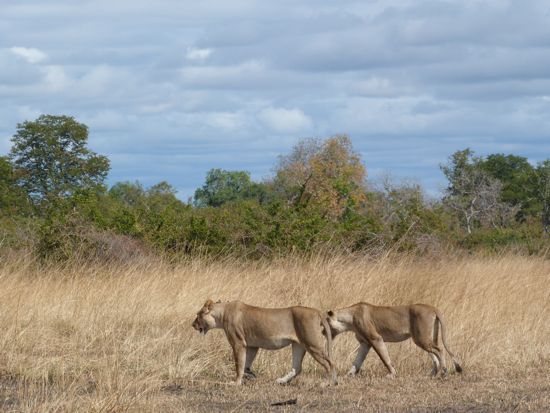
We spend about an hour just enjoying watching the lions, then head for the borehole hotspring for tea. The vista is both bleak and lush – where the water from the borehole has trickled, you can see green. The water is very hot, and you can smell the sulpher.
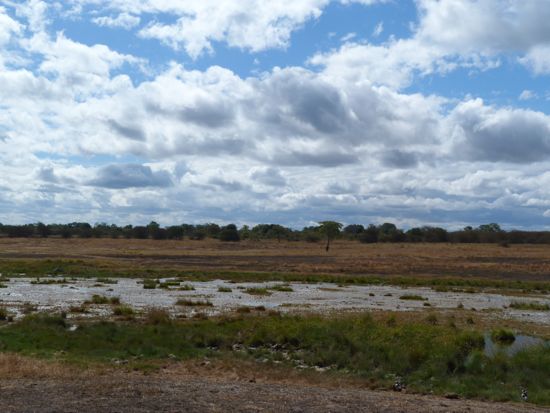
There is a funny story about the bore hole. A lodge was being built, Chichele, which wanted a borehole. The bore hole drillers asked the locals where was “chichele” (which means salty) and they didn’t know about the lodge; they sent the drillers to the old salt pan, also called “chichele.” They drilled a bore hole – out in the middle of nowhere – only to discover they had drilled in the wrong spot. They capped it, and today there is an oasis of green out in the middle of an otherwise fairly barren plain. It attracts a lot of wildlife – and those who prey on wildlife.
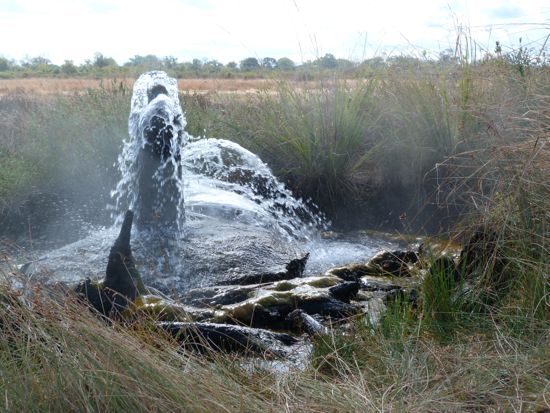

As we leave the hot spring, we spot more lions, maybe ten, a different pride. I say we, but it is really Julius, who sees the vultures circling and thinks there may be a kill in the area. We spot the lions, and then start the long drive back, stopping here and there along the way to take pictures or to learn about a whole lot of things we don’t know much about.
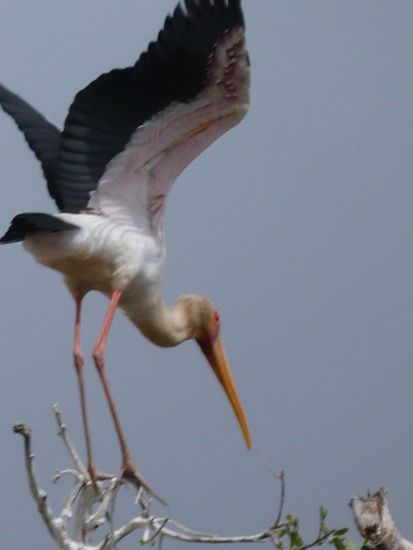
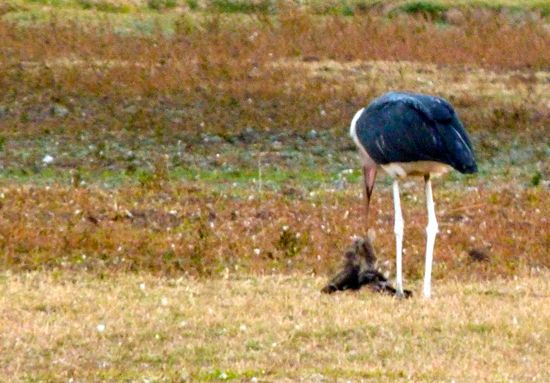
On our way back to Tena Tena, we pass through “The Colony” where the Yellow Billed Storks are nesting, hatching their young and teaching them how to fly. It is noisy, and hilarious; there is a lot going on. We particularly love the ‘flight school’ as young stork hesitate to take off, then practice their take offs and landings. Occasionally, one doesn’t make it, and there are Marabou Storks on the ground, who finish them off quickly.

We are late, and fortunately Claire has had sandwich plates made up for us so we won’t starve (LOL). We eat at the bar, and head for our cabins, but it is not an afternoon for resting – we have a visitor:
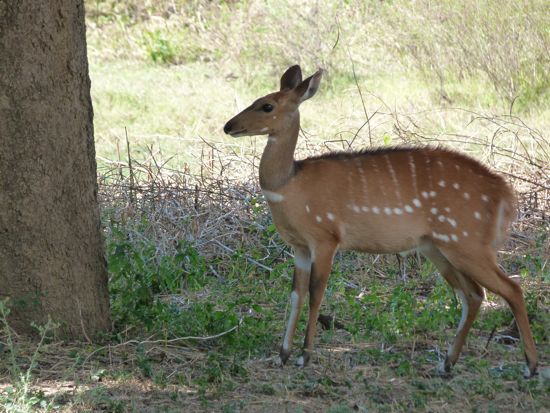
Most of the time, these little bushbuck are too shy for us to photograph, but here in the camp, there are a couple who have become used to the smells and noises of us intruders, and is oblivious to our cameras.
The afternoon drive starts off sedately along the Luangwa:

But we find beauty in the small things as we head toward sundown. These are Egyptian Geese settling in the lagoon nearby:

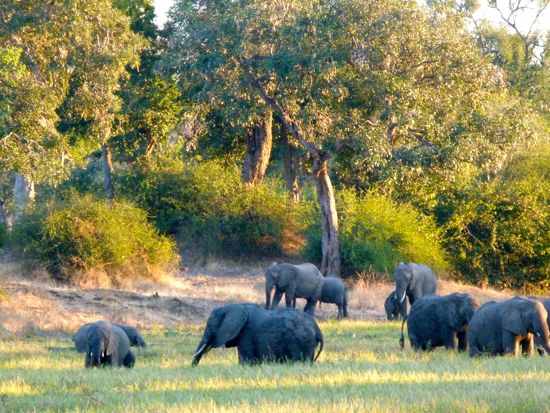
There are also elephant, an entire family, playing in the water:
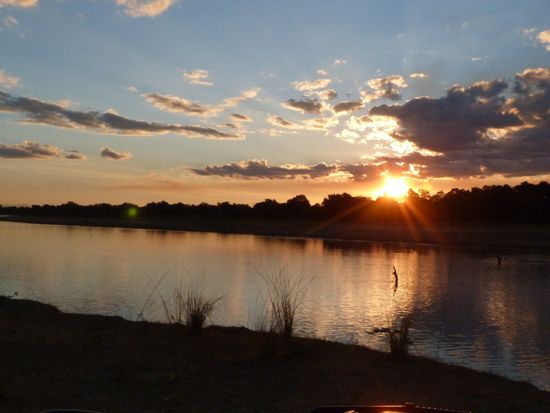
Sunset is spectacular. I am drinking Campari and Bitter Lemon, and because we are heading back early, I drink the whole drink.
Julius and Davis serve up sundowners:
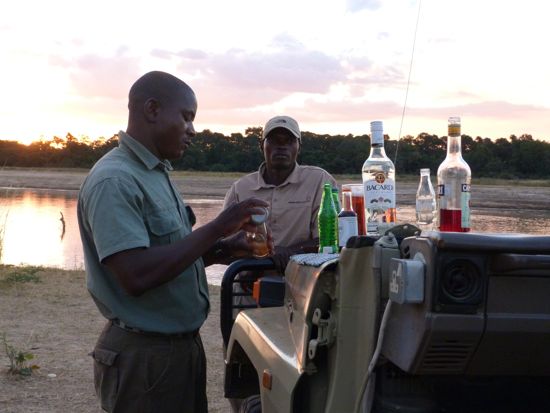
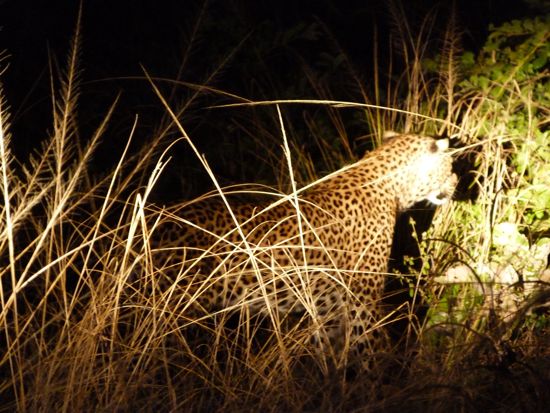
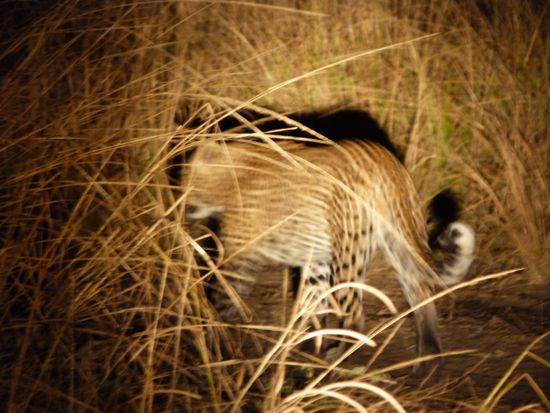
We had asked for a short night drive, but after ‘sundowners’ by the river, we find a pair of mating leopards, and the drive goes on a a lot longer than we intended. Mating leopards are exciting, they make a lot of noise, and are well worth a late drive, especially with a sky full of stars. NOTE TO SELF: No matter how tempting, limit your liquid intake at sundowners! Once the sky is dark, there is no safe bush to step behind and the roads are bumpy!

Julius helps us find the Southern Cross on the way back to camp, and shows us how to identify the Scorpion. The skies of the southern hemisphere are strange to us, but the stars are so bright and the night is so dark we just lie back and revel in the beauty of the heavens.
A very lively dinner, with the Swiss foursome, a new Scottish couple and us, eating ‘gammon’ which is ham, with pumpkin and mashed potatoes. Dessert is an amarula ice cream, which leads us all to the bar for shots of amarula liquer before he head for bed. It’s a lot harder organizing for the next early morning after a glass of wine and a shot of amarula, but we sleep like babies. We do hear lion roaring, but we just go right back to sleep.

Chongwe River Camp, Zambezi, Zambia
I used to be such an organized person. I had a responsible job where I juggled many important things. I had meetings and messages, and events and proposal deadlines, and somehow, I did it all, and I did it well.
Now that I have somewhat less to handle, I don’t handle it as well. I am too relaxed. I don’t obsess about details, I don’t wake up in the middle of the night gasping about something I may have forgotten, I don’t even keep a notepad by the side of my bed to write things down that wake me in the night.
When I was making arrangements for this trip, AdventureMan said to add on a few days at the Chongwe River Lodge, so I told the travel guy at Robin Pope Safaris to book us at the Chongwe River Lodge. Then, I just paid what the invoice said and never thought about it again. If you go to the RPS page, it will show you Chongwe River HOUSE, and that is where we thought we were staying. When we arrived, we were a little disconcerted to discover we were at the Chongwe River Camp, not the house, but our tent/cabin faced a pod of hippos, and we were immediately enchanted, and sometimes things happen for a reason, you know? We knew we were there for a reason, and just relaxed and enjoyed what the camp had to offer.
And oh, WOW, what the camp had to offer. First, every tent is situated to have a fabulous view, and the front of the tent is all clear net, you CAN close it if you want to, but you don’t have to, you have absolute privacy with on one looking in. They have a wide range of activities, lots of water sports, fishing, kayaking, hiking, fly camping . . . so much to do! Or . . . you can do nothing at all, too.
Our view overlooked a pod of hippos. All day and all night long, we could hear hippos. In the middle of the night, a hippo mom and a baby hippo were grazing two feet from the entrance to our tent – when I got up to watch, they quickly slipped back into the water.
That might disturb some people, but it totally enchants me! I was told some people get grumpy because they can’t sleep, that they request earplugs . . . I cannot imagine. I love the sounds, and somehow, it makes me feel safer inside knowing wild things are roaming around at night. I’ve always felt human beings were the far more dangerous threat than the animals.
So I will bore you with a bunch of photos, and you will see the things I love – details of the tents and lounge and dining areas, and photos that I wish had sound attached so you could be lulled to sleep by the laughter of the hippos.
This is the Chongwe River airport:
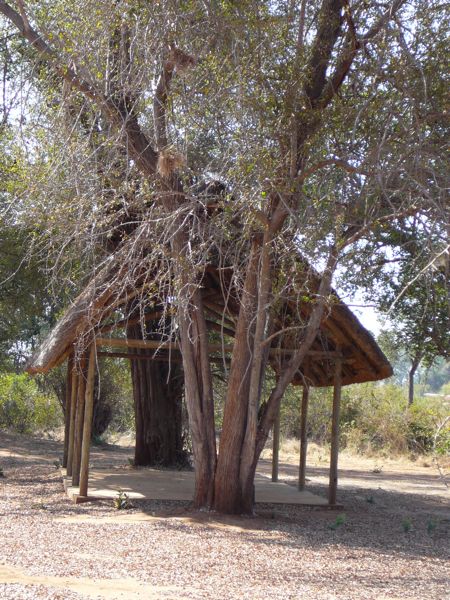
This is the airstrip we flew into – you can see elephant dung all over the strip, but there were no elephants on the strip when we flew in:

Zambia was experiencing a huge airplane fuel crisis while we were there, so flights were being consolidated. One night, there was NO fuel at any of the major airfields. Here us the fuel storage at Chongwe:

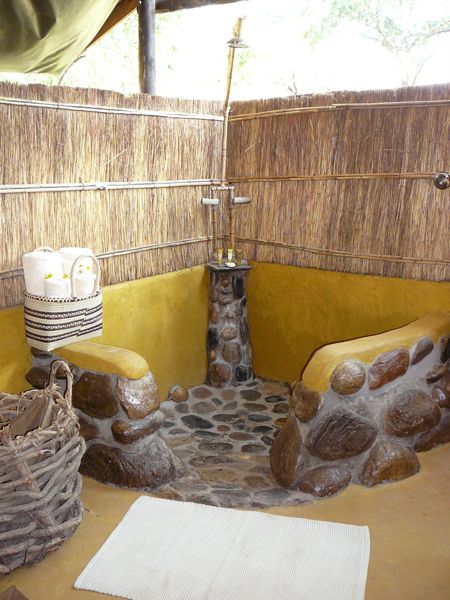
This is my idea of camping – king size bed, good sheets, a great bathroom and a great view of hippos:

The bathroom! Can you see why I enjoy camping so much? The shower has a European style flash heater – so practical, and you get hot water in a heartbeat without burning a lot of trees.


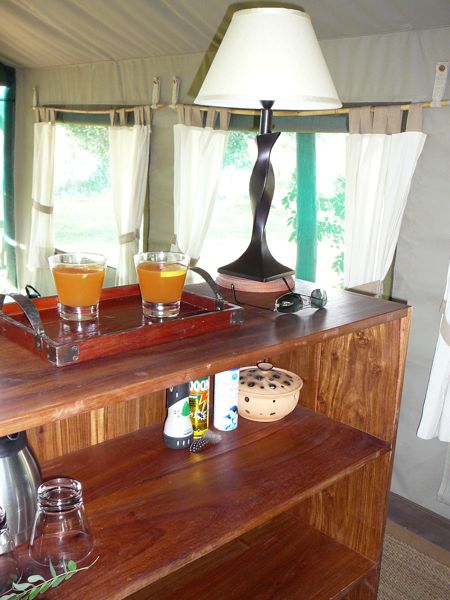
Storage/clothing shelves in the bedroom. Rooms come with flashlights, insect repellant sprays, and a whistle in case you feel in danger:
Dining in the bush – and the food was great. Because it is the middle of winter in Zambia, nights can be chilly, and we had charcoal braziers between diners at night to keep us from shivering. It was toasty warm! When we would get back to our tents, there would be hot water bottles warming our beds, so we could just jump in.

The coffee/tea/hot chocolate bar, with French press Zambian coffee, yummmmm:

This is how the camp would look at night when we would come back from a game drive or a boating trip – purely magic, with all the twinkling candles. The camp offers fishing, hiking, game drives, kayaking, all kinds of activities, or . . . just chilling:

This is the lounge area and library in the daytime:

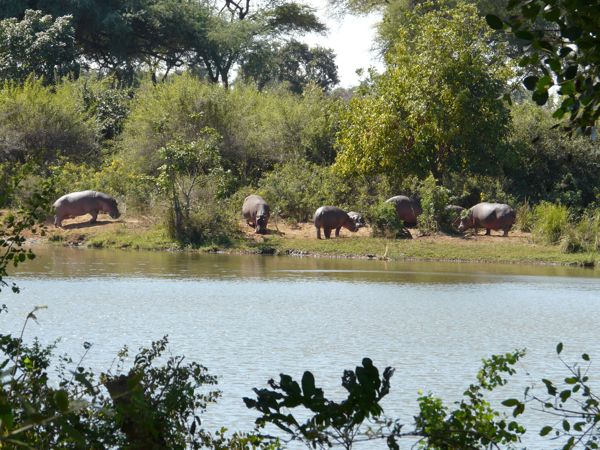
These are “my” hippos – oh, this just made my time at Chongwe River Camp, hearing their laughter, hearing their arguements. Just up the river all the animals would come down to drink at dusk. I could sit and take photos and never intrude on them – warthogs, impala, elephant, waterbuck, geese, heron, egret, ibis . . . and lots of baboon.
We saw everything on our game drives, but I will start with the great Kudu, because finding a male kudu not shyly running away is a great treat:

I think this lion finds tourists boring – he and his wives endured our presence for about 45 minutes before ambling off to another shady glen:

This was a great thrill for me – an elephant swimming to one of the Zambezi islands. Don’t worry, I was using my great telephoto, I was not that close. We did not bother the elephant, we kept our distance.
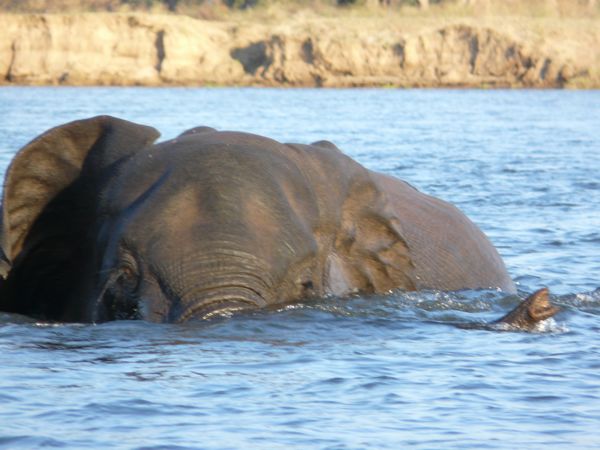
Here is the big guy safely on his island:
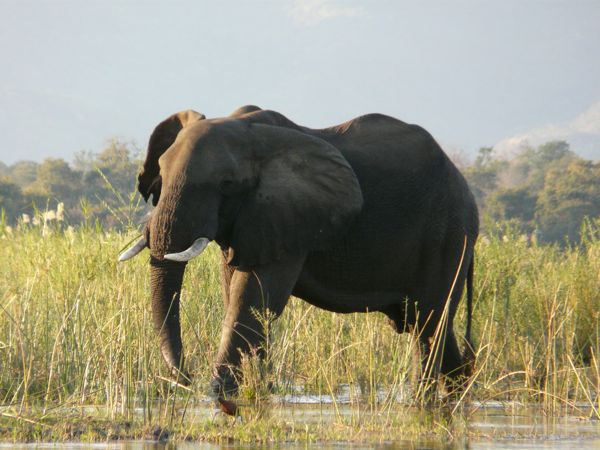
And just look at this guy! He was a big as a HUMMER! Our guide said he had seen even bigger on the Zambezi. (gulp!)
Water for Elephants by Sara Gruen

This is another one of those books I picked up on the last day of my last travels in the US. I had been through the Barnes and Noble nearby several times, picked this up and looked at is at least a dozen times, then put it down, just not that interested. On the last day, who knows why, I bought it and stuck it in my outer pocket of my suitcase. Maybe it was the only thing I could see that would fit, I don’t know. I had rejected it so many times before.
It hasn’t even been on my night stand, the books I really really intend to read. It has been on a shelf of books I will read someday when I don’t have anything else to do. Every now and then, it caught my eye. The Zanzibar Chest was on the same shelf. . . and that turned out to be a pretty good book. So recently, after I had read some books I had to read but were a little dry, and a couple books I wanted to read which were a little light, I grabbed Water for Elephants.
That was day before yesterday. I couldn’t put it down. I had a whole list of things to get done yesterday, but once I started Water for Elephants, I was lost, totally immersed in the tawdry world of circuses, bound in the magic of the illusion and performances, mesmerized by what goes on behind the scenes to make the spectacular possible.
The main character loses his parents in a totally unnecessary car accident just as he is about to take his final exams in Veterinary Science, at Cornell University. (You might think I am throwing in too much useless detail here, but it matters.) Stunned by the triple loss of both his parents, and the discovery that they had hocked everything to the bank to fund his education, he blanks on his exams and hits the road, ending up with a second rate circus.
What is so amazing about this author is that once you start reading, you are THERE.
The above mentioned Zanzibar Chest keeps you hooked by it’s painfullness, but for both AdventureMan and myself, we never liked the author, we found him a little full of himself. It doesn’t take away from the Zanzibar Chest being a worthy read, and unforgettable read.
Water for Elephants, on the other hand, has a hero you love to love. In a world of strict boundaries, a heirarchical social structure, he manages to cross all the boundaries. He truly loves the animals, and in one scene, that love just radiates, emanates, it illuminates the book from the inside, and makes you feel light and crazy with that same sort of love, love of the whole of creation. Jakob is loyal to his friends, and loyal even to his enemies, he is sacrificial in his loyalty, and, in the end, he is vastly and abundantly rewarded for his good character.
There is something for everyone, just like a circus. Like a circus, too, it has illusions, it distracts with one hand while the trick is performed with another, there is sensuality, there is sexuality, there are photos from old circuses. There are things which could offend just about every sensibility; there is kindness, there is cruelty, justice and injustice and cosmic justice. Sometimes you just have to suspend judgement and go with the read. This is one of those books.
I would say this is one of the finest reading experiences I have had for a long time. Brava, Sara Gruen. Worth every penny.
I’ve told AdventureMan as soon as he finishes The Zanzibar Chest, he has to start Water for Elephants. I can hardly wait. It’s that good.
You can find Water for Elephants in paperback at Amazon.com for $8.37 + shipping.
Recent Comments
ExpatAlien on What Country am I Living … intlxpatr on Yellowstone: Old Faithful to C… Michelle on Yellowstone: Old Faithful to C… Cathy on No Grown-Ups in Charge intlxpatr on Waiting for Snow Wikipedia Donate Button

Amazina


Early Voting in Florida


 Here There and Everywhere