Antarctic Ice Melting Faster Now than Last 1,000 Years
Found this morning on AOL News; this is not good news.
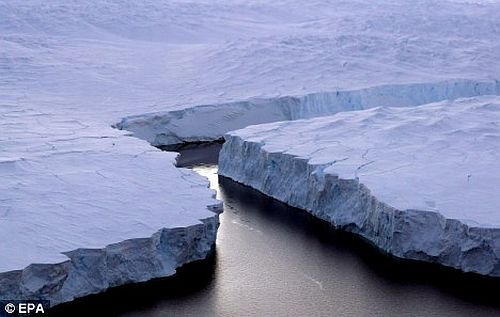
Summer Ice Melt In Antarctica Is At The Highest Point In 1,000 Years, Researchers Say
Reuters | Posted: 04/15/2013 2:39 am EDT | Updated: 04/15/2013 6:36 pm EDT
CANBERRA (Reuters) – The summer ice melt in parts of Antarctica is at its highest level in 1,000 years, Australian and British researchers reported on Monday, adding new evidence of the impact of global warming on sensitive Antarctic glaciers and ice shelves.
Researchers from the Australian National University and the British Antarctic Survey found data taken from an ice core also shows the summer ice melt has been 10 times more intense over the past 50 years compared with 600 years ago.
“It’s definitely evidence that the climate and the environment is changing in this part of Antarctica,” lead researcher Nerilie Abram said.
Abram and her team drilled a 364-metre (400-yard) deep ice core on James Ross Island, near the northern tip of the Antarctic Peninsula, to measure historical temperatures and compare them with summer ice melt levels in the area.
They found that, while the temperatures have gradually increased by 1.6 degrees Celsius (2.9 degrees Fahrenheit) over 600 years, the rate of ice melting has been most intense over the past 50 years.
That shows the ice melt can increase dramatically in climate terms once temperatures hit a tipping point.
“Once your climate is at that level where it is starting to go above zero degrees, the amount of melt that will happen is very sensitive to any further increase in temperature you may have,” Abram said.
Robert Mulvaney, from the British Antarctic Survey, said the stronger ice melts are likely responsible for faster glacier ice loss and some of the dramatic collapses from the Antarctic ice shelf over the past 50 years.
Their research was published in the Nature Geoscience journal.
(Reporting by James Grubel; Editing by Paul Tait)
Drought and Rising Food Prices
We are all so interconnected. I knew rice prices here in Kuwait had gone sky high, so high that imported American rice is now a relative bargain. I always bought Indian rice, in an effort to buy more (relatively) locally, and I knew India had restricted rice exports, but I didn’t know that the long drought in Australia was also contributing to the short supply.
You can read the entire article at this New York Times link.
THE FOOD CHAIN
A Drought in Australia, a Global Shortage of Rice
By KEITH BRADSHER
Published: April 17, 2008
. . . . . .
The collapse of Australia’s rice production is one of several factors contributing to a doubling of rice prices in the last three months — increases that have led the world’s largest exporters to restrict exports severely, spurred panicked hoarding in Hong Kong and the Philippines, and set off violent protests in countries including Cameroon, Egypt, Ethiopia, Haiti, Indonesia, Italy, Ivory Coast, Mauritania, the Philippines, Thailand, Uzbekistan and Yemen.
Drought affects every agricultural industry based here, not just rice — from sheepherding, the other mainstay in this dusty land, to the cultivation of wine grapes, the fastest-growing crop here, with that expansion often coming at the expense of rice.
The drought’s effect on rice has produced the greatest impact on the rest of the world, so far. It is one factor contributing to skyrocketing prices, and many scientists believe it is among the earliest signs that a warming planet is starting to affect food production.
It is difficult to definitely link short-term changes in weather to long-term climate change, but the unusually severe drought is consistent with what climatologists predict will be a problem of increasing frequency.
Read the rest of this article, and related articles, by clicking HERE.
Recent Comments
intlxpatr on Yellowstone: Old Faithful to C… Michelle on Yellowstone: Old Faithful to C… Cathy on No Grown-Ups in Charge intlxpatr on Waiting for Snow intlxpatr on Waiting for Snow Wikipedia Donate Button

Amazina


Early Voting in Florida


 Here There and Everywhere