Libyans Say “Sorry” In Counter-Protests
I was living in Qatar, and the Libyan ambassador’s wife had invited me, along with several other women, to morning coffee. It’s what people did. I was sitting between one of my Libyan friends and my good Iranian friend, and I started laughing. I said “Oh, what is this good little American girl doing sitting between a Libyan and an Iranian?” and then we all laughed. We weren’t Libyan, or American, or Iranian, we were just women who liked each other; we got along.
We were all religious women. Not the same religion, but all believers in the Abrahamic tradition. I felt more comfortable with them than I felt around non-religious women. We had a lot of fun together, and we liked each other.

It breaks my heart when bad things happen, and I know how good these people are, and that the people on the attack have their own agenda which has nothing to do with Islam, or Christianity, and everything to do with power. If they prevail, I fear for my good friends.
This article from USA Today made me cry this morning. Ambassador Stevens was loved, and these brave people are risking their futures to tell us so.
Libyans express sorrow over killing of Americans
by Donna Leinwand Leger, USA TODAY
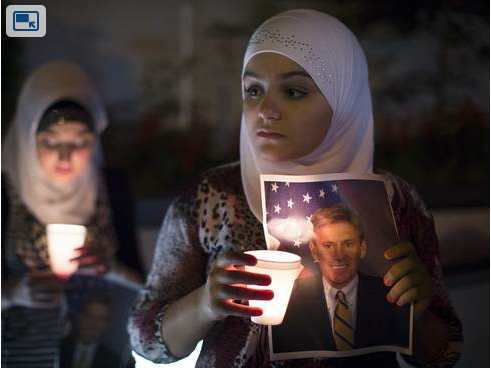
Hours after learning of Ambassador Chris Stevens’ death, the Libyan Youth Movement transformed its Facebook page into a tribute to the slain diplomat. It changed its cover photo from “Free Libya” graffiti sprayed on a Tripoli wall to a somber photo of Stevens with the tag “RIP Christopher Stevens1960-2012.”
“As North America wakes up, dread washes over me. What a rough night. I’m sorry for the horrible day the world is about to face,” the administrator of the Shabab Libya page wrote. “We are sorry.”
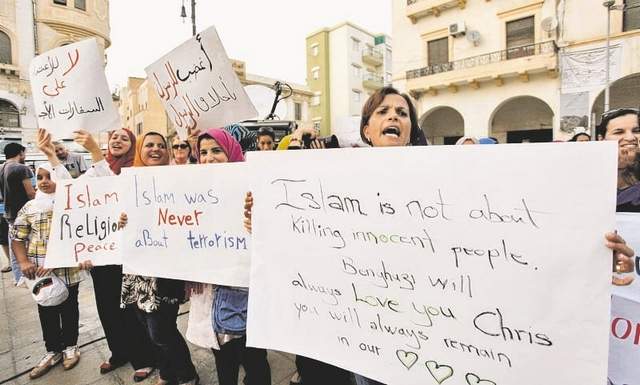
As anti-American protests swept across North Africa and the Persian Gulf, a counter-protest of apology emerged. Photos of Libyans carrying hand-lettered signs condemning the violence and expressing contrition for their countrymen appeared on Facebook. “Sorry” became the trending mantra of Libyans on Twitter.
At one counter-protest, an unidentified man carried a crude sign phonetically written in English with blue marker on lined notebook paper, “Sorry People of America this not the Pehavior of our ISLAM and Profit.”
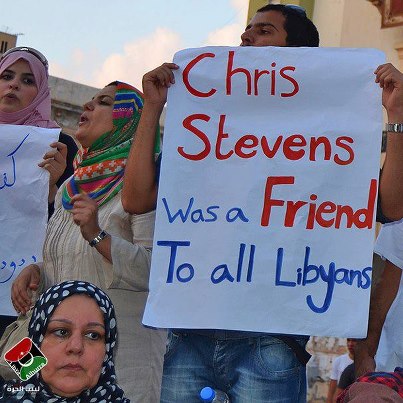
Another sign in red, white and blue read: “Chris Stevens wasa friend to all Libyans.”
On Facebook, one group formed The Sorry Project, designed to collect thousands of personal, written apologies from Libyans. Its profile photo is a man holding a sign, “USA. We are sorry. We are sad.”
“We Are Sorry,” the group wrote on the page created Sept.11. “We would like show that as Libyans we do not support on the actions committed by these criminals. USA, we are sorry and we will say it one thousand times over. Our apologies will never be enough, but the Libyan people will always be grateful for you since you were the first to stand by us in our fight for freedom and hopefully you will continue supporting us.”
One commenter, Hajer Sharief, vowed to avenge Stevens’ death by rebuilding a “new civilized democratic Libya.”
“We promise, we will not tire, we will not falter, and we will not fail,” Sharief wrote. “This is the way real Libyans will pay you back Mr. Ambassador Chris Stevens.”
At the ceremony Friday outside Washington to repatriate the remains of the four American victims, President Obama acknowledged Libya’s internal conflict.
“I know that this awful loss, the terrible images of recent days, the pictures we’re seeing again today, have caused some to question this work. And there is no doubt these are difficult days. In moments such as this — so much anger and violence — even the most hopeful among us must wonder,” Obama said. “But amid all of the images of this week, I also think of the Libyans who took to the streets with homemade signs expressing their gratitude to an American who believed in what we could achieve together. I think of the man in Benghazi with his sign in English, a message he wanted all of us to hear that said, ‘Chris Stevens was a friend to all Libyans.’ “
US Ambassador Killed by Angry Mob in Libya
Most people who die heroic deaths don’t wake up in the morning thinking “today I will do something heroic.” Most people who die heroic deaths end up dead because they make a choice to do the right thing.
Some minor film maker made a film mocking the prophet Mohammed. Under our system, it was his right; a man (or woman) can say what they think, even if another disagrees with it. It doesn’t mean the film is accurate, it doesn’t make it a good film; he had an idea and he made a film. The film – or even the idea of the film – is causing outrage, and attacks on US Embassies in Islamic countries. Ambassador Chris Stevens personally went to the consulate site to make sure his people got out safely while the consulate was under attack by an angry mob. He lost his life in the effort. May he rest in peace.
I’ve never liked crowds, and even less when a crowd is excited, or angry, and becomes a mob. There is something about doing things as a large group that anesthetizes thinking; mobs do horrendous things that any one individual acting within the mob would never do. Group-think is dangerous thinking; you need disagreement and dissent to rein in rash actions.
From today’s Huffpost:
TRIPOLI, Libya — The U.S. ambassador to Libya and three American members of his staff were killed in the attack on the U.S. consulate in the eastern city of Benghazi by protesters angry over a film that ridiculed Islam’s Prophet Muhammad, Libyan officials said Wednesday.
They said Ambassador Chris Stevens was killed Tuesday night when he and a group of embassy employees went to the consulate to try to evacuate staff as the building came under attack by a mob guns and rocket propelled grenades.
The three Libyan officials who confirmed the deaths were deputy interior minister for eastern Libya Wanis al-Sharaf; Benghazi security chief Abdel-Basit Haroun; and Benghazi city council and security official Ahmed Bousinia.
The State Department said Tuesday that one American was killed in the attack. It has not confirmed the other deaths.
The attack on the Benghazi consulate took place as hundreds of protesters in neighboring Egypt scaled the walls of the U.S. Embassy in Cairo and tore down and replaced the American flag with a black Islamic banner.
The attacks in Benghazi and Cairo were the first such assaults on U.S. diplomatic facilities in either country, at a time when both Libya and Egypt are struggling to overcome the turmoil following the ouster of their longtime authoritarian leaders, Moammar Gadhafi and Hosni Mubarak, in uprisings last year.
The protests in both countries were sparked by outrage over a film ridiculing Muhammad produced by an Israeli filmmaker living in California and being promoted by an extreme anti-Muslim Egyptian Christian campaigner in the United States. Excerpts from the film dubbed into Arabic were posted on YouTube.
Stevens, 52, was a career diplomat who spoke Arabic and French and had already served two tours in Libya, including running the office in Benghazi during the revolt against Gadhafi. He was confirmed as ambassador to Libya by the Senate earlier this year.
Before Tuesday, five U.S. ambassadors had been killed in the line of duty, the last being Adolph Dubs in Afghanistan in 1979, according to the State Department historian’s office.
___
Michael reported from Cairo. Associated Press writer Matthew Lee in Washington contributed to this report.
Recent Comments
ExpatAlien on What Country am I Living … intlxpatr on Yellowstone: Old Faithful to C… Michelle on Yellowstone: Old Faithful to C… Cathy on No Grown-Ups in Charge intlxpatr on Waiting for Snow Wikipedia Donate Button

Amazina


Early Voting in Florida


 Here There and Everywhere