The Last True Detective
Every now and then AdventureMan and I find a series we really like, and True Detective, Sunday nights on HBO, is one of those. From the first notes of the melancholy theme song playing over shots of rural Louisiana sights, cane processing plants, bayous, angst-ridden detectives, and shots of the crime scenes, you know this is not going to be your typical detective series.
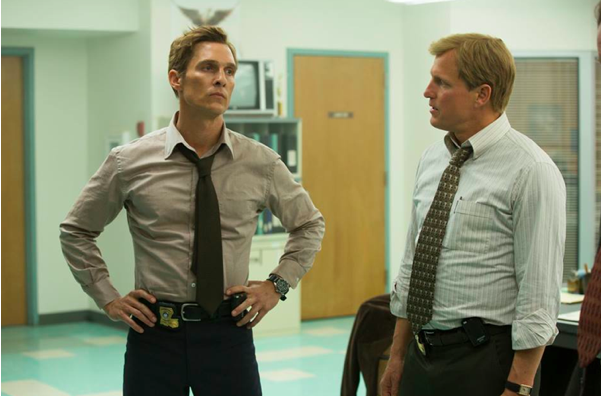
It is pure HBO, not-suitable-for-children kind of stuff. The two detectives investigating the murder in episode one are damaged, flawed men, each haunted by different but equally destructive demons. These are the good guys, trying to get the job done in spite of all the barriers thrown up to prevent them digging too deeply where it might inconvenience the bad guy(s).
Tonight is episode 8, the last episode. We have been waiting all week, hoping they will tie all the dangling, intriguing threads together. Hoping that neither of these two detectives, whom we have grown to like and maybe even admire, are involved with the crime.
It’s HBO. You never know.
Defending the World Against Bland Food
One of our life dreams came true when we were able to visit Avery Island and the McIlhenny Company. Tabasco sauce is on every table in almost every restaurant in the South, right along with the salt and pepper. When AdventureMan was serving in VietNam, soldiers had a tiny bottle of Tabasco in each ration, to spice up the food. The quote “defending the world against bland food” gave me a big grin. Rest in Peace, Paul C.P. McIlhenny. (This is from AOL News/Huffpost today)

Paul C.P. McIlhenny Dead: CEO Of Tabasco Company Dies At 68
AVERY ISLAND, La. — Paul C.P. McIlhenny, chief executive and chairman of the board of the McIlhenny Co. that makes the trademarked line of Tabasco hot pepper sauces sold the world over, has died. He was 68.
The company, based on south Louisiana’s Avery Island, said in a statement that McIlhenny had died Saturday. The statement, released Sunday, credited McIlhenny’s leadership with introducing several new varieties of hot sauces sold under the Tabasco brand and with greatly expanding their global reach.
McIlhenny was a member of a storied clan whose 145-year-old company has been producing the original world-famous Tabasco sauce for several generations, since shortly after the Civil War. The statement said McIlhenny joined the company in 1967 and directly oversaw production and quality of all products sold under the brand for 13 years.
Under his management, the company experienced years of record growth in sales and earnings, according to the company.
McIlhenny also worked to develop an array of items that could be marketed and emblazoned with the Tabasco logo: T-shirts, aprons, neckties, stuffed toy bears, and computer screensavers, the Times-Picayune of New Orleans noted. The newspaper first reported the death and noted that McIlhenny was an executive with a keen sense of humor, quipping days before he reigned as Rex, the King of Carnival, for Mardi Gras in 2006: “We’re defending the world against bland food.”
The Times-Picayune said he had taken up the post of company president starting in 1998 before adding the title of CEO two years later. It added that his cousin, Tony Simmons, took over as president last year.
“All of McIlhenny Company and the McIlhenny and Avery families are deeply saddened by this news,” said Tony Simmons, president of McIlhenny Company and a McIlhenny family member, in the company’s statement.
He added: “We will clearly miss Paul’s devoted leadership but will more sorely feel the loss of his acumen, his charm and his irrepressible sense of humor.”
The statement said McIlhenny led the way on new brand merchandising, taking an instrumental role in the company’s catalog business of licensed merchandise. He also was a driving force behind the growing global reach of Tabasco products, today sold in more than 165 countries and territories.
The company said McIlhenny, at the time of his death, was also a company director. He was a sixth-generation member of the family to live on Avery Island and among the fourth generation to produce the Tabasco brand sauce on Avery Island, where patriarch Edmund McIlhenny had founded the company in 1868.
Born on March 19, 1944, he grew up in New Orleans and spent much of his childhood moving between New Orleans the family compound on Avery Island, according to The Times-Picayune.
Reports noted he also had been an impassioned board member of America’s Wetland Foundation because of his longtime interest in preserving south Louisiana coastlines crumbling under the onslaught of decades of erosion.
Attorney Edward Abell called his friend McIlhenny “a well-known figure.”
“It really kind of puts us on the map here,” Abell said, “because the Tabasco products are known all over the world.”
Foods a la Louisiane: Jambalaya
Did I tell you I collect cookbooks? One of the guidelines I use is that the cookbook have the name of a person attached to each recipe; if your name is on a recipe going into a book, you know you are going to be very careful that this recipe is really, really good.
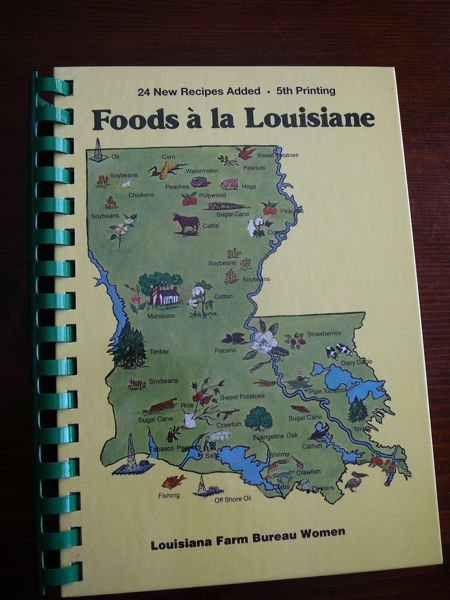
I don’t remember buying this cookbook, but it is a gem. On the other hand, there have been some surprises . . . there is a recipe for making boudin, that ubiquitous Cajun sausage, and it starts off with “1 large hoghead.” The directions state that you boil the hog’s head until tender, let it cool, remove meat from bones, then grind hoghead meat with heart, kidney, onions, parsley, etc. in a meat grinder.
Thank goodness boudin is not a favorite of mine. Andouille, a spicier sausage, IS a favorite of mine and if I see a recipe for andouille, I am NOT going to look at it.
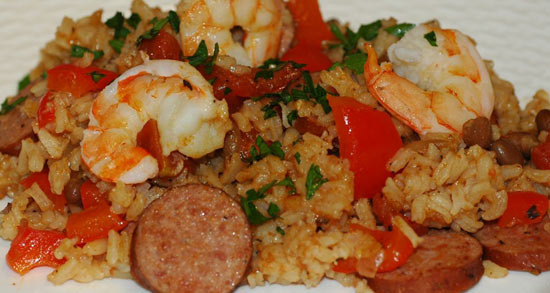
I love making jambalaya – and here is a genuine Louisiana recipe:
JAMBALAYA
1/2 cup vegetable oil or drippings
2 medium onions, chopped
2 stalks celery, chopped
1 cup fresh parsley, chopped
1 medium green pepper, seeded and chopped
1/2 cup chopped green onion tops
Water
2 1/2 teaspoons salt
1 teaspoon garlic powder
Red Pepper to taste
Pepper to taste
Browning agent or 2 teaspoons Kitchen Bouquet
2 lbs peeled raw shrimp
4 cups long grain rice
Heat oil over low heat in a heavy 6 quart Dutch oven until warmed. Add vegetables; saute until lightly browned. Add enough water to cover vegetables; add seasoning and browning agent. Bring to a boil; add shrimp. Cook over medium heat for 10 minutes. Stir in rice; cook 10 minutes. Cover and cook until rice is tender, stirring occasionally. Yield 10 – 12 servings.
I do jambalaya all the time (DISCLAIMER: I am neither a Louisiana native nor of Cajun descent, so what I do cannot be taken as authentic, even if it is tasty 🙂 ) and I use more spices, chopped tomatoes and I don’t add the shrimp until the rice is cooked; I add it at the end and give it five minutes for the heat of the rice and cooked ingredients to cook the shrimp. We also use andouille sausage (or a turkey sausage if we are entertaining Moslem friends) and some cut artichoke hearts, maybe a small jar of pimentos, maybe some leftover peas. Sort of like a jambalaya/paella 🙂
James Lee Burke and the Creole Belle
James Lee Burke is number one on my guilty-pleasures list.

I first met his main character Dave Robicheaux in A Morning For Flamingos, a book I picked up in a military library at Lindsay Air Station, a post that doesn’t even exist any more. In the cold dark endless winter in Wiesbaden, Germany, James Lee Burke lit up my life. I had thought I was picking up just another escapist mystery novel, but when James Lee Burke puts words together to describe the way a storm moves in over the bayou, prose becomes poetry.
There is a downside. Whether it is his character Dave Robicheaux, the former New Orleans cop, now head homicide investigator in New Iberia, Louisiana, or his Hackberry Holland series set in West Texas, James Lee Burke’s books are filled with extreme violence and disturbing images that live in your head for a long time.
I’ve recommended James Lee Burke to friends, some of whom have said “Why do you read this trash??? It is HORRIBLE! It is full of over-the-top violence!”
And then again . . . he is writing about some really really bad people. They are out there. There are people who exist who inflict cruelty. I don’t understand it, I can’t begin to fathom where the urge would come from, but I’ve seen it. It’s out there. James Lee Burke pulls up that rock and exposes the dark happenings underneath.
On one level, as I started reading Creole Belle, I thought “Oh James Lee Burke, stop! Stop! It’s the same old formula! A downtrodden victim (often a beautiful woman) cries for help. You and Clete start looking for information and end up beating people up and then they retaliate by threatening your family! There is a rich, beautiful woman who seems vulnerable and who you kind of like, but she is complicated. There are rich amoral people who keep their hands clean, but who are calling the shots and never go to jail! Stop! Stop!”
Well, I should say that, and maybe I should stop. Then he starts talking about the smoke from the sugar cane fields and the bridge over the Bayou Teche, and the big Evangeline oak in St. Martinsville, and I am a goner. I’m sucked in, I’m hooked.
I detest the violence and the images. I keep coming back because James Lee Burke has some important things to say.
I’d love to have him to dinner. I’d love for him and our son to have a chance to talk about Law Enforcement. Here is what James Lee Burke has to say in Creole Bell:
There are three essential truths about law enforcement: Most crimes are not punished; most crimes are not solved through the use of forensic evidence; and informants product the lion’s share of information that puts the bad guys in a cage.
My son hates shows like CSI, and Law and Order, where the evidence convicts the criminals. He says it raises unreal expectations in juries, and makes it harder to get a conviction.
We watched a Violation of Parole hearing, or actually a series of hearings, where the judge asked each individual whose parole was about to be revoked what had happened when he or she was re-arrested. In each case, the parolee had done something stupid; drove a car with an expired license, drove to another state, was arrested driving drunk, etc. EVERY time. The judge made his point, I believe.
From Creole Belle:
But if Caruso was the pro Clete thought she was, she would avoid the mistakes and geographical settings common to the army of miscreants and dysfunctional individuals who constitute the criminal subculture of the United States. Few perpetrators are arrested during the commission of their crimes. They get pulled over for DWI, an expired license tag, or throwing litter on the street. They get busted in barroom beefs, prostitution stings, or fighting with a minimum-wage employee at a roach motel. Their addictions and compulsions govern their lives and place them in predictable circumstances and situations over and over, because they are incapable of changing who and what they are. Their level of stupidity is a source of humor at every stationhouse in the country. Unfortunately, the pros – high end safecrackers and jewel thieves and mobbed-up button men and second story creeps – are usually intelligent, pathological, skilled in what they do, middle class in their tastes and little different in dress and speech and behavior from the rest of us.
And then there are paragraphs like this that discuss the human experience, and have a far wider application than the book:
No one likes to be afraid. Fear is the enemy of love and faith and robs us of all serenity. It steals both our sleep and our sunrise and makes us treacherous and venal and dishonorble. It fills our glands with toxins and effaces our identity and gives flight to any vestige of self-respect. If you have ever been afraid, truly afraid, in a way that makes your hair soggy with sweat and turns your skin gray and fouls your blood and spiritually eviscerates you to the point where you cannot pray lest your prayers be a concesion to your conviction that you’re about to die, you know what I am talking about. This kind of fear has no remedy except motion, no matter what kind. Every person who has experienced war or natural ctastrophe or man-made calamity knows this. The adrenaline surge is so great that you can pick up an automobile with your bare hands, plunge through glass windows in flaming buildings, or attack an enemy whose numbers and weaponry are far superior to yours. No fear of self-injury is as great as the fear that turns your insides to gelatin and shrivels your soul to the size of an amoeba.
Last, but not least, this is what keeps me coming back to James Lee Burke, so much so that I buy the book almost as soon as it is released. James Lee Burke isn’t afraid to take on the big guys. He “gives voice to those who have no voices.” (Proverbs 31:8) His focus is always on the dignity of the common man, the dignity of hard work, done well, and on the dignity of doing unexpected kindnesses to those who have no expectation of kindness.
. . . All was not right with the world. Giant tentacles of oil that had the color and sheen of feces had spread all the way to Florida, and the argument that biodegradation would take care of the problem would be a hard sell with the locals. The photographs of pelicans and egrets and seagulls encased in sludge, their eyes barely visible, wounded the heart and caused parents to shield their children’s eyes. The testimony before congressional committees by Louisiana fisher-people whose way of life was being destroyed did not help matters, either. The oil company responsible for the blowout had spent an estimated $50 million trying to wipe their fingerprints off Louisiana’s wetlands. They hired black people and whites with hush-puppy accents to be their spokesmen on television. The company’s CEO’s tried their best to look ernest and humanitarian, even though the company’s safety record was the worst of any extractive industry doing business in the United States. They also had a way of chartering their offshore enterprises under the flag of countries like Panama. Their record of geopolitical intrigue went all the way back to the installation of the shah of Iran in the 1950’s. Their even bigger problem was an inability to shut their mouths.
They gave misleading information to the media and the government about the volume of oil escaping from the blown well, and made statements on worldwide television about wanting their lives back and the modest impact that millions of gallons of crude would have on the Gulf Coast. For the media, their tone-deafnessness was a gift from a divine hand. Central casting couild not have provided a more inept bunch of villains.
James Lee Burke has a voice, and he uses it. He could just cash in on his reputation as an Edgar Award winning author, but he uses his voice to speak out against injustice and corruption. He is a champion of the people. I’ve written several book reviews, and taken some trips just because I wanted to see James Lee Burke country; if you are interested in those, you can read them here.
I have a concern about this series, in that this book ended differently than all the others. So differently it made me seriously question whether Burke intends to continue writing about Dave Robicheaux or if Dave is about to hang up his shield and call it a day. He’s a guilty pleasure I am not yet ready to give up.
Hell Bent for Texas and the Country Kitchen
(This is my first blog entry done from an iPad, and I still have a lot to learn about how to make the same technologies work that seemed so easy on my computer. Bear with me!)
We could have taken more time, but we decided to make it all in one day – Pensacola to Bryan/College Station, Texas, to see old Texas friends. We made it out the door at exactly seven a.m. – a miracle, and chat chat chatted our way across the remaining few miles of Florida, flew across Alabama, zipped across Mississippi. About when we figured we were half way, and were hungry for lunch, we found ourselves back in familiar territory – the Atchafalaya Basin, Bayou Teche and serious Cajun country. And – we also needed gas, so drifting into the gas station on fumes, we breathed a sigh of relief and focused on our next project – what to eat, where to eat.

An answered prayer – The Country Kitchen. As we drove into the parking lot, AdventureMan lowered his window and said “Can you smell that??” The smell of smoking meat pulled us happily inside, where we ordered BBQ chicken. I did something I never do – my phone rang and I had to make a quick decision on a side, and I went with cornbread dressing. What a blessing of fate, while it is something I probably should not eat much of, it was SO delicious, hot, spicy and sweet. It was hard to resist. I also had the sweet peas – they were out of green beans. AdventureMan had very much the same, except with rice.
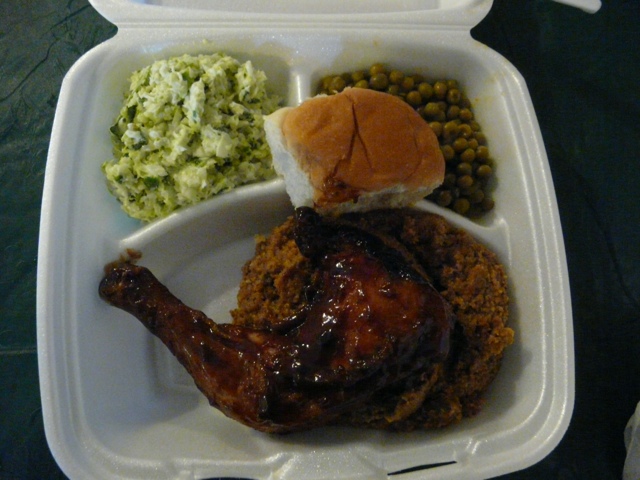
SO Good.
If you find yourself outside of Lafayette, LA, find this gem. The cooking is all real food, probably not the healthiest, probably they use fat in just about everything, but it is oh, so delicious.

Now Google tells us that the quickest way to get to Bryan, TX is to get off the Interstate at Beaumont, TX, just after crossing the state line. This road is hilarious – two lanes, with speed limits of 70 on several stretches, churches along the way with names like Cowboy Church and Lonesome Dove Chapel, and a stand set up selling Mayhaw jelly.
It was a very very long drive, and, at long last, we arrived at our friends’ beautiful, serene house, spent the evening laughing and catching up, with never a silent moment, we all just had so much to say. Finally, exhausted, we fell into bed, only to rise ready for more chat the next morning. Aren’t old friends the BEST? No matter how much time has passed, you can pick right up, share your hearts and you can talk about everything.
It was a joyful breakfast, again full of tears and laughter, and then, the painful parting. We have this wonderful memory though – just as we were about to leave, we asked about those Mayhaws. what were they, and then we asked about a song AdventureMan can almost remember, “Way Down Yonder in the Paw Paw Patch,” which our friend knew and sang, and as we left we were all laughing once again.
Zapote in Breaux Bridge, Louisiana
It’s dark, and we’ve been outdoors for hours so we are hungry again. AdventureMan knows what he wants; his favorite comfort food is Mexican. We turn into Zapote and we know we have come to the right place – there are lots of customers, and they look like locals.
We order, and the first surprise is the iced tea – it comes in pitchers! It’s a lot of tea:

I order Camerones (Shrimp) Diablo and AdventureMan orders Carne Asada. Both real good. 🙂
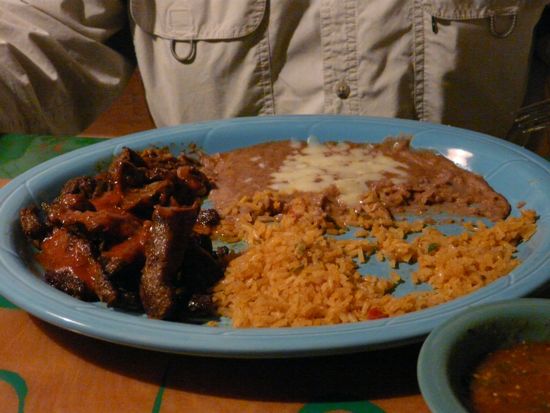

No, I don’t know why it came with french fries, and no, I didn’t eat them. 🙂
Cajun Country Swamp Tours
The Cajun Country Swamp Tour out of Breaux Bridge, LA, was such a highlight of our trip that we did it twice, once at sunset, and then again in full daylight the next day. The first night, we were with Butch, the owner, and the next day with Shaun, his son. Both were great trips.
Now here is the thing – there is more than one swamp tour company, and you have to be sure to get the right one (this one is the right one.) It’s not like Florida, where you look for the sign. When you get to Lake Martin, where this tour takes place, there is no kiosk, nothing except a tour boat coming in, but even this boat doesn’t have a sign on it. You have to know who you are looking for.
These people were so helpful in getting us booked. We really wanted to be with an eco-tour kind of exploration; some of the swamp tours are purely awful, and exploitive, hard on the animals, disruptive of the environment. We read the reviews; Cajun Country Swamp Tours is the group we wanted to be with. Our sunset cruise was delightful, just us, Butch, who is a wealth of information, and a family of five, the youngest of whom fell asleep almost as soon as the boat left the tie-up. The second day we took a private tour, and they gave us a good price. We like being able to watch the birds, watch the light change, wait for the right shot – it’s worth it to us.
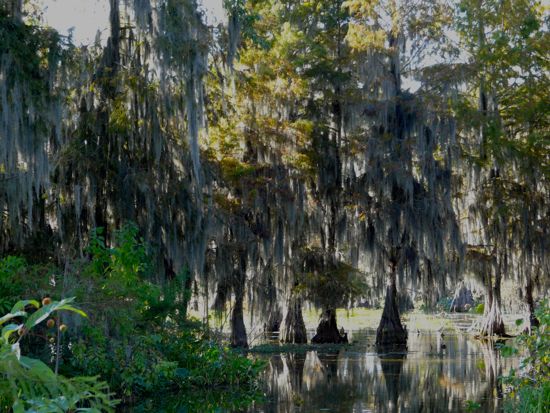
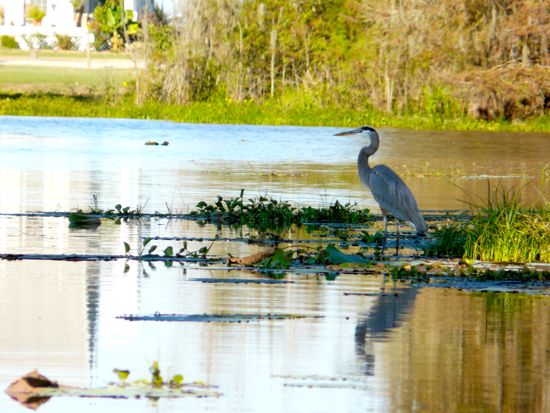
Lake Martin is beautiful, in a lowlands kind of way (it looks a lot like parts of Pensacola.) Taking photos was fun, and also a challenge. Here is the challenge; sometimes the camera doesn’t really understand what it is supposed to focus on, so you think you are shooting a heron, and the camera is busy focusing on the tree two feet behind the heron. Sometimes you want to capture this exact light, but the camera sees ‘this exact light’ a little differently than you do.
This is what the tour boat looks like – very shallow, so it can get into very shallow places, and so it can drift over logs in the swampy areas:

Focus examples:


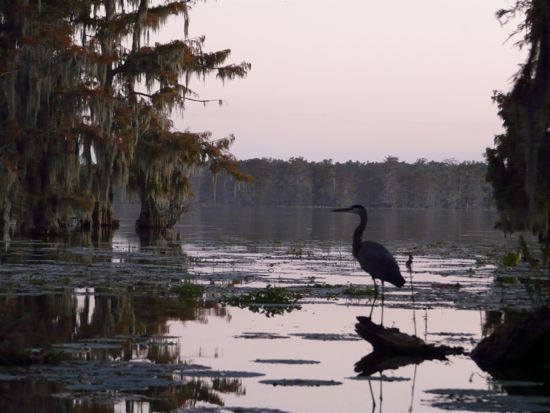
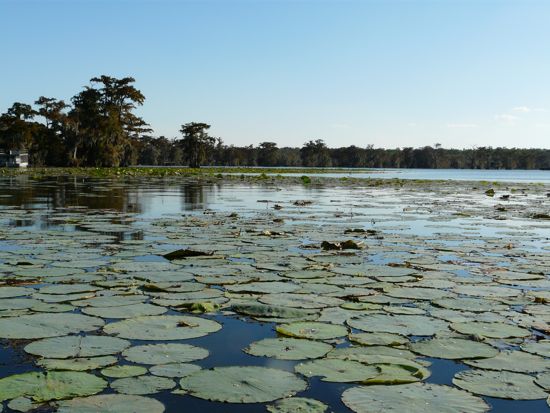
Now, just settle back in your seat and enjoy the swamp and bayous with us on St. Martin’s Lake:
This is a special bird, the Black Crowned Night Heron, only rarely at St. Martin’s Lake:
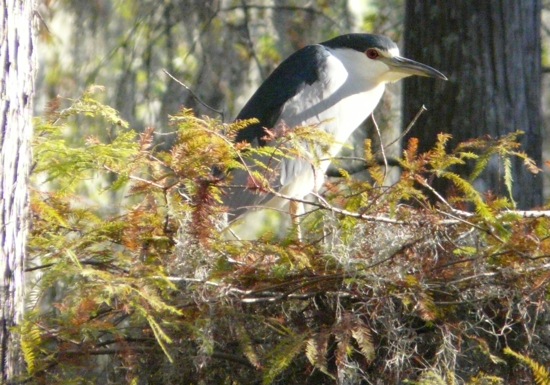
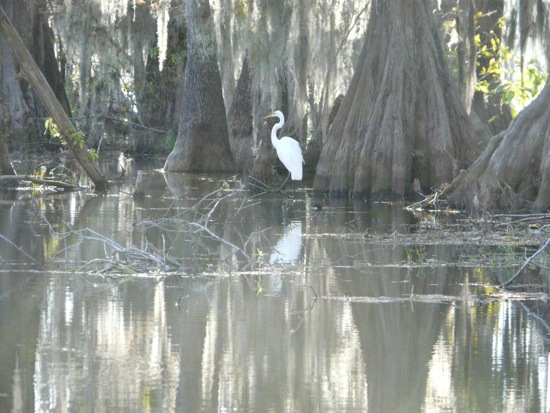
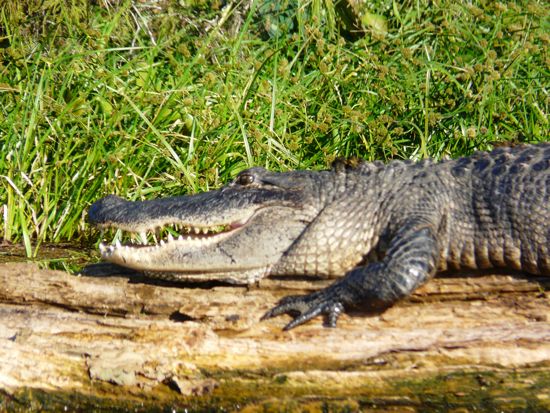
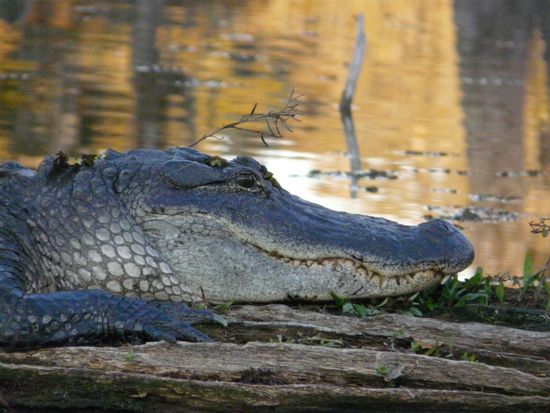
Lots of gators, soaking up sun before their long winter’s hibernation:

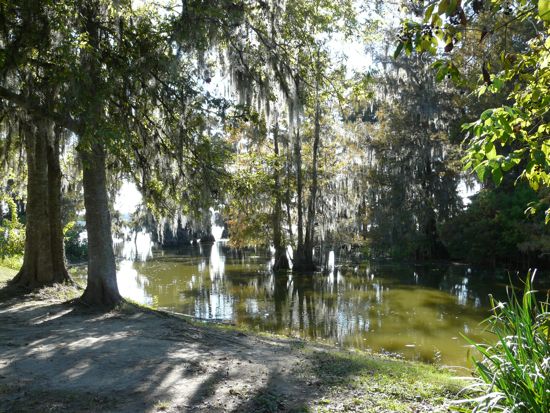

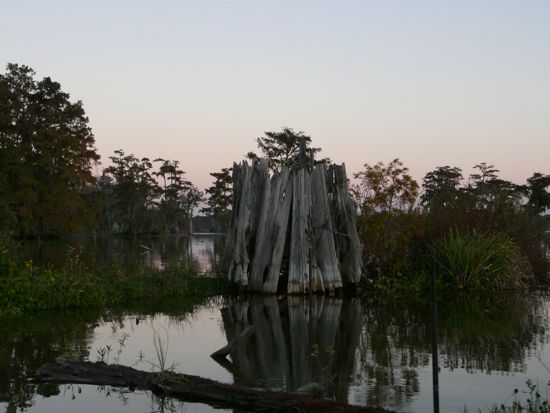
You might think this is a stump, but you would be wrong. This is Shaun’s duck hide; he built it himself:




This little anhinga lost one wing, probably to an alligator, but has figured out how to climb this tree and then plunge down when he sees a fish. He can’t really fly anymore, but he is managing:
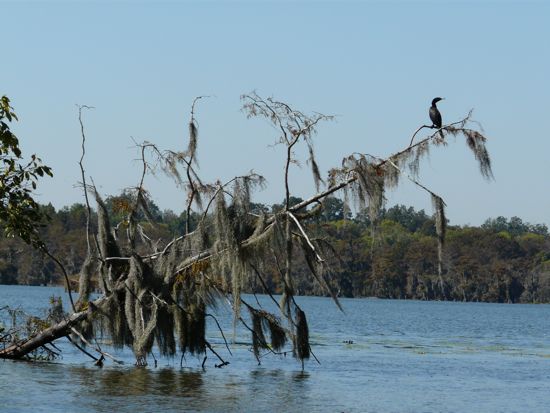
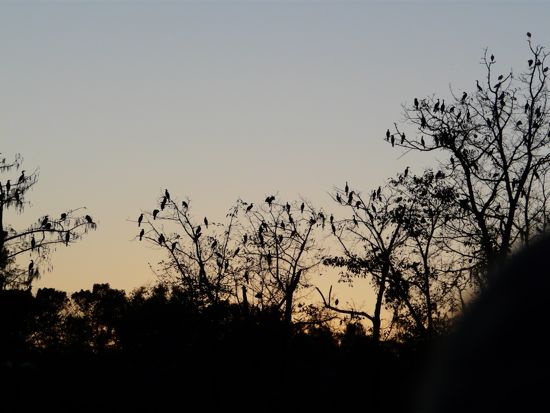
Thousands of birds perched in these trees, the ‘rookery:’
Bon Creole in New Iberia
“OK, but I want to eat lunch at Clementine’s,” I replied, as AdventureMan is scheduling some Cajun Country Swamp Tours for the afternoon and the next day. We drive back into New Iberia, and make sure we are going in the right direction on the one-way Main Street, only to discover Clementine’s is closed on Monday. Oh, Aarrrgh.
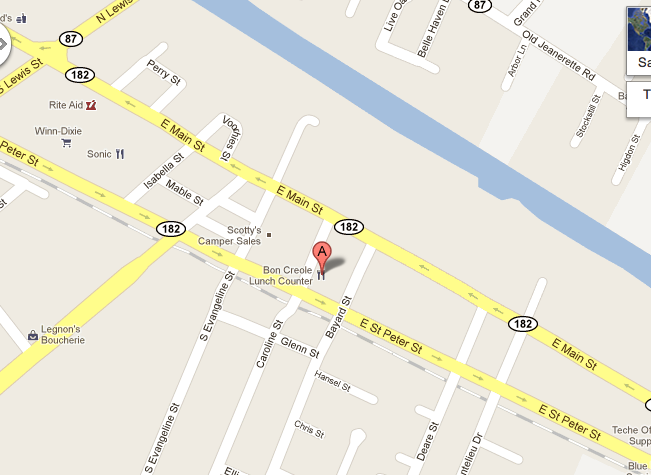
But I love my iPhone. I love it because I can put in an address, and it shows me how to get there, when to turn, where we are . . . I love it. I love it because I can put in “great food in New Iberia” and up comes names – and ratings. The highest rating other than Clementine’s is a place called Bon Creole, and it is on the one way street, St. Peters, going in the opposite direction of Main Street, so we turn around and head back in the other direction.
We are HUNGRY. So when we miss it the first time, and have to go around the block, AdventureMan says “I think I saw it, but it looked closed.” I think I saw it, too, but it looked . . . like some dive. As we come around the second time, we see a button-down-shirt-and-chinos kind of guy coming out, so we know it must be open, and he looks like a working local, not some tourist like us. And did I mention we are hungry? We decide to give it a try.

You walk in and order at the counter. I can’t say we got a warm welcome. The woman behind the counter wasn’t rude, she was just working hard, and there really wasn’t a smile. I ordered the daily special, but it was already gone. “OK,” I say, “I’ll take the gumbo, and some potato salad.”
“Potato salad comes with it.” She doesn’t even look up from writing down the order. So far, we are not encouraged, but there are a goodly amount of customers inside, and as we wait for our food, we get to listen in on all the town gossip, which is not unlike town gossip in most towns, who drinks too much, who is going out on who, and can you imagine someone wearing that to church?
Our food arrives, a bowl of gumbo, a bowl of rice and a bowl of potato salad, plastic utensils.

And then, with the first bite, everything changes.
“Oh, WoW!” I say, and my eyes open wide. “Wow!”
AdventureMan is having the same experience. “This is REALLY good!” he says.
We are quiet now, eating this totally delicious seafood gumbo. We are both busy trying to figure out how they made it taste so seafood-y, lots of shrimp, maybe some crab, but the gumbo itself, essence of shellfish, it is SO good.
What if we had judged by the exterior and had ended up in some plastic and mediocre place? What if we had missed this totally awesome seafood gumbo? This gumbo was seriously GOOD.
If you find yourself in New Iberia, hungry and looking for some seriously good gumbo, here is where to find Bon Creole:
Bon Creole also has a lot of fried dishes; we were just looking for something not-fried, but if you like fried, you too will like Bon Creole.
Avery Island and Tabasco Sauce
Sometimes it’s funny why people make the choices they do. We knew one of the first things we wanted to do on this trip was to visit Avery Island. There are a lot of little reasons. First, was that when AdventureMan was young, he was sent to a far away country, Vietnam, to fight for his country. Most of his time was spent out in the jungle, and they carried most of their food on their backs. They ate something called C-rations, little meals, like with cans of food, and the Avery/McIlhenny Tobasco company made little tiny bottles of tabasco sauce to include with each meal package. It’s a small thing, but those little bottles of tabasco sauce made a difference to those soldiers.
Later, as we flew in and out of the Middle East, Delta had a special short feature on Avery Island. Long story short, we’ve always wanted to visit there, and now we had the opportunity.

(You have to see this mosquito statue to appreciate it; it must be about 5 feet long and 4 feet high, and there are several of them. )
It was a beautiful morning, and the drive was beautiful, too, cool and lovely. Avery island is surrounded by a kind of river/moat, so it really is an island that once used to be a sugar cane plantation. As soon as we opened our car doors, the mosquitos came at me; I am a mosquito magnet.

The tour of the factory had already started, so I scooted over to the country store, which is a really run place. Who would think there could be so many products devoted to Tabasco Sauce?
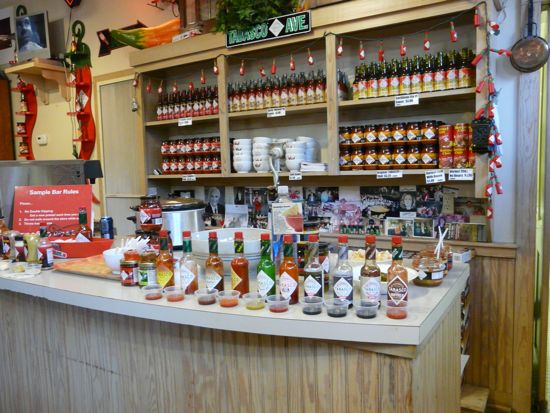


Oops! Time to get back over to the factory for our tour, which is like 5 minutes, then a 10 minute movie. Just before the movie starts, the guide (who also works in the gift shop while the movie is running) gives each person tiny sample bottles of several Tabasco products – cool!

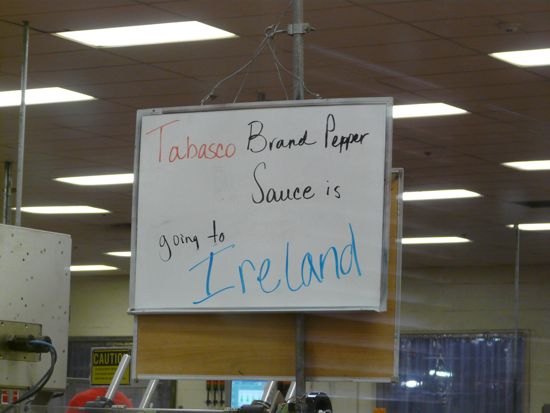
After the movie, we get to tour alongside the factory and go into the museum. Very cool. Thousands and thousands of tobasco bottles being filled, and each day they post which country(ies) they are sending this batch to. Today is Ireland.

Tabasco is made with a secret formula of specially grown tabasco peppers, vinegar and salt. Lucky for them, they have their own salt mine on the property. Just about everything they need to make tabasco sauce, right at their fingertips. This was a fun tour to take, and one of our dreams was fulfilled.

A Visit to Cajun Country in Louisiana
I guess I might have mentioned a time or two that I read an author named James Lee Burke. I remember the very first book I read – A Morning For Flamingos. I remember where I found it – the US Forces library on Lindsay Air Station. I remember it was late winter in Germany, the time when you think Spring will never come, that it will be grim and grey and cold for the rest of your life. I sought escape, which Mysteries/Detective novels provide, but I never expected poetry. From the very first page of A Morning for Flamingos, I was spellbound. While his novels have some horrific violence in them, and his detective Dave Robicheaux is a recovering alcoholic with some seriously self-destructive issues, you can sort of skim through the bad parts; there will be more poetry soon.
He is one of the few authors I will buy in hard cover.
I’ve been waiting. I wanted to see New Iberia, but I had to find a time when all the universal factors would line up – AdventureMan would be in the same country as me, the weather would be cool enough that travel would be enjoyable, and there was a low likelihood of running into a lot of tourists. The stars aligned, and off we went, a mere five hours away, to Cajun Louisiana.
We drove to New Orleans, first, visiting the welcome station to pick up brochures and figure out what we wanted to see and where we wanted to stay.

The welcome center was clean and well stocked, lots of bathrooms available for the visitors, lots of visitors, and ladies behind the counters full of first hand information about where we should go, where we should eat and where we might stay.
I have a thing about bridges. I had an accident on a bridge once, and I’m still a little nervous about bridges. This is the kind of bridge I hate:

This southernmost part of Louisiana is lowland, and there are bridges everywhere. Some of them are bridges like I have never seen anywhere else:

We arrived in the middle of the sugar cane harvest. I didn’t know what fields of sugar cane looked like; now I do:

There were big huge carts full of cane, all going to be processed on the same day they were cut:

All this time we were looking at sugar cane, we were getting hungrier and hungrier, but it was Sunday, and a lot of places were already closed, if they had been open at all. We finally found a restaurant in New Iberia, Pelicans, where I shocked my husband by ordering the vegetable plate – but it was all deep fried vegetables; asparagus, green beans, broccoli and carrots. He had a BBQ sandwich.

I think we were the only tourists in the place. The bar was full; the restaurant was empty, except for us.
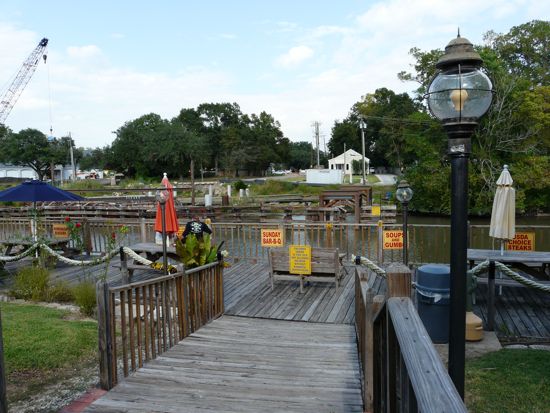


We wanted to find someplace really fun to stay, full of character, and I had been looking at some cabins in Breaux Bridge. When we got ready to check them out, we discovered that the people who ran it were gone! There was a phone number, which we called, and the very kind owner called back and told us to go take a look, and which cabins were available.
You know, things just aren’t the way they used to be. I remember my Mom and Dad’s house, the first one they bought. The closet in the Master bedroom was only about 4 feet by 3 feet deep, with one bar and with a shelf. People had fewer clothes then, even in Alaska, where they also had heavy coats and ski pants and stuff. Bathrooms were small, only what was necessary, not like the spa-bathrooms people want now (me included.)
These cabins were cute. They were built right out over the bayou, and you could fish off your own balcony, each cabin separate and free standing. The place was clean. It was also really small, with small beds and small bathrooms. I don’t have asthma, but there was a musty smell, and I was worried I wouldn’t be able to breathe. We also like a good mattress, so we can sleep well. I looked at AdventureMan, who was looking at me. We were both on the same track; we couldn’t stay there. I called the lady back. “The cabins are really nice,” I said, “But we’re old and have allergies. We can’t stay here.” My husband was looking at me in a mixture of horror and hysteria. As we got in the car, his shoulders were shaking. He put a quiver in his voice (my voice did NOT quiver) and started saying “We’re o-o-o-o-ld, and we . . .” We were both rolling with laughter. I just didn’t know what else to say. We used to stay in places like this, but now we put a higher value on sleep.
We headed for a tried and true Marriott – actually, two of them – in Lafayette, only to discover that there was an oil and gas conference starting this week and there were NO rooms at the Marriott. We headed back toward New Iberia and settled into a Hampton Inn – nice, clean, roomy, and no character, we could have been in Seattle or Pennsylvania, but we could breathe.
Recent Comments
intlxpatr on Yellowstone: Old Faithful to C… Michelle on Yellowstone: Old Faithful to C… Cathy on No Grown-Ups in Charge intlxpatr on Waiting for Snow intlxpatr on Waiting for Snow Wikipedia Donate Button

Amazina


Early Voting in Florida


 Here There and Everywhere