Mangaf Mansion
Every time I see this house, I grin. I love it that someone has the money and the imagination to build exactly the house he wanted, and that he did it knowing he would probably get criticism. He built it anyway. Good on him.

Doha Souk Transport
As a young military wife, it was hugely shocking to me when people felt sorry for me that I had to move all the time. Yes, it is painful being far away from family. And yes, it is painful leaving good friends. But in expat world, we all leave sooner or later, this contract ends, this posting leads to another – and some of us are just wired to need the stimulation.
My husband walks into each new posting with credentials – people know what he has done and accomplished, he has “gravitas.” I get to seek out the drycleaner who won’t ruin my clothes, the man who sells the best tomatoes, and to try to get the heating fixed when no one wants to talk to a woman, and to try to find the roads that will get us where we need to go. In short, I am staff.
And, in spite of all my griping, I got the life I was meant to have. I love the variety, I love the shock of finding others think differently, perceive differently, and my own assumptions are challenged. And I love taking photos.
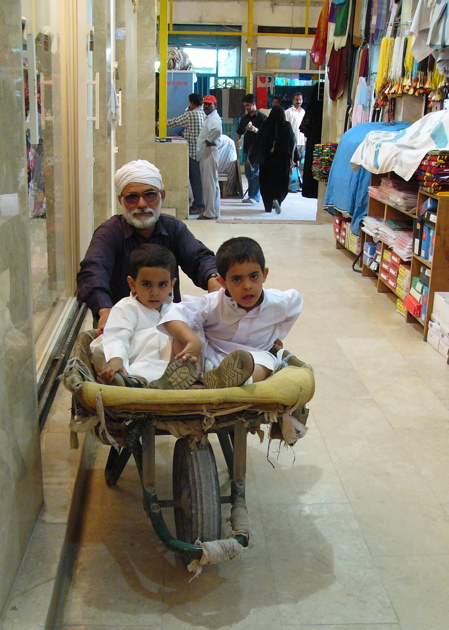
Here is one of my favorites – these wizened old men are always available to carry your excess and heavy packages, and this man was hired to carry the two adorable boys and “nanny” them as mom went from shop to shop. I asked permission before shooting the photo, from a man I assumed to be the father, but the mom came swooping out, asking what I was doing. Fortunately for me, the man calmed her down and all was well.
Better Faster Smarter Solution
My husband jokes that when I have a sore throat, it is the beginning of a common cold, but when he has a sore throat, it is a rare tropical disease and he should be babied and coddled and have tea and soup brought to him, and warm washcloths, and we should speak in sweet soft voices in case he is breathing his last.
Last night I had a tickle. My husband, God bless him, knows that what makes me all better is miso soup, so I had miso soup for dinner last night.

Today, I think I have the rare tropical disease kind of sore throat. It was just a tickle yesterday, but by night I was in the grips of a no-kidding, no sleeping sore throat and stuffed nose, coughing, and feeling rotten. I feel like something the Qatteri Cat dragged in.
I rarely get sick. I don’t have time to get sick now. Please, dear readers, share your top “get rid of a cold” solutions, and do it NOW! I need your help!
Trek and Date Time Stamp
It was me but it wasn’t me. I’ve been gone, out on a short trek, the kind of trek where a computer would be laughable, in terms of time, in terms of connection. And it forced me to try something new . . .
Word Press has a Date Time Stamp feature. Instead of pressing “publish” when you finish an entry, you go down to “post timestamp” and you click in the Edit Timestamp box, then you choose the date and time you want the article published.
It’s not that I don’t trust technology, but I don’t always trust my grasp of how it works, so I tested it before I left and to my astonishment, it worked like a charm. It’s hard to believe something so cool could also be so easy, so straight forward.
So I have tagged it, in addition to other tags, with “lies” because it kinda IS a lie – it implies I am somewhere when I am really somewhere else. And the good news is – it really works!
FEMA Calls Rebuilding Complete As New Orleans Restored To Former Squalor
This is from The Onion. Remember friends, The Onion is SATIRE. Please note the last line, and weep.
NEW ORLEANS—After an unprecedented 18-month cleanup and repair effort supervised by the Federal Emergency Management Agency and several state and local government bureaus, Undersecretary for Federal Emergency Management R. David Paulison announced Monday that the city of New Orleans has been successfully returned to its pre–Hurricane Katrina state of decay and deterioration.
“Our job here is done,” said Paulison, who was joined by Louisiana Gov. Kathleen Blanco in a ceremony along the banks of the Industrial Canal. “Our beloved Big Easy has its soul back. The downtown shops are open and in full violation of code, the nightlife is alive with the sound of violence, and the streets are once again safe for poverty and vice.”
The $41 billion restoration of the city’s hallmark abandoned buildings, shacks, vacant lots, and standing trash piles was among the most complex and painstaking ever undertaken. Starting just four weeks after the August 2005 hurricane, workers recovered millions of pieces of flood-damaged debris, cleaned them of sediments and chemicals, and then replaced them where they were originally found.
The work, however, did not proceed without controversy, often grinding to a halt as preservationists quarreled in court over which sections of rot, toxic chemical compounds, PCBs, bacteria, and pathogens predated Katrina.
Despite the bitter disputes, Blanco declared the restoration project an “unqualified success,” and invited the estimated 200,000 New Orleanians who still reside outside the city to return.
“We’ve done our best to ensure the city is as well off as it was before Katrina hit,” Blanco said. “It’s all back—the same abandoned cars, the broken bottles, the spent shotgun shells, the rat colonies, even the used diapers on the front lawns. People of New Orleans, welcome home.”
The most impressive progress was made in the Ninth Ward, the lowest-lying and most devastated section of New Orleans. Due to severe water and mold damage, the difficult decision was made to gut or tear down a majority of the neighborhood’s houses, then laboriously reconstruct them to their previous dilapidated condition seven feet below sea level. Many returning residents, including custodial worker and father of four Stanley Gibson, 41, expressed shock at the success of the rebuilding efforts, saying he “never dreamed in a million years [he] would be going back to that place.”
“Before the storm, I lived paycheck to paycheck in a run-down two-bedroom house,” Gibson said. “I never thought I’d see that house again, but here it is—same sagging roof, compromised foundation and everything. Someone even found my car and put a quarter of a tank of gas back in it.”
As part of the citywide restoration efforts, downtown medical facilities that flooded during Katrina, such as Charity Hospital, were drained, repaired, and meticulously under-funded based on past financial records and other historical evidence. Hospital officials said the facility could be ill-prepared for overcrowding by uninsured and indigent patients as early as next week.
Public schools were fully reopened last Monday after being stocked with outdated textbooks and refurbished chairs for every student to share.
Even New Orleans’ world-famous French Quarter was given a much-needed boost, with the flood-related detritus covering Bourbon Street cleared and replaced with discarded plastic beads, vomit, and used condoms.
“It’s like nothing has changed,” said Covenant House director Michelle Beauchamp, whose organization received FEMA funds to rebuild and reopen a homeless shelter. “The workers rebuilt all 25 rooms exactly as small as they used to be, and soon we’ll be ready to serve New Orleans’ 10,000 homeless men, women, and children again.”
Residents noted that the same attention to detail could be seen in the levees and floodwalls, which were restored by the Army Corps of Engineers to their “classic” pre-Katrina condition.
Despite FEMA’s official declaration of completion, not all facets of New Orleans squalor have been restored. City officials say the return of New Orleans citizens is essential to the survival of the city’s crumbling economy and renowned 25 percent poverty rate. And in a sharp and historically inaccurate contrast, federal aid continues to flow into the city, preservationists say.
After several years of bureaucratic restructuring and appointee shuffling, FEMA assured New Orleans residents that it, too, has regained its former level of quality.
“If another hurricane hits New Orleans, we will be just as prepared to help as we were before Katrina,” Paulison said.
Mystery Back Again
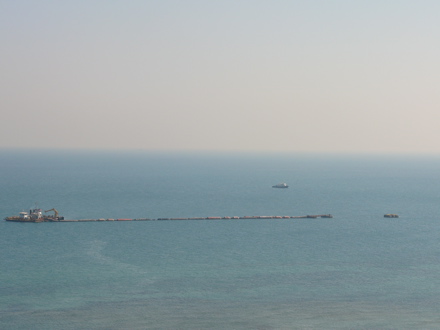
Several months ago I posted a photo of a . . . something . . . out in the Gulf. I can’t figure out what this is, what it is doing. It is a large sturdy raft with mechanical equipment. It is visited several times a day by a couple different serious looking modern fishing boats – maybe coast guard boats. I can’t really tell.
It may be a dredge, as it is in shallow water and has all those tubes connected to floats. Or it may have to do with fishing. I don’t see any sand coming up, nor do I see fish. This is a great mystery to me. (Idly musing . . . )

I keep hoping one of you will recognize it and tell me what it is. Otherwise, the comment section is open for idle speculation.
Breakfast at Paul’s
It’s a great thing, being a grown-up. A lot of the things that were hard and fast rules as you are raising children get thrown out the window once it is just you and your husband once again.
When I was little, I remember Saturday nights. We would have hamburgers with all the trimmings, and watch a favorite TV show while we ate. It was the only night of the week we could eat in front of the TV.
There was a price to be paid, though. My mother would never allow a bottle on the table. There were special small bowls for the mustard, ketchup, relish, sliced onions, tomatoes, lettuce, etc. Putting condiments IN the bowls was no big deal, but I hated spooning the ketchup back into the narrow necked ketchup jar.
I will never forget my horror visiting my parents home with my son, and seeing a ketchup bottle on the table. I couldn’t believe it! I said “we were never allowed to put a ketchup bottle on the table when we were growing up!” and my Mom just laughed and said “now that we have raised you correctly we can do as we please!”
I totally get it. Now that it is just my husband and me, we also break the rules. We go out to eat more often. Sometimes we stay up late, even on a work night. Sometimes we leave a mess in our project room. I heard my husband tell the cat “Mom is going on a trip and we won’t even have to make the bed!” We’re easier on ourselves and we are easier on one another.
But best of all, when my husband wants a strawberry tart, even for breakfast, he can have a strawberry tart. He loves the ones from Paul’s. We don’t have breakfast there often, but we always enjoy it when we do.

Mobissimo
Have you heard about Mobissimo? It is one of the best sites for comparing airfares from one place to another. I owe this to a good friend, now working in Afghanistan. He makes his reservations through Mobissimo and shared the information with me.
You can include multiple destinations, something many of the travel sites don’t handle well, and you can see where you would be connecting and how long that connection will be.
I don’t always book through Mobissimo, but it is usually my first stop to get a glimpse of price comparisons and connections.
Alison’s Clam Chowder
This is one of the first recipes in my collection. My very best friend from college taught me how to make it and gave me the recipe. You can get all the ingredients in Kuwait, and can buy Kuwaiti clams in the fish markets and at the Sultan Center.
Alison’s Clam Chowder
This is still one of our very favorite soups – especially on a cold winter’s day. Serve with a baguette (French bread, not a diamond!) and a green salad. It’s all you need.
2 strips bacon (beef or turkey bacon in Kuwait)
1 large onion, chopped
2 cans clams and juice (drain the juice, but save it)
2 cups water
4 cups milk
1 large potato
Sautee bacon slowly, so it releases lots of grease. Take out bacon, chop it up, and reserve it.
Sautee onion in bacon grease until soft. Cool, add water and clam juice, and chopped potato. Cook until potato is no longer hard, but not too soft.
Add milk and warm to serving temperature, add canned clams and reserved bacon pieces. Sooooooooo EASY!
Report: Humans ‘very likely’ cause global warming
This morning, CNN reports that humans are very likely the cause of global warming. No kidding.
This week, an unexpected storm killed 19 in Central Florida. Global warming is said to be creating stronger, more dangerous hurricanes in the Atlantic. This has had a personal impact on us – we bought a house in Florida this year, only to receive word shortly after buying it that hurricane insurance would be almost impossible to get in the future.
We are planning to make the house as hurricane-survivable as we can, but very little can survive the direct impact of a max force hurricane. It is a terrifying event, and makes a believer out of the non-spiritually oriented.
We really have no idea how far along the process of global warming is, or if it will accellerate beyond our ability to undo the damage we may have done. Or . . . is this just another in a long series of cycles of weather change?
Story Highlights
• Scientists release a 21-page report strongly linking humans to climate change
• Report scientist: Evidence of warming on the planet is unequivocal
• Scientists predict global temperature increases of 3.2-7.1 degrees F by 2100
• Sea levels could rise between 7 and 23 inches by the end of the century
(CNN) — Global warming is here and humans are “very likely” the blame, an international group of scientists meeting in Paris, France, announced Friday.
“The evidence for warming having happened on the planet is unequivocal,” said U.S. government scientist Susan Solomon, who also is a member of the Intergovernmental Panel on Climate Change.
“We can see that in rising air temperatures, we can see it in changes in snow cover in the Northern Hemisphere. We can see it in global sea rise. It’s unequivocal,” she said. (Watch scientist Susan Solomon deliver the grim news on global warming )
In a 21-page report for policymakers, the group of climate experts unanimously linked — with “90 percent” certainty — the increase of average global temperatures since the mid-20th century to the increase of manmade greenhouse gases in the atmosphere.
Fossil fuels like methane and carbon dioxide trap heat near the surface, a process known as the greenhouse effect. The greenhouse effect is a natural phenomenon, but human activities, like the burning of fossil fuels, can pour enormous volumes of these gases into the atmosphere, raising the planet’s temperature and destabilizing the climate. (Watch what happens to our planet when manmade emissions get trapped in the atmosphere )
The report found it was “likely” — “more likely than not” in some cases — that manmade greenhouse gases have contributed to hotter days and nights, and more of them, more killer heat waves than before, heavier rainfall more often, major droughts in more regions, stronger and more frequent cyclones and “increased incidence” of extremely high sea levels.
The report noted that 11 of the last 12 years have ranked among the 12 warmest years on record with the oceans absorbing more than 80 percent of the heat added to the climate system. Add in the melt-off of glaciers and sea ice and sea levels are rising.
The IPCC predicted global temperature increases of 1.8 to 4 degrees Celsius (3.2 to 7.1 degrees Fahrenheit) by 2100 and sea levels to rise between 7 and 23 inches (18 and 58 centimeters) by the end of the century. (Watch how rising sea levels could affect San Francisco )
“An additional 3.9-7.8 inches (10-20 centimeters) are possible if recent, surprising melting of polar ice sheets continues,” the report stated.
The group will meet again in April to discuss the socioeconomic impact of climate change.
Defining ‘likely’
The IPCC was established in 1988 to study climate change information. The group doesn’t do independent research but instead reviews scientific literature from around the world.
The United Nations-sanctioned group was formed by the World Meteorological Organization and U.N. Environment Program.
The group’s goal is to produce “a balanced reporting of existing viewpoints” on the causes of global warming, according to its Web site.
The panel’s reports are influential references for policymakers, scientists and other climate change experts.
Friday’s release is the beginning of the panel’s first major report since 2001. The rest of the report is due out later this year.
The 2001 report found that the 1990s were “very likely” the warmest decade on record. It also said that most of the observed warming over the last 50 years was “likely due to increases in greenhouse gas concentrations due to human activities.”
The authors defined “likely” as between 66 percent to 90 percent probable, and “very likely” as a 90 to 99 percent.
Renewed concern in U.S.
Friday’s report comes amid renewed debate in the United States. (Full story)
In his State of the Union address, President Bush called for the use of more environmentally friendly technologies to “confront the serious challenge of global climate change.”
It was the first time he has discussed the issue in a State of the Union address.
The White House has said Bush’s proposals would stop the growth of carbon dioxide emissions from cars, light trucks and sport utility vehicles within 10 years.
Leaders in the Democratic-controlled House of Representatives and Senate held hearings on climate change this week. (Full story)
CNN’s Peggy Mihelich and David E. Williams contributed to this report.
Recent Comments
ExpatAlien on What Country am I Living … intlxpatr on Yellowstone: Old Faithful to C… Michelle on Yellowstone: Old Faithful to C… Cathy on No Grown-Ups in Charge intlxpatr on Waiting for Snow Wikipedia Donate Button

Amazina


Early Voting in Florida


 Here There and Everywhere