Picoult and My Sister’s Keeper
I don’t know where I got the idea that Jodi Picoult wrote girly books, maybe because when you go to a bookstore there are so many of them? I just assumed they were romance and passed right by until several months ago, in a small used book store, I found one that was in the book club section, and those are usually pretty good reads. I bought it, but put off reading it, assuming it was an easy read, maybe I would read it on an airplane one day.
For some reason I moved it up, maybe I had heard a review or something. It moved to the bedside group, the “in line for immediate reading” group. At a time when we were particularly busy, I finished my other book and this was next, and I thought “Oh well, yes we are busy, but this will be light reading.”
I couldn’t have been more wrong.
This book, My Sister’s Keeper, is not light reading. It is a book a lot like We Need To Talk About Kevin one of the most terrifying and unforgettable books I have ever read. It is a book about motherhood, and parenting and tough choices. It is a book about how sometimes your entire life is yanked, and all the focus is on one area, to the detriment of others. It is a particularly tough book if you are a mother.
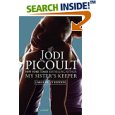
The main character, Anna, was conceived so that her stem cells, from the umbilical cord, will be used to help her sister, Kate, who has leukemia. Family life is chaotic, to say the least, as the vigilant parents’ attention is constantly on Kate, who suffers frequent relapses.
Picoult uses the voices of Anna, Kate, Jessie – the brother, a pyromaniac, Brian (the father), Sara (the mother), Campbell (Anna’s lawyer) and Jesse (Anna’s guardian ad litem) to tell the story.
Anna has approached Campbell, a lawyer, to achieve medical emancipation. She loves her sister, she has shared a room and her entire life with her sister, she has given stem cells, she has given bone marrow, she has been through several medical procedures to keep her sister’s cancer in remission, but at 13, she balks when expected to give one of her kidneys is a last ditch attempt that even the doctors have little expectation will succeed. She hires a lawyer.
Sara is a mother you would love to hate. You would love to grab her by the shoulders and say “Pay attention! You have THREE children, and two of them need your attention, too!” but something holds you back, and that something is the serious doubt you have about how you would handle the same situation. In extreme circumstances, people make the best choices they can, and when you are in extreme circumstances day after day, things start to fray, and then they start to fall apart. This family is past the fraying part, and we hold our breaths hoping they won’t fall apart.
It’s not a hard read because of the technical terms; this is a book where a 13 year old knows all the vocabulary of cancer, and we learn it, too. It flows naturally in the book.
Kate has acute promyelocytic leukemia. Actually, that’s not quite true – right now she doesn’t have it, but it’s hibernating under her skin like a bear, until it decides to roar again. She was diagnosed when she was two; she’s sixteen now. Molecular relapse and granulocyte and portacath – these words are part of my vocabulary, even though I’ll never find them on any SAT. I’m an allogeneic donor – a perfect sibling match. When Kate needs leukocytes or stem cells or bone marrow to fool her body into thinking it’s healthy, I’m the one who provides them. Nearly every time Kate’s been hospitalized, I wind up there, too.
None of which means anything except that you shouldn’t believe what you hear about me, least of all that which I tell you about myself.
Aha! We are reading a book with an unreliable main character!
It is a hard read because we all have families, and we all face tough decisions. There is a part of us that says “thank God we are not in this situation” and another part that says “there but for the grace of God . . . ” It is a tough book because we don’t know who we will become when life-changing circumstances hit us, we don’t know what choices we would make, because we are afraid, and because we don’t want to find out.
There are some surprises, though, and you will want to keep reading. There is a lot of love here, in the cracks between the tragedies. My Sister’s Keeper has three sets of sisters, and a lot of focus on that very special relationship. The men, too, come off well at the end.
Not an easy read, but a book that will stay in your heart for a long time.
10 Comments »
Leave a reply to intlxpatr Cancel reply
Recent Comments
ExpatAlien on What Country am I Living … intlxpatr on Yellowstone: Old Faithful to C… Michelle on Yellowstone: Old Faithful to C… Cathy on No Grown-Ups in Charge intlxpatr on Waiting for Snow Wikipedia Donate Button

Amazina


Early Voting in Florida


 Here There and Everywhere
I didn’t read this one by her but I read Nineteen Minutes, The Pact, Salem Fall’s, The Tenth Circle and Vanishsing Acts. They are all very good books, I love her writing style it keeps me interested from cover to cover.
Chirp, have you finished A Thousand Splendid Suns? You are quite a reader!
I’m glad you’ve discovered Jodi Picoult, she’s one of my favorite authors, My sister’s keeper really gives you the full moral dilemma. Thats ne of the best things about Picoult. Her books look at a different side of the story than you normally get.
Enjoy!
Thanks, Pinky! What other authors do you like? 🙂
Yes I have finished “A Thousand Splendid Suns” its amazing! I’m reading “A Long Way Gone” by Ishmael Beah now. This one is heart breaking!
I don’t think I’ve read that! What are the other two? (I know you read three at a time!)
Hehe I wish I had time to read three books at one time. Those were the good old days!
I LOVED that boook, it’s so heartbreaking!
I still haven’t read My Sister’s Keepers (which supposedly the best one out there) but I have finished the Tenth Circle, and couldn’t finish Vanishing Acts because I was distracted by other books. I guess her latest book is Nineteen Minutes and Change of Heart is due to be released next year.
I have another one somewhere by Picoult; I don’t even know what it is. It’s not on the bedside table yet . . . .somewhere in the other stacks of books waiting to be read!