Minarets
You’d think I would pick up on things sooner, but here’s the problem. When you don’t know something, you often don’t even know you don’t know. In a recent post on an Al Ahmadi minaret one of my commenters asked if I couldn’t tell it was a Shiite minaret. At first, I thought he was being funny, but it nagged at me, so I started asking around.
It turns out almost everone except me can tell the difference. Most say, as I would, “oh you just kind of know, it looks more Iranian” but occasionally someone will say something concrete, like “if it has a green roof on the minaret, it is Shiite” or “if the windows look like keyholes, it is Shiite.”
Who would know? Not me! But I am learning.
So, help me out here. This mosque near City Center on 5th ring. Definitely Shiite?

This mosque is in Qurain – I love the very purpleness of it. Is this a Sunni mosque? I ask because the windows look kind of like keyholes.
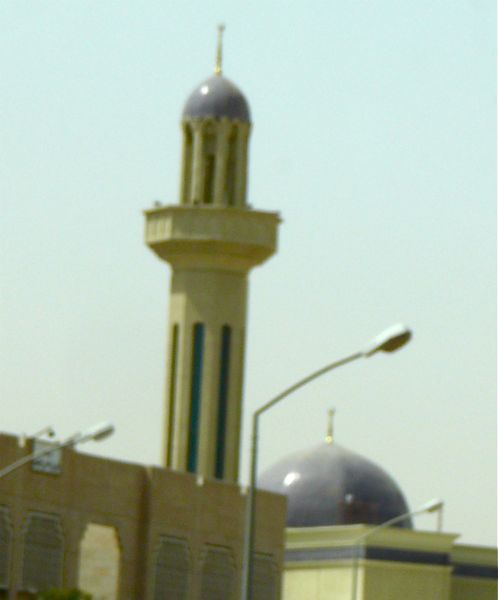
Now – services. I’m an Episcopalian, a sub-sect of Christianity, and I can walk into almost any Anglican/ Lutheran/ Catholic church in the world and even if it is in another language, I have a pretty good idea what is going on, because we are liturgical, we follow a pattern of worship, and the three services are very similar, with very subtle difference. In fact so subtle I probably couldn’t even tell you what the differences are. Islamic services are also considered liturgical – having a set pattern of worship.
So if you were Sunni or Shiia, and walked into a service, could you tell a Sunni service from a Shiia service? Are there differences?
I am sorry to be so ignorant; help me be less so!
21 Comments »
Leave a comment
Recent Comments
ExpatAlien on What Country am I Living … intlxpatr on Yellowstone: Old Faithful to C… Michelle on Yellowstone: Old Faithful to C… Cathy on No Grown-Ups in Charge intlxpatr on Waiting for Snow Wikipedia Donate Button

Amazina


Early Voting in Florida


 Here There and Everywhere
“When you don’t know something, you often don’t even know you don’t know”, I love that quote and I’ve been quoting it every once in a while.
Well, your impressions are right, the first one is a Shiite mosque and the second one is a Sunni one.
Shiite mosques are known for their green hemispheres, use of lighting on “minarets” and for the identifiable writings on the entrance of the mosque.
I’ve never been to Shiite mosque before but I suspect that the interior design might look different. And there is the prayer’s call which is a little bit different.
As for the services, I don’t know what are the services in either of them rather than praying, Friday’s noon prayer speech and some small scattered educational circles at the corners. One thing for sure is that you can tell from the praying posture that if the prayer is Sunni or Shiite. This is as far as I can go.
P.S.
There is something that you’ll probably be fascinated by (Architectural-wise) which is Shiite Hussainiya
🙂 I can tell the difference only when I can see the writing – the calligraphy “just looks more Iranian” :D.
The call to prayer is noticeably different: in addition to stating that there is no god but God and that Muhammad is his prophet, the Shia call adds Ali, as wali Allah. So even if the mosques don’t look visibly different, their calls to prayer give them away.
In Syria & Lebanon, Shia were historically known as mutawila, a derivative of wali. I’ve never heard the term used today, though, and I’m not sure whether it was a positive term. It may have been like nasrani for Christians and yahudi for Jews – used, but not as polite as masihi or musawi. Have you ever heard this?
Touche’, thank you. And thank you for adding more. And actually, I think I have some friends who are Shiia, so I will ask them to take me to a Hussainiya. I remember last year one blogger wrote about cooking a big feast during (Ashura?) and it looked and sounded like the women were having a lot of fun. The pots were HUGE. And I think the feast was served in a Husseiniya – does one worship in a Husseiniya AND sit in one socially as well?
Aha! Thanks, Little Diamond, I will have to look, find one I think is Shiia and then hang out and listen for the prayer. (Remembering the days when my son could sing all the words because we lived so near the mosque 🙂 )
I have heard Nasrani used, in North Africa, not here, and AdventureMan says he NEVER hears it used. I didn’t know it was a deprecatory term. . . you will have to teach me another way of saying “I am Christian” because I thought it was Ana Nasrani 😦
As we know,
There are known knowns.
There are things we know we know.
We also know
There are known unknowns.
That is to say
We know there are some things
We do not know.
But there are also unknown unknowns,
The ones we don’t know
We don’t know.
—Donald Rumsfeld (Ha!)
I know at least some (maybe all?) Shi’a put a flat rock where their heads land when prostrating, which would be rather noticeable.
The word Nasrani is not a deprecatory term. It’s a term that one would say if speaking in formal Arabic. People in this region tend to say Masihi. So you should say Ana Masihia (feminine) Ana Masihi (masculine).
So now the expectation is we who visit you regularly are all minaret savvy. Enlighten us next on inter-faith influences on church and masjid architecture, s’il vous plait!
🙂 maybe it isn’t derogatory – or isn’t now, although the scholarly interpretations I have seen (which could be just heads=in-the-clouds) have said that it was historically less respectful. Nasrani means Nazarene, and masihi means of the Messiah, so perhaps the difference is that the second acknowledges Christians’ belief that Jesus is the Messiah and not merely a guy from Nazareth?
As for services, one major difference is that Shia pray with their hands down at their sides when standing, while Sunnis fold their arms near their chests. And some Shia do pray on a small square/octagonal tile formed of clay from Karbala. I’ve seen devout Shia friends pray with it and devout ones pray without it, so I’m not sure how requisite it is.
P ou p: like mosques, church architecture differs from region to region. In the US, there are differences between Catholic, Orthodox, and Protestant churches, but what also helps are the names (“Our Lady of …” is usually Catholic) and the fact that most US churches list their denomination under or as part of the name (“Ascension Baptist Church”).
Yes, cozy, Donald Rumsfeld, a very bright man, a very funny insightful man who just got in with the wrong crowd, boys gone wild. He’s right about one thing, it’s those unknown unknowns where we get ourselves into the deepest trouble. Like quicksand, we walk in and don’t even know what hit us.
Aha, ??? Ana masihia! I am glad to know it is not deprecating here; I have heard it used often in North Africa in an everyday kind of way. Our Arabic used to be more formal, and people would look at us like “what planet did you come from?”
BL, as you can see, I am feeling my way in the dark here. I bet there are experts out there. . . but they are not me! On my blogroll you will find the most wonderful blog: John Lockerbie’s design pages and he has researched all kinds of cool things – he knows the names of all the dhows and how to tell them apart and how they are used, and he can tell you the whys and hows of all the old Arabic architecture, the wind towers, etc. It is a fabulous website, full of information.
Morning, Little Diamond!
I agree with all the above about identifiying both mosques and the prayer call and how to pray.
You’ll notice Shiite mosques and/or Husseiniyas have lots of writings outside and banners and such. They also include a lot of the color green. Some of the writing looks like there is blood dripping from words. (Long story)
I didn’t know any of this either.
H0ope you don’t mind when I add a linkback on my post from yesterday – it was about mosques.
What about mosques with white rooftops??
Please, Nicole, you are always welcome. And it would be good from people to go from here to see what you have posted, too.
Thanks, Lady. I have heard the bloody story, even got some additional information this morning from BBC, who are running a segment on the difference between Sunni and Shia today. Truth, it is still confusing to me, but I keep my ears and eyes open.
This was the post I thought about.
It reminded me of one you posted a while back about how mosques are financed:
http://nicoleb.org/b2/index.php/renovation
You and I are on the same track so often, Nicole, or our paths are intertwining! Must be fate.
Interesting post. I once had a Sunni friend who went and prayed in a shia mosque and didn’t even realize it until her colleagues told her later on.
I told her that the difference is the crescent on top–sunni mosques have them, shia ones don’t. She doubted that was true coz according to her some sunni mosques that don’t have a crescent on top. But as far as i know no shia mosques have crescents; they might have the word Allah but not a crescent…well the ones in iran anyway 😀
BTW, since i knew you live minarets i took a couple of pix of minarets here so i can post them for ya…but unfortunately i hadn’t set the aperture right and the pic turned out kinda blurry 😦
Wait! Wait! Magical, the top mosque in this post has those crescent moons on top! And I also have seen Sunni mosques without crescents. Keep shooting those photos, Magical, I want to see those minarets! 🙂
I guess it’s only true about shia mosques in Iran. From now on whenever i pass by a mosque here i would snap a pic 😀
I just posted two pictures of mosques in Tehran. The first one is somewhere in central Tehran, the second one is in my neighborhood
Magical, I checked your MirrorPolisher blog and there is nothing there on minarets; I clicked on the blue type and there is nothing there. 😦
oh sorry i forgot to mention it’s not on mirrorpolisher. i still have problems signing in on blogspot 😦
i’m temporarily using http://www.mymagicaldroplets.wordpress.com
Wooo Hoooo! I love your wordpress site, Magical!