Easter Monday Sunrise, March 24, 2008

It’s not that I am lazy, it is that with the coming of summer (two weeks of spring just isn’t long enough!) the sunrises don’t differ a lot from one another. It’s just one hot, sunny, hazy day after another.
(Sorry, yes that was cruel to my friends in the US and Europe who are struggling with the cold and snow and ice and wishing for a hot summer day!)
Happy Easter Monday!
Election Fever
I have a very dear friend who will say “I don’t have a dog in that fight” and that is the way I feel about your upcoming elections. You (Kuwait, Kuwait leadership, Kuwait people) are in our prayers for a fair election, and that you elect good leadership. You know what a mess it has been; it would be nice to elect people who can work with the government to get things done.
So I don’t have a clue who those people would be, but I know YOU do.
Here is what tickles me, what I can’t resist commenting on from this morning’s Kuwait Times:
ELECTION FEVER GRIPS STATE
Tribes, groups move to chose candidates • Eligible voters rise to 361,000 including 200,000 women
Holy Smokes! Almost FORTY THOUSAND more women voters than men voters??? Woooo HOOOOOO, Kuwaiti women!
Colorful Answers
Amethyst:
Main Entry:
am·e·thyst
Pronunciation:
\ˈa-mə-thəst, -(ˌ)thist\
Function:
noun
Etymology:
Middle English amatiste, from Anglo-French & Latin; Anglo-French, from Latin amethystus, from Greek amethystos, literally, remedy against drunkenness, from a- + methyein to be drunk, from methy wine — more at mead
Date:
13th century
1 a: a clear purple or bluish-violet variety of crystallized quartz that is often used as a jeweler’s stone b: a deep purple variety of corundum
2: a moderate purple
— am·e·thys·tine \ˌa-mə-ˈthis-tən\ adjective
Argent
argent
Main Entry:
ar·gent
Pronunciation:
\ˈär-jənt\
Function:
noun
Etymology:
Middle English, from Anglo-French & Latin; Anglo-French, from Latin argentum; akin to Greek argyros silver, argos white, Sanskrit rajata whitish, silvery
Date:
15th century
1archaic : the metal silver; also : whiteness
2: the heraldic color silver or white
— argent adjective
Azure
azure
Main Entry:
azure
Pronunciation:
\ˈa-zhər\
Function:
noun
Etymology:
Middle English asur, from Anglo-French azeure, probably from Old Spanish, modification of Arabic lāzaward, from Persian lāzhuward
Date:
14th century
1archaic : lapis lazuli
2 a: the blue color of the clear sky b: the heraldic color blue
3: the unclouded sky
— azure adjective
Celadon
celadon
Main Entry:
cel·a·don
Pronunciation:
\ˈse-lə-ˌdän, -lə-dən\
Function:
noun
Etymology:
French céladon
Date:
circa 1768
1: a grayish-yellow green
2: a ceramic glaze originated in China that is greenish in color; also : an article with a celadon glaze
Cerise
cerise
Main Entry:
ce·rise
Pronunciation:
\sə-ˈrēs, -ˈrēz\
Function:
noun
Etymology:
French, literally, cherry, from Late Latin ceresia — more at cherry
Date:
1844
: a moderate red
Chartreuse
Main Entry:
char·treuse
Pronunciation:
\shär-ˈtrüz, -ˈtrüs\
Function:
noun
Etymology:
Chartreuse
Date:
1884
: a variable color averaging a brilliant yellow green
Dun
in Entry:
1dun
Pronunciation:
\ˈdən\
Function:
adjective
Etymology:
Middle English, from Old English dunn — more at dusk
Date:
before 12th century
1 a: having the color dun bof a horse : having a grayish-yellow coat with black mane and tail
2: marked by dullness and drabness
— dun·ness \ˈdən-nəs\ noun
Magenta
Main Entry:
ma·gen·ta
Pronunciation:
\mə-ˈjen-tə\
Function:
noun
Etymology:
Magenta, Italy
Date:
1860
1 : fuchsin
2 : a deep purplish red
Puce
puce
Main Entry:
puce
Pronunciation:
\ˈpyüs\
Function:
noun
Etymology:
French, literally, flea, from Old French pulce, from Latin pulic-, pulex — more at psylla
Date:
1833
: a dark red
Smalt
smalt
Main Entry:
smalt
Pronunciation:
\ˈsmȯlt\
Function:
noun
Etymology:
Middle French, from Old Italian smalto, of Germanic origin; akin to Old High German smelzan to melt — more at smelt
Date:
1558
: a deep blue pigment consisting of a powdered glass that contains oxide of cobalt
Smaragd:
Main Entry:
sma·ragd
Pronunciation:
\smə-ˈragd, ˈsma-ˌragd\
Function:
noun
Etymology:
Middle English smaragde, from Latin smaragdus, from Greek smaragdos, of Semitic origin; akin to Akkadian barraqtu gemstone
Date:
13th century
: emerald
— sma·rag·dine \smə-ˈrag-dən, ˈsma-rəg-ˌdīn\ adjective
Terra Cotta
terra-cotta
Main Entry:
ter·ra–cot·ta
Pronunciation:
\ˌter-ə-ˈkä-tə\
Function:
noun
Usage:
often attributive
Etymology:
Italian terra cotta, literally, baked earth
Date:
1722
1: a glazed or unglazed fired clay used especially for statuettes and vases and architectural purposes (as roofing, facing, and relief ornamentation); also : something made of this material
2: a brownish orange
Turmeric
turmeric
Main Entry:
tur·mer·ic
Pronunciation:
\ˈtər-mə-rik also ˈtü-mə- or ˈtyü-\
Function:
noun
Etymology:
Middle English turmeryte
Date:
15th century
1 : an Indian perennial herb (Curcuma longa syn. C. domestica) of the ginger family with a large aromatic yellow rhizome
2 : the boiled, dried, and usually ground rhizome of the turmeric plant used as a coloring agent, a flavoring, or a stimulant
3 : a yellow to reddish-brown dyestuff obtained from turmeric
Turnsole
The dyestuff folium or turnsole, prepared from the annual plant Crozophora tinctoria (“dyers’ crook carrier”, from its use and the curved tip of its spike of florets), was a mainstay of medieval manuscript illuminators from the development of the technique for extracting it in the thirteenth century (Thompson and Hamilton 1933:41). It joined the vegetal-based woad and indigo in the illuminator’s repertory, but the queen of blue colorants was always the expensive lapis lazuli or its substitute azurite, ground to the finest powders. According to its method of preparation, turnsole produced a range of translucent colors from blue, through purple to red, according to its reaction to the acidity or alkalinity of its environment, in the chemical reaction, not understood in the Middle Ages, that is most familiar in the Litmus test.
Folium (“leaf”), was actually derived from the three-lobed fruit, not the leaves. in the early fifteenth century, Cennino Cennini, in his Libro dell’ Arte gives a recipe “IXVIII: How you should tint paper turnsole color” and “ILXXVI To paint a purple or turnsole drapery in fresco.” Textiles soaked in the dye vat would be left in a close damp cellar in an atmosphere produced by pans of urine. It was not realized that the oxidizing urine was producing ammonia, but the technique reminds us how foul-smelling was the dyer’s art.
The colorant was downgraded to a shading glaze and fell out of use in the illuminator’s palette by the turn of the seventeenth century, with the easier availability of less fugitive mineral-derived blue pigments.
Turnsole was used as a food colorant, mentioned in Du Fait de Cuisine which suggests steeping it in milk. The French Cook by François Pierre La Varenne (London 653) mentions turnsole grated in water with a little powder of Iris.
Herbals indicated that the plant grows on sunny, well-drained Mediterranean slopes and called it solsequium from its sunflower-habit of turning its flowers to face the sun, or “Greater Verucaria”;[1] early botanical works gave it synonyms of Morella, Heliotropium tricoccum and Croton tinctorium. (from Wikipedia)
Verdigris
Main Entry:
ver·di·gris
Pronunciation:
\ˈvər-də-ˌgrēs, -ˌgris, -grəs also -ˌgrē\
Function:
noun
Etymology:
Middle English vertegrese, from Anglo-French verdegrece, vert de Grece, literally, green of Greece
Date:
14th century
1 a: a green or greenish-blue poisonous pigment resulting from the action of acetic acid on copper and consisting of one or more basic copper acetates b: normal copper acetate Cu(C2H3O2)2·H2O
2: a green or bluish deposit especially of copper carbonates formed on copper, brass, or bronze surfaces
Except for turnsole, all the definitions above came from Merriam-Webster.com
I especially loved looking on Wikipedia. They always tell you more than you need to know, and I can get lost learning new things about a word I don’t know.
A Love of Colors
A friend who shares a love of both colors and words sent this quiz to me this morning, challenging me to match them up WITHOUT using a dictionary to see how many I got right. I thought I only missed two, but I missed four. This is challenging even for native English speakers. I know some of you will know at least one, because when I looked it up, it was a Persian word! Have fun, and let us know how you did. And which work do you like best?

Copy Shop
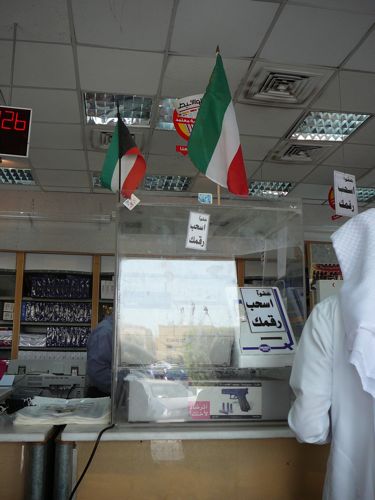
“I’m at the copy shop!” I shouted into the phone over the commotion in the background.
“Who are you with?” AdventureMan shouted back.
“No one! I am by myself!” I holler.
“By yourself? Why?” he asks.
“Why?” he responds, “why are you in the copy shop by yourself?”
“There are a lot of other people here, I meant I am not here with anyone. That’s what all the noise is about. They have a number machine, so I figured out how to get a number, but only me and one other buy took a number, everyone else just comes in and gets waited on, no taking numbers!”
Not only that, but in spite of the fact that there are already people waiting, some people, always men, will walk in and say in a loud voice “Excuse me! Excuse me!” or snap their fingers (I am not joking!) or say “I am ready now!” and expect to be taken right away, and I can see why, they are almost always taken right away. I guess they intimidate the guys behind the counter or something.
I held my number up to catch the eye of one of the copy-shop guys and immediately more noises happen, the numbers that incidate who is being waited on change and my number is up.
“Gotta go!” I say and take care of getting come copies made.
The next morning as we are dressing and catching up on what’s happening in one another’s lives, he says to me “I still don’t understand why you would sit and drink coffee all by yourself.”
I look at him in utter astonishment. From time to time, I do sit by myself in a coffee shop while I am waiting for a friend, or if my internet isn’t working, and I never think twice about it. But I hadn’t been anywhere near a coffee shop recently. What is he talking about?
“You remember yesterday, when I called you,” he continues. And I start laughing.
“Copy shop! Copy shop! Not coffee shop!”
And then we are both laughing.
Anything but Pedestrian
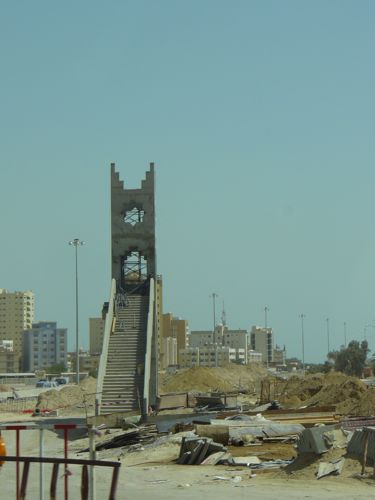
Yesterday on 5th ring, we saw the beginnings of the new pedestrian overpasses, which are anything but pedestrian in their design.
Look at that! Not only do they honor the architectural element of the wind tower tradition in Kuwait, but they will also allow pedestrians to cross safely to the other side. For all the derision we heap on highway planners here, they deserve a big pat on the back for these.
From Wikipedia on Windcatchers: A Wind Tower (Persian: badgir, Arabic: “barjeel” or badghir(from Persian)) is a structure seen on ancient buildings of the Middle East, particularly Iran and Bahrain. This acted like a natural air conditioner creating a soothing effect in the harsh conditions of the desert.
Salt Talk
I am reading through a cook book I found recently, Best of the Best, published in 1998 by Food and Wine, and claiming to be the best receipes from cookbooks published every year. Maybe – I don’t know.
This quote caught my eye:
“The right amount of salt can make or break a dish . . . In general, though, I find home cooks rarely cook with enough salt. Most people would be shocked at the amount of salt used in professional kitchens, where we season every component of a dish carefully, and then combine them.”

AdventureMan and I gave up cooking with salt years ago, adding as we eat, as needed. I always laugh because food tastes SO good when we go out. We always knew it had to do with the fact the food was salted, and had lots of fat in it that we didn’t know about, but this is the first time I have seen it documented so blatantly. It is just one of those boxed comments, so I don’t know who said it.
Reservations
I just had a truly gut-wrenching experience.
I’ve been checking airline prices for my summertime journey back to the USA. I use Mobissimo most often, but I use them all, just to see how prices compare.
The prices have been high. I finally reserved – paying more than what I used to pay for business-class for an economy-class ticket. Seats are disappearing, prices are soaring and I am betting many families will opt just not to travel this summer, or to travel using a Jazeera-type-airline for travel to more local vacation sites.
If you have travel plans, you might want to start looking at your plans now. It’s going to be a rough summer out there.
A.Word.a.Day: Karuna
I love A.Word.A.Day. You will see it down there at the very top of my blogroll. They send me an e-mail every day with a new word, where it came from and how it is pronounced and used. I’m pretty good with words, and AWAD challenges me to keep growing. Love it. You can subscribe by clicking the blue words above or clicking on A.Word.A.Day in the Blogroll. Today’s word:
karuna (KUH-roo-na) noun
Loving compassion.
[From Sanskrit karuna (compassion).]
“Once we experience and feel this inter-dependence of all living beings,
we will cease to hurt, humiliate, exploit and kill another. We will want
to free all sentient beings from suffering. This is karuna, compassion,
which in turn gives rise to the responsibility to create happiness and
its causes for all.”
Suresh Jindal; Interdependence of All Living Beings; The Times of India
(New Delhi); Nov 13, 2003.
Education and No Child Left Behind
One of the most cynical education programs ever put into place, in my opinion, is the No Child Left Behind program. It’s impact, while claiming lofty goals, in actuality forced schools to exclude students who would fail, so as not to have them on their statistical base.
Quote from article: If low-achieving students leave school early, a school’s performance can rise.
In this story from the New York Times you can read how US schools fudge statistics to have a respectable high school graduation rate for federal funding purposes, while the truth is far less positive.
JACKSON, Miss. — When it comes to high school graduation rates, Mississippi keeps two sets of books.
One team of statisticians working at the state education headquarters here recently calculated the official graduation rate at a respectable 87 percent, which Mississippi reported to Washington. But in another office piled with computer printouts, a second team of number crunchers came up with a different rate: a more sobering 63 percent.
The state schools superintendent, Hank Bounds, says the lower rate is more accurate and uses it in a campaign to combat a dropout crisis.
“We were losing about 13,000 dropouts a year, but publishing reports that said we had graduation rate percentages in the mid-80s,” Mr. Bounds said. “Mathematically, that just doesn’t work out.”
Like Mississippi, many states use an inflated graduation rate for federal reporting requirements under the No Child Left Behind law and a different one at home. As a result, researchers say, federal figures obscure a dropout epidemic so severe that only about 70 percent of the one million American students who start ninth grade each year graduate four years later.
California, for example, sends to Washington an official graduation rate of 83 percent but reports an estimated 67 percent on a state Web site. Delaware reported 84 percent to the federal government but publicized four lower rates at home.
The multiple rates have many causes. Some states have long obscured their real numbers to avoid embarrassment. Others have only recently developed data-tracking systems that allow them to follow dropouts accurately.
The No Child law is also at fault. The law set ambitious goals, enforced through sanctions, to make every student proficient in math and reading. But it established no national school completion goals.
“I liken N.C.L.B. to a mile race,” said Bob Wise, a former West Virginia governor who is president of the Alliance for Excellent Education, a group that seeks to improve schools. “Under N.C.L.B., students are tested rigorously every tenth of a mile. But nobody keeps track as to whether they cross the finish line.”
Furthermore, although the law requires schools to make only minimal annual improvements in their rates, reporting lower rates to Washington could nevertheless cause more high schools to be labeled failing — a disincentive for accurate reporting. With Congressional efforts to rewrite the law stalled, Secretary of Education Margaret Spellings has begun using her executive powers to correct the weaknesses in it. Ms. Spellings’s efforts started Tuesday with a measure aimed at focusing resources on the nation’s worst schools. Graduation rates are also on her agenda.
You can read the rest of the story HERE.
Our young people are the leaders and decision makers of tomorrow. My generation thought we were going to change the world, and here the world continues on it’s merry way to pollution, desolation and degradation. I hope the young people of today can do what we have failed to do – create a better world.
Recent Comments
intlxpatr on Yellowstone: Old Faithful to C… Michelle on Yellowstone: Old Faithful to C… Cathy on No Grown-Ups in Charge intlxpatr on Waiting for Snow intlxpatr on Waiting for Snow Wikipedia Donate Button

Amazina


Early Voting in Florida


 Here There and Everywhere