Sabille Shop
I love sabilles. Sabilles are localized charity, “in a dry and thirsty land” they are provided by generous souls that the thirsty might have cool, fresh water to refresh thenselves in the heat of the day. You will see them at mosques, along city streets, in every neighboorhood. They come in fanciful shapes; if you type “sabille” into the HT&E search window, you will see more. I love the Kuwait Liberation Tower ones, and also the water-tower wannabes, but I also like the ones that look like old castles or old doors or jugs. I love it that people go to the trouble to make something utilitarian interesting, even artistic.
Recently, I found a shop in the Wafa Mall that sells sabilles:

The shop is called Fine Things, and also has some fancy presentation boxes and this, which looks like a mail box to me, but might be for collecting charitable donations, or . . . ? I might be totally wrong. Your guess is as good as mine:

I like this tiny little mall because it has commercial kitchen supply shops with all kinds of display cases and things you don’t find very often. There is also a mattress shop; I always laugh when there is a family shopping there for mattresses because the parents don’t say “NO!” to their kids, so the kids are JUMPING ON THE MATTRESSES! The salesmen seem unable to ask the parents to make them stop.
Just-Before-Sunrise 3 March 2008
Sunrise this morning was just another sunrise, no clouds, nothing to distinguish itself. But – just before sunrise – a whole other story:

It is 72°F / 22°C and very hazy, the kind of haze that also sends people to the hospital with aggravated asthma.
Dharfur: The Janjaweed are Back
Lynsey Addario for The New York Times:
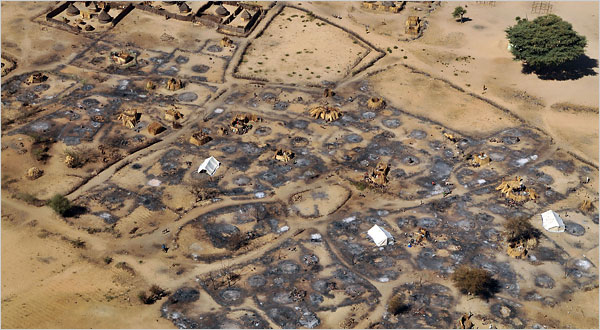
SULEIA, Sudan — The janjaweed are back.
They came to this dusty town in the Darfur region of Sudan on horses and camels on market day. Almost everybody was in the bustling square. At the first clatter of automatic gunfire, everyone ran.
The militiamen laid waste to the town — burning huts, pillaging shops, carrying off any loot they could find and shooting anyone who stood in their way, residents said. Asha Abdullah Abakar, wizened and twice widowed, described how she hid in a hut, praying it would not be set on fire.
“I have never been so afraid,” she said.
The attacks by the janjaweed, the fearsome Arab militias that came three weeks ago, accompanied by government bombers and followed by the Sudanese Army, were a return to the tactics that terrorized Darfur in the early, bloodiest stages of the conflict.
Such brutal, three-pronged attacks of this scale — involving close coordination of air power, army troops and Arab militias in areas where rebel troops have been — have rarely been seen in the past few years, when the violence became more episodic and fractured. But they resemble the kinds of campaigns that first captured the world’s attention and prompted the Bush administration to call the violence in Darfur genocide.
Aid workers, diplomats and analysts say the return of such attacks is an ominous sign that the fighting in Darfur, which has grown more complex and confusing as it has stretched on for five years, is entering a new and deadly phase — one in which the government is planning a scorched-earth campaign against the rebel groups fighting here as efforts to find a negotiated peace founder.
The government has carried out a series of coordinated attacks in recent weeks, using air power, ground forces and, according to witnesses and peacekeepers stationed in the area, the janjaweed, as their allied militias are known here. The offensives are aimed at retaking ground gained by a rebel group, the Justice and Equality Movement, which has been gathering strength and has close ties to the government of neighboring Chad.
Government officials say that their strikes have been carefully devised to hit the rebels, not civilians, and that Arab militias were not involved. They said they had been motivated to evict the rebels in part because the rebels were hijacking aid vehicles and preventing peacekeepers from patrolling the area, events that some aid workers and peacekeepers confirmed.
Please read the rest of the article HERE.
My husband and I have long supported an organization called Medecins Sans Frontiers / Doctors Without Borders. Wherever there is human misery, these brave doctors go and serve those suffering, and their life-saving work is performed under the worst possible conditions. They don’t look at politics. They look at human suffering, and do their best to alleviate it, or to do what they can. These heroic doctors are serving in Dharfur – while they can. When Medicins Sans Frontiers have to pull out, you know that the situation is as bad as it can be.
The accept donations from anyone, anywhere. Be generous.
How Good People Turn Evil
This is a subject that fascinates me – how even “good” people can do very very bad things . . . The article and interview is from Wired.com science/discoveries and you can read the entire article and view a videotape by clicking on the blue type.
TED 2008: How Good People Turn Evil, From Stanford to Abu Ghraib
By Kim Zetter 02.28.08 | 12:00 AM
MONTEREY, California — Psychologist Philip Zimbardo has seen good people turn evil, and he thinks he knows why. Zimbardo will speak Thursday afternoon at the TED conference, where he plans to illustrate his points by showing a three-minute video, obtained by Wired.com, that features many previously unseen photographs from the Abu Ghraib prison in Iraq (disturbing content).
In March 2006, Salon.com published 279 photos and 19 videos from Abu Ghraib, one of the most extensive documentations to date of abuse in the notorious prison. Zimbardo claims, however, that many images in his video — which he obtained while serving as an expert witness for an Abu Ghraib defendant — have never before been published.
The Abu Ghraib prison made international headlines in 2004 when photographs of military personnel abusing Iraqi prisoners were published around the world. Seven soldiers were convicted in courts martial and two, including Specialist Lynndie England, were sentenced to prison.
Zimbardo conducted a now-famous experiment at Stanford University in 1971, involving students who posed as prisoners and guards. Five days into the experiment, Zimbardo halted the study when the student guards began abusing the prisoners, forcing them to strip naked and simulate sex acts.
His book, The Lucifer Effect: Understanding How Good People Turn Evil, explores how a “perfect storm” of conditions can make ordinary people commit horrendous acts.
He spoke with Wired.com about what Abu Ghraib and his prison study can teach us about evil and why heroes are, by nature, social deviants.
Wired: Your work suggests that we all have the capacity for evil, and that it’s simply environmental influences that tip the balance from good to bad. Doesn’t that absolve people from taking responsibility for their choices?
Philip Zimbardo: No. People are always personally accountable for their behavior. If they kill, they are accountable. However, what I’m saying is that if the killing can be shown to be a product of the influence of a powerful situation within a powerful system, then it’s as if they are experiencing diminished capacity and have lost their free will or their full reasoning capacity.
Situations can be sufficiently powerful to undercut empathy, altruism, morality and to get ordinary people, even good people, to be seduced into doing really bad things — but only in that situation.
Understanding the reason for someone’s behavior is not the same as excusing it. Understanding why somebody did something — where that why has to do with situational influences — leads to a totally different way of dealing with evil. It leads to developing prevention strategies to change those evil-generating situations, rather than the current strategy, which is to change the person.
You can read the rest of the article and view the video HERE.
Kuwait Towers 29

In today’s Kuwait Times is a notice that today, the Towers turn 29 years old, and in honor of that milestone Mushari Al-Sanousi announces that to commemorate its success and celebrate the occasion, a 30% discount will be offered at the Towers Restaurant to all diners today, March 30th.
Donna Leon: Suffer the Little Children
After reading Zanzibar Chest I decided it was time to give myself a break, and I allowed myself another Donna Leon book, this one Suffer the Little Children. I am currently reading another detective series, recommended by my sister, set in China. What they all seem to have in common is a very tired, sad, jaded view of corruption in society, and particularly among the poorly paid police. Sigh.

In this book, a Doctor and his wife are invaded in the middle of the night by the carabinieri, a kind of police in Venice. I am not sure how the two agencies differ, maybe it is like the difference between state police and local police in the US, but when the paper was faxed over coordinating with Brunetti’s office, it got lost somewhere, and the action was never coordinated, and Brunetti gets a call in the middle of the night.
The doctor and his wife have adopted a child illegally. They bought an unwanted child from an Albanian woman, paid for her pregnancy expenses, paid a huge fee to her, and then had the child taken from them. Here is the saddest part of the story – the child’s mother doesn’t want the child, the illegally adopting parents want him back desperately, but the child is sent to a state orphanage, because of the illegal adoption.
It is a very sad book.
Here is why I read Donna Leon – some of her paragraphs are just brilliant. Memorable. Unforgettable.
“Brunetti’s profession had made him a master of pauses: he could distinguish them in the way a concert-master could distinguish the tones of the various strings. There was the absolute, almost belligerent pause, after which nothing would come unless in response to questions or threats. There was the attentive pause, after which the speaker measured the effect on the listener of what had just been said. And there was the exhausted pause, after which the speaker needed to be left undistrubed until emotional control returned.
Judging that he was listening to the third, Brunetti remained silent, certain that she would eventually continue. A sound came down the corridor: a moan or the cry of a sleeping person. When it stoped, the silence seemed to expand to fill the place.”
When you read Donna Leon, you forget you live anywhere else. For one brief moment, you become Venetian, you live in Guido Brunetti’s shoes. The speak the Venetian dialect, you think like a Venetian. What an escape!
The paperback edition will be out in April for $7.99 at Amazon.com for $7.99 plus shipping.
Taking the Cat for a Drag
When we were first married, we got our first cat. Being book people, we read a book about training cats that told us how easy it was to train a cat to go for a walk on a leash.
We tried it. We tried it several times. We tried it with several different cats. We never found a cat who could be trained to go for a walk on a leash. The Qatteri Cat scratched me bloody when I just tried to put on the harness. I never even got the leash attached. I still have the harness. I still have the leash – never been used.
We called it “Taking the Cat for a Drag.” It looks a lot like this:

Enter the ICHC online Poker Cats Contest!
First Sunrise in March
Sunrise is starting to look a lot like summer – not so many clouds to make it more dramatic. We still have some clarity, the sky is still more blue and less hazy, but every sign is there that the cold winter is over and summer is well on its way. It is 48°F / 9°C, and there isn’t a cloud in the sky, only that wicked, poisonous haze hanging over the horizon.

Recent Comments
ExpatAlien on What Country am I Living … intlxpatr on Yellowstone: Old Faithful to C… Michelle on Yellowstone: Old Faithful to C… Cathy on No Grown-Ups in Charge intlxpatr on Waiting for Snow Wikipedia Donate Button

Amazina


Early Voting in Florida


 Here There and Everywhere