Holiday Sunrise
Good morning, Kuwait, and a beautiful day it is going to be:

No, that isn’t an attack helicopter in the photo, it is a bird, and I didn’t even see him until I uploaded the photo. The sun is coming up around 0615 in the morning, and mornings are still cool and comfortable.

It’s a quiet morning, as people sleep in; today is a holiday – the Prophet Mohammed’s birthday.
Honored Guest
In every country where I have lived, we have felt like honored guests. This week, I have been truly honored, my blogging friend Hilaliya has asked me to be an occasional guest blogger on his revamped blog, now featuring a Kuwait Blogging Diwaniya. Pretty cool, huh? I have to admit it, I have a smile from ear to ear.
The revered blogger Don Veto led the way with an article yesterday, and I jumped in today.
In honor of my ear-to-ear smile, it’s called Smile for me Baby – Let Me See Your Grill but fair warning – it’s political polemic, about parliamentary gridlock, so you will see a grittier side of Intlxpatr.
Housing Prices Fall 30 – 40% in Kuwait
From today’s Arab Times
Price of residential homes falls as ‘meltdown’ digs in
KUWAIT CITY, March 10, (KUNA): Prices of residential homes in Kuwait have fallen between 30 and 40 percent since February, the Manazel Holding Company chairman said here Tuesday. The drop differs from one area to another, dipping by 60 percent at some areas and 15-20 percent at others, Adnan al-Nesf told Kuwait News Agency (KUNA). The prices have been on the wane since Laws 8 and 9 for 2008 were put in place. Both laws bar companies from selling or buying houses, he said.
The global financial crisis is to blame for the decline in house rates, al-Nesf added. The laws were adopted after the prices had reached record levels, but the situation could have been solved in a way that would not lead to a ban on home activities by mortgage companies, he said. Several rules and controls could be imposed on dealing in homes that directly concern citizens; including allowing landlords to sell their houses only after five years of buying, he suggested.
However, he voiced optimism that the crisis would be resolved soon, especially following a recent court ruling allowing the Kuwait Finance House (KFH) to deal in houses. An improvement in the real estate sector would surely push the economic wheel forward, he argued, pointing out that the property market was waiting for an in-the-offing rescue plan to be put in place soon. Just like other companies, real estate dealers have been negatively affected by the current world financial meltdown, he affirmed. But, he recognized that most property dealers were trying to retrench their expenses, lay off workers or cut workers’ salaries.
Wild Blue Yonder
Today was the Kuwait show of military might. No sandstorm, thanks be to God. Somehow, I had thought yesterday was Wednesday and thought how sad it was it would have had to be cancelled. When I woke up today and realized it was Wednesday, I could hardly wait.
Just the sound of the roaring jets gives me a grin. I once lived near a huge airbase, and we lived with the sound day and night. It never bothered me. I always knew these were men and women who sacrificed their lives to serve their country in a profession that looks a lot more glamorous than it is. Flying can be exciting, but it can also be very tedious. You are away from your family for long hours. It gets old. They persevere.
The young men and women chosen to fly these fighter planes have to have superior physical condition and reflexes. Think about you and the car your daddy gave you – it may be expensive, but it didn’t cost billions. These planes do. It’s an amazing responsibility, a privilege and an honor to be selected.
Bu Yousef, tell your friend he was supposed to waggle his wings when he flew by so I would know which one he was! 😉
Macaholic, it was a little hazy, but the attack helicopters are for you. 🙂




‘Kuwait could deport 11,000 expats’
From today’s Arab Times
‘Kuwait could deport 11,000 expats’
KUWAIT CITY, March 10: Kuwait will deport 11,000 expatriate workers after the issuance of a decision to close files of sponsors involved in human trafficking and establishment of illusory companies, reports Al-Qabas daily quoting a reliable source from the Ministry of Social Affairs and Labor. According to the source, the ministry has prepared a comprehensive report about the human trafficking cases in Kuwait, ahead of the US State Department Trafficking in Persons (TIP) Report, which will be released by the middle of this year.
The report states that Kuwait is bent on clearing its name over human trafficking accusations. It highlighted negative comments about Kuwait, which include the absence of a law to incriminate those involved in human trafficking and incompetence of personnel in charge of human trafficking victims. This has prompted the ministry to coordinate with its justice counterpart and other relevant government authorities to lay down a draft bill to curb human trafficking and people smuggling. The draft bill has been finalized and referred to the Cabinet, which will pave the way for its submission to the National Assembly for voting. Both ministries are also exerting efforts to establish a higher authority to support the expatriate workers.
Despite claims that Kuwait has taken positive steps to remove its name from the TIP watch list, Kuwait received a letter from the charge d’ affaires of the American Embassy in Kuwait mid-last year, warning that the country might retain its ranking in the watch list if it fails to take the necessary measures to curb human trafficking, and provide training to the Ministry of Social Affairs and Labor employees on how to deal with the victims of human trafficking.
The reports also mentioned the establishment of a shelter in Kheitan for expatriates who run away from their sponsors, indicating several international and Arab delegations visited and praised the center, but they all demanded for more procedures. In response to such demands, the Ministry of Social Affairs and Labor asked its education counterpart to provide more schools as temporary shelters for the expatriate workers, as well as its finance counterpart to allocate the required budget for the construction of shelters in various governorates.
Meanwhile, the report has also underscored the fact that the employees assigned at the shelter have undergone various training courses at Johns Hopkins University in the US, in addition to a workshop conducted under the supervision of the International Organization for Migration (IOM), which was held in Bahrain several months ago. The report has also confirmed that the human trafficking victims have been provided with the necessary services, such as psychological and medical services, through an integrated team, consisting of representatives from the concerned ministries.
The Most Dangerous Job in Kuwait
From today’s Al Watan:
KUWAIT: The operations room received a call informing them that an Asian domestic maid tried to commit suicide by stabbing herself while at her sponsor”s house in the Salmiya area. Police officers and medical teams rushed to the scene where paramedics administered emergency medical aid and rushed her to Mubarak Hospital, where she was admitted to the intensive care unit. However, on interrogating her, she alleged that she did not attempt suicide but that she had been stabbed. Investigations are underway to ascertain the authenticity of the statement.
OK. Stop and think about it. How do you stab yourself? I can imagine, if I were wanting to commit suicide, a hundred ways easier than trying to stab oneself. Don’t you think the police would have been suspicious from the very beginning?
Every time I read about another domestic committing suicide, I wonder. I have heard many many things.
I wonder how many women commit suicide by “jumping” off the balcony? Those who survive often say they were thrown, or pushed, by “the madam.”
One girl told me that every maid brought into the household where she works immediately has to have her hair cut very short (and unflattering) and to wear voluminous and ugly uniforms, because “the madam” is afraid her husband and sons will be attracted to the maids.
I wonder how many slaps, how much screaming, how many humiliations, how many approaches or attacks from male members of the household one endures before absconding?
Think about it. You’re from a really really poor country, and you leave behind family, even your own children, for the hope of earning enough money so that the children can go to school, and have a better life, so that maybe you can build your own little bungalow one day, not fancy, just a roof over your head. People who come here to earn a living have a lot of incentive to make it work. They will endure a great deal before seeking a way out.
I have so many friends who treat their household help like members of the family, teaching them new skills, helping them earn extra money, giving them food and clothing. I believe they are in the majority, the kind employers.
But so many stories of domestics being abused! Even if it is a mere, say 5%, what options does the domestic have? The brave ones, the self-confident ones, might go to the police, only to have her employers state that she stole something, and she finds herself under arrest, or quickly deported. Many cannot even leave the house, and have no telephone with which to call a friend in an emergency situation.
Will the new labor law have anything to say about protecting these very vulnerable family helpers from a dangerous or abusive employer? What effect does it have on children to see their parents treating employees like mere possessions? How does it impact our souls and our entrance into paradise when we don’t (as the Quran instructs) pay our employees their promised salary at the agreed upon time?
What will happen to this poor woman, stabbed, in a strange hospital, whose employers claim she stabbed herself?
“Praying on land not owned by the mosque is legally invalid”
From today’s Al Watan:
Furor over mosque demolition a ”political ploy”
Staff Writer
KUWAIT: The newest attempt to demolish a mosque located on stateـowned property gave raise to several concerns from the populace.
Prominent Shiite cleric in Kuwait Mohammed Baqir AlـMahri stated that praying on land not owned by the mosque is legally invalid.
He also condemned demands for the prosecution of the Chairman of the State Property Violation Committee, Mohammed AlـBader, who, he said, “must be honored for honoring the law and meeting the request of the Ministry of Awqaf for the removal of all mosques in violation.”
He went on to state that all the turmoil surrounding the removal of the mosque was “a ploy to gain votes,” in case of the dissolution of the council.
Member of the Municipal Council and the Chairman of the Development and Reform Commission Khalifa AlـKhorafi agreed with AlـMahri”s views and stated that Kuwait is suffering from a major crisis that reeks of a general lack of confidence and faith in most matters that concern the state.
He warned against hasty decisions and explained that the mosque was not a heritage monument and that it was mainly used as a storage space.
He pointed out that before the demolition of the mosque the council had ensured the availability of another mosque in the same area and that the permission of many preachers and scholars was taken long before the attempt to demolish the holy structure. He went on to state that all had agreed that it was illegal to pray in the mosque, a fact agreed to by Dr. Ajil AlـNashmi.
Meanwhile, lawyer Nawaf Sari praised the act of MPs against the demolition of the mosque and referred to it as a “glorious stand.” He said that there was no justification for the elimination of the mosque and that people should protect Islamic and religious beliefs whenever possible. He also demanded the persecution of Mohammed AlـBader and blamed him for the deterioration of the political system in the country.
I don’t understand. How can this be an issue? An old, run-down mosque was erected – illegally – on public property. Before the mosque was demolished, authorities informed and had consensus from the local clerics, and the mosque was only used for storage? What is furor about? Why is tearing down an old mosque an attack on Islamic beliefs? I see mosques torn down around Kuwait all the time – usually just before a newer, bigger mosque takes its place. In this case, they insured sufficient mosques were available before they demolished this one.
Seattle-like Sunrise
Good morning, Kuwait!
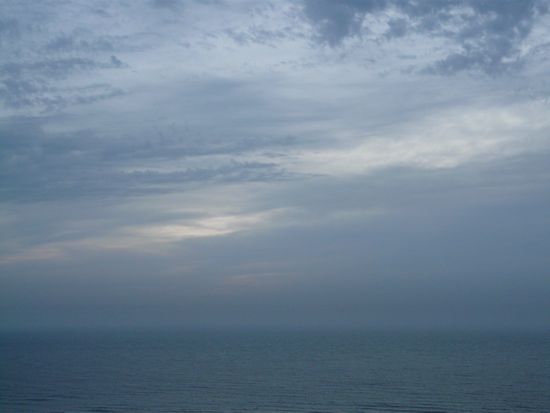
(How many different blues can you count in this photo? This is a RICH photo in the blue-grey spectrum, one of my favorites.)
When I saw the skies this morning, all cloudy and gloomy, I thought for a minute I was back in Seattle. If I were in Seattle, the temperatures would be much much lower – it is already getting hot in Kuwait, and this Friday we will hit a huge high:
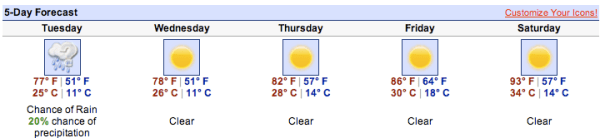
But something is goofy with Zanzibar, on my WeatherUnderground favorites:

How can that be right? Highs almost in the 90’s, lows almost freezing?
It just might rain a little out there, my Kuwait friends. Be careful on the roads and remember:
Don’t Call Until You Reach Your Destination!
In Xanadu: A Quest by William Dalrymple
This book was on my (huge) “Read Me” stack, and I picked it up for a change of pace. As I started reading, I wondered “how did this get there?” My first instinct was it was a recommendation from Little Diamond. As I was reading, however, I came across a segment that was what our priest had read in church around the Feast of the Epiphany about the birthplace of the wise men who came seeking the Christ Child after his birth. I wrote down the title and ordered it from amazon.com (which has some copies used from 72 cents).

William Dalrymple wrote this book when he was a mere 22 years old. He and a travelling companion took off to trace Marco Polo’s journey from Jerusalem to Xanadu, where he was taking oil from the sanctuary lamp to Kubla Khan.
In a world where we have all been taught to be so careful, they take incredible risks. They travel on the cheap – staying in fleabag hotels, sometimes sleeping “rough”, i.e. out in the open. They travel any way they can – an occasional train, but more often a truck, a bus, whatever is going their way. One very long segment they travelled on top of a pile of coal.
They travel from Jerusalem up through Syria and into Turkey, then turn east and cross Iran, Pakistan and Afghanistan to China. They have some amazing adventures, see some astounding scenery and because of their mode of travel, have a lot of time to talk with their travelling companions or people in the cities where they are staying.
I am blown away that an unmarried couple would cross Iran, Pakistan and Afghanistan. I guess they told people they were married to share a room (they were on a budget) and they were only friends, not a couple, but what a risk. I am astonished that they were never asked to produce a marriage license or any proof of marriage when they stayed in hotels. I am astonished at the girls (one left in Lahore and another joined him, but these are girls who are friends, not anything more) would travel on the backs of trucks full of men, and never blink an eye.
The book is occasionally hilarious. Most of the hilarity results from foods they have to eat – sometimes it is the only food available – or from misunderstandings because of lack of a common language, or due to their frequent bouts of diarrhea, what I really liked about the author was that he was rarely pompous, and when he is funny, it is usually about some conversation he has had, or some mistake he has made.
One of my favorite parts of the book happens in Iran:
As we sat waiting for the bus to Tabriz, the next town on Marco Polo’s itinerary, we watched the mullahs speeding past in their sporty Renault 5s. Iran was proving far more complex than we had expected. A religious revolution in the twentieth century was a unique occurence, resulting in the first theocracy since the fall of the Dalai Lama in Tibet. Yet this revolution took place not in a poor banana republic, but in the richest and most sophisticated country in Asia. A group of clerics was trying to graft a mediaeval system of government and a pre-medieval way of thinking upon a country with a prosperous modern economy and a large and highly educated middle class. The posters in the bus station seemed to embody these contradictions. A frieze over the back wall of the shelter spoke out, in the name of Allah, against littering. On another wall two monumental pictures of the Ayatollah were capped with the inscriptions in both Persian and English:
BEING HYGENIC IS DIRECTLY RELATED ON THE MAN’S PERSONALITY
and:
ALLAH COMMANDS THE RE-USE OF RENEWABLE RESOURCES.
We had expected anything of the Ayatollah. But hardly that he would turn out to be an enthusiastic ecologist.
The challenge of this journey is to follow as closely as possible the path Marco Polo took, but two segments of the journey go through off-limits areas. They find a way into one, to discover later it is an atomic testing area, and the second, at the very end, around Xanadu, they find receptive Chinese officers who take them to have a brief glimpse of the ruins of Xanadu while booting them out of the area. As they stand in Xanadu, they repeat a poem that every American child grows up with in English Literature:
In Zanadu did Kubla Khan
A stately pleasure-dome decree:
Where Alph, the sacred river, ran
Through caverns measureless to man
Down to a sunless sea.
So twice five miles of gertile ground
With walls and twoers were girdled round:
And there were gardens bright with sinuous rills.
Where blossom’d many an incense-bearing tree:
And here were forests ancient as the hills,
Enfolding sunny spots of greenery.
(Coleridge)
I liked this book. Dalrymple is a history major, and often quotes from historical – even obscure – texts to illuminate what he observes. I think I may look at a couple more he has written since.
Red Sky at Morning . . .
The Qatteri Cat had me up early this morning, and as I made the coffee, I glanced out the window – WOW. Beautiful sky, very red sky, and I wonder if here “red sky at morning, sailors take warning” holds true? It looks like a beautiful day – again – and the water is smooth as glass.

The Qatteri Cat has gone back to sleep.
Recent Comments
ExpatAlien on What Country am I Living … intlxpatr on Yellowstone: Old Faithful to C… Michelle on Yellowstone: Old Faithful to C… Cathy on No Grown-Ups in Charge intlxpatr on Waiting for Snow Wikipedia Donate Button

Amazina


Early Voting in Florida


 Here There and Everywhere