Somali Pirate Code of Conduct
Ever since I was a kid, I found pirates interesting and exotic and adventurous. The truth is probably that those olden day pirates had bad teeth, scurvey – they had lived hard and fast and they probably aged quickly.
Of course, today we have Johnie Depp and the Pirates of the Caribbean series, which makes pirating look mostly like a lot of fun.
So a year or so ago, I wrote a post on the Somali pirates, and got an interesting response. It got me started looking more deeply into what is going on with the pirates there.
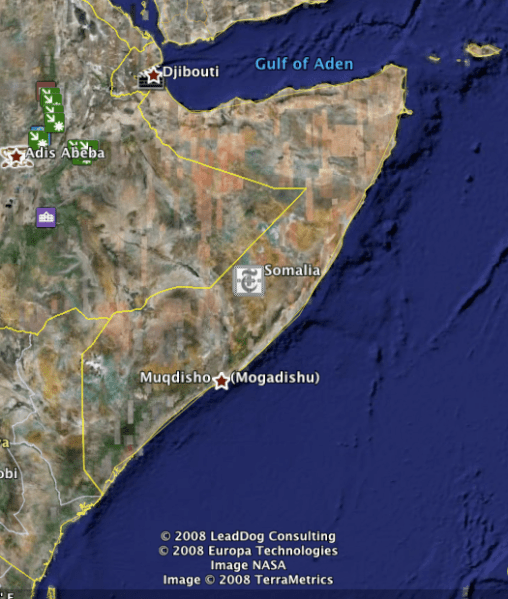
Yesterday, in the paper was an article about the Somali pirate code of conduct – with fines and punishments for infractions. I found a complete article in Newsweek, April 27.
What is bothering me now is that the one pirate captured by the US when it retook the captured US freighter (in the report filed by one BBC reporter) said he was just a frail teenager, a kid, and that the pirates had already agreed to surrender when they were blown out of the water. You could hear her attempting to control her rage.
I know it is a thorn in the side for all shippers and freighters and passenger ships who travel through waters anywhere near to Somalia. And yet . . . I kind of ask myself what the options are? Somalia is a for sure failed-nation. They haven’t been able to cobble together a government for over twenty years. Deadly, long lasting poisons have been dumped along their shoreline – and major industrial nations paid Somalis a pittance to dump their wastes there. Their coastline has been overfished. Families are starving, live is – or was – dismal.
I think it is pretty cool that they developed an enforceable – and enforced – code of conduct.
Here is the article from Newsweek:
It was a hit with the U.S. public, but president Obama’s decision to authorize the Pentagon to kill three Somali pirates who took an American sea captain hostage sent shudders through the world’s shipping and insurance industries. Because the pirates are motivated chiefly by money, maritime experts say, they have—at least until now—taken good care of the crews they hold captive. A document retrieved from a ship hijacked last year contained a “list of written rules” of conduct pirates had to follow, according to a maritime security expert who requested anonymity when discussing sensitive material. The document included a series of “punishments” to be imposed on any hijacker who struck a hostage.
Shipping companies and insurers are far more likely to fork over large ransoms if they have confidence that their personnel and cargo will be released unharmed, and while the scourge of piracy has been disruptive, so far there have been virtually no casualties among innocent people. According to estimates, there were 111 pirate attacks off the Somali coast in 2008; 42 were successful, resulting in the capture of 815 seamen. As of last week, according to one estimate, all but 37 had been released, and two had died—one reportedly of illness. Experts say the rate of attacks has increased sharply this year, and “the more [authorities] shoot, the more the pirates will shoot back,” says Tom Wilson, a Somalia analyst for the British consulting firm Control Risks.
Protecting the 23,000 merchant vessels sailing annually near the Horn of Africa would require a naval fleet of at least 60 ships, according to U.S. government and private experts; the existing international antipiracy task force has about 20. And attacking the Somali coastal villages where the pirates are based could potentially radicalize generations of Somalis. “That would be a 19th-century solution,” says Neil Roberts, a marine insurance expert with Lloyd’s Market Association in London. Industry experts say the only solution to piracy is the creation of a viable Somali government back on dry land.
According to industry officials, ransom demands have ranged as high as $25 million—but in most cases they are negotiated down to about $2 million to $3 million, and insurers then pay out claims to the shipping companies. As hijackings have increased in frequency, pirates have become fussier about how their money gets delivered. Initially, said a shipping-industry source who also asked for anonymity, ransoms were often handed off to shady Somali expats in places like Kenya. After Kenyan authorities cracked down, the pirates began insisting on airdrops via parachute into the ocean near Somali coastal villages, where they have cash-counting machines ready. Until the U.S. opened fire, one of the pirates’ biggest headaches had been dealing with the sheer volume of money they’ve collected. Last year, according to an insurance-industry official, one pirate’s boat capsized because he had overloaded it with cash.
I found this on National Post dated April 30, 2009; it is a copy of what I had read in the newspaper:
MOGADISHU — A mobile tribunal, a system of fines and a code of conduct: the success of Somali pirates’ seajacking business relies on a structure that makes them one of the country’s best-organised armed forces.
A far cry from the image conveyed in films and novels of pirates as unruly swashbucklers, Somalia’s modern-day buccaneers form a paramilitary brotherhood in which a strict and complex system of rules and punishments is enforced.
They are organized in a multitude of small cells dotting the Indian Ocean and Gulf of Aden coastline. The two main land bases are the towns of Eyl, in the breakaway state of Puntland, and Harardhere, further south in Somalia.
“There are hundreds of small cells, linked to each other,” Hasan Shukri, a pirate based in Haradhere, told AFP in a phone interview.
“We talk every morning, exchange information on what is happening at sea and if there has been a hijacking, we make onshore preparations to send out reinforcement and escort the captured ship closer to the coast,” he explained.
Somali piracy started off two decades ago with a more noble goal of deterring illegal fishing, protecting the people’s resources and the nation’s sovereignty at a time when the state was collapsing.
While today’s pirates have morphed into a sophisticated criminal ring with international ramifications, they have been careful to retain as much popular prestige as possible and refrain from the violent methods of the warlords who made Somalia a by-word for lawlessness in the 1990s.
“I have never seen gangs that have rules like these. They avoid many of the things that are all too common with other militias,” said Mohamed Sheikh Issa, an elder in the Eyl region.
“They don’t rape, and they don’t rob the hostages and they don’t kill them. They just wait for the ransom and always try to do it peacefully,” he said.
Somalia’s complex system of clan justice is often rendered obsolete by the armed chaos that has prevailed in the country for two decades, but the pirates have adapted it effectively.
Abdi Garad, an Eyl-based commander who was involved in recent attacks on U.S. ships, explained that the pirates have a mountain hide-out where leaders can confer and where internal differences can be solved.
“We have an impregnable stronghold and when there is a disagreement among us, all the pirate bosses gather there,” he told AFP.
The secretive pirate retreat is a place called Bedey, a few miles from Eyl.
“We have a kind of mobile court that is based in Bedey. Any pirate who commits a crime is charged and punished quickly because we have no jails to detain them,” Mr. Garad said.
Some groups representing different clans farther south in the villages of Hobyo and Haradhere would disagree with Mr. Garad’s claim that Somalia’s pirates all answer to a single authority.
But while differences remain among various groups, the pirates’ first set of rules is precisely aimed at neutralizing rivalries, Mohamed Hidig Dhegey, a pirate from Puntland, explained.
“If any one of us shoots and kills another, he will automatically be executed and his body thrown to the sharks,” he said from the town of Garowe.
“If a pirate injures another, he is immediately discharged and the network is instructed to isolate him. If one aims a gun at another, he loses 5% of his share of the ransom,” Mr. Dhegey said.
Perhaps the most striking disciplinary feature of Somali “piratehood” is the alleged code of conduct pertaining to the treatment of captured crews.
“Anybody who is caught engaging in robbery on the ship will be punished and banished for weeks. Anyone shooting a hostage will immediately be shot,” said Ahmed Ilkacase.
“I was once caught taking a wallet from a hostage. I had to give it back and then 25,000 dollars were removed from my share of the ransom,” he said.
Following the release of the French yacht Le Ponant in April 2008, investigators found a copy of a “good conduct guide” on the deck which forbade sexual assault on women hostages.
As Ilkacase found out for himself, pirates breaking internal rules are punished. Conversely, those displaying the most bravery are rewarded with a bigger share of the ransom, called “saami sare” in Somali.
“The first pirate to board a hijacked ship is entitled to a luxurious car, or a house or a wife. He can also decide to take his bonus share in cash,” he explained.
Foreign military commanders leading the growing fleet of anti-piracy naval missions plying the region in a bid to protect one of the world’s busiest trade routes acknowledge that pirates are very organised.
“They are very well organized, have good communication systems and rules of engagement,” said Vice Admiral Gerard Valin, commander of the French joint forces in the Indian Ocean.
So far, nothing suggests that pirates are motivated by anything other than money and it is unclear whether the only hostage to have died during a hijacking was killed by pirates or the French commandos who freed his ship.
Some acts of mistreatment have been reported during the more than 60 hijackings recorded since the start of 2008, but pirates have generally spared their hostages to focus on speedy ransom negotiations.
With the Robin Hood element of piracy already largely obsolete, observers say the “gentleman kidnapper” spirit could also fast taper off as pirates start to prioritize riskier, high-value targets and face increasingly robust action from navies with enhanced legal elbow room.
They have warned that the much-bandied heroics of a U.S. crew who wrested back control of their ship and had their captain rescued by navy snipers who picked off three pirates could go down as the day pirates decided to leave their manners at home.
I used to read science fiction novels about a diplomat named Retief, I think they were by Keith Laumer. He would find himself in an alien environment with a horrible unsolvable problem and he would find a great solution, where everyone walked away OK. I wish there were a Retief who could negotiate a win/win out of this situation.
11 Comments »
Leave a reply to Mathai Cancel reply
Recent Comments
ExpatAlien on What Country am I Living … intlxpatr on Yellowstone: Old Faithful to C… Michelle on Yellowstone: Old Faithful to C… Cathy on No Grown-Ups in Charge intlxpatr on Waiting for Snow Wikipedia Donate Button

Amazina


Early Voting in Florida


 Here There and Everywhere
I am by most peoples standards ultra-liberal and compassionate to a fault. It is incredibly sad the captive was a frail kid – but he committed a violent adult criminal act and should be held accountable as such. Would we be so unsure if the same youth had commited an act of rape?
It is also incredibly sad that three people lost their lives out of economic desperation. But desperation drives bad decisions and the Navy’s was only authorized to use deadly force if they felt the captive’s life was in imminent danger. While the pirates may have agreed to surrender they had made no action to actually do so – e.g., toss their weapons over board, hands over head, untie the captive, etc. When they put a pistol to his head they left the Navy commander no choice – especially in today’s mass media second guessing – can you imagine the media crucifiction he would have endured had the captive been shot at point-blank range?
I’m also extremely sensitive to the plight of the Somali nation – but, theft on the high seas with no real goal of theft but to negotiate a pay-off that insurance companies, and not the freight line nor the shipper have to pay, is nothing more than extortion. If the shipping industry doesn’t mind why don’t they pay a “trade-route” passage fee to the pirates out of their own pocket or hire their own on-board security? – because then the cost comes out of their (and their investors) profits and not someone elses. The fact that the money comes from insurers only means the cost is passed on to others….like ourselves when the time comes for us to ship our household goods to our next location.
The capture of a cargo vessel also costs business revenue as they may be depending on the cargo for inventory; it disrupts the economy (for instance, all of the products the US soldiers purchase in the post exchange have to be shipped in as well as most of the food used to feed them) and could also endanger our military supply line thereby endangering untold numbers of lives.
The situation in Somalia is tragic and the reasons dispicable. But I am reminded of the scene from “Doctor Zhivago” where he steals a board from a fence for firewood and makes a comment along the line, “When one man steals to survive it is a minor crime; but when a whole society is forced to steal to survie it is anarchy.”
You make good points, as usual, BitJockey. (First, thanks for reading the article. Sometimes I write a post and wonder if anyone will really read it. )
We hadn’t heard a lot about this code of conduct. Yes, I remember reading that the gun was pointed at the captain’s head, and yes, I agree, it was one of those choices you have to make.
I also think of Robin Hood, and how robbing the rich to give to the poor has become legend . . . I actually like the idea of paying a passage fee, except that then it could start happening all around the world and we would no longer have open seas . . .
BTW, I think I remember that something like a whopping 98% of goods in Kuwait come by sea. That is just mind boggling.
A current article from yesterday – RPG (rocket propelled grenade launcher), high explosives and MILLIONS of dollars in ransom.
http://www.reuters.com/article/topNews/idUSTRE54102L20090502?feedType=RSS&feedName=topNews
The other problem with a shipping lane “fee” is to whom would they pay it? With a corrupt government the money would still never make it to the poor – a very complex social issue indeed. Such disparity between the rich and the poverty often make me question my faith but I realize the situation is not of God’s making but of man’s.
I would submit the Robin Hood comparison is a little flawed. The rich he stole from were the nobility that taxed and “enslaved” the peasants. The money he stole and gave to the poor was returning to them what had been theirs in the first place. The pirates aren’t attacking ships of their own country or even of countries who are supporting a potential enemy – they’re simply attacking based purely on risk probability and profit potential. One has to wonder what they might accomplish if they expended as much effort and money into some legal venture as they are their illegal one. Their “code of honor” has nothing to do with honor with regard to their victims but with self preservation of their illegal activities. Even drug cartels and organized crime families have those types of “codes of honor.”
Friends of mine have been talking about some of their travels to India and the utter poverty and filth people there are forced to live in. I haven’t seen Slum Dog but they tell me it shows India pretty much like they saw it. I think of Mother Theresa in Calcutta. I think of the millions of famished and starving tribes in Africa. If those large populations took the same actions we would have the potential for another Al Qaeda class situation.
We can be sympathetic to their plight but we should never tolerate it nor rationalize it as justification for their actions.
BitJockey – I also hear that there may be other big money in other nations pulling the strings, using high tech to determine which vessels to go after, etc. Have you seen anything on that?
Code of Honor ;
Unfortunately there is no honor among thieves
Its a good article but no matter what code of conduct they have/enforce ultimately its robbery. IMHO deadly force has to be used to stop this.
Comment from BitJockey sent to e-mail, but too cogent not to print:
Some surfing results below but first….
From your article it reports an average of $2-$3 million per successful attack x 42 successes comes to $84-$126 MILLION dollars in 2008 alone. That’s not a bunch of despearte starving people trying to survive.
The “fine” for stealing a wallet was $25K out of his SHARE – $25K was 4 months of my last jobs salary and that was after 24 years as a federal civil service employee. If a meal costs a $0.25 in Somalia he could have lived like a king for the rest of his life on the “fine” alone.
Honor? The consequence of shooting another pirate is execution. Shooting a hostage results in execution.
I’m going to have to continue disagreeing with you on this one – there is nothing either honorable or cool about their activities.
This one is dead on target to your question – http://www.usni.org/magazines/proceedings/story.asp?STORY_ID=1813
The United Nations estimates that pirates raked in around $20 million last year, this in a country where 25 cents can buy dinner.
While small gangs of armed men riding in fast skiffs are the dramatic face of piracy, these men are just the foot soldiers of sophisticated criminal enterprises in which major infrastructure is land-based. The most successful pirates—those with the weapons and intelligence to pull off attacks on supertankers hundreds of miles from land—are employed by wealthy criminal bosses, many of them expatriates, and draw on information provided by paid sources inside key Kenyan maritime agencies.
Omar described pirate networks as something akin to the West’s mafia. Resources are concentrated in the hands of a few senior bosses, each employing “capos” commanding bands of low-ranking pirates. The capos, Omar said, are former Somali army soldiers from before the civil war, when Somali troops trained in the Soviet Union. The capos and their subordinates operate from pirate enclaves in northern Somalia, especially in the town of Eyl.
Terrorist ties – http://www.wate.com/Global/story.asp?S=10162903
“Among other things, he says, maritime powers should go after the pirates’ bases of operation. In the case of the Somali pirates, he adds, that means taking seriously the symbiotic relationship that has developed between the pirates and the Shebab Islamist organization that controls Somalia.
The two groups do not seem to have an ideological link, says Mr. Gartenstein-Ross, but evidence suggests each benefits from the other: The pirates pay “taxes” for their haven and to avoid being shut down. The two groups have trained each other in martial and maritime skills, he adds.
More worrisome still, says Gartenstein-Ross, is the link Shebab has developed with Al Qaeda.
“If you take the communications we know exist between the two, add Al Qaeda’s stated hope of bankrupting the global economy, and mix in the devastating impact of a skyrocketing price of oil because of some dramatic act of piracy against oil tankers, you see why we could wake up some day wishing we’d done a lot more to stop the Somali pirates.”
A page with a lot of links to articles – http://warisboring.com/?page_id=1061
Details more extended and harrowing attacks – http://www.esquire.com/the-side/feature/somali-pirate-attack-rescues-040909
A big business and endangerment of the starving that are supposedly their reason for attacking – http://www.washingtontimes.com/news/2009/jan/04/danger-on-the-high-seas/
From modest beginnings a decade ago, Somali pirates have taken advantage of their country’s anarchy to build sophisticated criminal enterprises that rake in millions of dollars annually, making piracy Somalia’s biggest industry.
One victim of the rise in piracy has been the U.N.-led aid effort for Somalia.
Something to add to your links: a proposal for holistic and realistic solutions to solving the pirate problem in Somalia: http://piratewatcher.blogspot.com/2009/05/real-solutions-to-pirate-problem-in.html
Somali pirates who hijacked a Chinese bulk carrier in the Indian Ocean have threatened to execute its 25 Chinese crew members if any rescue operation is attempted.
The De Xin Hai was carrying about 76,000 tonnes of coal from South Africa to India when it was seized by gunmen on Monday about 1,200 kilometers miles east of Somalia.
”We tell China not to endanger the lives of their people with any rescue operation,” Hassan, an associate of the gang, told Reuters by phone from the pirate stronghold Haradheere.
”If they try that, we will execute the whole crew. We tell them to change their mind regarding any rescue, otherwise they will regret it. We know what they are planning to do.”
Foreign Ministry spokesman Ma Zhaoxu said earlier in Beijing that his government had ”actively started rescue operations” for the ship, but declined to give details.
Observers said they expected a diplomatic resolution.
self storage
British yacht couple in Somali pirate lair
Friday, October 30, 2009
A British couple whose Indian Ocean yachting holiday was cut short when their yacht was hijacked have joined hostages on another captured ship at the Somali pirate lair of Harardhere.
Paul Chandler, 58, and his wife Rachel, 55, have not been heard from since last Friday when they set off a distress signal from the Lynn Rival, on its way from the Seychelles to Tanzania.
The British Ministry of Defence confirmed that their abandoned yacht had been sighted.
Pirates continued their rampage around the Seychelles and seized a Thailand-flagged trawler yesterday, bringing to nine the number of hijacked ships held off Somalia.
ADVERTISEMENT
The European Union’s anti-piracy naval force said the Thai Union 3, believed to be crewed by Russians, came under attack from two pirate skiffs.
The developments came as China prepared to deploy a fresh naval convoy to the Gulf of Aden to protect vessels from Somali pirates, just 10 days after a Chinese bulk carrier was hijacked.
The flotilla setting sail today will consist of two missile frigates tasked with replacing two other Chinese frigates patrolling shipping lanes in the gulf.
The capture of the De Xin Hai with 25 crew last week prompted Beijing to vow to rescue the vessel and crew.
迷你倉
I saw that. I know the Somalis are very poor, and this is something they are doing to raise money to support their families, but I have a terrible feeling that they are taking enormous risks, and cannot, in the long term, win.