Parking Mayhem
This is a view trying to leave the Souq al Waqef around nine o’clock on a date-night Thursday evening. There are two exit booths. Maybe one of the cashiers needed to go drink tea and never came back; only one booth is open. Those who are too important (or think they are) to wait in line edge, edge, edge slowly in front of you. It took forever to get out.

You will note that there are two lines formed to exit – through one booth!
Some of these guys are so important that in trying to get into your line, they block traffic in the oncoming lanes, too, so then things really get gridlocked.
The good news is that parking is relatively inexpensive – less than a dollar for an hour, maybe up to a buck fifty, two bucks for four – five hours. The drawback is that the system really isn’t working smoothly yet.
Al Maharah, Souk al Waqif Hotel
I got it half right. I was good taking photos until our main courses arrived, but when we got to Al Maharah, there were only a few groups. I took all the photos before there were a lot of people there. But the truth is, when our main courses – the seafood skewers – arrived, they were so good, I forgot to photograph them.
The secret is out. The food is SO good!
It was one of those wonderful nights in Doha when it isn’t so hot anymore, there is a breeze blowing. No, not a cool breeze, a comfortable breeze, and all of a sudden, all you want is to be outside. We roamed the souqs, making a purchase here and there, until we got to the hotel. We had actually intended to eat somewhere else, but the food in the hotel just looked so good.
The service is friendly and attentive, without being intrusive. They get five stars right off the top for striking that balance.
The menu is in Arabic and English, and has beautiful photos to help you decide what to order. We were totally tempted by the soups, but knowing we will be back, we both ordered the salad bar and the Mixed Seafood Grill Skewers. Oh WOW.

The restaurant is beautiful and serene. Several tables were reserved, and pre-ordered arrangements of hors d’oeuvres were being set out in beautiful serving dishes. We were so tempted to snatch a bite on our way back from the salad bar – the arrangements were artistic and tempting.
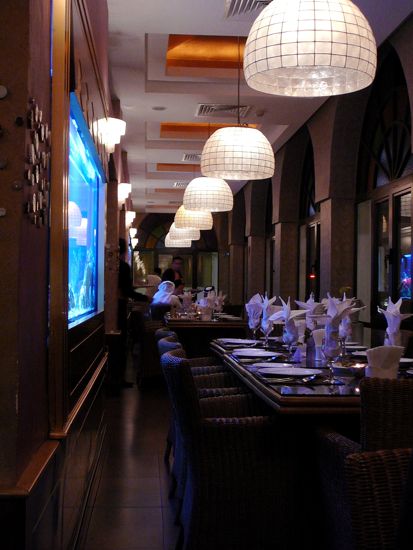
The Seafood Bar:

Part of the Salad Bar:

Our salad plates – they had so many good things!

They also had piping hot fresh out of the oven bread, Yumm!

The only problem is that the restaurant is right by one of the souk exits, where you pay for parking. Because everyone is so important, and jockeys for non-existent places in the line which has formed, it can be a little exciting sitting next to the window, not knowing if the yahoo who is trying to edge his way into the line even has a driving license. There is a fabulous terrace on this hotel; I wish the restaurant were up on the terrace area!
After dinner, there is also a dessert bar, or you can order a la carte. We couldn’t eat another thing, but it sure is tempting:
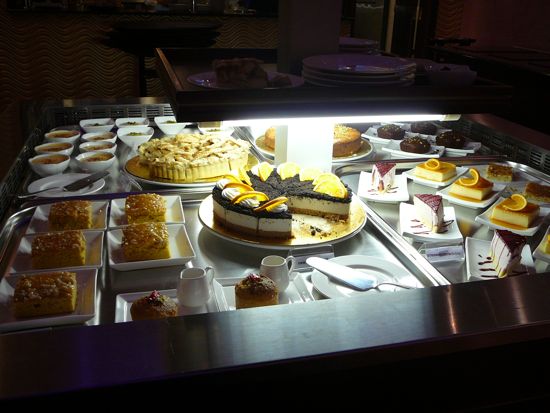
Not only will we go back, we will take our friends, especially now when being outside is so divine! It was a lovely, elegant evening, the food is reasonably priced. We didn’t see any wine being served, so if that is important to you, you will probably be better off at one of the more western hotels. And – get there early if you don’t have reservations. By eight, every table was taken.
Doha or USA?
On the homeward drive, I saw this sight, and laughed. There is a clue as to where this is, but it sure looks a lot like a street in the USA:

The Carrefour Majlis
Hubby and I were at a mall which is one of the Qatar see-and-be-seen places tonight, not to see nor to be seen, but looking for a special end table. As it turns out, we can probably get it, but not until January. No problem.
AdventureMan wanted to pick up some teas for his office and I needed skim milk so we headed for the Carrefour before leaving.
“Oh! How totally cool!” I said to AdventureMan, “Look! They have provided a tent majlis for guys waiting for their wives to grocery shop!” (A majlis, sometimes called diwaniyya, is a place where people gather – usually men, but not always, sometimes women also gather in a majlis but usually separately from men)
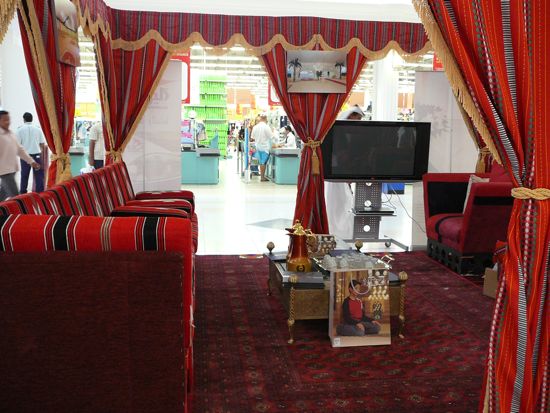
“I think that is one of the Islamic Center places,” AdventureMan said.
On our way out of Carrefour with our purchases, the majlis was packed, and everyone was drinking Arabic coffee in graceful little cups, even one western couple. It is a lovely, hospitable oasis, full of soft surfaces in a hard surface mall.
Qatari Police Balloon?
I thought this was so cute when I passed it on B-ring today:
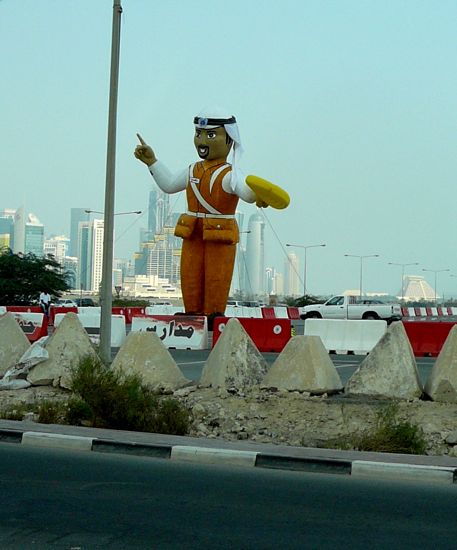
I don’t know what it’s all about, but I like it that he has on bright clothing and a reflector vest to help him be safe while he is directing traffic. 🙂
Doha: Keep Your Camera Handy
Today I had one of those experiences I have so often in Doha, a “no-one-would-believe-me” moment, but I have learned to keep my camera handy, and fortunately we were stopped in traffic so I could snap this one without endangering any lives, especially my own.
Traffic is steady, busy, but pretty mellow. Yeh, there are the normal “I’m-going-to-make-a-left-turn-from-the-right-lane” guys; I’ve lived here for so long it doesn’t even rate a roll of the eyes. It’s part of the Doha / Kuwait driving culture.
This, however, I only see in Qatar. Mr. I’m-So-Important-I-Can’t-Wait is this guy in the white Land Cruiser.
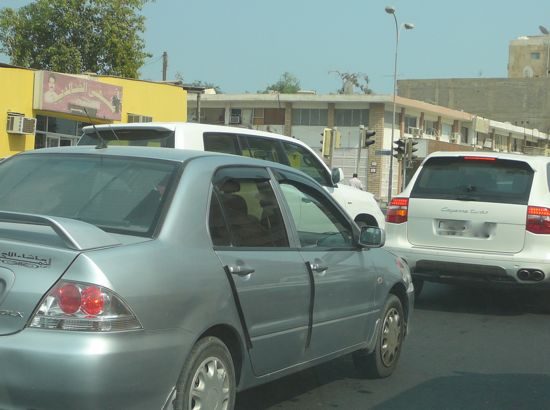
He is sitting half on top of the street median, trying to get back into traffic going in his direction. To get there, he drove down the wrong way down the street on the other side of the divider. At first, there was no traffic, but when traffic came, he got up on the divider so he was only HALF blocking traffic from the other direction, and he is bullying his way back into the line he was too important to wait in.
I carry my camera now, every day, in my purse, because I know if I just tell you about these things, you won’t believe them.
I have seen this also at major roundabouts. Some yahoo drives up the other side of the road to the roundabout to avoid waiting in the line. Up over the medians, facing oncoming traffic. I know, I know, what are they thinking?
In Kuwait, I was sickened by the number of young men killed on the roads every week, every month. If it were an epidemic killing young men, people would do something about it, but tell these guys to obey the law? Make them pay fines for reckless driving? Make them wear seat belts? Their behavior tells me that no one has ever held them accountable for their arrogant and dangerous driving habits.
While we are told that “no one is above the law” somehow the message hasn’t made it to these guys.
Truthful Visitor on Doha Press
Do you ever visit QatarLiving.com? It’s one of those places where you can end up passing a lot of time, and it is also a place where there is both a lot of information and a lot of misinformation. There are some very good posts, and then there are some poseurs.
A recent Forum discussed the statement by Qatar Attorney General Dr Ali bin Futais Al Marri that “no one is above the law.” As forums often do, the threads segued into a discussion of freedom of the press in Qatar.
I almost split my sides, I was laughing so hard. I asked Truthful Visitor if I could print his post on this blog, and he gave me permission. I hope you enjoy it as I did. 🙂
Don’t you folks know that all the newspapers in Qatar are screened by the Ministry of Interior every evening before publication for the following day? Anything that doesn’t fit the required image is cut out.
Hence you always get the presence of evil (there’s always an Asian gang being deported for doing something dreadful like burglary or selling liquor) page 1, bottom of the page, that covers the Evil In Our Midst; then the sycophantic article about HH who has just made some pithy pronouncement on The Necessity For Mutual Understanding And Education Across The World, page 2; some phony figures about how much more the Pearl property or other investments have increased pages 3 – 5; some baloney about how safe the country is for investment, page 6; then the gushing op-ed about how the best societies in the world are so great because they have been enforcing Islamic values, pages 6 – 8; Qatar Airways wins award for best in-flight hot towels, page 9, and a new order for 500 Airbus aircraft (thanks to the strategic profitability of the airline! ha!) . And not to forget, Gulf Escapes Economic Downturn for the fourth week in a row, page 10 ad infinitum.
The Filipina maids found dead and decayed in the desert? The photos of the police when they turn the water cannons on the labour camps outside the Industrial Area? Oh no. Those photos were seized under duress. These things are just not family -friendly, now are they?
If it doesn’t fit the great narrative of Qatar, it’s not really news!
Thank you, Truthful Visitor. (truthfulvisitor/-a-t-/me.com)
Curvy Women Smarter?
Not everyone agrees with the conclusions found by a recent US study discussed on BCC News Health but for those of us who are curve endowed, it gives some hope . . . 🙂
Curvy women may be a clever bet
Women with curvy figures are likely to be brighter than waif-like counterparts and may well produce more intelligent offspring, a US study suggests.
Researchers studied 16,000 women and girls and found the more voluptuous performed better on cognitive tests – as did their children.
The bigger the difference between a woman’s waist and hips the better.
Researchers writing in Evolution and Human Behaviour speculated this was to do with fatty acids found on the hips.
In this area, the fat is likely to be the much touted Omega-3, which could improve the woman’s own mental abilities as well as those of her child during pregnancy.
Men respond to the double enticement of both an intelligent partner and an intelligent child, the researchers at the Universities of Pittsburgh and California said.
The findings appear to be borne out in the educational attainments of at least one of the UK’s most famous curvaceous women, Nigella Lawson, who graduated from Oxford.
But experts are not convinced by the findings.
“On the fatty deposits being related to intelligence front, it’s very hard to detangle that from other factors, such as social class, for instance, or diet,” said Martin Tovee of Newcastle University.
“And much as we logically like the idea that men are interested in the waist to hip ratio, it actually features relatively low down the list of feature males look for in a potential partner.”

“It Was a Mistake!” The Fall of the Wall
BBC News reports today that while the ease in travel restrictions was planned, the way it happened – was a mistake!
When the Berlin Wall opened on 9 November 1989 Brian Hanrahan was the BBC News reporter on the ground. This year he’s been back to talk to some of those whose decisions made this key moment in 20th Century history possible.
From the safe distance of 20 years, the opening of the Berlin Wall can be seen as inevitable – the natural consequence of changes that were reshaping Europe. But for most of 1989 it was unthinkable.
And the decision itself was an accident – intended neither to happen the way it did nor to spark off the tumultuous changes that followed.
I heard the inside story of what started this extraordinary rush of events from one of those who made the decision in the East German Politburo – the communist party’s ruling body.
With hindsight, it’s the border guards we must thank
Politburo reformer Hans Modrow
Hans Modrow was a communist reformer in the Gorbachev mould. He had only just been given a place on the Politburo as East Germany’s leaders tried to head off the demands for change that were sweeping the country. But as a new boy his opinions counted for little.
He remembers an agitated discussion about the travel restrictions – the laws which banned most East Germans from leaving the country and which had sparked off the popular discontent.
At the end of it the party leader, Egon Krenz, suddenly produced a new set of regulations. From now on it would be much easier for East Germans to travel.
What annoyed Mr Modrow was the autocratic way in which the Communist Party still did business. “We couldn’t change anything, he says, We sat there like stupid little boys. We just had to do what we were told.”
‘Blurted out’
But now came a blunder that would bring down the Berlin Wall and the East German state with it.
The intention was to announce the changes overnight and phase in the new rules the next morning. Instead one of the Politburo members, Guenter Schabowski, blurted out the plans during a televised press conference – and compounded his error by adding the new rules would come into force “immediately”.
Live press conferences were a novelty in communist days, and Mr Schabowski was becoming something of a celebrity through his appearances. Mr Modrow is still scathing about Mr Schabowski’s preening in front of the media.
The Politburo announce the decision to allow people to cross the border
“The order wasn’t to be published until 0400 in the morning. But Mr Schabowski didn’t notice. He went into an international press conference. And he was so arrogant and full of himself. We had no idea this was happening.”
Mr Schabowski’s announcement was complicated and bureaucratic, and like many others that evening I puzzled over it before concluding that it signalled free travel. If this was true it would mean the end of the Berlin Wall because the whole fearsome structure with its watchtowers, barbed wire and guard dogs had become redundant.
East Berliners were rather quicker off the mark. Tens of thousands of them started turning up at the border demanding to be let across.
But the guards hadn’t been told anything – their standing orders were to stop anyone crossing. Until recently they’d been instructed to shoot to kill anyone who tried.
This night they tried to turn people back – but after a generation being pushed about Berliners turned belligerent and refused to go.
Stunned guards
The standoff between the armed guards and the angry crowds soon grew tense and dangerous.
The guards asked their headquarters for orders but the government ministries in charge of security told them nothing. Mr Modrow and the other Politburo members had gone home unaware of what was going on.
With radio and TV reports bringing more people on to the streets, Mr Modrow says it was the border guards themselves who decided what to do.
“With hindsight it’s the border guards we must thank, not any of us in the Politburo. The guards on the ground – at the time – made the critical decision. They ignored their standing orders. They said, ‘Open the border.'”
I arrived at the main border post just in time to see the barriers swing open as the guards gave up any attempt to regulate the crossing. They looked stunned at the mass of people streaming past them. Their whole world was collapsing about them.
But if East Germany’s leaders were ignorant of what was happening, the rest of the world was already watching on television.
In Washington, James Baker was at lunch with the President of the Philippines, Cory Aquino, when he was told the news. A short while later, hearing that people were taking sledgehammers to the wall, he abandoned the table and hastened over to the White House.
Changed world
There he and President Bush were taken aback at what they saw. They’d had no warning. “It was happening before our eyes. Maybe the Soviet leadership saw it coming but I don’t think anyone in allied capitals anticipated it happening with that speed.”
And Mr Baker admitted candidly that he was daunted by the scale of the task ahead in reshaping world alliances. As the West’s chief diplomat he would have to do most of it. “The world as I had known it all my adult life changed that day, and it changed fundamentally. I had grown up with the Cold War. Everyone in my generation had.”
In the Kremlin the man most responsible for the change slept through it. The Soviet leader had been tipped off a few days earlier about the way the East Germans were thinking.
Mr Gorbachev chuckled as he remembered the rush to tell him what had happened. “They reported to me quite early in the morning. They were in a hurry to let me know. We had been expecting it to happen. It could have happened at any time.”
And he was matter-of-fact about the consequences. “I took note of the report. It moved us on to a new phase. Not that I was enthusiastic about it, but I accepted it as something that had to happen. We understood that the time was coming for the German problem to be addressed.”
In London Douglas Hurd had been foreign secretary for just 15 days. He noted the news from Berlin in his diary. “The regime and now the wall are crumbling fast,” he wrote. But he was already wondering how he could persuade the Prime Minister, Margaret Thatcher, to consider the idea of a united Germany.
Berliners were only just opening the bottles of sparkling Sekt at the beginning of a street party that would last for days. Many were still uncertain what exactly was happening.
But in a few short hours they had changed the contours of world politics and there could be no going back. The inevitable, unthinkable accident had happened.
Recent Comments
ExpatAlien on What Country am I Living … intlxpatr on Yellowstone: Old Faithful to C… Michelle on Yellowstone: Old Faithful to C… Cathy on No Grown-Ups in Charge intlxpatr on Waiting for Snow Wikipedia Donate Button

Amazina


Early Voting in Florida


 Here There and Everywhere