Losing Fat Easy and Painless – Too Good to be True?
In an article in today’s Peninsula I learned that I can go in for six treatments, just lie there, no sweat, no starvation diets, and fat can be . . . melted (?) by laser and then massaged away, drained away by my lymphatic system.
It sounds wonderful! No sedation, no risk of infection, no long term ill effects like stomach stapling or banding. The fat just goes away! My dream come true!
I am such a cynic. There is a part of me that just can’t believe it could be that easy. What do you think?
Al Emadi Hospital unveils new technology for fat reduction
Web posted at: 1/6/2010 1:43:36
Source ::: THE PENINSULA
DOHA: Al Emadi Hospital has launched fat reduction services by “Zerona”, the latest device to break down body fats, becoming the first medical facility in Qatar to have the new technology. The technology saves patient a great deal of time and works without any side effects eliminating Cellulite and fat from the skin, embroidering and strengthening the figure without any surgical interference.
“The significant role of the device has been scientifically proven success in detecting fat under the skin and fragmenting its sizes into liquid body fats which can be disposed of. The machine uses cold laser technology to break down the fat cells under the skin in several stages. The results do not appear until after six sessions – around two weeks,” said Dr Mohammed Al Emadi, Director, Al Emadi Hospital.
The body fat broken using cold laser can be disposed through the lymphatic vessels with an added help of several massage sessions.
“It can help to get rid of fats in areas which do not respond to exercise and diet. The device works on the upper and lower limbs, breast and abdomen, neck, back and hips. It helps to dispose of cellulite that leads to distortions in the skin, and helps remove the fat masses in the abdomen and buttocks where a difference can be seen in the outer thigh or waist after the completion of the required sessions,” said Dr Kamal Hussein Saleh, a consultant in medical and plastic surgery and replacements and laser treatments.
A clear change in all clothing measurements has been noted after the sessions, according to Dr Saleh. The fact that it does not cause sudden changes in weight is an added advantage of the device compared with other of laser devices. The device is easy to use and can be used at any time, with no sedation or surgical interference.
Since it is a cold laser, it does not generate any heat or redness on the skin and is makes it possible for the patient to continue normal work after the session. Since the device does not touch with the skin, it is superior to regular lasers which may lead to the transmission of some skin diseases. It does not cause emission of fumes or gases, as it is the case of laser hair removal.
Pomegranate May Fight MRSA?
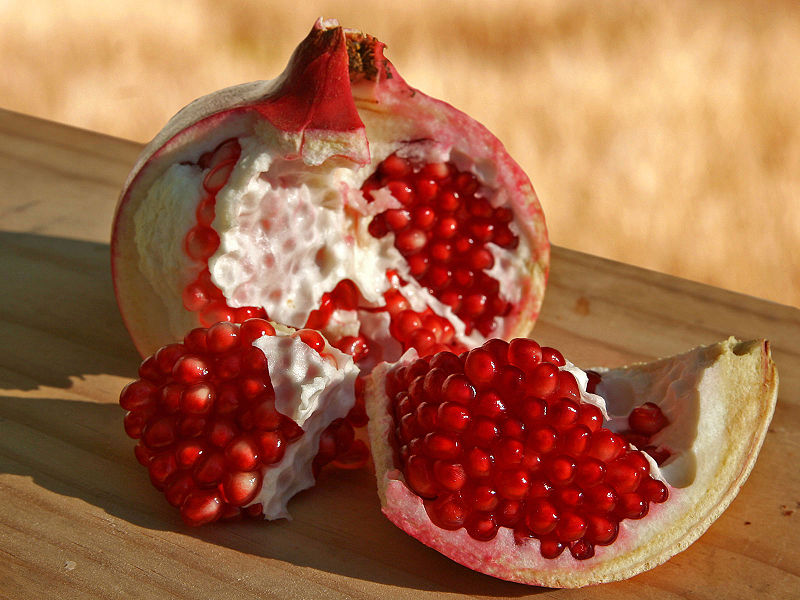
I found this article on AOL Health News and I am delighted to have any excuse to buy and eat a pomegranate. Now, even more so.
You may think I am overly concerned about MRSA, but I am convinced that it was MRSA that ended up killing my father. He was old, yes, but amazingly resilient and sturdy. He had a fighting spirit, and no matter what happened, he took control of his own “wellness.”
He went in for a routine operation (although few operations are ‘routine’ at 87) and ended up with a horrible infection where his IV had been inserted, an infection that wasn’t caught for about a week. He complained; people thought he was exaggerating. Eventually it was diagnosed as MRSA. He had to go through several rounds of intravenous Vancomycin, each of which lasted 30 days, and, I am convinced, none of which got rid of the infection because a month or so later, it would be roaring back.
What are we doing to ourselves? Antibiotic resistant bacteria are a result of over reliance on antibiotics, and for what? For viral diseases which cannot be cured by an antibiotic!
Eat more pomegranates!
By Katherine Tweed
Stopping the superbug methicillin resistant Staphylococcus aureus (MRSA) has researchers looking for new antibacterial agents in all corners of the globe. Not only are these bacteria difficult treat due to resistance to certain antibiotics, they are especially dangerous because they can be transmitted via casual contact. Scientists at the University of Kingston, Surrey in the UK have found there is promise in pomegranates.
Pomegranates have long been known for their antibacterial and therapeutic health benefits, especially in Brazil. While most of us think of pomegranates as being chock-full of antioxidants, they may fight more than free radicals. A study published in BMC Complementary and Alternative Medicine found that when the fruit’s rind is combined with metal salts and vitamin C, they hold promise in killing MRSA.
“It was the mix that fantastically increased the activity — there was synergy, where the combined effects were much greater than those exhibited by individual components,” study author Declan Naughton told the Daily Mail. “It shows nature still has a few tricks up its sleeve.”
Drug-resistant staph infections such as MRSA are a growing problem, primarily in hospital settings. MRSA infections accounted for two percent of staph infections in U.S. hospitals in 1974, but that figure jumped to 63 percent in 2004, according to the CDC.
Don’t reach for the pomegranate lotion just yet, however. The research was done in a lab setting, and it is still in the preliminary stages. Also, pomegranate rind on its own was not able to stop or slow the growth of drug-resistant staph infections. The authors say that while there is potential for pomegranates enhanced with metal salts, further investigation is needed.
Recent Comments
ExpatAlien on What Country am I Living … intlxpatr on Yellowstone: Old Faithful to C… Michelle on Yellowstone: Old Faithful to C… Cathy on No Grown-Ups in Charge intlxpatr on Waiting for Snow Wikipedia Donate Button

Amazina


Early Voting in Florida


 Here There and Everywhere