1001 Inventions: Muslim Inventions That Changed the World
A fabulous new exhibition, 1001 Inventions has opened, and will be coming to this country in December of this year. The exhibit details our Muslim heritage in the arts and sciences.
1001 Inventions – Discover The Muslim Heritage In Our World
From coffee to cheques and the three-course meal, the Muslim world has given us many innovations that we take for granted in daily life. As a new exhibition opens, Paul Vallely nominates 20 of the most influential- and identifies the men of genius behind them
Saturday, 11 March 2006

1 The story goes that an Arab named Khalid was tending his goats in the Kaffa region of southern Ethiopia, when he noticed his animals became livelier after eating a certain berry. He boiled the berries to make the first coffee. Certainly the first record of the drink is of beans exported from Ethiopia to Yemen where Sufis drank it to stay awake all night to pray on special occasions. By the late 15th century it had arrived in Mecca and Turkey from where it made its way to Venice in 1645. It was brought to England in 1650 by a Turk named Pasqua Rosee who opened the first coffee house in Lombard Street in the City of London. The Arabic qahwa became the Turkish kahve then the Italian caffé and then English coffee.
2 The ancient Greeks thought our eyes emitted rays, like a laser, which enabled us to see. The first person to realise that light enters the eye, rather than leaving it, was the 10th-century Muslim mathematician, astronomer and physicist Ibn al-Haitham. He invented the first pin-hole camera after noticing the way light came through a hole in window shutters. The smaller the hole, the better the picture, he worked out, and set up the first Camera Obscura (from the Arab word qamara for a dark or private room). He is also credited with being the first man to shift physics from a philosophical activity to an experimental one.
3 A form of chess was played in ancient India but the game was developed into the form we know it today in Persia. From there it spread westward to Europe – where it was introduced by the Moors in Spain in the 10th century – and eastward as far as Japan. The word rook comes from the Persian rukh, which means chariot.
4 A thousand years before the Wright brothers a Muslim poet, astronomer, musician and engineer named Abbas ibn Firnas made several attempts to construct a flying machine. In 852 he jumped from the minaret of the Grand Mosque in Cordoba using a loose cloak stiffened with wooden struts. He hoped to glide like a bird. He didn’t. But the cloak slowed his fall, creating what is thought to be the first parachute, and leaving him with only minor injuries. In 875, aged 70, having perfected a machine of silk and eagles’ feathers he tried again, jumping from a mountain. He flew to a significant height and stayed aloft for ten minutes but crashed on landing – concluding, correctly, that it was because he had not given his device a tail so it would stall on landing. Baghdad international airport and a crater on the Moon are named after him.
5 Washing and bathing are religious requirements for Muslims, which is perhaps why they perfected the recipe for soap which we still use today. The ancient Egyptians had soap of a kind, as did the Romans who used it more as a pomade. But it was the Arabs who combined vegetable oils with sodium hydroxide and aromatics such as thyme oil. One of the Crusaders’ most striking characteristics, to Arab nostrils, was that they did not wash. Shampoo was introduced to England by a Muslim who opened Mahomed’s Indian Vapour Baths on Brighton seafront in 1759 and was appointed Shampooing Surgeon to Kings George IV and William IV.
6 Distillation, the means of separating liquids through differences in their boiling points, was invented around the year 800 by Islam’s foremost scientist, Jabir ibn Hayyan, who transformed alchemy into chemistry, inventing many of the basic processes and apparatus still in use today – liquefaction, crystallisation, distillation, purification, oxidisation, evaporation and filtration. As well as discovering sulphuric and nitric acid, he invented the alembic still, giving the world intense rosewater and other perfumes and alcoholic spirits (although drinking them is haram, or forbidden, in Islam). Ibn Hayyan emphasised systematic experimentation and was the founder of modern chemistry.
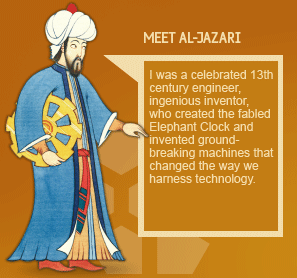
7 The crank-shaft is a device which translates rotary into linear motion and is central to much of the machinery in the modern world, not least the internal combustion engine. One of the most important mechanical inventions in the history of humankind, it was created by an ingenious Muslim engineer called al-Jazari to raise water for irrigation. His 1206 Book of Knowledge of Ingenious Mechanical Devices shows he also invented or refined the use of valves and pistons, devised some of the first mechanical clocks driven by water and weights, and was the father of robotics. Among his 50 other inventions was the combination lock.
8 Quilting is a method of sewing or tying two layers of cloth with a layer of insulating material in between. It is not clear whether it was invented in the Muslim world or whether it was imported there from India or China. But it certainly came to the West via the Crusaders. They saw it used by Saracen warriors, who wore straw-filled quilted canvas shirts instead of armour. As well as a form of protection, it proved an effective guard against the chafing of the Crusaders’ metal armour and was an effective form of insulation – so much so that it became a cottage industry back home in colder climates such as Britain and Holland.
9 The pointed arch so characteristic of Europe’s Gothic cathedrals was an invention borrowed from Islamic architecture. It was much stronger than the rounded arch used by the Romans and Normans, thus allowing the building of bigger, higher, more complex and grander buildings. Other borrowings from Muslim genius included ribbed vaulting, rose windows and dome-building techniques. Europe’s castles were also adapted to copy the Islamic world’s – with arrow slits, battlements, a barbican and parapets. Square towers and keeps gave way to more easily defended round ones. Henry V’s castle architect was a Muslim.
10 Many modern surgical instruments are of exactly the same design as those devised in the 10th century by a Muslim surgeon called al-Zahrawi. His scalpels, bone saws, forceps, fine scissors for eye surgery and many of the 200 instruments he devised are recognisable to a modern surgeon. It was he who discovered that catgut used for internal stitches dissolves away naturally (a discovery he made when his monkey ate his lute strings) and that it can be also used to make medicine capsules. In the 13th century, another Muslim medic named Ibn Nafis described the circulation of the blood, 300 years before William Harvey discovered it. Muslims doctors also invented anaesthetics of opium and alcohol mixes and developed hollow needles to suck cataracts from eyes in a technique still used today.
11 The windmill was invented in 634 for a Persian caliph and was used to grind corn and draw up water for irrigation. In the vast deserts of Arabia, when the seasonal streams ran dry, the only source of power was the wind which blew steadily from one direction for months. Mills had six or 12 sails covered in fabric or palm leaves. It was 500 years before the first windmill was seen in Europe.
12 The technique of inoculation was not invented by Jenner and Pasteur but was devised in the Muslim world and brought to Europe from Turkey by the wife of the English ambassador to Istanbul in 1724. Children in Turkey were vaccinated with cowpox to fight the deadly smallpox at least 50 years before the West discovered it.
13 The fountain pen was invented for the Sultan of Egypt in 953 after he demanded a pen which would not stain his hands or clothes. It held ink in a reservoir and, as with modern pens, fed ink to the nib by a combination of gravity and capillary action.
14 The system of numbering in use all round the world is probably Indian in origin but the style of the numerals is Arabic and first appears in print in the work of the Muslim mathematicians al-Khwarizmi and al-Kindi around 825. Algebra was named after al-Khwarizmi’s book, Al-Jabr wa-al-Muqabilah, much of whose contents are still in use. The work of Muslim maths scholars was imported into Europe 300 years later by the Italian mathematician Fibonacci. Algorithms and much of the theory of trigonometry came from the Muslim world. And Al-Kindi’s discovery of frequency analysis rendered all the codes of the ancient world soluble and created the basis of modern cryptology.
15 Ali ibn Nafi, known by his nickname of Ziryab (Blackbird) came from Iraq to Cordoba in the 9th century and brought with him the concept of the three-course meal – soup, followed by fish or meat, then fruit and nuts. He also introduced crystal glasses (which had been invented after experiments with rock crystal by Abbas ibn Firnas – see No 4).
16 Carpets were regarded as part of Paradise by medieval Muslims, thanks to their advanced weaving techniques, new tinctures from Islamic chemistry and highly developed sense of pattern and arabesque which were the basis of Islam’s non-representational art. In contrast, Europe’s floors were distinctly earthly, not to say earthy, until Arabian and Persian carpets were introduced. In England, as Erasmus recorded, floors were “covered in rushes, occasionally renewed, but so imperfectly that the bottom layer is left undisturbed, sometimes for 20 years, harbouring expectoration, vomiting, the leakage of dogs and men, ale droppings, scraps of fish, and other abominations not fit to be mentioned”. Carpets, unsurprisingly, caught on quickly.
17 The modern cheque comes from the Arabic saqq, a written vow to pay for goods when they were delivered, to avoid money having to be transported across dangerous terrain. In the 9th century, a Muslim businessman could cash a cheque in China drawn on his bank in Baghdad.
18 By the 9th century, many Muslim scholars took it for granted that the Earth was a sphere. The proof, said astronomer Ibn Hazm, “is that the Sun is always vertical to a particular spot on Earth”. It was 500 years before that realisation dawned on Galileo. The calculations of Muslim astronomers were so accurate that in the 9th century they reckoned the Earth’s circumference to be 40,253.4km – less than 200km out. The scholar al-Idrisi took a globe depicting the world to the court of King Roger of Sicily in 1139.
19 Though the Chinese invented saltpetre gunpowder, and used it in their fireworks, it was the Arabs who worked out that it could be purified using potassium nitrate for military use. Muslim incendiary devices terrified the Crusaders. By the 15th century they had invented both a rocket, which they called a “self-moving and combusting egg”, and a torpedo – a self-propelled pear-shaped bomb with a spear at the front which impaled itself in enemy ships and then blew up.
20 Medieval Europe had kitchen and herb gardens, but it was the Arabs who developed the idea of the garden as a place of beauty and meditation. The first royal pleasure gardens in Europe were opened in 11th-century Muslim Spain. Flowers which originated in Muslim gardens include the carnation and the tulip.
“1001 Inventions: Discover the Muslim Heritage in Our World” is a new exhibition which began a nationwide tour this week. It is currently at the Science Museum in Manchester. For more information, go to www.1001inventions.com.
8 Comments »
Leave a reply to Ali Cancel reply
Recent Comments
ExpatAlien on What Country am I Living … intlxpatr on Yellowstone: Old Faithful to C… Michelle on Yellowstone: Old Faithful to C… Cathy on No Grown-Ups in Charge intlxpatr on Waiting for Snow Wikipedia Donate Button

Amazina


Early Voting in Florida


 Here There and Everywhere
I agree that these are all wonderful inventions (after all, we do quilt!) but the question that perhaps might be more pertinent today is what are they inventing now? My dad works in a manufacturing trade organization and teaches classes in a college MBA program and he has statistics about the current patents filed by all Muslim nations. The only thing that has been invented recently was a prayer rug with a compass imbedded in it so they could find which way to face. Islam, during our Dark Ages when the Western world as a whole was highly discouraged from doing anything involving invention or science, was a light into the darkness. But some would say now that the situation is exactly opposite. What is being invented? Some are coming up with new ways to kill soldiers, some aren’t coming up with anything. It makes me sad, because I know that actual Islam is a peaceful religion, but it has been twisted in much the same way that our own Christian religion once was. We once crusaded against Muslims because, for all intents and purposes, they were different, and a threat. Now some Muslims are crusading against us for the same reasons.
Don’t take this the wrong way, I do realize that true Islam is much different than what many claim it is. But in many ways, it is not the way it once was; there are no new inventions coming out of the culture.
You are saying the exact same thing as my young Kuwaiti friends, Emma – why are they not making this same kind of progress now? Most of them blame their education system, which relies heavily on memorization and discourages individual initiative.
But in our own country, where they come to study engineering, there are few, if any, American students taking engineering classes. I have always thought of engineers as the wheels of progress in any society, they are problem solvers, and why aren’t many of our American young interested in becoming engineers?
Education is the fountain of invention. Creating a mind that questions, and tests and analyzes, and is eager for work – are we as a country valuing education, and teaching our young to strive, to work hard, to seek for the highest that is within themselves?
a great lot of these inventions came at a time when the mughal emperors lived in luxury, employing the brightest minds as royal scientists to check out any stream of science without worry about money.
p.s. i dont think gardens were invented by the muslims… the chinese and indians had them a far before.i know the “western world” never thought about it, but generally all easterners knew a lot more… only, the moslems were at the forefront of the silk route, so were the “front” and were mostakenly assumed to be the source of all this knowledge .
One thing I really liked about this article was that they mentioned origins in other places – for example, that chess originated in India – but that the Muslims either took something to a new level or improved it in some way or spread the knowledge. 🙂 Good point about the forefront of the silk route – most Americans still think pasta came from Italy. 🙂
What a beautiful point you brought here….
“The Arabic qahwa became the Turkish kahve then the Italian caffé and then English coffee”
i never knew coffee was invented and specialized by Muslims —-
Muslims Rose to the Peaks of Glory cuz they used to Follow Quran + Sunnah —-
Thats why ALLAH (S.W.T.) rewarded Muslims with Science & Technology and High Place in the World —
cuz its –ONLY– in the hands of Allah (S.W.T.) to Lift one group of people to the heights of Glory —-
Rise of Good Muslims is Inevitable —
its just that we were Wondering in Wrong direction — Following the West —-
if we Follow Our Quran + Sunnah
INSHALLAH — There is NO LIMITS to the progress we will make…….
I mean who can have more Knowledge, Enlightenment, Awareness than Allah(S.W.T.) —
and Allah(S.W.T.) is talking to us in Holy Quran —
i like to point one more fact here…..
How Quran tells us — how to build Space Rockets —Summary—- “If you want to Leave Earth for Space, so Leave, WITHOUT FORCE YOU WILL NEVER LEAVE IT”
Quran clearly states that without FORCE we can not Leave Earth for space — thats why all the Space Flights have so many Rockets attach to them —-
Muslim countries of Central Asia were also a great Center of SCience & Technology during the Glorious Islamic Empire—
There was a Famous Muslim Space Scientist working for Russian Space Program —
he was like founding father of Russian Space program including Meer and Russian Space flights — i dont remember his name — Search Net
Ali, thank you for your lengthy response to this post. You do know that Yahweh / Allah / God are all one and the same, do you not? That we descendants of Abraham are three branches of one tradition, and that the God of Abraham is the God of the Christians, the Moslems and the Jews?
Our book says we have all strayed far from the true path and have gone our own ways. Would you agree with that?
you don’t have to limit it to the descendants of Abraham (Ibrahim), coz we are all, the entire human race, are the descendants of Adam and Eve. We were all once under one religion, Adam and Eve’s. People of other prophets have also strayed. People all over the world, who don’t belong to Abraham, Jesus, Moses or Mohammed PBUT all, have strayed. So, yes, the God of Abraham is the God of the Christians, Jews, and Muslims, and the rest of the prophets.
We believe in what was given, by God, to all his prophets, from wisdom to teachings and revelations.. etc. but we also believe that not all religions were kept pure from Man’s interference throughout the years. Thats why the first Surah in the Quran, Al Fatiha, contains the following verses (it is also the surah we repeat 5 times a day in every prayer):
“Guide us on the straight path,
the path of those who have received your grace;
not the path of those who have brought down wrath, nor of those who wander astray.
Amen.”
I also believe that it’s late and I shouldn’t be writing this like I’m some sort of a preacher… I should get me some sleep 🙂
PS. Hey you 🙂 it’s been a while!
Hey Yousef, I’m glad to see you. 🙂 I love it, in the midst of the darkness of chaos and violence, to see that our books are so similar, that our beliefs, in their essence, are identical. I wish more Christians knew the translation you gave above, the exact words you say, five times a day, every day of your life.
Did you see that the movie Water for Elephants is out now? I’m interested to see how closely it sticks to the book.
Our son has us reading the Game of Thrones series, and we are totally hooked. Have you read any of them?