April’s ‘Pink’ Moon and Lunar Eclipse Thursday
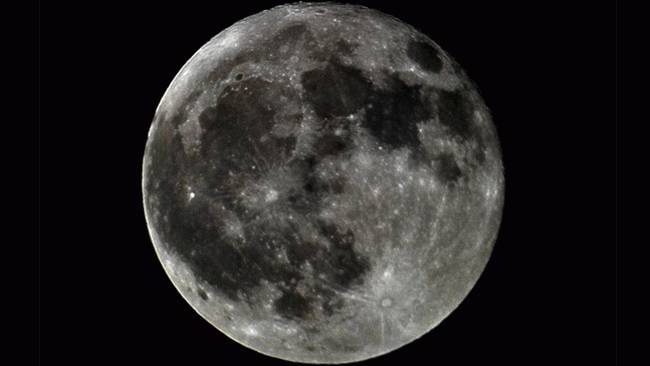
While I don’t recall the year of this episode, I can state most definitely that it took place in the month of April, since many years later I learned that traditionally the full moon of April is called the “pink moon,” a reference made to the grass pink or wild ground phlox which is one of the earliest widespread flowers of the spring season.
So on Thursday night, when you look skyward at this year’s version of the “pink” April full moon, remember not to take the term literally!
A Bit of an Eclipse
While this month’s full moon may not look pink, if you live in Europe, Africa or much of Asia, you will notice something a bit different about it, because it will take place on the night of a lunar eclipse.
Unfortunately, in North America, none of this eclipse will be visible, since the actual instant of full moon occurs on Thursday afternoon (April 25), when the moon is below the horizon.
Beginning at 2:04 p.m. EDT, the moon begins to meet the Earth’s shadow; a little over two hours later it arrives under the middle of that shadow. By then the moon will have just risen and will be visible low to the east-southeast horizon as seen from Ireland, and will be setting over south-central Japan in the morning hours of Friday, April 26.
Feeble at Best
If we were to rank a total eclipse of the moon as a first-rate event, then what is scheduled to be seen on Thursday for those living in the Eastern Hemisphere would almost certainly fall into the third- or even fourth-rate category; in fact it might add new meaning to the term “underwhelming.”
During the first 110-minutes of the eclipse, the moon’s northern hemisphere pushes ever-so-gradually into the Earth’s partial shadow, called the penumbra. The outer two-thirds of this are too subtle to detect; but then perhaps by 3:30 p.m. you may realize you are beginning to detect the ever-so-slight gradient of a soft grey darkening around the top of the moon.
At 3:54 p.m., the moon’s northern limb finally makes contact with a much more abrupt shadow, the blackish-brown umbra. This chord of shadow on the moon grows and retreats over a span of less than half an hour; yet at its deepest at 4:07 p.m. EDT, the partial eclipse will reach its peak at a puny 1.48 percent as the moon’s northern (upper) limb literally grazes the umbral shadow and remains in contact with it until 4:21 p.m.
This dark shadow’s coverage can be described as feeble at best. To the unaided eye, even to those with acute visual skills, it will hardly cause a perceptible dent on the lunar disk. However, anyone who glances up at the moon around that time will likely notice that the uppermost part of the disk of the moon will appear smudged or tarnished. This effect will probably fade away by around 5 p.m., with the moon appearing as its normal self. Officially, though, the moon will not completely free itself from the outer penumbral shadow until 6:11 p.m.
No comments yet.
Recent Comments
ExpatAlien on What Country am I Living … intlxpatr on Yellowstone: Old Faithful to C… Michelle on Yellowstone: Old Faithful to C… Cathy on No Grown-Ups in Charge intlxpatr on Waiting for Snow Wikipedia Donate Button

Amazina


Early Voting in Florida


 Here There and Everywhere
Leave a comment