What is Lent and Why Do We Observe Lent?
From today’s AOL News:

Ash Wednesday 2014: History, Dates, Traditions Of Lent’s First Day Of Fasting
Ash Wednesday is observed on March 5, in 2014. The Christian holy day marks the beginning of Lent, a 40-day season of fasting that is considered preparation for Holy Week and the celebration of Easter.
Although there is no Biblical reference to Ash Wednesday or Lent, scholars of Christianity date the tradition of a 40-day fasting period back to 325 A.D.
Lent mirrors Jesus’ own 40-day period of fasting, described in the book of Matthew. Observers have ash placed on their foreheads in the shape of the cross as the words from Genesis 3:19 are spoken: “You are dust, and to dust you shall return.”
Fasting requirements for Catholics are outlined by the Code of Canon Law, and include eating no meat on the Fridays during Lent, as well as fasting on Ash Wednesday and Good Friday. (Fasting in this case refers to eating just one full meal a day.)
Many Christians will make personal vows of abstinence during Lent, which could include anything from refraining from eating candy, meat, vowing not to gossip, or being less selfish. Others will make a vow to do more for others including volunteering and working for social justice. All are expected to spend more time in prayer and reflection as Lent is considered by many to be an opportunity for spiritual transformation.
The Catholic nun Sister Joan Chittister writes:
Lent is the opportunity to change what we ought to change but have not…Lent is about becoming, doing and changing whatever it is that is blocking the fullness of life in us right now… Lent is a summons to live anew…Lent is the time to let life in again, to rebuild the worlds we’ve allowed to go sterile, to “fast and weep and mourn” for the goods we’ve foregone. If our own lives are not to die from lack of nourishment, we must sacrifice the pride or the sloth or the listlessness that blocks us from beginning again. Then, as Joel (2:12-18) promises, God will have pity on us and pour into our hearts the life we know down deep that we are lacking.
John and Charles Wesley, Anglicans
“That’s not the REAL hymn” AdventureMan often says on a Sunday as we are singing. He grew up Methodist, and while the Anglican churches overseas often have tunes to hymns that differ from the American tunes, AdventureMan has a staunch loyalty to the Methodist hymns. His loyalty is so strong that he thinks they ARE Methodist hymns.
Sorry, AdventureMan. The breakaway sect that became the Methodist Church in America started under their influence, but the Wesley brothers remained Anglicans.
The Liturgical Calendar: The Church Remembers
Today the church remembers John and Charles Wesley, Priests, 1791, 1788.
John and Charles were raised together at the rectory in Epworth. They studied at Oxford, and together they were ordained into the ministry of the Church of England. Together they journeyed to America and served there as missionaries in Georgia for the Society for the Propagation of the Gospel. Together they led the great evangelical revival of the eighteenth century.
This movement attempted to foster among Christians a strong personal commitment to Jesus. Its leaders, such as John and Charles, preached and sang in the open fields, on street corners, and in the market places. They actively opposed slavery and drunkenness. John was the more impressive preacher, Charles the musician. (The Hymnal 1982 contains twenty-three of Charles’s hymns.)
The Evangelical Movement led to the formation of several religious societies. The most famous of these was the “Methodist” Society, so-called for its strict and methodical practices. Some of these societies, especially in America, separated from the English Church. John and Charles Wesley, however, did not forsake the Church of England. Their feast day would seem an appropriate time to recommit ourselves to the spread of Christ’s kingdom among all classes of people.
Lord Christ, make us ready to journey forth into the world to do your work and to praise your Name, and all for your glory. Amen.
Lord God, you inspired your servants John and Charles Wesley with burning zeal for the sanctification of souls, and endowed them with eloquence in speech and song: Kindle in your Church, we entreat you, such fervor, that those whose faith has cooled may be warmed, and those who have not known Christ may turn to him and be saved; who lives and reigns with you and the Holy Spirit, one God, now and for ever. Amen.
More Money For MEEEEEEEEEE!
Ooooh, a consignment of money to MEEEEEEEEEEEE!

(Reminder: this is a SCAM)
Pensacola Grand Mardi Gras Parade 2014
We love having a grandson, not that we need an excuse, but it’s always more fun to go to a parade when you have a youngster with you. Today was particularly fun, he is four and totally gets the whole parade thing, we found a great parking place with no driving around and we had a great place to watch the parade from. Some kids sitting in front of us knew our grandson, and we were all invited “up front” to be with them.
Parades are always more fun with fun people, and these people were fun. The parade was fun. This is a family parade, lots and lots of children, and the bead throwers and gift givers are most generous to the children. While grown-ups compete to catch the beads, they turn around and give them to the little ones almost immediately. It’s a gentle spirit, and everyone has fun.
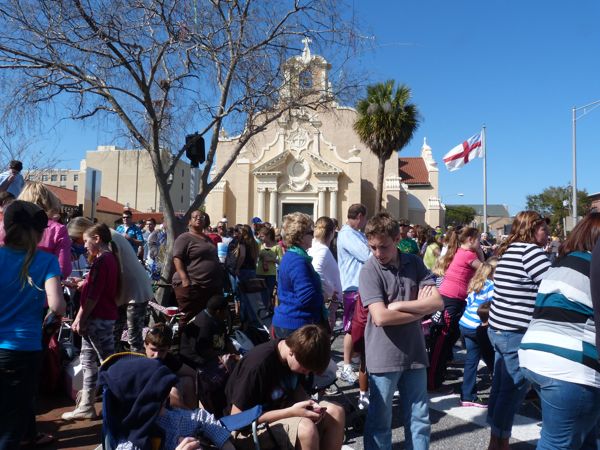
Our favored place is very near our church. You can see how crowded it is as the parade begins. It only gets worse; Mardi Gras parades attract more than 50,000 people. Imagine, 50,000 people all behaving themselves, families, children, and when it ends, the street looks normal within an hour or so. Thank God for civility.
Our church and the Mardi Gras revelers waiting for the parade. If you look closely, you can see beads hanging in the tree from the Krewe of Lafitte Parade the night before. Pensacola has LOTS of parades 🙂 :
I watched this guy in this crazy-wonderful horse head get LOTS of beads during the parade:

Everyone has a gimmick to try to get more beads, but it is a FAMILY parade, so there are no drunks (not that I saw anyway) and no one lifting up their shirts for beads. Several people had “targets” for bead throwers:



McGuires throws green beads, and our grandson got one with a medallion, very special 🙂 We’ve hung them all – all this treasures – in his room at our house so his little baby sister doesn’t chew on them by accident and he can visit them every time he stays 🙂 :

As you can see, it was a fabulous day for a parade, maybe 70 degrees F. and a slight breeze. We say “when March comes in like a lamb, it goes out like a lion” so we are expecting that the end of March may be cold and dreary, perfect Lent weather.
MERS Virus Found to be Widespread
Thank you, John Mueller, for this fascinating article from Science NOW:
Middle Eastern Virus More Widespread Than Thought
 Bernard Gagnon/Wikimedia CommonsTrail of infection. Scientists have found MERS virus in camels from Sudan and Ethiopia, suggesting the virus is more widespread than previously thought.
It’s called Middle East respiratory syndrome, or MERS, after the region where almost all the patients have been reported. But the name may turn out to be a misnomer. A new study has found the virus in camels from Sudan and Ethiopia, suggesting that Africa, too, harbors the pathogen. That means MERS may sicken more humans than previously thought—and perhaps be more likely to trigger a pandemic.
MERS has sickened 183 people and killed 80, most of them in Saudi Arabia. A couple of cases have occurred in countries outside the region, such as France and the United Kingdom, but those clusters all started with a patient who had traveled to the Middle East before falling ill.
Scientists have uncovered more and more evidence implicating camels in the spread of the disease. They found that a large percentage of camels in the Middle East have antibodies against MERS in their blood, while other animals, such as goats and sheep, do not. Researchers have also isolated MERS virus RNA from nose swabs of camels in Qatar, and earlier this week, they showed that the virus has circulated in Saudi Arabian camels for at least 2 decades.
Malik Peiris, an infectious disease researcher at the University of Hong Kong, and colleagues expanded the search to Africa. In a paper published last year, they showed that camels in Egypt carried antibodies against MERS. For the new study, they took samples from four abattoirs around Egypt; again they found antibodies against MERS in the blood of 48 out of 52 camels they tested. But the most interesting results came from taking nose swabs from 110 camels: They found MERS RNA in four animals that had been shipped in from Sudan and Ethiopia.
Peiris cautions that it is unclear whether the infected camels picked up the virus in Sudan and Ethiopia or on their final journey in Egypt. Abattoirs could help spread MERS just like live poultry markets do for influenza, he says. “You cannot point the finger exactly at where those viruses came from,” he says. “But I would be very surprised if you do not find the virus in large parts of Africa.”
If so, that changes the picture of MERS considerably. No human MERS cases have been reported from Egypt or anywhere else in Africa, but if camels are infected, they may well occur, says Marion Koopmans, an infectious disease researcher at Erasmus MC in Rotterdam, the Netherlands. “It would be important to look systematically into that,” she writes in an e-mail. “Health authorities really need to test patients with severe pneumonia all across Africa for MERS,” Peiris says.
The researchers were able to sequence the virus of one of the camels almost completely, and it is more than 99% identical with viruses found in people. “I would be very surprised if this virus cannot infect humans,” says Christian Drosten, a virologist at the University of Bonn in Germany. But the virus also shows a few intriguing differences from known camel samples, he says. “We have to analyze this carefully in the next few days, but it looks like this sequence broadens the viral repertoire found in camels,” he says. If the viruses found in camels show more genetic variation than those isolated from humans, that is further strong evidence that camels are infecting humans and not the other way around.
Anthony Mounts, the point person for MERS at the World Health Organization in Geneva, Switzerland, says that it is very likely that human MERS cases occur in Africa. “Wherever we find [infected] camels, there is a good chance we’ll find [human] cases if we look closely,” he says. And humans may be exposed to camels in Africa much more often than in the Middle East: There were about 260,000 camels in Saudi Arabia in 2012, but almost a million in Ethiopia and 4.8 million in Sudan, according to the U.N. Food and Agriculture Organization. The more human cases there are, the higher the risk that the virus will one day learn how to become easily transmissible between people, which could set off a pandemic.
The researchers also looked at the blood of 179 people working at the camel abattoirs for antibodies against MERS virus, but found none. That shows that the virus is only rarely successful in infecting human beings, Peiris says. “What we need to find out now is the reason for these rare transmissions.”
Jesus Heals Lepers
My friend Renee sent this one, along with several Christian cartoons, but this one really made me laugh. Yes, as Christians, it is OK to show the image of Jesus.
In our book, the Bible, there are even small jokes. In one verse, a man is told that Jesus, the Messiah, had come from Nazareth, and the man says “can anything good come out of Nazareth?” People are people, yes, it was meant to be humorous.


Recent Comments
ExpatAlien on What Country am I Living … intlxpatr on Yellowstone: Old Faithful to C… Michelle on Yellowstone: Old Faithful to C… Cathy on No Grown-Ups in Charge intlxpatr on Waiting for Snow Wikipedia Donate Button

Amazina


Early Voting in Florida


 Here There and Everywhere