New Crop Palm Trees
Sitting over a long lunch, a friend asked me if I could remember my earliest impressions of Kuwait, and all I could remember was that the traffic speeds scared the hell out of me. Then, yesterday morning, we were driving on 40 and my memory was jogged; I remember moving here from Qatar and thinking how GREEN Kuwait is.
Qatar is impeccably clean. Street crews are out all the time, insuring that the highways are immaculate. There are beautiful flowers and wide boulevards. But when you leave Qatar, you realize your eyes are starved for green. I remember landing here the first time, and seeing pockets of green, even in very desert-like areas. I love the way the government has planted trees, especially palm trees. Your mind may not always register them, but it makes for a nicer environment.
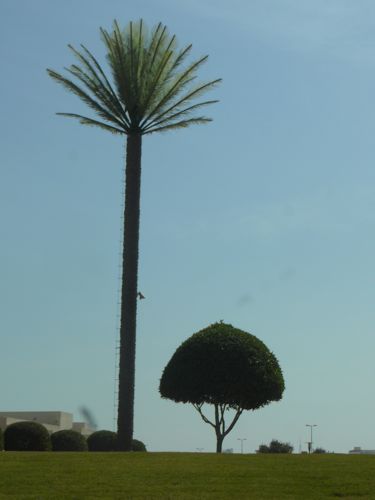
I noticed recently a new crop of palm tree antennas. I think this is a total hoot. A generation ago, everyone in this area was buying Eiffel tower replicas for their roofs to bring in TV signals; now the communication towers are being disguised – and I love it. I blogged about this a while back but this time, I am going to challenge YOU – take your camera and open your eyes. When you see a disguised communications tower, shoot it.
How do you recognize them? They are taller than any real palm tree you have ever seen. They have no dead leaves and nothing on the trunk. They tend to be near hotels, but I also see them occasionally in a residential district.
You can blog it, or you can send it to me as a JPEG attachment and I will publish them. Be sure to tell us where it is taken. Here is the one I saw at the Hilton:
Here is the previous entry on Palm-Tree-Antennas.
And bravo to whoever came up with this idea – it is clever and it is a great disguise for those communication towers. Gives me a grin whenever I see them.
No sunrise today; the dust is rolling in and the sun can barely be seen. The temperature at 0830 is 66°F/19°C.
And Everything Went Wrong
Five minutes ago there was another accident outside my house. I was on the phone before I even spotted it, calling 777.
The guy who hit the other guy is backing up and . . .DRIVING AWAY! There must be 20 witnesses with cell phones looking dumbfounded as he is driving away, but not so dumbfounded they are not taking photos of the car with their cell phones and writing down the license number. I am sorry, whoever was the hitter was dumber than dumb.
777 rings and rings. Some man finally answers, sounding annoyed, and when I ask for the traffic police, he says something – it didn’t sound very nice – and hung up on me. (The women must have gone home. They are always polite, efficient, and competant.) When I dialed the local police directly (yep, we’ve talked before so I DO have their number) NO ONE answers.
It is time for prayer, but . . . 20 minutes later, the hit car is still causing all kinds of traffic problems and no one can do anything because no police are coming.
Update – two minutes later, there are cops, there is an ambulance, and there are 20 people showing photos to the police of the numbskull who hit and run. Don’t you just love technology?
Segregation – Integration – Choice
A fascinating new and very long article from The New York Times Magazine section discusses a school where boys and girls have a choice of integrated or segregated classrooms – in the same school.
I would have hated going to an all-girl school, and at the same time, I think it is far for people to have a choice in how they want to learn. What was right for me is not right for everyone else, and maybe not for YOU – or your children.
Here is a quote from deep in the article, about how things are succeeding at one same-sex school. I wonder how this technique would fly in Kuwait 😉
If a child arrives at 7:31 a.m., his parents will receive a call at 5:45 the next morning to make sure that boy will be at school on time.
By ELIZABETH WEIL
Published: March 2, 2008
On an unseasonably cold day last November in Foley, Ala., Colby Royster and Michael Peterson, two students in William Bender’s fourth-grade public-school class, informed me that the class corn snake could eat a rat faster than the class boa constrictor. Bender teaches 26 fourth graders, all boys. Down the hall and around the corner, Michelle Gay teaches 26 fourth-grade girls. The boys like being on their own, they say, because girls don’t appreciate their jokes and think boys are too messy, and are also scared of snakes. The walls of the boys’ classroom are painted blue, the light bulbs emit a cool white light and the thermostat is set to 69 degrees. In the girls’ room, by contrast, the walls are yellow, the light bulbs emit a warm yellow light and the temperature is kept six degrees warmer, as per the instructions of Leonard Sax, a family physician turned author and advocate who this May will quit his medical practice to devote himself full time to promoting single-sex public education.
Foley Intermediate School began offering separate classes for boys and girls a few years ago, after the school’s principal, Lee Mansell, read a book by Michael Gurian called “Boys and Girls Learn Differently!” After that, she read a magazine article by Sax and thought that his insights would help improve the test scores of Foley’s lowest-achieving cohort, minority boys. Sax went on to publish those ideas in “Why Gender Matters: What Parents and Teachers Need to Know About the Emerging Science of Sex Differences.” Both books feature conversion stories of children, particularly boys, failing and on Ritalin in coeducational settings and then pulling themselves together in single-sex schools. Sax’s book and lectures also include neurological diagrams and scores of citations of obscure scientific studies, like one by a Swedish researcher who found, in a study of 96 adults, that males and females have different emotional and cognitive responses to different kinds of light. Sax refers to a few other studies that he says show that girls and boys draw differently, including one from a group of Japanese researchers who found girls’ drawings typically depict still lifes of people, pets or flowers, using 10 or more crayons, favoring warm colors like red, green, beige and brown; boys, on the other hand, draw action, using 6 or fewer colors, mostly cool hues like gray, blue, silver and black. This apparent difference, which Sax argues is hard-wired, causes teachers to praise girls’ artwork and make boys feel that they’re drawing incorrectly. Under Sax’s leadership, teachers learn to say things like, “Damien, take your green crayon and draw some sparks and take your black crayon and draw some black lines coming out from the back of the vehicle, to make it look like it’s going faster.” “Now Damien feels encouraged,” Sax explained to me when I first met him last spring in San Francisco. “To say: ‘Why don’t you use more colors? Why don’t you put someone in the vehicle?’ is as discouraging as if you say to Emily, ‘Well, this is nice, but why don’t you have one of them kick the other one — give us some action.’ ”
During the fall of 2003, Principal Mansell asked her entire faculty to read “Boys and Girls Learn Differently!” and, in the spring of 2004, to attend a one-day seminar led by Sax at the school, explaining boys’ and girls’ innate differences and how to teach to them. She also invited all Foley Intermediate School parents to a meeting extolling the virtues of single-sex public education. Enough parents were impressed that when Foley Intermediate, a school of 322 fourth and fifth graders, reopened after summer recess, the school had four single-sex classrooms: a girls’ and a boys’ class in both the fourth and fifth grades. Four classrooms in each grade remained coed.
Separating schoolboys from schoolgirls has long been a staple of private and parochial education. But the idea is now gaining traction in American public schools, in response to both the desire of parents to have more choice in their children’s public education and the separate education crises girls and boys have been widely reported to experience. The girls’ crisis was cited in the 1990s, when the American Association of University Women published “Shortchanging Girls, Shortchanging America,” which described how girls’ self-esteem plummets during puberty and how girls are subtly discouraged from careers in math and science. More recently, in what Sara Mead, an education expert at the New America Foundation, calls a “man bites dog” sensation, public and parental concerns have shifted to boys. Boys are currently behind their sisters in high-school and college graduation rates. School, the boy-crisis argument goes, is shaped by females to match the abilities of girls (or, as Sax puts it, is taught “by soft-spoken women who bore” boys). In 2006, Doug Anglin, a 17-year-old in Milton, Mass., filed a civil rights complaint with the United States Department of Education, claiming that his high school — where there are twice as many girls on the honor roll as there are boys — discriminated against males. His case did not prevail in the courts, but his sentiment found support in the Legislature and the press. That same year, as part of No Child Left Behind, the federal law that authorizes programs aimed at improving accountability and test scores in public schools, the Department of Education passed new regulations making it easier for districts to create single-sex classrooms and schools.
Foley Intermediate School began offering separate classes for boys and girls a few years ago, after the school’s principal, Lee Mansell, read a book by Michael Gurian called “Boys and Girls Learn Differently!” After that, she read a magazine article by Sax and thought that his insights would help improve the test scores of Foley’s lowest-achieving cohort, minority boys. Sax went on to publish those ideas in “Why Gender Matters: What Parents and Teachers Need to Know About the Emerging Science of Sex Differences.” Both books feature conversion stories of children, particularly boys, failing and on Ritalin in coeducational settings and then pulling themselves together in single-sex schools. Sax’s book and lectures also include neurological diagrams and scores of citations of obscure scientific studies, like one by a Swedish researcher who found, in a study of 96 adults, that males and females have different emotional and cognitive responses to different kinds of light. Sax refers to a few other studies that he says show that girls and boys draw differently, including one from a group of Japanese researchers who found girls’ drawings typically depict still lifes of people, pets or flowers, using 10 or more crayons, favoring warm colors like red, green, beige and brown; boys, on the other hand, draw action, using 6 or fewer colors, mostly cool hues like gray, blue, silver and black. This apparent difference, which Sax argues is hard-wired, causes teachers to praise girls’ artwork and make boys feel that they’re drawing incorrectly. Under Sax’s leadership, teachers learn to say things like, “Damien, take your green crayon and draw some sparks and take your black crayon and draw some black lines coming out from the back of the vehicle, to make it look like it’s going faster.” “Now Damien feels encouraged,” Sax explained to me when I first met him last spring in San Francisco. “To say: ‘Why don’t you use more colors? Why don’t you put someone in the vehicle?’ is as discouraging as if you say to Emily, ‘Well, this is nice, but why don’t you have one of them kick the other one — give us some action.’ ”
During the fall of 2003, Principal Mansell asked her entire faculty to read “Boys and Girls Learn Differently!” and, in the spring of 2004, to attend a one-day seminar led by Sax at the school, explaining boys’ and girls’ innate differences and how to teach to them. She also invited all Foley Intermediate School parents to a meeting extolling the virtues of single-sex public education. Enough parents were impressed that when Foley Intermediate, a school of 322 fourth and fifth graders, reopened after summer recess, the school had four single-sex classrooms: a girls’ and a boys’ class in both the fourth and fifth grades. Four classrooms in each grade remained coed.
Separating schoolboys from schoolgirls has long been a staple of private and parochial education. But the idea is now gaining traction in American public schools, in response to both the desire of parents to have more choice in their children’s public education and the separate education crises girls and boys have been widely reported to experience. The girls’ crisis was cited in the 1990s, when the American Association of University Women published “Shortchanging Girls, Shortchanging America,” which described how girls’ self-esteem plummets during puberty and how girls are subtly discouraged from careers in math and science. More recently, in what Sara Mead, an education expert at the New America Foundation, calls a “man bites dog” sensation, public and parental concerns have shifted to boys. Boys are currently behind their sisters in high-school and college graduation rates. School, the boy-crisis argument goes, is shaped by females to match the abilities of girls (or, as Sax puts it, is taught “by soft-spoken women who bore” boys). In 2006, Doug Anglin, a 17-year-old in Milton, Mass., filed a civil rights complaint with the United States Department of Education, claiming that his high school — where there are twice as many girls on the honor roll as there are boys — discriminated against males. His case did not prevail in the courts, but his sentiment found support in the Legislature and the press. That same year, as part of No Child Left Behind, the federal law that authorizes programs aimed at improving accountability and test scores in public schools, the Department of Education passed new regulations making it easier for districts to create single-sex classrooms and schools.
Sabille Shop
I love sabilles. Sabilles are localized charity, “in a dry and thirsty land” they are provided by generous souls that the thirsty might have cool, fresh water to refresh thenselves in the heat of the day. You will see them at mosques, along city streets, in every neighboorhood. They come in fanciful shapes; if you type “sabille” into the HT&E search window, you will see more. I love the Kuwait Liberation Tower ones, and also the water-tower wannabes, but I also like the ones that look like old castles or old doors or jugs. I love it that people go to the trouble to make something utilitarian interesting, even artistic.
Recently, I found a shop in the Wafa Mall that sells sabilles:

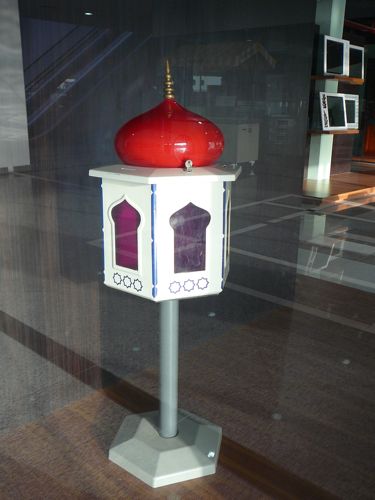
The shop is called Fine Things, and also has some fancy presentation boxes and this, which looks like a mail box to me, but might be for collecting charitable donations, or . . . ? I might be totally wrong. Your guess is as good as mine:
I like this tiny little mall because it has commercial kitchen supply shops with all kinds of display cases and things you don’t find very often. There is also a mattress shop; I always laugh when there is a family shopping there for mattresses because the parents don’t say “NO!” to their kids, so the kids are JUMPING ON THE MATTRESSES! The salesmen seem unable to ask the parents to make them stop.
Just-Before-Sunrise 3 March 2008
Sunrise this morning was just another sunrise, no clouds, nothing to distinguish itself. But – just before sunrise – a whole other story:

It is 72°F / 22°C and very hazy, the kind of haze that also sends people to the hospital with aggravated asthma.
Dharfur: The Janjaweed are Back
Lynsey Addario for The New York Times:
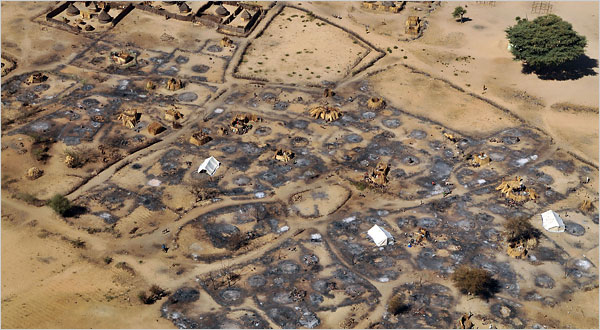
SULEIA, Sudan — The janjaweed are back.
They came to this dusty town in the Darfur region of Sudan on horses and camels on market day. Almost everybody was in the bustling square. At the first clatter of automatic gunfire, everyone ran.
The militiamen laid waste to the town — burning huts, pillaging shops, carrying off any loot they could find and shooting anyone who stood in their way, residents said. Asha Abdullah Abakar, wizened and twice widowed, described how she hid in a hut, praying it would not be set on fire.
“I have never been so afraid,” she said.
The attacks by the janjaweed, the fearsome Arab militias that came three weeks ago, accompanied by government bombers and followed by the Sudanese Army, were a return to the tactics that terrorized Darfur in the early, bloodiest stages of the conflict.
Such brutal, three-pronged attacks of this scale — involving close coordination of air power, army troops and Arab militias in areas where rebel troops have been — have rarely been seen in the past few years, when the violence became more episodic and fractured. But they resemble the kinds of campaigns that first captured the world’s attention and prompted the Bush administration to call the violence in Darfur genocide.
Aid workers, diplomats and analysts say the return of such attacks is an ominous sign that the fighting in Darfur, which has grown more complex and confusing as it has stretched on for five years, is entering a new and deadly phase — one in which the government is planning a scorched-earth campaign against the rebel groups fighting here as efforts to find a negotiated peace founder.
The government has carried out a series of coordinated attacks in recent weeks, using air power, ground forces and, according to witnesses and peacekeepers stationed in the area, the janjaweed, as their allied militias are known here. The offensives are aimed at retaking ground gained by a rebel group, the Justice and Equality Movement, which has been gathering strength and has close ties to the government of neighboring Chad.
Government officials say that their strikes have been carefully devised to hit the rebels, not civilians, and that Arab militias were not involved. They said they had been motivated to evict the rebels in part because the rebels were hijacking aid vehicles and preventing peacekeepers from patrolling the area, events that some aid workers and peacekeepers confirmed.
Please read the rest of the article HERE.
My husband and I have long supported an organization called Medecins Sans Frontiers / Doctors Without Borders. Wherever there is human misery, these brave doctors go and serve those suffering, and their life-saving work is performed under the worst possible conditions. They don’t look at politics. They look at human suffering, and do their best to alleviate it, or to do what they can. These heroic doctors are serving in Dharfur – while they can. When Medicins Sans Frontiers have to pull out, you know that the situation is as bad as it can be.
The accept donations from anyone, anywhere. Be generous.
How Good People Turn Evil
This is a subject that fascinates me – how even “good” people can do very very bad things . . . The article and interview is from Wired.com science/discoveries and you can read the entire article and view a videotape by clicking on the blue type.
TED 2008: How Good People Turn Evil, From Stanford to Abu Ghraib
By Kim Zetter 02.28.08 | 12:00 AM
MONTEREY, California — Psychologist Philip Zimbardo has seen good people turn evil, and he thinks he knows why. Zimbardo will speak Thursday afternoon at the TED conference, where he plans to illustrate his points by showing a three-minute video, obtained by Wired.com, that features many previously unseen photographs from the Abu Ghraib prison in Iraq (disturbing content).
In March 2006, Salon.com published 279 photos and 19 videos from Abu Ghraib, one of the most extensive documentations to date of abuse in the notorious prison. Zimbardo claims, however, that many images in his video — which he obtained while serving as an expert witness for an Abu Ghraib defendant — have never before been published.
The Abu Ghraib prison made international headlines in 2004 when photographs of military personnel abusing Iraqi prisoners were published around the world. Seven soldiers were convicted in courts martial and two, including Specialist Lynndie England, were sentenced to prison.
Zimbardo conducted a now-famous experiment at Stanford University in 1971, involving students who posed as prisoners and guards. Five days into the experiment, Zimbardo halted the study when the student guards began abusing the prisoners, forcing them to strip naked and simulate sex acts.
His book, The Lucifer Effect: Understanding How Good People Turn Evil, explores how a “perfect storm” of conditions can make ordinary people commit horrendous acts.
He spoke with Wired.com about what Abu Ghraib and his prison study can teach us about evil and why heroes are, by nature, social deviants.
Wired: Your work suggests that we all have the capacity for evil, and that it’s simply environmental influences that tip the balance from good to bad. Doesn’t that absolve people from taking responsibility for their choices?
Philip Zimbardo: No. People are always personally accountable for their behavior. If they kill, they are accountable. However, what I’m saying is that if the killing can be shown to be a product of the influence of a powerful situation within a powerful system, then it’s as if they are experiencing diminished capacity and have lost their free will or their full reasoning capacity.
Situations can be sufficiently powerful to undercut empathy, altruism, morality and to get ordinary people, even good people, to be seduced into doing really bad things — but only in that situation.
Understanding the reason for someone’s behavior is not the same as excusing it. Understanding why somebody did something — where that why has to do with situational influences — leads to a totally different way of dealing with evil. It leads to developing prevention strategies to change those evil-generating situations, rather than the current strategy, which is to change the person.
You can read the rest of the article and view the video HERE.
Kuwait Towers 29

In today’s Kuwait Times is a notice that today, the Towers turn 29 years old, and in honor of that milestone Mushari Al-Sanousi announces that to commemorate its success and celebrate the occasion, a 30% discount will be offered at the Towers Restaurant to all diners today, March 30th.
Donna Leon: Suffer the Little Children
After reading Zanzibar Chest I decided it was time to give myself a break, and I allowed myself another Donna Leon book, this one Suffer the Little Children. I am currently reading another detective series, recommended by my sister, set in China. What they all seem to have in common is a very tired, sad, jaded view of corruption in society, and particularly among the poorly paid police. Sigh.

In this book, a Doctor and his wife are invaded in the middle of the night by the carabinieri, a kind of police in Venice. I am not sure how the two agencies differ, maybe it is like the difference between state police and local police in the US, but when the paper was faxed over coordinating with Brunetti’s office, it got lost somewhere, and the action was never coordinated, and Brunetti gets a call in the middle of the night.
The doctor and his wife have adopted a child illegally. They bought an unwanted child from an Albanian woman, paid for her pregnancy expenses, paid a huge fee to her, and then had the child taken from them. Here is the saddest part of the story – the child’s mother doesn’t want the child, the illegally adopting parents want him back desperately, but the child is sent to a state orphanage, because of the illegal adoption.
It is a very sad book.
Here is why I read Donna Leon – some of her paragraphs are just brilliant. Memorable. Unforgettable.
“Brunetti’s profession had made him a master of pauses: he could distinguish them in the way a concert-master could distinguish the tones of the various strings. There was the absolute, almost belligerent pause, after which nothing would come unless in response to questions or threats. There was the attentive pause, after which the speaker measured the effect on the listener of what had just been said. And there was the exhausted pause, after which the speaker needed to be left undistrubed until emotional control returned.
Judging that he was listening to the third, Brunetti remained silent, certain that she would eventually continue. A sound came down the corridor: a moan or the cry of a sleeping person. When it stoped, the silence seemed to expand to fill the place.”
When you read Donna Leon, you forget you live anywhere else. For one brief moment, you become Venetian, you live in Guido Brunetti’s shoes. The speak the Venetian dialect, you think like a Venetian. What an escape!
The paperback edition will be out in April for $7.99 at Amazon.com for $7.99 plus shipping.
Taking the Cat for a Drag
When we were first married, we got our first cat. Being book people, we read a book about training cats that told us how easy it was to train a cat to go for a walk on a leash.
We tried it. We tried it several times. We tried it with several different cats. We never found a cat who could be trained to go for a walk on a leash. The Qatteri Cat scratched me bloody when I just tried to put on the harness. I never even got the leash attached. I still have the harness. I still have the leash – never been used.
We called it “Taking the Cat for a Drag.” It looks a lot like this:

Enter the ICHC online Poker Cats Contest!
Recent Comments
intlxpatr on A Lawless, Authoritarian … Kuwait Someday on A Lawless, Authoritarian … intlxpatr on Oh Thank You, Amazon! Rivergirl on Oh Thank You, Amazon! intlxpatr on Give to Those Who Ask Wikipedia Donate Button

Amazina


Early Voting in Florida


 Here There and Everywhere