Taking the Cat for a Drag
When we were first married, we got our first cat. Being book people, we read a book about training cats that told us how easy it was to train a cat to go for a walk on a leash.
We tried it. We tried it several times. We tried it with several different cats. We never found a cat who could be trained to go for a walk on a leash. The Qatteri Cat scratched me bloody when I just tried to put on the harness. I never even got the leash attached. I still have the harness. I still have the leash – never been used.
We called it “Taking the Cat for a Drag.” It looks a lot like this:

Enter the ICHC online Poker Cats Contest!
First Sunrise in March
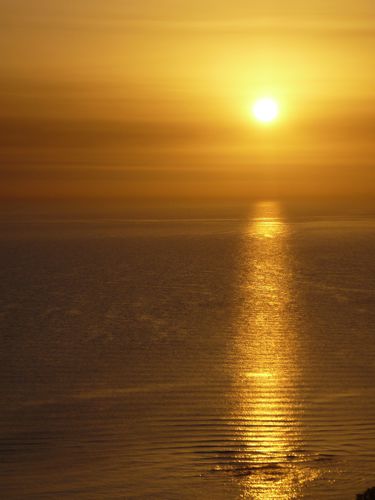
Sunrise is starting to look a lot like summer – not so many clouds to make it more dramatic. We still have some clarity, the sky is still more blue and less hazy, but every sign is there that the cold winter is over and summer is well on its way. It is 48°F / 9°C, and there isn’t a cloud in the sky, only that wicked, poisonous haze hanging over the horizon.
“So Many Christians!”
My Kuwaiti friend was shaking his head in disbelief. He had been to the old city to pay a condolence call on a Friday, and happened by the Lighthouse compound near the Sheraton circle on a Friday morning, just as some of the services were getting out.
“I had NO idea!” he looked at me in absolute amazement.
I just laughed. When we first got here, we attended church on that compound; our church moved off only months ago, when the road construction work got seriously under way and parking increasingly became a problem. It was the most amazing experience on earth – there were the Indian Men’s Catholic services and the Philipine Evangelical service and the rock-music evangelical service and the staid Anglican services and the family Philipine Catholic services and . . . well, you get the picture. There are an amazing number of expatriate Christians in Kuwait. At any one time on the compound, there are about twelve different services going on, and no sooner does one finish and the participants exit, than the new group is coming in.
Now, churches meet all over Kuwait. They met in villas, they meet in schools, they meet in every neighborhood. Today, in our church, we asked for blessings on Kuwait, on the Emir and his family, and those in leadership positions in Kuwait. We prayed for the leaders of all the countries in our congregation (English, Irish, Scottish, South African, Chinese, Indian, Nigerian, Kenyan, Dutch, Egyptian, Ethiopian, American, Australian {I have forgotten a few, I am sure} . . . lots and lots of blessings!) Most of all, we thank God for the freedom to worship in Kuwait.

(This is not our church in Kuwait. This is the Church of the Holy Sepulcher, in Jerusalem. I was looking for a church that looked more Middle Eastern than Western, and this is what I could find!)
Our pastor also has a blog, q8bridge about which he says “The purpose of this blog is to enable a bridge to be built between Christians and Muslims, especially those living in Kuwait. Through questions and dialogue we hope to promote deep friendships and mutual understanding.”
He examines the beliefs we have in common, and where we differ, and some of the reasons why we differ. I urge you to have a look.
Leap Year Reversals
Here it is, gals, a chance that only comes up once every four years – and only one day – February 29.
In Western culture, it is the day that women can propose to men!
I don’t know anyone who has actually done this, proposed on February 29, but it’s an old legend.
The below is from About.com: Leap Year Traditions where you can read all kinds of information about today’s uniqueness.
Leap Year has been the traditional time that women can propose marriage. In many of today’s cultures, it is okay for a woman to propose marriage to a man. Society doesn’t look down on such women. However, that hasn’t always been the case. When the rules of courtship were stricter, women were only allowed to pop the question on one day every four years. That day was February 29th.
Children Damaged by Materialism
A recent study discussed in BBC Health News:
Children ‘damaged’ by materialism
Some 89% of adults think children are more materialistic than ever
Most adults in the UK believe that children’s well-being is being damaged because childhood has become too commercial, a lifestyle poll has found. Some 89% of adults in the GfK NOP survey of 1,255 people believed today’s children were more materialistic than previous generations.
The poll is one of the contributions to a continuing inquiry into childhood.
The Children’s Society said adults had to “take responsibility for the current level of marketing to children”.
Bob Reitemeier, chief executive of the society, said: “A crucial question raised by the inquiry is whether childhood should be a space where developing minds are free from concentrated sales techniques.
“To accuse children of being materialistic in such a culture is a cop-out,” he said.
Mr Reitemeier said: “Unless we question our own behaviour as a society we risk creating a generation who are left unfulfilled through chasing unattainable lifestyles.”
The children’s market is worth an estimated £30 bn a year.
As chief executive of the National Schools Partnership, Mark Fawcett brings business and marketing into schools, and he believes you cannot shield children from the real world.
“We have to live in the current communications era where children can see a huge amount of information,” he told BBC TV news. “We have to use our judgement and we have to, as an industry, make sure we are working with children and families, and not exploiting them.”
Selling lifestyles
The evidence on lifestyle is part of a six-part series of investigations published by the Children’s Society for a continuing inquiry into childhood in the UK which brings together the views of academics, religious communities, teachers, local authorities and authors.
Dr. Rowan Williams, the Archbishop of Canterbury, who is patron of the inquiry, said: “Children should be encouraged to value themselves for who they are as people rather than what they own. “The selling of lifestyles to children creates a culture of material competitiveness and promotes acquisitive individualism at the expense of the principles of community and co-operation.”
Comment: It’s not just children. We are ALL damaged when we start to measure ourselves by what we own. You can read the entire article Here.
History of Architecture in Old Kuwait City (5)
One last quote from this wonderful book by Saleh Abdulghani Al-Muttawa, because it summarizes his ideas on what makes house practical for the weather and customs of this region:
Cultural Response
. . .the major critical cultural and customs problems which concern housing are;
1. Privacy for female inhabitants
2. Separation between female and male guests, and separation between guests, in general, and house members.
3. Future family expansion
. . . The approach to solving those critical problems are as follows:
1. To assure privacy for family members, and especially female members. The family part of the house has been pushed all the way to the back; in other words, it is on the north side far away from the street. It is difficult, or impossible, for anyone passing by the house to be able to look through and see the inside, especially with all those trees and plants placed in front of the house. Another conservative step has been taken by separating the family entrance from the guest’s entrance, and placing the family entrance close to the driveway and the garage for easy and private access. All that gave the female members of the family more free and secured mobility inside the house.
2. The prototype design provides a separate quarter for the guests, “Dewania.” The “Dewania” is placed on the southern side of the house away from the family entrance, to provide privacy for both family members and guests. The “dewania” is actually divided into two “dewanias,” female “dewania” and male “dewania.” For more seclusion and privacy of both sexes, the entrance of the female “dewania” is placed on the west side and the entrance of the male “dewania” is placed on the east side. Both entrances are close to the main road to make it more convenient and easy for the guests to come in and out. Each “dewania” has its own bath. There is only one dining room, because most of the time only men stay for dining. (Women have to go home to cook for their families.) If it happens that both sexes stay for dining, women can be accomodated in their “dewania.” A collapsible partition is placed in between the two “dewanias.” In big events like wedding parties or feasts, the partition can be collapsed, so the space would be large enough for a sizable number of people.
In a post last week, How decisions are made in Kuwait we had a long discussion about diwaniyas in the comments section. What I like about al-Muttawa’s concept is that collapsible wall in between the female and male diwaniyya. It could allow the females to listen in on major political discussions – what? You think we aren’t interested? You are wrong! – and participate.
“How can they participate while separated?” my western friends will be asking.
There are emmisaries. When sitting with the women, in Saudi Arabia, I wondered at first how my husband and I would both know when it is time to go. In western society, we have a meeting of the eyes and my husband will give an almost imperceptible nod and I know it is time to begin to make our farewells. As the hour got later and later, and still later, I finally asked one of the women how I would know when my husband wanted to leave.
“You want to leave?” she gasped in horror!
“No, No!” I assured her, “I just don’t know how I will know when my husband wants to leave!”
“Your husband will send for you! The children will tell you!” she laughed, and I stopped worrying. The children were running back and forth from room to room, reporting on the happenings in the men’s diwayya, where a holy man was discussing morality and requirements of morality.
This was one of my favorite places in Saudi Arabia, the house of friends. In the women’s majlis, there was only a TV, and seating around all the walls. There was nothing on the walls, nothing, not a picture, not a calligraphy, nothing, but the furniture was strong and comfortable, and the hospitality never-ending. When dinner time came, we went to an adjacent entirely bare room, bare except for the lavish dinner laid on the floor, where we all sat and ate, and one huge cupboard, full of mattresses. The dining room became one of the sleeping rooms when all the guests departed.
I didn’t get a tour of the house; I only know what I saw from my entrance through the family entrance into the female part of the house, my brief glimpse of the kitchen area – large and utilitarian. What I remember most clearly was the love and joy in the family, and that all the walls were totally devoid of anything decorative.
+ + + + + +
When I came to live in Kuwait, the real estate people showed me 20 villas and one apartment. The villas, each and every one, were HUGE! Most of them were three or four floors, more than one had an elevator, and several had their own swimming pools.
Most of the houses had a large kitchen – separate from the house, outside! Alongside it were the quarters for the maids, the drivers, the guard, etc. Most of the houses had at least five bedrooms, at least two diwaniyyas.
In the newer areas, there was barely two feet between houses, so windows on the sides of the houses were non-existent, or heavily curtained over, making those rooms very dark. In the older houses, the bathrooms were small and the spaces were divided strangely, by western ways of thinking.
Mostly, though, the villas were lovely, full of luxurious materials and beautiful touches. As I would walk though, sounds bounced off the thick cinderblock walls and the marble floors.
AdventureMan works long hours. I would think of me and the Qatteri Cat bouncing around in the huge house like two little peas in a big bowl, and where would I find him if he hid out for a while? The villas were just too much space for our little family, and we opted for the apartment, although the apartment is bigger than many homes in the United States. AdventureMan and the Qatteri Cat still look at me accusingly from time to time; they always enjoyed an hour or two together in the garden on Friday mornings, and now we have no garden. . . all we have (I can’t even keep a straight face as I write this) is that glorious 24-hour-a-day 180° view of the Arabian Gulf. 😉
+ + + + + + +
If I ever see this book for sale, I will come back here and update. If YOU see it for sale, please come back here and let us know!
“Whirling Chaff”
From Psalm 83
Verse 13
O my God, make them like whirling dust,*
like chaff before the wind.
Reading the Lectionary readings for today I came across this verse in the very first reading. It brought a grin to my face.
Lent continues. The Lord sends me out in my car almost daily, in spite of my best laid plans. I struggle to keep my resolution not to call – not to even THINK – bad names at the fools on the road who cause disruption, chaos and pain. It helps to have a substitute in mind, so I have something I CAN say instead of just struggling NOT to say the words that immediately come to mind.
The above verse will do nicely – don’t you think?
History of Architecture in Old Kuwait City (4)
This is my favorite section from The History of Architecture in Old Kuwait City by Saleh Abdulghani Al-Mutawa, Architect. It is quoted from the section called Social Customs, starting on page 206:
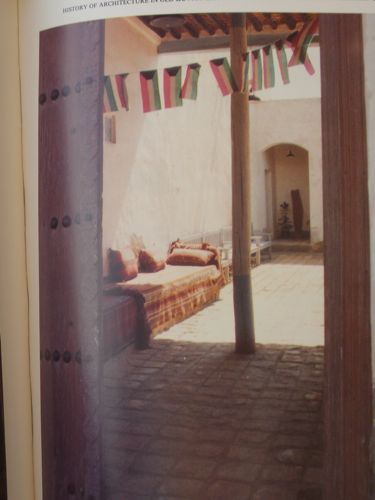
Kuwait is a small nation, with population of one million, that actually has a large influence on people’s behavior; it makes the whole country like one unified family. In the neighborhoods, it is customary to see houses left open and without any security measures, always ready for visitors, which reflects the strength of the relations between neighbors, and the confidence they enjoy. The most distinctive customs are:
1. Large families; average size is eight members. The young generation is trying to minimize the family size. They live in rather large houses, seven to ten bedrooms, which is considered to be an average size house. The house provides privacy for the boys, when they grow up and have their own families.
2. Large family groups, either under one roof or in clustered dwellings, is noticable throughout Kuwait neighborhoods. That reflect the willingness of families and relatives to cooperate and help each other.
3. Newly married sons tend to stay in their parent’s house and share the cooking and dining, so houses have rather large kitchens and dining rooms.
4. Families and relatives visit each other on Fridays and stay for lunch, which is the main meal of the day. The number of visitors varies from 20 – 50 persons, depending on the size of the families. Men and women visit in separate rooms, since separation of males and females is part of the custom. (The author notes that he is talking about old habits and traditions that were prevailing in the old city.)
5.All houses have what is called “Dewania” which is a guest room. In well designed houses, two “Dewanias” were furnished, one for males and one for females, since separation between males and females is mandatory as far as the customs are concerned. The “Dewania” has its separate entrance from the rest of the house, which is to provide privacy for the inhabitants and prevent sudden interactions with guests. It is considered bad for a female to be seen by a male guest, and vice versa. In poorly designed houses, the “Dewanias” don’t have proper privacy and seclusion. The men have the habit of visiting the neighborhood “Dewanias” at night for socialization and discussion of daily matters. In the past the “Dewanias” were the only news sources for the people. Different “Dewanias” are known by the last name of the owners. Hot tea and Arabian coffee are served on a regular basis and in big events like celebrations, “Eads”, wedding parties, and so forth, big feasts held for families, friends and neighbors.
6. “Chay Aldaha”, or afternoon tea at which it is customary for women to visit each other and gossip. Hot tea and cookies are served for refreshment. “Chay Aldaha” is held in the female “Dewania” to ensure privacy for female guests and to prevent sudden embarrassing interactions with male inhabitants.
7. Women are dressed in conservative clothes when they go out; the face and the two hands are the only parts of the body which are exposed. (The author makes a note that he is talking about old habits and traditions which were prevailing in the city) Privacy for women inside the house is an important factor. They should not be seen from the outside while they are doing their daily housework, and should not be in the way when male guests are visiting in the house.
As you can see, the winds of change have blown through Kuwait creating many, many changes. This book captures a slice of time in Kuwait history, and a wealth of information you don’t even know you know. The ways Kuwaitis lived for generations have changed, just in the last 20 years. I was particularly taken with the author’s mention – several times – that women should not be seen tending to their daily housework – how many Kuwaiti women do you know who are doing housework?
There is a current controversy regarding removal of diwaniyyas constructed on public grounds – if this is an old and accepted tradition, perhaps some adjustment can be made, particularly where the diwaniyyas are not impeding public transport or walking paths? Perhaps some can be “grandfathered”, i.e. exceptions made because of historical location?
Meanwhile, my Kuwaiti friends, sorry for boring you with these descriptions of your family dwellings; you already know all this, but the rest of the world does not, and I wanted to share this with those who follow this blog because they find you exotic and fascinating. 🙂 You really need to add this book to your libraries, as a record of a way of life that seems to be slipping all to quickly into the past.
Back to Work Sunrise
Last night, in the middle of the night, I thought I heard raindrops on the window. I was too drowsy to get up and look, but this morning I can see the pavement is damp and small almost-puddles, so I think we had a small shower, at least where I live.
The sky looks like it might turn blue, well above the horizon, but the horizon is thick and threatening – it almost reminds me of Fires of Kuwait, the award winning show at the Kuwait Science Center about the teams who put out the fires set by Saddam Hussein’s retreating forces as they tried to inflict one final devastation on the Kuwait economy. I can’t imagine what it must have been like here while the wells were being capped, and I wonder if anyone is keeping statistics on the history of health issues of those who were here during that terrible time.
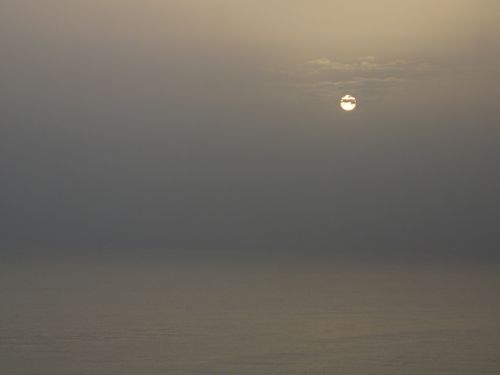
It is 55°F / 13°C at 0700; Weather Underground: Kuwait shows no precipitation, so maybe I imagined it.
History of Architecture in Old Kuwait City (3)
I am quoting so much from Saleh Abdulghani Al-Mutawa. Architect, that you may think you don’t need to run out and buy the book but I assure you, I am only sharing with you a few of the gems I found within. The author has done so much research with such loving attention that the book is full of treasure, every page offers something worthy.
The Year of Demolish
It is a sad memorial in Kuwait’s history. In Rajab 1289 A.H. (i.e. in the middle of the nineteenth century), heavy rains accompanied by severe winds hit the old Kuwait city, and demolished most of the mud houses. Sea waves went high and hit and wrecked ships. It was a disaster for Kuwaitis.
A second natural disaster took place in Kuwait on 30 November 1954 when heavy rains fell and demolished houses and forced 18,000 Kuwaitis to seek refuge in newly built schools. Houses built of mud and a little cement were severely affected, while houses built of rock were not affected.
My Kuwait friends – tonight, instead of going out in your cars, stay home! Sit with your grandparents and ask them about the house they grew up in. Ask them about the meals they cooked. Ask them about the heavy rains, so heavy that they could destroy houses and force 18,000 Kuwaitis to abandon their homes and go stay in schools. These are amazing stories – learn your stories from your grandparents . . . and then come tell us all the stories in your own blogs. If you don’t have a blog, or if you want to share here, you are welcome.
Some of my Kuwait friends ask why I care more about these things than the Kuwaitis. First – my Kuwaiti friends care. In my country, we call these people “the silent majority.” Every now and then the majority energizes and asserts itself. Kuwaitis care. Change is happening, it happens slowly. Keep the faith.
Second – I live here. I may not be Kuwaiti, but I care about the places where I live. If God has placed me here, I trust that he has his reasons, and it is my obligation to him to learn as much as I can and to serve – wherever he may place me. He placed me in Kuwait.
Tomorrow I will print my very favorite part of this book – where it describes family living. Meanwhile, run out and buy your own copy. There is so much I am not covering. This book is a part of your heritage.
Recent Comments
intlxpatr on A Lawless, Authoritarian … Kuwait Someday on A Lawless, Authoritarian … intlxpatr on Oh Thank You, Amazon! Rivergirl on Oh Thank You, Amazon! intlxpatr on Give to Those Who Ask Wikipedia Donate Button

Amazina


Early Voting in Florida


 Here There and Everywhere