Tarek Rajab Calligraphy Re-Visit

Oh, the Tarak Rajab Calligraphy Museum is such a treasure! This time we went back just to have time to watch the entire film on calligraphy, the cutting of the quills and the mixing of the ink, how the paper is prepared and burnished, how ornamentation is developed . . . every time we visit this museum, we see something new, and we learn something new.
This time, I was looking for details. Oh WOW.
Here is a little of what I found:


Kuwait is blessed to have such a gem of a museum, and open to the public free of charge, in a beautiful building, with gracious spaces. You can find more information on their website for both museums (The Tarak Rajab Museum is just around the corner) at The Tarak Rajab Museum website.
Woo Hooo Al Ahmadi
Great sign, Al Ahmadi!

I would love to see a Keep Kuwait Clean sign, maybe a series of them. The one I see features one of the beautiful, pristine beaches, and then the green green of the gulf. That contrast always takes my breath away, and it breaks my heart to see them filthy with fast-food wrappers, and detritus washed up from the boats.
Nicole B / Rainmountain, who has a photography and blog site has a one woman campaign to keep her segment of the beach clean in Mahboula. God bless you, Nicole!I think many of the schools also have beach clean-up days, and some clubs, too.
What would your sign feature? I’m not very artistic – those of you who are, would you do a sign, link to this blog entry so we can come visit?
New Minarets in Fehaheel
I love going out to Fehaheel; it’s kind of got a wild west feeling, with no regard to traffic lanes, no regard to traffic laws, it’s just not the city – it’s a step back in time, even with the beautiful Al Koot and Al Manshar Malls.
Two years ago, they tore down the old minaret on the mosque in the center of town on the Gulf Road, and the wrecker that tried to knock the minaret down got tangled – and fell over! It took months to clean that mess up, and then for the last two years they have been building the new “> twin minarets.
Recently the scaffolding came down. Here is how they look now – a serious facelift for a delightful old lady.

African Textiles at KTAA
If color, texture and weave are your kind of thing, there is a wonderful group in Kuwait for you. Before I even came to Kuwait, people told me about the Kuwait Textile Arts Association, and oh, what a trip.
A friend asked me if I were going to this month’s meeting. I hadn’t seen any announcements for it, and then she said “you ought to come! It’s African textiles.”
Magic words.
You know AdventureMan and I love going to Africa. And a meeting on African textiles? Woooo Hooooooo! Yes, I will admit it, I am totally a textile geek.
Africa is a huge subject to cover, when it comes to textiles, and the speaker did well – Nigeria, Tunisia, Cameroon, Mali, indigo dying, small loom weaving. . . You could teach an entire college level course on any one of those topics, and he gave a great overview.
You can join KTAA for 10KD per year, or you can attend each meeting for 2KD. Meetings are held once a month at the Sadu House, where they also have a fabulous collection of books on textiles.


Cab Ride
When I received this in the e-mail this morning, I realized I had read it before. I read through it anyway, and was every bit as moved as when I read it the first time, and so, I share it with you.
Twenty years ago, I drove a cab for a living. When I arrived at 2:30 a.m., the building was dark except for a single light in a ground floor window. Under these circumstances, many drivers would just honk once or twice, wait a minute, and then drive away. But I had seen too many impoverished people who depended on taxis as their only means of transportation. Unless a situation smelled of danger, I always went to the door. This passenger might be someone who needs my assistance, I reasoned to myself.
So I walked to the door and knocked. “Just a minute”, answered a frail, elderly voice. I could hear something being dragged across the floor. After a long pause, the door opened. A small woman in her 80’s stood before me. She was wearing a print dress and a pillbox hat with a veil pinned on it, like somebody out of a 1940s movie. By her side was a small nylon suitcase. The apartment looked as if no one had lived in it for years. All the furniture was covered with sheets.
There were no clocks on the walls, no knickknacks or utensils on the counters. In the corner was a cardboard box filled with photos and glassware. “Would you carry my bag out to the car?” she said. I took the suitcase to the cab, then returned to assist the woman. She took my arm and we walked slowly toward the curb. She kept thanking me for my kindness “It’s nothing”, I told her. “I just try to treat my passengers the way I would want my mother treated”. “Oh, you’re such a good boy”, she said.
When we got in the cab, she gave me an address, and then asked, “Could you drive through downtown?”
“It’s not the shortest way,” I answered quickly.
“Oh, I don’t mind,” she said. “I’m in no hurry. I’m on my way to a hospice”.
I looked in the rear-view mirror. Her eyes were glistening. “I don’t have any family left,” she continued. “The doctor says I don’t have very long.” I quietly reached over and shut off the meter.
“What route would you like me to take?” I asked.
For the next two hours, we drove through the city. She showed me the building where she had once worked as an elevator operator. We drove through the neighborhood where she and her husband had lived when they were newlyweds. She had me pull up in front of a furniture warehouse that had once been a ballroom where she had gone dancing as a girl.
Sometimes she’d ask me to slow in front of a particular building or corner and would sit staring into the darkness, saying nothing. As the first hint of sun was creasing the horizon, she suddenly said, “I’m tired. Let’s go now.”
We drove in silence to the address she had given me. It was a low building, like a small convalescent home, with a driveway that passed under a portico. Two orderlies came out to the cab as soon as we pulled up. They were solicitous and intent, watching her every move. They must have been expecting her. I opened the trunk and took the small suitcase to the door. The woman was already seated in a wheelchair.
“How much do I owe you?” she asked, reaching into her purse.
“Nothing,” I said. “You have to make a living,” she answered. “There are other passengers,”
I responded. Almost without thinking, I bent and gave her a hug. She held onto me tightly. “You gave an old woman a little moment of joy,” she said. “Thank you.” I squeezed her hand, and then walked into the dim morning light. Behind me, a door shut. It was the sound of the closing of a life.
I didn’t pick up any more passengers that shift. I drove aimlessly lost in thought. For the rest of that day, I could hardly talk. What if that woman had gotten an angry driver, or one who was impatient to end his shift? What if I had refused to take the run, or had honked once, then driven away? On a quick review, I don’t think that I have done anything more important in my life.
We’re conditioned to think that our lives revolve around great moments. But great moments often catch us unaware – beautifully wrapped in what others may consider a small one. People may not remember exactly what you did, or what you said, but they will always remember how you made them feel.
Amazing Performance en Point
A friend sent me this u-Tube video. I love dance, and I have never seen anything like THIS! It’s a French broadcast, but you don’t need to understand French to understand how incredible this couple’s performance is.
How Work Stress Changes Your Body
From yesterday’s BBC Health News:
Work stress ‘changes your body’
Stress seems to produce biochemical changes
A stressful job has a direct biological impact on the body, raising the risk of heart disease, research has indicated.
The study reported in the European Heart Journal focused on more than 10,000 British civil servants.
Those under 50 who said their work was stressful were nearly 70% more likely to develop heart disease than the stress-free.
The stressed had less time to exercise and eat well – but they also showed signs of important biochemical changes.
The studies of Whitehall employees – from mandarins to messengers – started in the 1960s, but this particular cohort has been followed since 1985.
As well as documenting how workers felt about their job, researchers monitored heart rate variability, blood pressure, and the amount of the stress hormone cortisol in the blood.
They also took notes about diet, exercise, smoking and drinking.
Then they found out how many people had developed coronary heart disease (CHD) or suffered a heart attack and how many had died of it.
Lead researcher Dr Tarani Chandola, of University College London, said: “During 12 years of follow up, we found that chronic work stress was associated with CHD and this association was stronger both among men and women aged under 50.
“Among people of retirement age – and therefore less likely to be exposed to work stress – the effect on CHD was less strong.”
You can read the rest of the study HERE,
Yesterday and Today
Yesterday, as I was blogging early in the morning, everything suddenly went wonky and I discovered I was no longer blogging as the blogger, but as a guest. I did everything I could think of, and nothing worked. All day long, srom time to time I would try to log in and it would tell me I was not a valid user. I even changed passwords – nothing doing, the password was not the problem, I was the problem.
Finally, late last night just before bed, I could get on again. I was concerned whether I could get on today, but so far so good, only it doesn’t want to publish my posts. (and as a blogger, like what’s the point, if you can’t post???)
For my not-living-in-Kuwait readers, yesterday we had rain. I suspect rain may be part of the problem – rain has always screwed things up in Florida, in Seattle, in Germany . . .
Here is a photo of the gently falling rain on local vegetation:
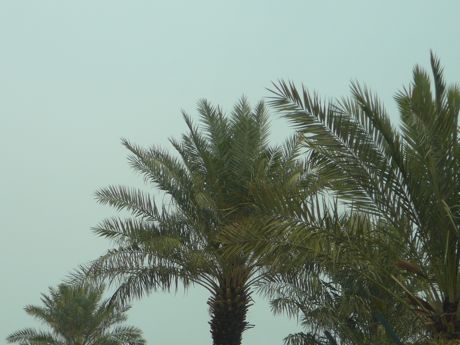
Yeh, I don’t know why the sky looks sort of blue-green, it was really cloudy, but I was shooting toward the sea and maybe the sea reflected green on the clouds (?)
And here is the sunrise from this morning – all two seconds of it. It’s a good thing I was waiting with my camera, this is all I got:
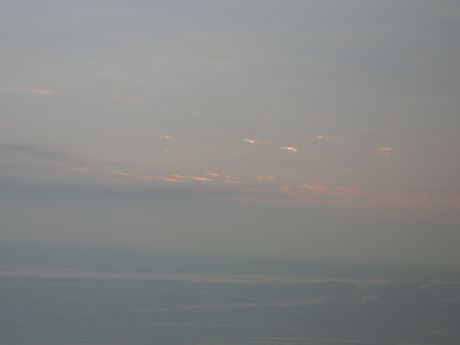
Two seconds later, it was gone. Here is what we have now:
It seems to be brightening, even though we still have cloud cover. Kuwait is a dry country, and desperately needs the rain. This is the dryest, coldest rainy season in memory.
Dream Dealer Tickets
Dream Dealer tickets available by calling Nicky at 593-7165 or email: dreamscene_productions@yahoo.com.

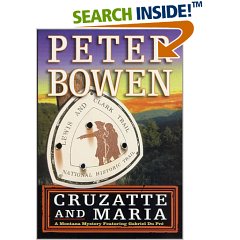
Bowen: Cruzatte and Maria
Peter Bowen’s tales of Montana in transition are an acquired taste. When I first started reading them, at my sister’s recommendation, I had a hard time getting past the dialect. The main character, Gabriel DuPre, speaks English differently; he is Metis, a mixture of French, Indian and who knows what, here before America was America, as he says “long time gone.”
You get used to it. It still makes me think he should be in New Orleans, speaking as he does, it sounds very Cajun, but you get used to it.
Peter Bowen’s Gabriel DuPre is another treat to myself (like Donna Leon.) Reading the latest book I bought, saved for just this time, a cold wintery January, brightened my outlook considerably.
The first book I read, Wolf, No Wolf had to do with environmentalists putting wolves back into the mountains where once they had flourished, but where now, for a couple centuries, people have been raising cattle. Guess what? Hungry wolves love cattle. It makes for some very hostile feelings.
That theme – local culture against intruding environmentalists – continues in this book, where DuPre is hired as a consultant on a film being made about Lewis and Clark. The locals in the Coronado area are no happier with all the film crews and tourists than the ranchers were with the wolves – and people end up dead.
In addition, DuPre’s friend Benetsee and his daughter Maria spend time together in the sweat lodge, and later, his daughter, Marie, sees a mound and is revisited by a vision she had. She tells her dad, DuPre, to dig, and he uncovers a trove of treasures cached by the Lewis and Clark expedition. Partly, it is the incursion of the spiritual and supernatural that I find so intriguing in these books; there is a reality, and then a greater reality, and they co-exist. Bowen makes it seem and feel entirely natural. I love it.
The book has some highly entertaining, laugh-out-loud moments, takes great pokes at the eco-tourist, and at the same time deals with some serious issues. We get to hear DuPre fiddle his old Voyageur songs, we get to hear what people are saying at the local bar, where cheeseburgers are the plat du jour. It is a great way to pass a winter’s day.
Recent Comments
intlxpatr on A Lawless, Authoritarian … Kuwait Someday on A Lawless, Authoritarian … intlxpatr on Oh Thank You, Amazon! Rivergirl on Oh Thank You, Amazon! intlxpatr on Give to Those Who Ask Wikipedia Donate Button

Amazina


Early Voting in Florida


 Here There and Everywhere