Tai-ho’s in Kenmore, WA
“If she didn’t have a refrigerator, Intlxpatr (only she calls me by my real name), what did she do about laundry and diapers when you came along?”
I just looked at her stupidly. That had never occurred to me.
“I remember our next door neighbors had a barrel-shaped washing machine with a hand cranked wringer,” I responded, “but I think by that point my Mom had a more modern washing machine. I don’t know what she was using when I was born.”
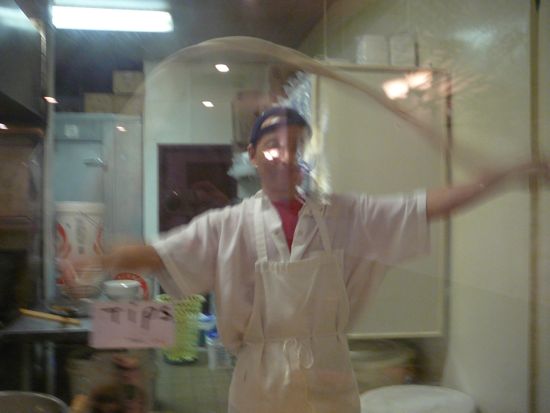
Then, over noodles at Tai-Ho’s, where you watch the noodle-maker man in a specially built window, surrounded by Chinese, Chinese-Americans and Chinese-food lovers, we reminisced about our own babies, and laundry services. We were mothers of the hip generation, back-to-nature, and for eco reasons, we used a diaper service, which was considered much more earth-friendly.
“Oh! The smell of that diaper pail!” I groaned. We both moved on to Pampers after a few months with the soiled diaper smell.
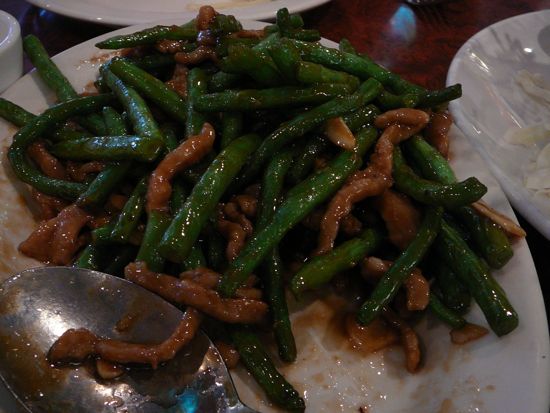
We were rescued from any further contemplation of those pungent smells by the arrival of a delicious Hot and Sour Soup, a big bowl, which we divided, followed quickly by the Green Beans with Meat:
And then – one of the specialities of the house, the Seafood Basket, which is served in a basket of those noodles we saw the noodle-maker-guy making, filled with delectable scallops, shrimp, fish, fresh steamed crispy broccoli and water chestnuts, covered with a foam of egg whites – magnificent.
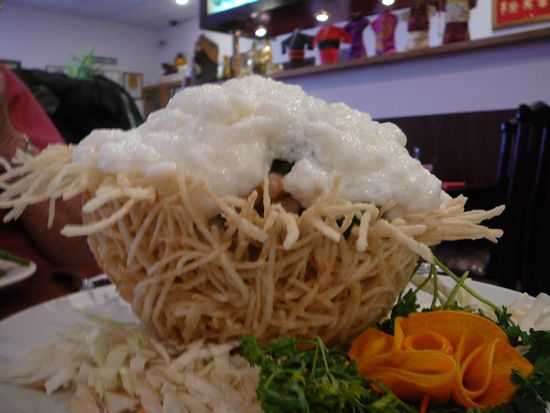
My friend had recommended the Green Beans, but she didn’t know about the Seafood Basket – we just ordered it to see what it was like. After it came, we saw other diners asking the waitress about it and several more came out of the kitchen. It was DELICIOUS.
Tai-Ho Restaurant
http://www.taihorestaurant.com
6312 NE Bothell Way
Kenmore, WA 98028
(425) 485-4020
If you are coming from Kuwait – or elsewhere – and want to eat like a local, you want Tai-Ho’s. It is purely wonderful.
Superlative Day: Gone Fishing
I’ve had some great and memorable days in my life, and this is one of them. My good friend said “Hey, you want to go fishing Friday?” and I said “Yes!” I had to go get a one-day fishing license, and I could add crab for a mere 50 cents, so I did.
We met up at 6:30 a.m. and were on the water by 7 a.m. on one of the hottest day’s in Seattle’s summer. As we left the marina, we passed an Eagle. (We thought of you, AdventureMan!)

AdventureMan must have heard us talking about him, because as the sun rises, he calls from Kuwait, eating Felafel sandwiches and ice cream as we watch the sun rise:

And set the crab traps – this is what an empty crab trap looks like. We put turkey legs and old fish heads in the bait box to attract the crabs:

It is a gorgeous morning. As my friends dig out the fishing polls, I admire the mountains and the sparkles on the waters of Puget Sound:

My friend has baited my hook and hands the rod to me. I lower the weight to the bottom, pull it up just a little and – an immediate nibble:
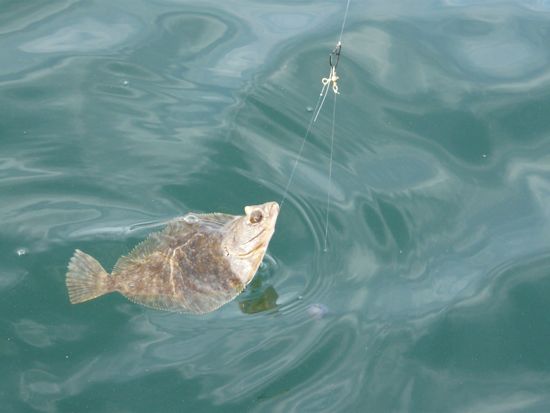
He’s a good size and he’s a keeper. My friend grabs my camera to take my photo with my first fish of the day, I hold the fish up – and just as she is snapping the shot, the fish does a little flip right off the hook and back into the water!
It doesn’t matter – the fish are biting and we are hauling them in. Some are too small; we take them off the hooks and throw them back, telling them to have a good life, grow big and we will see them again, we hope!
After about an hour of superlative fishing, we go back to check the crab pots. They are HEAVY with crab!
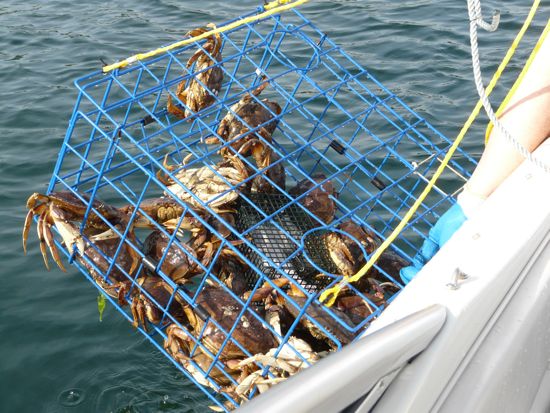
You can’t keep any female crab, or any male under a certain size, so any crab you think you might want to keep, you have to measure. You get a HUGE fine if you are caught with undersize crab. As we bring in the crab and the fish, my friend notes them down on our licence records, which have to be sent in to the state at the end of the season, listing fish we have caught, crab we have caught, and how many we threw back.

We catch a couple rock crab – those you don’t have to measure, and you can keep. Most of what we catch is the sweet and delectable Dungeness Crab – my very favorite after Alaska King Crab.
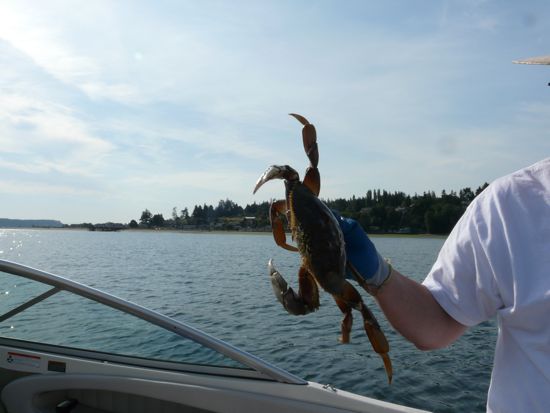

We had just decided to quit for the day – it was getting really, really HOT for Seattle, like 90°F/33°C (and there is an advisory for hot weather, and air stagnation) and we have nearly our limit for crab, and a respectable amount of fish, and we are happy, happy fisherpeople! Just as I am about to raise my line, I get a big bite, and catch the last fish!
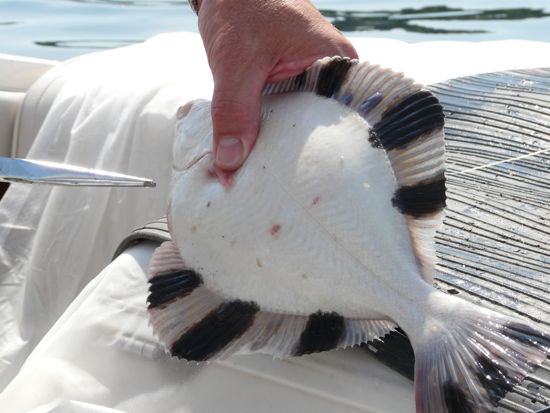
Here is our bucket, full of fish. The cooler is full of crab. What a great day to be alive.

Photo Nuts
My two sisters and I all have the same camera, and my niece, and my son and his wife, so we all share information. Like on our trip, EnviroGirl explained that if you made the picture size smaller, it extends the optical zoom, so if you don’t need a really vast photo, you can focus on something and get this huge telephoto. I had no idea until she explained it. Like yes, it is in the book, and I even read the book, but there is SO MUCH in the book.
My sister Sparkle told us about using a feature called Fireworks. She tried it for fireworks – it works! It also works on moon shots, although there is another feature called Starry Nights for that.
One thing totally cracks me up. There used to be a Simple Mode indicated with a heart, it was simple and automatic, and no one liked to use it. The newer models have something called Intelligent Automatic, and we all use that mode because it gets the best photos. We would never dream of using something called “simple” but “intelligent!” That’s very different!
Mariner Man, Sparkle’s husband, doesn’t use the same camera but he showed us a new technique he says is working for him, getting interesting and new photos: put your camera really near the ground or on the ground.

Sand Castle


Good tip, Mariner Man!
So I’m kind of waiting for sunset, and photo ops just keep happening. There are wonderful kids flying kites, and I wait, and I get the shot I want – what joy!

And then, as the sun continues setting, along come a couple surfers.

This isn’t such a great shot, but it is the only shot I got of one of them up on his board. He wasn’t up for very long.

This hasn’t happened to me for a long time – my memory card is full. I have to quickly go through and delete anything excessive to have room for the sunset. And then – the sun goes into a fog bank. I had thought it would shine through, but no – the fog EATS the sun! And, just at that moment, the surfers decide to go home and I get my last shot:

Let’s Go Fly a Kite
There is so much to do!
There is a long walking promenade along the beach, wide enough for bicycles, moms with strollers, people skating, people walking their dogs, and people just walking or jogging.
On the beach, people are swimming, sunning, building magnificent sand castles, fishing, and . . . flying kites.

Some of the kites are purely magnificent. Here is my favorite – a pirate ship!

Oregon Beach Rental
The Oregon coast is a beach lover’s delight. My mother’s family had cabins on the beach that they rented out every summer, so my Mom grew up on the Oregon beaches, and consequently, we did, too. The cabins, which were always beachy and utilitarian, have become increasingly sophisticated.
We have rented both sides of a wonderful cottage. Our side of the cottage easily sleeps 14 people (we are four people) and the other side of the cottage easily sleeps 10 – 12. They have huge dining tables, cupboards full of glasses, dishes, serving platters, dishwashing AND dishwasher detergents – they are fully equipped with stoves, microwaves, coffee makers, washers and dryers, even hair dryers, even shampoos and conditioners, even beach towels and beach equipment and bike helmets. I am astonished at how equipped they are.

This is called the Little House, and if you want to rent it, you can find it here:
Little House on the Promenade
The cottage has two beautifully furnished living rooms (with additional sleeping on fold out couches if you have a very large family), chairs, TVs, fireplaces, games, books, magazines . . . and it is completely wired for wi-fi. Wooo Hoooo for me!

Although it can be two separate rentals, when it is one family renting both sides, there is a secret passage connecting the two rentals, so we are back and forth in one another’s kitchens all day. Oh, what fun.
Oregon Sunset
This is not your Kuwait sunrise – we are on the way far west coast, and what we get here, when we are on the water, is spectacular sunsets. I thought of you when I saw this sunset last night – and the sun set around 8:45 at night! I didn’t have the energy to share it with you last night, but I will share it with you now.

And just moments later, day is done:

Qatteri Cat Takes a Bath
“The Qatteri Cat really needs a bath,” I say to my friend as we sip coffee in her living room, “He’s gotten all matted in the heat. The truth is, I’m afraid to bathe him. He has calmed down so much since we got him, but when he gets scared, his primitive brain takes over and he has scratched and bitten me.”
I am thinking particularly of when we first got him. He was scared of me, he didn’t much like women at all. He adored AdventureMan (still does) and slowly, slowly warmed up to me.
He had a house outside, called a “cat containment center.” Go ahead. Laugh. All our friends did, too, but it gave us peace of mind. Qatteri Cat could be outside in the garden, and we knew he was safe. People put out poisoned fish in our neighborhood, to kill stray cats, and we didn’t want that heartbreak.
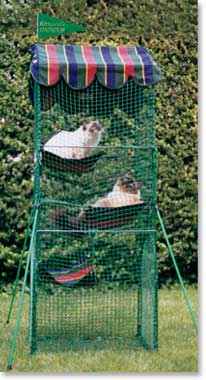
(This is called the cat penthouse, and it is created by Kittywalk. They have all kinds of things for pets, including, I am not kidding, pet strollers, in case you want to take your cat for a walk, but they don’t walk, they ride. I cannot imagine using one of these pet strollers in Kuwait. . . . or anywhere.)
So Qatteri Cat is out in his cathouse, and I hear an snarling, howling YOWWWWWLLLLL. His friend, Satchmo, from up the street has wandered over to say hello and Qatteri Cat is totally out of control. He is mad, he is running and throwing himself against the walls of the kitty penthouse, and Satchmo – all he wants is to be friends!
I get the trusty squirt bottle and shoo Satchmo away. I talk calmly to Qatteri Cat, calmly, calmly, and I open the door. He tries to rush out and I get him by the scruff of the neck, you know, how they tell you so the cat will go immobile? He can’t scratch and bite if you have him by the scruff, right?
Wrong. Wrong. So very very very wrong.
I still have scars. I got him inside, and gave him a 30 minute time out in the bathroom to calm himself down. When I did that, he totally forgot what had happened and would be fine. Actually, most of the time 5 minutes was enough, but I figured with all that adrenelin going through his system, 30 might be safer.
Fast forward. Bath time.
My sweet friend really knows animals.
“Don’t try it alone, Intlxpatr. That isn’t a job for one person. Get AdventureMan to help you, tell him to hold him by the scruff of the neck! Like his mother. He needs to know you are in control.”
So yesterday, I talked AdventureMan through what we needed to do. I will get everything prepared, and then one of us has to hold the Qatteri Cat and one of us has to soap him, massage him and rinse all the soap out.
AdventureMan chose to hold the cat. I was greatly relieved.
We got him into the bidet (first mistake, QC is a BIG cat) with a towel in the bottom, and when I started pouring the water, QC started howling. We are not talking your everyday miow here, we are talking, as AdventureMan put it, the sound of a cat having surgery without anaesthesia. I was so afraid our neighbors were going to report us for pet torture – because that is what he was howling.
Not only that, but it’s one thing to try to hold a terrified cat by the scruff of the neck (bad enough!) and another thing totally to try to control a terrified, wet, soapy cat. I was scrubbing, pouring, QC was howling, AdventureMan is saying “Hurry up! hurry up! I can’t hold him much longer” and there is water water everywhere. We have the bathroom door closed, so when QC gets out of AdventureMan’s grasp, we quickly capture him again. We are all soaking wet, QC is still soapy, and AM and I are panting and laughing and we need to get this job DONE.
We transfer him to the bathtub and finish the rinsing, and wrap him in a towel. At no time does he stop his shrieking, not until we let go. He is still very very wet, but he won’t let us – or a towel – anywhere near him. Finally, I put a towel in a sunny spot and leave, and when I have been gone a significant amount of time, QC seeks the nice warm towel in a nice warm spot.
I check on him every ten minutes or so. He doesn’t want to see me. Finally, maybe an hour later, he comes in and stretches out on my legs. All is forgiven, if not forgotten.
But here is the really cool thing. As terrified as he was, he didn’t scratch and he didn’t bite. Maybe he might have, if AdventureMan had not held him firmly, but we have held him firmly before and gotten terribly scratched and bitten. I think, as bad as it was. Qatteri Cat trusts us enough to suspect we were not trying to kill him. And his coat is a lot nicer, now, except the holes show where I have been cutting out the lumps.
Today’s Kuwait Times: Monday, 21 July
First, to give credit where credit is due, the Kuwait Times has become better and better during my time here in Kuwait. The grammar is better, they have (most-of-the-time) stopped using “red handed” in every crime report, and the captions under the photos match the photos.
Until today. I think an editor must be on vacation.
Here is the photo:

And here is the caption under the photo: KUWAIT Director of Public Relation and Moral Guidance department COL Adel Al-Hashash receiving Deputy Chairman of Police Sports Association COL Mubarak Al-Mubarak and head of police Karate team to the Arab championship LTC Waleed Ghanem Al-Ghanem over the weekend.
Now down at the bottom of the page is the same caption, with this photo:

Also on page 2 is the following article – please read it closely and tell me if I am reading it correctly – that this will compel women, but not men, to go to the reconciliation committee before filing for divorce? I hate divorce. I am all in favor of family counseling. I am in favor of any law helping families, as long as it applies equally to men and to women:
Family Court will halve divorce rates in Kuwait
Published Date: July 21, 2008
KUWAIT: Judge Faisal Al-Mirshid has revealed that family court should be up and running in Kuwait within one year, predicting that its existence would halve the country’s divorce rates. The Appeal Court head, member of the Higher Judicial Council and chairman of the committee entrusted with establishing the family court said that the court’s establishment would reduce divorce cases by 50 percent because those asking for divorce will first have to go to the reconciliation committee, otherwise their cases will be automatically rejected in all courts.
Al-Mirshid said that a ministerial decision has been issued to establish the family court, and the committee has already begun working on the regulatory legal framework which will control its decision making process, reported Al Jarida.
He explained that the committee has already contacted the Awqaf Ministry’s Secretariat General regarding the allocation of a building to house the family court, which will include several departments and sections, including a shelter for women and children fleeing domestic violence.
He explained that it will also establish a fund to help Kuwaiti families and provide financial aid for divorced Kuwaiti women or those whose husbands are imprisoned.
Al-Mirshid said that there are some impediments to the success of the family courts, including a need to amend the current divorce legislation in order to compel women seeking a divorce to first resort to the reconciliation committee before filing for divorce.
He said the family court law will be applied to followers of the Jaafari Shia sect followers just like other personal affairs legislation, emphasizing that there is no contradiction with the idea of Jaafari courts which call for reconciliation before resorting to court for divorce.
He said that there will also be a fund established to provide expenses for families within the Jaafari rules.
Last, but not least, on the very same page 2 is this intriguing article. So you tell me – what are they saying DID happen?
MoI clarifies erroneous rescue operation
Kuwait: The Ministry of Interior clarified an erroneous report published in some local dailies recently. It referred to a report on the rscue operation of four persons whose boat sank off the Kubbar island.
It said the coast guard acted promptly the minute they received the call, while the delay in rescuing them was actually caused through wrong coordination.
That error resulted in the team having to scour the entire square area around the island in their search for the missing persons.
Help was sought from a helicopter from the US search rescue team to assist in the operations, it added.
Ministry officials also disclosed that the four persons of both sexes were not in any way related to the Al-Sabah family, and that the search operation succeeded in locating them and getting them safely ashore without any casualties.
They said contradictory reports of the rescue operations published in newspapers was due to the fact that the media did not source the correct information from the concerned authorities.
A statement released by the ministry said rescue teams from the fire service department as well as central operations (777) participated in the rescue.
One Step Beyond: Baan Sabaidee
We all have our limits. When it comes to food, my limits are farther out there than most – I like taste. I like most cuisines, or at least most of most cuisines. I do have my limits.
One limit is okra / ladyfingers/ bamyi:

One time, at a buffet in Jordan, I told my husband I was going back for something I found totally delicious, and he laughed and said “You know it is okra?” No, I didn’t know. I did go back and get a little more anyway, but it no longer tasted the same – I knew it was okra. It’s the texture; okra is, to me, slimy, gooey, in my mouth it gives me shudders. It’s like raw oysters. Shudder.
Deep fried okra in a spicy tomato sauce was OK – until I knew it was okra.
I was visiting with a friend, working on some projects and we decided to order out from a nearby newly opened Thai restaurant for lunch. She’s a crazy woman, like me. We are not alike – she says “tomahto” and I say “tomato” and somehow we get along just fine. We decided to order things we have never ordered before.
We ordered two safe things – the first was Gai Sate (chicken sate). It was gorgeous and delicious. The sauce is one of the best sauces I have had with Thai food, hot, sweet, and sesame. Delightful.

The second safe thing was Pad Thai, which was also beautiful and tasty:

We ordered Pad Ka Phrao, because we had never heard of it, and because it has basil leaves in it:

It was delicious.
We loved the way the food was packaged. The green curry and the soup was packed in sealed plastic sacks, inside the normal plastic containers. Not a single drop was spilled in the bag. I’m impressed. I love soups, and I hate the mess when soups spill in the bags:

This is the green curry (Gaeng Khew Wan). It is totally delicious.
You know me. I love fish. We had never tried the Tom Kling (smoked herb soup) so we ordered that, with grilled smoked fish. It came beautifully packaged, like the above curry. When we went to eat the soup, however, although it was delicious, I had to fish out the fish. I am not normally squeamish, but their little fishy eyes were too much for me:


AdventureMan and I later made a trip to find the restaurant. It wasn’t easy, but it was worth the trouble. Tucked back behind some of the behomoth apartments on the Southern Gulf Road, it only has maybe six tables, but it is tiny and exquisite. Someone went to a lot of trouble to make this little place beautiful and serene. Although it is a new restaurant, it was already packed when we got there, but a table opened up just as we arrived.
We asked for recommendations, and tried the Tod Mun (shrimp cakes) and a dish I loved. Pad See Ew, which was vermicelli noodles stir fried in soy sauce with shrimp. We also had the chicken sate again – delicious. We were busy watching other people with big pots of something in front of them, shared by groups. We have to go back and try that, whatever it was.
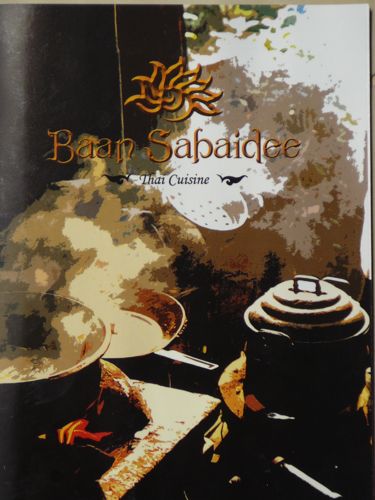
Their take out menu has a nice feel to it – heavy paper with good photos so you can guess what you are ordering:
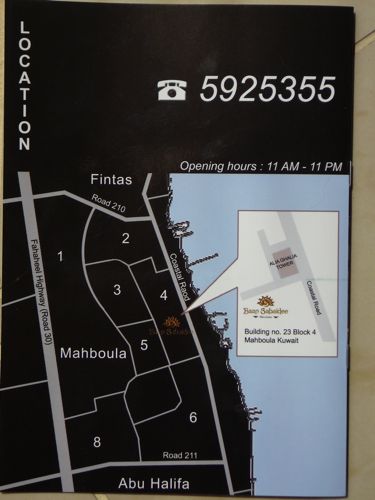
And- the bonus – it has a map of how to get there on the back, so I don’t have to confuse you trying to figure out the directions:
If they are full, I noticed across the street is another branch of China Queen, one of the best kept secrets in Kuwait for Chinese food with authenticity.
More Three Cups of Tea
The timing couldn’t be better. Thank you, Phantom Man, for sending a link to this New York Times article on Three Cups of Tea, from the July 13th New York Times.
By NICHOLAS D. KRISTOF
Published: July 13, 2008
Since 9/11, Westerners have tried two approaches to fight terrorism in Pakistan, President Bush’s and Greg Mortenson’s.

Greg Mortenson with Sitara “Star” schoolchildren. Photo: Fred R. Conrad/The New York Times
Mr. Bush has focused on military force and provided more than $10 billion — an extraordinary sum in the foreign-aid world — to the highly unpopular government of President Pervez Musharraf. This approach has failed: the backlash has radicalized Pakistan’s tribal areas so that they now nurture terrorists in ways that they never did before 9/11.
Mr. Mortenson, a frumpy, genial man from Montana, takes a diametrically opposite approach, and he has spent less than one-ten-thousandth as much as the Bush administration. He builds schools in isolated parts of Pakistan and Afghanistan, working closely with Muslim clerics and even praying with them at times.
The only thing that Mr. Mortenson blows up are boulders that fall onto remote roads and block access to his schools.
Mr. Mortenson has become a legend in the region, his picture sometimes dangling like a talisman from rearview mirrors, and his work has struck a chord in America as well. His superb book about his schools, “Three Cups of Tea,” came out in 2006 and initially wasn’t reviewed by most major newspapers. Yet propelled by word of mouth, the book became a publishing sensation: it has spent the last 74 weeks on the paperback best-seller list, regularly in the No. 1 spot.
Now Mr. Mortenson is fending off several dozen film offers. “My concern is that a movie might endanger the well-being of our students,” he explains.
Mr. Mortenson found his calling in 1993 after he failed in an attempt to climb K2, a Himalayan peak, and stumbled weakly into a poor Muslim village. The peasants nursed him back to health, and he promised to repay them by building the village a school.
Scrounging the money was a nightmare — his 580 fund-raising letters to prominent people generated one check, from Tom Brokaw — and Mr. Mortenson ended up selling his beloved climbing equipment and car. But when the school was built, he kept going. Now his aid group, the Central Asia Institute, has 74 schools in operation. His focus is educating girls.
To get a school, villagers must provide the land and the labor to assure a local “buy-in,” and so far the Taliban have not bothered his schools. One anti-American mob rampaged through Baharak, Afghanistan, attacking aid groups — but stopped at the school that local people had just built with Mr. Mortenson. “This is our school,” the mob leaders decided, and they left it intact.
You can read the entire article in the New York Times by clicking on the blue type.
Recent Comments
intlxpatr on Shampoo Ginger tigerbutterya0c5ff1d… on Shampoo Ginger intlxpatr on British Soldier Kidnapped, Esc… John on British Soldier Kidnapped, Esc… intlxpatr on British Soldier Kidnapped, Esc… Wikipedia Donate Button

Amazina


Early Voting in Florida


