Jeep Mercy
I guess the guy felt sorry for me and was giving me a special treat. I always get just a small car, as long as it has four doors. Sometimes they give me something sporty, sometimes something clunky. Sometimes I take them back and say “this car doesn’t drive very well, I want something else” and they give me something else.
When he told me where the car was, I asked “what did you give me.” He grinned and said “You’ll like it; it’s a silver Jeep. I was thinking Jeep like a BIG YUKON kind of thing, but when I saw it, it is Jeep like the size of a Toyota Rav 4, and I really love silver.
On the other hand, I truly hate travelling for 24 hours straight and then getting into a strange car and driving for about an hour on Seattle’s congested freeways at going home time.
I think he felt sorry for me because when he entered my driver’s license it was DECLINED! It had expired! Thank God I had another one, a lifetime license from another country, but I have to run down to tomorrow and get a new Washington State one. I was SO embarrassed.
(Seattle is heartwrenchingly beautiful at this time of the year; blue skies, huge showy rhodedendrons in bloom, it is just gorgeous)
Here is what I saw: congestion congestion congestion – Seattle has outgrown the highways built many years ago. Potholes, bad spots in the pavement, accidents waiting to happen. Oh wait! These are the same things I complain about in Kuwait!
One thing you will NEVER hear me complain about in Kuwait – People in Seattle just drive SO slow. Penalties for speeding and penalties for accidents you cause are so huge, so severe, and people are stultifyingly SLOW!
Travel Mercies
Every morning, before we leave the house, my husband and I pray together. We give thanks for all the blessings we receive, we pray for people and their needs, we pray for God to guide us in every thing we do, great and small.
Before a recent trip, we prayed for travel mercies. Most of these trips are long, endurance tests really. About the best I can do is to bury myself in a book or magazine or puzzle.
I remember when travel used to be fun. I remember when there were ladies lounges on board, and even bars (not that I ever hung out in bars). I remember the thrill of adventure.
Praying for travel mercies helps me to see blessings when they appear. And this last trip, they did appear. Every line I entered, I ended up at the front, or almost. I was able to shower in Amsterdam, and to be the first one, so (I’m a little compulsive here) the bathroom had been thoroughly cleaned overnight and I worried less about foot fungus and other invisible threats to my well-being.)
I had one very funny travel mercy – this has to be the hand of God.
It was what I call a high testosterone flight – mostly men, heading back home for a few weeks before coming back to Kuwait, or Iraq. When I found my seat, the buy behind me had his foot up on my armrest, at the very back of the armrest. The truth is, it doesn’t bother me, it is not the part of the armrest I use, but when I sat down, I smelled the most awful odor. . . sweaty feet.
In one book about life in the Gulf, I read that it is wise to wear sandals so that your feet can breathe, that wearing closed shoes makes your feet sweat. I can tell you, it isn’t just the Gulf – any hot climate, even cold climates, and track / tennis shoes will cause smelly feet. Hot weather just accelerates the process and accentuates the results.
What to do? It’s a full flight, and I don’t want an angry, insulted man behind me kicking my seat all night because I had the audacity to mention his smelly feet were invading my nostrils. If I keep my head turned away, I can bear it, but the flight is getting longer and longer with the thought of having to bear smelly feet all the way. This was a first for me.
I had a plan. As soon as the plane would take off, I would cover the guys foot with my blanket, and hope that would take care of the odor. I was just waiting for the right time.
Instead, I heard him complain to the flight attendant that his head set wasn’t working. The flight attendant brought him another head set, and that didn’t work. When the third one didn’t work – he changed his seat! Woooo HOOOOOOO, how is that for a travel mercy? I slept like a baby.
Expats Run More Red Lights
This is from today’s Kuwait Times.
KUWAIT: The Interior Ministry defended a new policy of deporting expatriates who run red lights by arguing that “the highest percentage of traffic violations are committed by expats, adding that this constitutes a hazard on the lives of motorists,” reported Al-Jarida.
The ministry in a statement said it had the legal right according to the Foreigners Residency law to deport expats for such offenses. And added that the ministry used this right as it is its administrative right according to the law. (sic)
I am blown away that they can say this with a straight face.
Money Magazine’s Advice to Indiana Jones
I could hear AdventureMan chuckling in the living room and I called out “what’s so funny?” He came into the kitchen and read me a small tongue-in-cheek article from Money Magazine discussing financial and career advice for fictional character Indiana Jones (the new movie will open May 22, WOO HOOOO!)
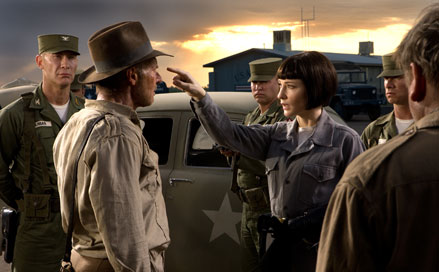
Unsolicited Advice for a Mid-Career Adventurer
After nearly two decades away, the big screen’s most adventureous archaeologist will once again be dodging bullets and laughing in the face of danter when Indiana Jones and the Kingdom of the Crystal Skull opens on May 22. It’s more fun than the average middle-aged guy gets on the job. Bit in returning to the jungle himself, career coach Cynthis Shapiro says, Indy isn’t exactly being whip-smart. An entrepreneur his age ought to think about taking on more of a management role.
° Be the Boss
Jones ought to delegate the dirty work and manage other treasure hunters for a cut of the take. That leverages his experience and gets him out of the snake pit.
° Choose a Successor
In this flick he gains a young sidekick (Shia LeBeouf) a protege whom he can train to head field ops one day. Meanwhile, he has plenty of contacts in exotic locales to hire as staff.
° Make the case
So clients don’t balk, Jones should play up his staff’s experience and the fact that local help lowers expenses. If he plays it right, profits rise and risk falls. That’s the holy grail. (Kate Ashford)
I always thought Jones was a university professor, so I figured he was funded by grants. And archaeologists – isn’t that what they do for fun, get their hands dirty? Go to the field? We got a good laugh from the Money magazine perspective, and we also think that not all success is to be measured in terms of money and moving up the ladder. Indiana Jones might experience a lot of job satisfaction by being the hands-on guy in the field!
Fireboat Practice
Who knew? Who knew the Kuwait Coast Guard – or the Kuwait Fire Department – now has fire boats? These look pretty new, and we are guessing they are having a practice, out in the Gulf on this beautiful Friday:


Fire boats are fairly specialized pieces of equipment. Once you buy them, you have to learn how to operate them. You don’t want them learning when YOUR boat is on fire, you want them to have had some exercises learning how to use their equipment efficiently. Bravo, Kuwait fire department.
Coen and No Country for Old Men
AdventureMan and I watched No Country for Old Men last night, and oh! it held us on the edge of our chairs. At the end, we ran for the phone to call our son and ask “Whoa! What happened??”

In short, we loved the movie (and I can hardly wait to read the book, although Cormac McCarthy goes a lot darker than I care to go). The Coen brothers also go darker than I care to go, but we find ourselves drawn to their movies because there is so much thought put into them, so many references to other genres, other films, and because the characters are so true to life. We first met them in Fargo, a movie we pull out and watch again from year to year – that’s a rare movie. We love the characters, even the bad guys are so human.
It’s the same in No Country for Old Men. Set in the desolation of West Texas, there are whole minutes when you listen to the wind whistling in the desert as the hero hikes down to a drug-exchange-gone-bad.
There is a good guy, a sherif played by craggy-faced Tommy Lee Jones, and an ordinary guy who finds a whole lot of money, and we really want him to get away with it, and then there is a really really bad guy, who is also smart, and . . . well, something inside of him is just bent. He’s not right. The Coen’s have a way of making him both appalling and just a guy doing his job very well. It’s not personal, but we wish he wouldn’t enjoy inflicting harm so much.
What I love about the Coen films is that they can capture the essence of a character so sparely, with just a few words, a few lines. There is a trailer park manager who refuses to give the very very bad guy an address. You hold your breath; she could get blown away, she doesn’t know it. She holds firm. In another scene, an older woman tells a Mexican man who has just helped her “You don’t see too many Mexicans in suits.” So so so politically incorrect, and so ordinarily normal, the plain-spokeness of the elderly. The Coen’s capture the West Texas-ness which permeates the film.
This movie is worth watching again.
Lemba, Arc of the Covenant and DNA
As I work in the Project Room, I often have the radio on, BBC. I get to hear all about the US elections from another point of view, I get exposure to music I might otherwise never hear, and I hear things that show up weeks, even months later in the news.
AdventureMan called and asked if I had heard the segment on the Lemba in Zimbabwe. I hadn’t, but I listened closely for the next couple days and it was repeated.
It is about a professor who discovered what he thinks is a replica of the Arc of the Covenant in a dusty museum in Zimbabwe. He explored further, and discovered the Lemba claim ancient connections with the Arc, and had priestly customs similar to old Jewish customs. When they underwent DNA testing, the priestly clan of the Lemba had the same genetic markers as the priestly clan of the Jews, the descendants of Aaron.
How fascinating is that? Legend has always claimed the Arc of the Covenant is or was hidden somewhere in Ethiopia . . . transport to Zimbabwe from Ethiopia would not be out of the question.
I went to BBC news online and did a search – no results. Maybe it takes a while for their newest stories to be documented in their search files.
Googling on the internet, I found Ethiomedia which says the following:
In a newly released book, University of London Professor Tudor Parfitt claims to have located the treasured artifact on a dusty shelf of an out-of-the-way museum in Harare, Zimbabwe.
“It was just by chance that I finally managed to track it down to a storeroom in Harare, was able to analyze it and discover that quite apart from anything else, it’s quite probably the oldest wooden object in sub-Sahara Africa,” said Parfitt, an expert in Oriental and African Studies.
“It’s massively important in terms of history, even apart from its status as the last surviving link to the original Ark of Moses.”
In his HarperCollins’ book, “The Lost Ark of the Covenant: Solving the 2,500 Year Old Mystery of the Fabled Biblical Ark,” Parfitt describes traipsing around the globe, decoding ancient texts and deciphering numerous clues to locate the enigmatic object.
Along the way, the man dubbed the “British Indiana Jones” by friends, colleagues and the Wall Street Journal uncovered genetic evidence confirming claims by the Lemba tribe that they
are descendants of ancient Israelite priests, the caretakers of the lost Ark.
He experienced a major breakthrough in 1999 when he took DNA samples from 136 male members of the Lemba tribe. In a finding that drew worldwide publicity, a genetic analysis confirmed they were descendants of Aaron, the brother of Moses.

So many discoveries have proven to be fraudulent that I hesitate to put too much faith in this discovery, but I have to admit that it appeals to the little girl in me, who still believes archaeologists have great adventures, and loves the Indiana Jones movies!
(I hear there is a new Indiana Jones movie coming out soon. I hope old Harrison Ford can recapture enough of his youth to make this as good as the first one.)
Qatteri Cat’s Great Adventure
This morning, as AdventureMan left for work, I was busy reading incoming e-mails and didn’t jump up immediately to lock the door behind him. The Qatteri Cat, as usual, was crying – he hates it when “The Fun Guy” leaves, and he got his baby and cried by the door for a while. Then – I heard a dreaded sound.
We hear it sometimes during the night. The Qatteri Cat is one smart cat – he has learned how to jump up high enough to hit the door handle on his way down, and his weight is enough to open the door. He jumped. I’m up and running, but it is too late, the door is open and the Qatteri Cat is out.
Other people with long-haired cats will know what I am talking about here – you don’t get dressed until you are just ready to leave, and you keep your clothes in closets that stay shut, so you don’t have long cat hair clinging to you as you go about your daily errands. So as I run to the door, I am rapidly calculating whether I can run outside and round up the Qatteri Cat, or whether I have to get dressed first.
It is still early. My Kuwaiti neighbor probably isn’t up, and if his maid sees me, I can claim she was delusional, that I would never be outside in my nightgown. If I get dressed first, the Qatteri Cat could disappear! So out I run, chasing the Qatteri Cat who thinks this is one GREAT game, Mom chasing him. He is making that little “Eh eh eh eh eh eh eh eh” sound that cats make when they see birds, or something else irresistable.
I chase him and cut him off, forcing him in a circle and back to the door. He resists, but he also knows when I am serious, I am SERIOUS (it has to do with cat “time-outs” in a room with just his food and litter box, and short term withdrawal of affection) so he reluctantly complies.
Now, he is sulking. He has his baby. He isn’t crying, he has ME in time-out, he has withdrawn his affection, I spoiled his fun. Even though the door is now locked, he tries every now and then, remembering there was a time when it opened.
Turning into a Kuwaiti
We were lingering over the last bites of dessert and coffee in our favorite French restaurant when one phone rang and after a brief conversation, my friend turned to the rest of us and said “We have to get home. That was Anwar saying another storm had rolled in.”
We had all known it was a possibility, but wanted to take the chance to get together anyway. It was one of those rare occasions when our husbands were out of town, we could eat at a restaurant WE liked that they didn’t, we could get together and not worry about when we were getting home. We flurried out, I quickly dropped off my friends and headed home.
The streets were relatively quiet and the traffic relatively slow. I found myself thinking about the evening and how far I have come, living in Kuwait. I’m driving at night, and I don’t even feel a surge of fear-filled adrenalin, I’m driving in a sandstorm going ho-hum, just need to get home, and I’ve just had a great evening with female friends.
And I thought “I’m turning into a Kuwaiti woman.”
The West is so couple oriented. I remember when I was living near my parents in Seattle, and my husband was overseas, I hated Sundays; Sundays seemed like couples’ day to me – couples/families go to church, go to breakfast, go out shopping. Mostly on Sunday I would go to church, go to breakfast with a bunch of church friends and then go home, spend the rest of the day reading the Sunday paper and working on projects. If I were out and about, I would only be reminded how lonely I was, how I was missing a piece, I was incomplete.
In the Gulf, most of the social life is segregated – women go to women’s things, men go to men’s things, families do family things. Things are changing, but there isn’t a lot of “married-people-having-dates-with-their-own-spouses going on. Women go to engagement parties, wedding parties, condolence calls, they go shopping, they meet up at restaurants, they get together in one another’s houses. Men meet up at the diwaniyya, a local shisha cafe, they visit their extended family, they hang out and play cards, they race along the streets. The great circle called men’s social life intersects with the great circle called women’s social life intersect only rarely.
And here I am, meeting up for dinner with my female friends, and driving home alone at night through a sandstorm. Yep. I am definitely turning into a Kuwaiti.
Traffic Watch
Never fear, the Qatteri Cat is on traffic watch today. All is well, you can tell by his relaxed stance. Every now and then, he will utter an alarm – birds come by and taunt him because they are flying freely and he is trapped inside. He’s not smart enough to say “yeh, but I get free food, water and medical care in this gilded cage.” All he knows is that he would love to be free to show those birds a thing or two.

Once, in our Qatar villa, a great big pigeon hit a window and then THUNKED to the ground, not 10 feet from QC, who was allowed in the garden as long as someone was with him. The bird was so big and QC was so astounded, that by the time he decided to go investigate, the bird had recovered consciousness, stood up and shook his wings. He was bigger than QC! As QC thought twice about approaching, the pigeon flew off. I am betting that is about the closest QC has been to a real live bird.
One time (one of many) the Qatteri Cat escaped the yard. This time I knew where he was within the first half hour, because I could hear him crying pitifully. I had to ask a neighbor if I could go into her back yard, and there was QC, high up in a tree, scared and unsure how to get down. There was a wind blowing, and the only thing QC could think of, every time the boughs swayed to a strong gust of wind, was to go higher. He had reached the spot where every gust made him sway like a pendulum. He was terrified.
It took me about an hour to talk him down. First, he had to get over his panic, because his terror was paralyzing him. Second, he didn’t know how to climb down, so he had to turn around, to kind of walk down the tree, which, with gravity, was a very scary thing. He kept turning and then turning back.
(How do you teach a cat to back down a tree?)
Finally, I just kept talking. I locked eyes with him, and every time he would look away, I would say his name, get him focused on me again. Slowly, slowly, he worked his way down (he was up very very high, higher than a ladder could reach). He ended up falling the last 20 feet, but I could catch him. His little heart was beating like thunder, his adrenelin was pumping and I had to hold on to him to get him home. He didn’t want to be held, and I have the scars to prove it.
The neighbor thought I was a nut case, I am sure, but I don’t care. A cat can be so paralyzed by fear that they cling to the tree until they are exhausted and drop to their death. Some cats will figure out how to get down, but not all, and not while a wind is blowing and swaying them back and forth.
As much as I love fresh air, we have to keep the windows closed. He’s a sweet cat. His little brain just goes on hold sometimes. If a bird taunted him, he would be out that window in a heartbeat, no second thoughts, just instinct.
Recent Comments
intlxpatr on Shampoo Ginger tigerbutterya0c5ff1d… on Shampoo Ginger intlxpatr on British Soldier Kidnapped, Esc… John on British Soldier Kidnapped, Esc… intlxpatr on British Soldier Kidnapped, Esc… Wikipedia Donate Button

Amazina


Early Voting in Florida


