Flea Infestation
Here’s the problem. Life doesn’t come with an instruction manual. OK, OK, we have our holy books, and they give us character guidelines. I am talking about specifics here, when life hands you those lemons, how do you make lemonade? Specifically!
When we move to Florida, we thought we were in Paradise. We had a house with a big pool, surrounded by shady trees, families of racoons, beautiful gardens – what’s not to like?
Paradise came with chamaeleons, lizards, cockroaches, even in the best houses. And fleas. We had to learn how to deal with them.
During our first and only flea infestation, at first we blamed the cats. Being a terrible mother, I asked my son to help, and he went into the walk in shower (No! Not naked! He was wearing swimming trunks!) to bathe the cats with anti-flea shampoo. I would get the cat trapped, put the cat in the shower, he would shampoo them, let one out and I would hand him the next one. Both cats loved him the best; he had chosen them from the litter.
When I saw this photo on LOLCATS, I really had to laugh.

see more crazy cat pics
Just so you will know, the solution is to take the cats to the vet and have them treated for fleas professionally. While the cats are at the vets, pour 20 Mule Team Borax over all your carpets and in all your upholstered furniture, let it stand overnight, and vacuum it all up. After you vacuum, bring the cats back. It really works. The borax creates a saline environment in which the fleas (and cockroaches) can’t survive, but it doesn’t hurt pets.
Moses Learns to Delegate
When I was young, I never would have thought that I would join a bible study on the life of Moses that took a whole year. When I was young, I was a believer, but never dreamed I would really STUDY the word. One day a person invited me in, and I found myself learning things I never would have dreamed.
I remember learning this segment, from Exodus, which is part of the readings for day. Moses listened to his father-in-law, and he had to learn to delegate, so he wouldn’t be worn out:
Exodus 18:13-27
13 The next day Moses sat as judge for the people, while the people stood around him from morning until evening. 14When Moses’ father-in-law saw all that he was doing for the people, he said, ‘What is this that you are doing for the people? Why do you sit alone, while all the people stand around you from morning until evening?’ 15Moses said to his father-in-law, ‘Because the people come to me to inquire of God. 16When they have a dispute, they come to me and I decide between one person and another, and I make known to them the statutes and instructions of God.’ 17Moses” father-in-law said to him, ‘What you are doing is not good. 18You will surely wear yourself out, both you and these people with you. For the task is too heavy for you; you cannot do it alone. 19Now listen to me. I will give you counsel, and God be with you! You should represent the people before God, and you should bring their cases before God; 20teach them the statutes and instructions and make known to them the way they are to go and the things they are to do. 21You should also look for able men among all the people, men who fear God, are trustworthy, and hate dishonest gain; set such men over them as officers over thousands, hundreds, fifties and tens. 22Let them sit as judges for the people at all times; let them bring every important case to you, but decide every minor case themselves. So it will be easier for you, and they will bear the burden with you. 23If you do this, and God so commands you, then you will be able to endure, and all these people will go to their home in peace.’
24 So Moses listened to his father-in-law and did all that he had said. 25Moses chose able men from all Israel and appointed them as heads over the people, as officers over thousands, hundreds, fifties, and tens. 26And they judged the people at all times; hard cases they brought to Moses, but any minor case they decided themselves. 27Then Moses let his father-in-law depart, and he went off to his own country.
Disability Awareness Day at Fenway
What a way to start your day. Watch what happens in Boston when the singer of the National Anthem gets the giggles:
New Look at WordPress
On this very sleepy Saturday morning I am up a little late, grab my coffee settle in with my laptop while AdventureMan reads aloud to me from a book he is perusing, and after I take care of my e-mail, I check in the blog.
WHOA!
What is this?
Overnight, WordPress instituted a new, very elegant desktop. When I sign in, I have an overview, with a lot of information clearly presented (I can only “snap” a part of the new desktop:)

Writing a new post also has a totally new look. Most of the changes are intuitive; I have only had a little trouble understanding the photo-insertion process, which was also the hardest part for me in the old WordPress format:

All in all, a happy surprise for a quiet Saturday morning!
Travel Nerds
We are a bunch of travel and geography nerds in my family. Nothing makes us happier than jumping in a airplane, reaching an exotic location and driving, getting our feet on new ground, seeing new things, learning new ways. We all have cameras glued to our hands and laptops stuffed in backpacks.
All my married life, people have looked at me with pity and tole me how they can’t believe I live with such uncertainty, never knowing where I will be in the next year – even the next few months. What I tell them is this – the truth is, we ALL never know. We ALL never know when something will happen that will change our lives dramatically, forever. We live day to day, not thinking about all the things that can happen. If we think too much about them, we might go crazy.
I consider myself blessed. I was created with a restless spirit, a spirit for new experiences and new ways of thinking. I was given a life where all those things became my daily bread.
What is fun for me is watching the next generation of young adults discovering their own lives, who they are meant to be.
My nephew, at Google Earth took his love of geography to new heights. He works in a place he loves, doing work he loves. He wrote to me yesterday, to tell me about a new game being played, a grown-up version of the old “Where in the World is Carmen Sandiego.” (one of the earliest computer games for kids) He has published a really really hard one on the Google team LatLong blog (as he says, he has the home court advantage in this game!) and he refers us to another blog, Where on GoogleEarth? where there are a series of contests to see if you can identify landmarks, special places, from the sky.
Here, for example, is the photo from contest #22 – and people have to write in telling what it is. Can YOU tell what it is? 🙂

A Long Way Gone: Ishmael Beah
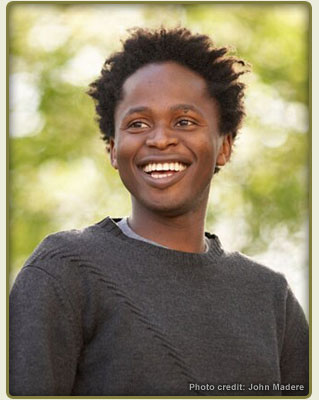

Back when I wrote an update on Dharfur, my blogging friend Chirp recommended a book, A Long Way Gone; Memoirs of a Boy Soldier by Ishmael Beah. I ordered it that very day, and read it this last week.
It is a truly heartbreaking autobiographical book about a young mischievous boy growing up in Sierra Leone, leading a relatively simple and carefree life in his village with his family. It is very African. He talks about the games he and his friends play, his fascination with rap music and the simple joys of the life he is leading.
Then the rebels come. The invade the villages, hopped up on dope, their dead eyes with no pity, raping, killing, chopping off limbs, stealing all the village food and burning the village behind them, often with people locked inside their huts.
Ishmael escapes once with friends, eventually returning to the village to find his entire family gone. Most of the book has to do with what he has to do to survive. Many villages are very afraid of groups of boys, even boys as young as these are – in their early adolescence – and will hurt them. At the very least, most of the villages hurry them along. At one point Ishmael is hiding out in the jungle forest on his own, hiding from lions, giant feral pigs, sleeping up in trees and looking for the rare fruit or grass that he can eat without getting sick.
Finally, after meeting up with some other boys and continuing to try to find his family, a village takes him in, a village run by the state soldiers. As they are attacked by rebels, the boys are forced to make a choice – go out on their own again (where the rebels will also try to recruit them, and if they refuse, will kill them) or agree to be soldiers. These are kids 12, 13, 14 carrying AK 47’s. As part of their training they are given drugs on a regular basis which keep them hopped up, full of energy, and not sleeping for days. The young boys learn to kill without pity. He becomes the very people he was fleeing.
This is a book about redemption. At the center where the boy soldiers are taken, they are constantly told “none of this was your fault.” It is a very African approach, a very human and loving approach to redemption of lives that might have been totally lost to the horrors they have witnessed and inflicted. The author is now nearly 30, and sounds – unlikely as it might be – happy.
Thank you, Chirp, for recommending this wonderful book.
5KD = LLLOOOLLLL
I have seen opinions, and heard people talking about how Kuwait has more important things to do than to penalize people who are using their mobile phones. They are outraged! Clean up the highways first, they say, give us better schools, enforce the laws already on the books (but leave our cell phones alone!)
I am sorry. I know I am going to get killed for this opinion, but have you ever followed someone driving while talking on a cell phone? Do you watch them wobble out of their lane, try to steer the car with their knee because they have the phone in one hand and they need to adjust the volume of the radio? In countries where mobile phone use has been monitored and statistics kept, they attribute a huge rise in inattentive driving to cell phone use. They have statistics. They can prove that cell phone use is linked to a rise in accidents.
Brave Qatar brought in a team of experts who interviewed seriously injured accident victims. Every single one of them was on a cell phone when involved in the accident.
My rant is this: a 5KD fine? In Kuwait, that is just laughable. A 5 KD fine (about $20 with the dollar diving into the cellar) is not a deterrent. I want to see a sliding scale: start at 50KD for the first incidence, double it for the second, double it again for the third, etc. Make it hurt.
There are too many drivers for the roads, even with the ongoing improvements. The drivers are ill experienced, and careless. Driving in Kuwait is lethal enough without the additional factor of cell phones. If you need to ask directions, pull over. It’s not that hard, you’re smart, you can figure it out.
St. Patrick and the Wearing of the Green
Growing up in the USA, everyone knows, as a kid, that on St. Patrick’s Day you wear green. It doesn’t mean you are Catholic, or Christian, it means you don’t want to get a pinch, because that is what happens to kids who don’t wear green. (You know how mean kids can be!)
Later on, maybe in high school, a few people will wear orange and explain that they are Irish protestants. Most of us, as kids, don’t really know a whole lot about St. Patrick other than that he went to Ireland to convert the heathens to believe in the church, and that he cast the snakes out of Ireland.
When you get older, St. Patrick’s Day is often a rollicking night in local taverns with Irish names, where they serve stew, and soda bread, and potatoes, and lots of green beer and live music singing old Irish songs.
There are references below to the short version of St. Patrick’s life, and a longer version. The longer version is the Catholic version and, while less documented, is longer and more interesting.
This is from Wikipedia, and is a short summary of the life of St. Patrick:
Saint Patrick (Latin: Patricius[2], Irish: Naomh Pádraig) was a Christian missionary and is the patron saint of Ireland along with Brigid of Kildare and Columba. Patrick was born in Roman Britain. When he was about sixteen he was captured by Irish raiders and taken as a slave to Ireland, where he lived for six years before escaping and returning to his family. He entered the church, as his father and grandfather had before him, becoming a deacon and a bishop. He later returned to Ireland as a missionary, working in the north and west of the island, but little is known about the places where he actually worked and no link can be made with Patrick and any church. By the eighth century he had become the patron saint of Ireland. The Irish monastery system evolved after the time of Patrick and the Irish church did not develop the diocesan model that Patrick and the other early missionaries had tried to establish.
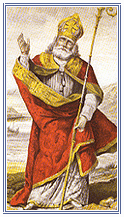
(From Who Was St. Patrick?)
The available body of evidence does not allow the dates of Patrick’s life to be fixed with certainty, but it appears that he was active as a missionary in Ireland during the second half of the fifth century. Two letters from him survive, along with later hagiographies from the seventh century onwards. Many of these works cannot be taken as authentic traditions. Uncritical acceptance of the Annals of Ulster (see below) would imply that he lived from 378 to 493, and ministered in modern day northern Ireland from 433 onwards.
More Mubarakiya Sights
It seems to be heating up quickly. The months when perusing the souks in daylight hours are coming to an end. We are trying to make the most of it while we can. A few more quick snaps from the Mubarakiyya Market on a quiet Friday:
Vegetable market public art I hadn’t spotted before:

Traditional clothing-seller:

Bath supplies:

Foodstuffs:

Those of you who live here walk right by these stalls all the time, and never notice that they are disappearing. I have been perusing old books about Kuwait, even some not so old, and Kuwait is changing so rapidly that even books only 10 years old or so have become outdated by the rapid passage of time.
For those of you not in Kuwait, there are malls. There are SO many modern malls. As in other countries, some are more upscale than others, but they are malls. In most, you are not supposed to take photos. In most, you will see the same stores you will see in any other country. Mubarakiyya is special because it is still an active market in the old style.
Lazy Mubarakiyya Friday
For our non-Kuwaiti friends, Friday is the day off in Kuwait if you only have one day off, Friday and Saturday for a few. It’s the perfect time of the year to visit the Mubarakiyya Souks – not too hot, not too cold and always something interesting to see. Grab your friends and family, and have lunch in the square where all the restaurants are.
In our two years of visiting the restaurant, we never realized the menu was on the bottom of the kleenex box:
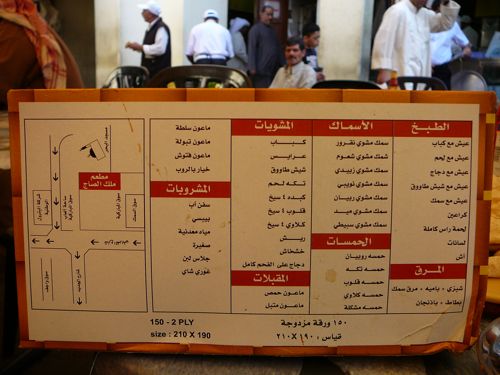
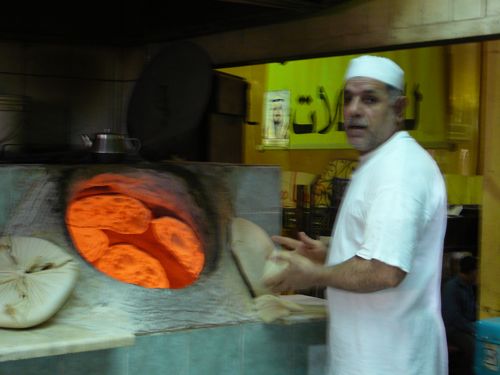
Bread making:
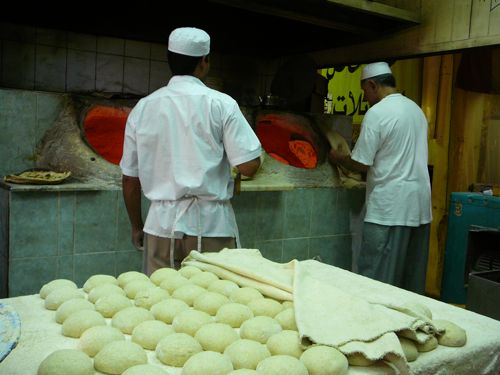
So good!
Kebab making:

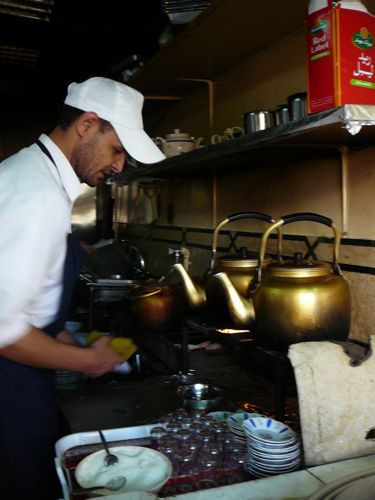
Busy in the tea stall:
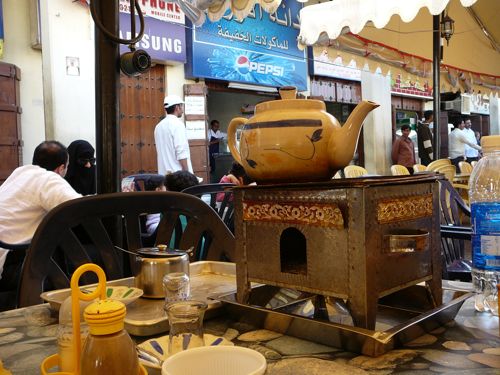
The tea stays HOT on the table tea-grill:
Recent Comments
intlxpatr on Shampoo Ginger tigerbutterya0c5ff1d… on Shampoo Ginger intlxpatr on British Soldier Kidnapped, Esc… John on British Soldier Kidnapped, Esc… intlxpatr on British Soldier Kidnapped, Esc… Wikipedia Donate Button

Amazina


Early Voting in Florida


