Lent and Laughter
“So how’s that workin’ for you?” cackles AdventureMan, on a roll. He is totally cracking himself up.
“Hey, where’s your wife, AdventureMan?” he goes on, his high story-telling voice as he goes on making up stories. “Oh, I had to send her back to the Us of A for cursing in the car during Lent.”
He is not even listening. He is on a roll. Oh, he thinks he is so funny.
Today is the first day of Great Lent, our 40 day season of repentance and looking inward, fasting and spiritual examination. AdventureMan has asked what sacrifice I will make, and I had just said that last year, giving up swearing in the car, one word in particular, while I was driving had been a real struggle, but that I had actually managed, mostly. Not perfectly, but mostly.
“This year,” I told him, “I am going to practice turning the other cheek, I am going to try to be a peaceful spirit on the road, I am raising the bar.”
That’s when he started cracking up. There was no stopping him.
He had already told me he is giving up liver and brains and kidneys for Lent, all foods he stays far away from anyway. AdventureMan doesn’t take sacrificing for Lent very seriously. “I’m going to fast the way Little Diamond describes in her blog, you know, like the Maronites,” he giggles, barely able to talk, “only instead of fasting from midnight to noon, I will fast from ten at night until ten in the morning!”
He is laughing so hard he can hardly hear me.
“That’s not a sacrifice!” I argue! “You are sleeping most of that time, and you don’t eat breakfast anyway! That’s not a sacrifice!”
‘You worry about YOUR sacrifices and I will worry about mine!” he says, and I know he is right.
The truth is, AdventureMan sacrifices every day of his life. He works hard to provide a good life for his family. He sacrifices his time and energy every single day. He goes to church with me willingly, he prays with me every morning. It’s enough.
“Bookstores, Bathouses, Bars . . . “
I’m following The Shield, a hard-edged detective show I have followed, when I can, ever since Glen Close was the police chief. If you thought Glen Close was tough as Cruella de Ville, wish you could see her as police chief/ 😉

The guy standing next to her is Detective Vic Mackey, a renegade plainclothes cop who plays fast and loose with the system. You know me, Mrs. Law and Order – whoda thunk I would find myself rooting for this guy as he undergoes close scrutiny from the Internal Affairs Division. He’s really a bad guy. He does really bad things. He is a LIAR! He lies to everybody! He kills people, he steals dope and money. And somehow you find yourself pulling for him. I don’t know why.
But the reason I am writing about this is because in yesterday’s episode, a couple guys get their private organs caught in rat traps because they stuck their organ in a place called a “glory hole” for a little excitement and got more than they had bargained for (ouch). See what you can learn from these shows? And this is on during daylight viewing hours?
So the new police chief, a very cool and tough black woman, tells the detectives to go check “bookstores, bathhouses, bars, you know, the places these perverts hang out. . . ” and I am thinking “BOOKSTORES?” BOOKSTORES?? I hang out in bookstores all the time! I never see any perverts at the Barnes and Noble, or Half Price Books!
The things you learn on televison. I hope children are not watching this show!
Adventures in Banking
Sometimes when I am faced with a difficult task, I just put it off. I put it off and put it off – it’s not such a bad strategy, really, as sometimes the problem can go away, or be overcome by events, or solves itself. Most of the time, I reach some point where I am required, finally, to deal with the problem.
I needed money. I had money in my bank, but I didn’t know how to get it. I called the bank to ask how to get money moved from this account to that account.
“No problem, habeebti (dear one),” the customer services lady said, when I explained my problem. Not only did she solve my problem, but she gave me a grin that lasted for the rest of the day. I’ve never had a bank employee call me “dear one” before.
When I would need money, I would go in to the Women’s Bank. It was cool – only women, no important men pushing their way in front. Sometimes we would drink tea as I sat at the desk and filled out the withdrawal form. It all worked fine until they broke off a separate Islamic bank, and I was banking with the non-Islamic side, so I had to use the regular bank.
One time, when I was withdrawing funds to pay for a trip, the customer at the next customer service desk looked just like Saddam Hussein. The customer service woman at that desk was explaining to him that yes, he had checks but he could only write checks for the funds he had deposited in the bank. You could see he got the part about having checks, and writing checks, but this part about funds in the bank to cover the checks – what was that? He looked puzzled, and fierce, and angry, and he argued with the woman, and thought she was messing with him.
Now, I needed to have my name listed on an account my husband had set up for me. After months of putting off the inevitable, including trips to the bank to actually get it done, only to find that branch of the bank was closed, we finally got to the right bank, together, and the bank was opened.
We explained to the receptionist what we wanted, a joint account. He looked at my husband:
“You want her on your account?” (the tone was disbelief)
(Husband nods)
“But WHY??”
(We look at him in astonishment.)
“No. It is not possible.”
(We drop our jaws.)
Then he pats my husband on the back, laughs (he was joking) and takes us to the place where this is done.
We go through the routine again, with the teller. Again, we get astonishment.
We are sent to an office, where paperwork is prepared. In actuality, my name will not be on the account, but I will have access to the account. I don’t know why. No one could ever explain it, other than that is the way it works.
Just to be sure, once my name is – well, not on the account, but allowed to use the account – I give it a try, to make sure it works.
At first, it doesn’t, but then the customer service guy comes by and tells the teller it is OK and voila! I have money! Later in the week, I will try it at an ATM to see if this really works. I’ve gotten cynical. It’s not Kuwait; I have had trouble using ATMs in my own little home town, too. It’s like ATM voodoo.
This bank has small vases of flowers everywhere; the flowers look fresh. There is a system, with taking a number and waiting your turn, and even the very important man who tried to cut the line is told, very politely, that he must take a number. I’m impressed. The bank employees are all very polite, seem to know their jobs, and although it seems our seemingly simple – to us – request is outside their norm, they work hard to accomodate us. All in all, I would give the customer service at this bank an A.
But best of all, I secretly like it that the customer service woman on the telephone calls me “dear one.”
Sue Monk Kidd: Mermaid Chair
It took me a long time to buy this book, and an even longer time to read it. I kept reading the description, and I didn’t like it at all. But it kept popping up on the “recommended for you” list on Amazon, and I had this inner feeling that I was meant to read it, even if I didn’t particularly care to.
After treating myself to Leon and Bowen, I thought now was the time.
At first I found The Mermaid Chair a little Anne Rivers Siddon-ish – and I like Anne Rivers Siddons, and I don’t like imitations, which this felt like. And I thought to myself “Anne Rivers Siddons does it better.”
I kept reading, though. The book was intriguing, and I wanted to know what happened next.
Sue Monk Kidd wrote another book I really liked called The Secret Life of Bees in which I learned a lot about bees, and found the story wonderfully redemptive.
Sue Monk Kidd and Anne Rivers Siddons also share a love of the mystical, and the mystical in religion, and the mystical in human relationships, and the mystical in the sisterhood of women, all of which I find fascinating, and parts of which I would like to believe myself.
In this book, there is a lot going on. The main character is feeling stagnant and small, and invisible in her marriage. Her daughter has left for college, and she is oddly unable to find things in life to interest her. Then, her mother cuts off her finger, her mother’s friends call her to come to Egret Island, and she finds herself suddenly caught up in a whirlwind of emotions and torments that she can barely understand.
She has avoided returning to her Egret Island home to avoid the pain of her father’s death when she was 12, and her mother’s decent into moodiness and madness. She returns, meets a monk and falls in love, copes badly with her mother’s demons, and fights her way through her own personal crisis.
Sue Monk Kidd makes it all work. The work floats with artistic references; Gaugain, Matisse, Chagall, their mysterious, delightful women in particular float throught this book in Mermaid guises, and our heroine, Jessie Sullivan, discovers her own mermaid-within.
I won’t say that this is the best book I have ever read – it isn’t. I will say that I loved reading it. I loved the feel of living on Egret Island, with the tides and the birds and the small town friends, the local dog, the raininess and windiness of it all. I feel like I was there. I know the graveyard, I know the winding paths, I know those little golf carts everyone uses to get around. I know what it’s like to have to take a ferry to get to the mainland, I know the tidal currents of life’s more overwhelming moments.
As our Jessie binds her marriage back together, she says this:
Each day we pick our way through unfamiliar terrain. Hugh and I did not resume our old marriage – that was never what I wanted, and it was not what Hugh wanted either – rather we laid it aside and began a whole new one. Our love is not the same. It feels both young and old to me. It feels wise, as an old woman is wise after a long life, but also fresh and tender, something we must cradle and protect. We have become closer in some ways, the pain we experienced weaving tenacious lines of intimacy, but there is a separateness as well, the necessary distance. . . . .
I tell him, smiling, that it was the mermaids who brought me home. I mean, to the water and the mud and the pull of the tides in my own body. To the solitary island submerged so long in myself, which I desperately needed to find. But I also try to explain they brought me home to him. I’m not sure he understands any more than I do how belonging to myself allows me to belong more truly to him. I just know it’s true.”
This is a good read. It’s worth its reputation, it’s worth picking up and reading through. While some might think it’s very much a chick book, I suspect men reading it might also find a lot with which to identify. You can find this book at Amazon.com (disclosure: yes, I own shares in Amazon) for about $11.20.

Tarek Rajab Calligraphy Re-Visit

Oh, the Tarak Rajab Calligraphy Museum is such a treasure! This time we went back just to have time to watch the entire film on calligraphy, the cutting of the quills and the mixing of the ink, how the paper is prepared and burnished, how ornamentation is developed . . . every time we visit this museum, we see something new, and we learn something new.
This time, I was looking for details. Oh WOW.
Here is a little of what I found:


Kuwait is blessed to have such a gem of a museum, and open to the public free of charge, in a beautiful building, with gracious spaces. You can find more information on their website for both museums (The Tarak Rajab Museum is just around the corner) at The Tarak Rajab Museum website.
African Textiles at KTAA
If color, texture and weave are your kind of thing, there is a wonderful group in Kuwait for you. Before I even came to Kuwait, people told me about the Kuwait Textile Arts Association, and oh, what a trip.
A friend asked me if I were going to this month’s meeting. I hadn’t seen any announcements for it, and then she said “you ought to come! It’s African textiles.”
Magic words.
You know AdventureMan and I love going to Africa. And a meeting on African textiles? Woooo Hooooooo! Yes, I will admit it, I am totally a textile geek.
Africa is a huge subject to cover, when it comes to textiles, and the speaker did well – Nigeria, Tunisia, Cameroon, Mali, indigo dying, small loom weaving. . . You could teach an entire college level course on any one of those topics, and he gave a great overview.
You can join KTAA for 10KD per year, or you can attend each meeting for 2KD. Meetings are held once a month at the Sadu House, where they also have a fabulous collection of books on textiles.


Bowen: Cruzatte and Maria
Peter Bowen’s tales of Montana in transition are an acquired taste. When I first started reading them, at my sister’s recommendation, I had a hard time getting past the dialect. The main character, Gabriel DuPre, speaks English differently; he is Metis, a mixture of French, Indian and who knows what, here before America was America, as he says “long time gone.”
You get used to it. It still makes me think he should be in New Orleans, speaking as he does, it sounds very Cajun, but you get used to it.
Peter Bowen’s Gabriel DuPre is another treat to myself (like Donna Leon.) Reading the latest book I bought, saved for just this time, a cold wintery January, brightened my outlook considerably.
The first book I read, Wolf, No Wolf had to do with environmentalists putting wolves back into the mountains where once they had flourished, but where now, for a couple centuries, people have been raising cattle. Guess what? Hungry wolves love cattle. It makes for some very hostile feelings.
That theme – local culture against intruding environmentalists – continues in this book, where DuPre is hired as a consultant on a film being made about Lewis and Clark. The locals in the Coronado area are no happier with all the film crews and tourists than the ranchers were with the wolves – and people end up dead.
In addition, DuPre’s friend Benetsee and his daughter Maria spend time together in the sweat lodge, and later, his daughter, Marie, sees a mound and is revisited by a vision she had. She tells her dad, DuPre, to dig, and he uncovers a trove of treasures cached by the Lewis and Clark expedition. Partly, it is the incursion of the spiritual and supernatural that I find so intriguing in these books; there is a reality, and then a greater reality, and they co-exist. Bowen makes it seem and feel entirely natural. I love it.
The book has some highly entertaining, laugh-out-loud moments, takes great pokes at the eco-tourist, and at the same time deals with some serious issues. We get to hear DuPre fiddle his old Voyageur songs, we get to hear what people are saying at the local bar, where cheeseburgers are the plat du jour. It is a great way to pass a winter’s day.

Berry and The Alexandrian Link
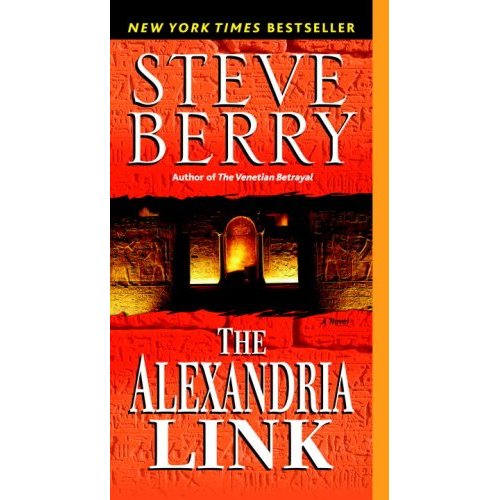
On his way back from a recent trip, AdventureMan bought a book in an airport, which he read and then asked me to read. Here is what he said:
“It’s not a great book, but I don’t know why I say that. It has an interesting idea and I want to know what you think.”
So just after I finished Inheritance of Loss I started in with this book, and it was the second book I will not recommend to you.
It is wooden. The characters are about a millimeter deep. The plot is unbelievable and doesn’t make sense and doesn’t hang together. It is full of adventure and travel and shoot-outs, which our “hero” miraculously comes through without a scratch while all around him his foes are dropping like flies.
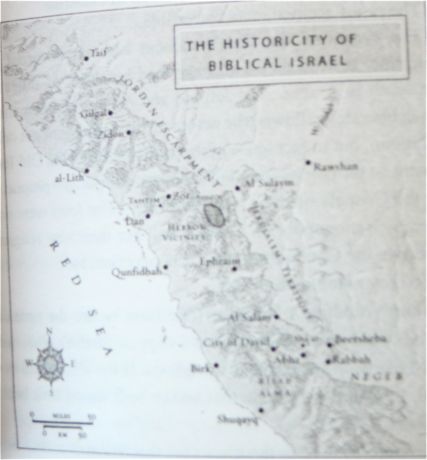
It DOES hinge on an interesting theory, one I had never heard before. There is a Lebanese historian and archaeologist, Kamal Salibi, who published a book called The Bible Came from Arabia. In this book Salibi makes his case for the “holy land” which was given to Abraham not being in Palestine at all, but rather in what is currently Saudi Arabia, along the western coast. He uses the utter lack of archeological findings in current day Israel/Palestine which support biblical accounts, and the plentitude of place names in the Asir region which closely resemble what the place names would have looked like and sounded like in ancient Hebrew, the language of the earliest biblical times.
The book, and the theory was, of course, controversial. If the contentions were true, it would undermine the foundation of the state of Israel in Palestine; it would mean that people have been fighting for the last 60 years over the wrong piece of land.
Here is a (very bad) photo of the map in the book which shows where Salibi believes the biblical cities were actually located. He believes “Jerusalem” was not a city, but an area within which were several cities. He believes “the Jordan” was not a river, but a mountain range, and that here, also, Moses and his refugees from Egypt wandered.
Unless you really love reading badly plotted books with cardboard characters, I would not recommend reading The Alexandrian Link. As a jumping off point for an interesting line of research – AdventureMan was right; this book gives you something new and different to contemplate.
The Door Into Summer
We had a cat, a street cat from Tunisia, named Cinnamon. I had taken our son to see a movie and when I got home, my husband looked funny. You know, a wife can tell. I said “what’s up?” and he gave me those big innocent Bambi eyes that tell you for SURE something is fishy, and he said “Nothing!”
Just then, we could hear loud loud miowing at the back door, the kind only a kitten can make, the kind that attracts attention. We went to the back door and there was this tiny little kitten, barely old enough to be away from her family, and she is stuck between the screen door and the back door.
“How very strange!” I said, looking accusingly at AdventureMan, who continued to try to look innocent.
“She looks cold!” he said. “Maybe we had better bring her in!”
Later he confessed, he has found her wandering around alone, wet and miowing in our backyard and had been feeding her while we were at the movie, then put her in the back door so we could “discover” her. He wanted to keep her. We already had one big cat, but we had wanted another, and here she was.
She was my Door into Summer cat. She still had all her wild instincts, even though we adopted her at such a young age. Once, in Germany, I found a dead hare on my steps, with it’s throat torn out, an offering from Cinnamon – but the hare was at least twice her size! She was always bringing us offerings of a dead nature; she was a born huntress. One time when AdventureMan got out of bed, he stepped on what he thought was a rolled up sock, but it moved! It was a badly wounded mouse!
Cinnamon hated winter. We lived in a house with a lot of doors, and when it would snow, she would go from door to door, asking us to open so she could go out. When the bitter cold with the biting wind would hit her face, she would back into the house and head for the next door – always looking for the door she remembered, the one which led out into summer.

moar funny pictures
I used to read a lot of Robert Heinlein. His books are SO politically incorrect, so sexist, he was an old engineer, but man, could he write. His writing takes you WAAAYYY out of the here and now, and makes you stretch to think in new ways.
He wrote a book called Door into Summer, in which he wrote about another cat:
“…While still a kitten, all fluff and buzzes, Pete had worked out a simple philosophy. I was in charge of quarters, rations, and weather; he was in charge of everything else. But he held me especially responsible for weather. Connecticut winters are good only for Christmas cards; regularly that winter Pete would check his own door, refuse to go out it because of that unpleasant white stuff beyond it (he was no fool), then badger me to open a people door. He had a fixed conviction that at least one of them must lead into summer weather.”
The Door into Summer – Robert A. Heinlein
You can read about Robert Heinlein on Wikipedia and you can find many of his books still in publication on amazon.com.
Rich Harvest in Fehaheel
I keep trying to capture the magic of the sun glinting off the fishing nets, and I fail. Maybe one day!
Meanwhile, I an swept away by the excitement of bringing in a rich harvest.
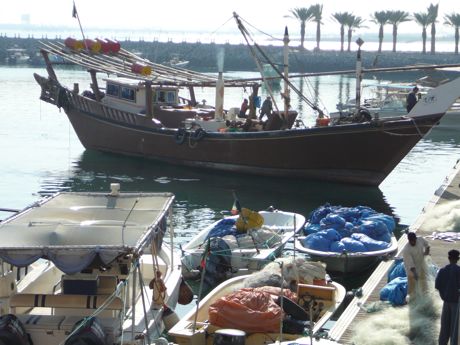



The fish are carried in baskets straight into the fish market, where they are auctioned off and sold. So fresh!
Recent Comments
intlxpatr on Shampoo Ginger tigerbutterya0c5ff1d… on Shampoo Ginger intlxpatr on British Soldier Kidnapped, Esc… John on British Soldier Kidnapped, Esc… intlxpatr on British Soldier Kidnapped, Esc… Wikipedia Donate Button

Amazina


Early Voting in Florida


