Moon over Kuwait Towers
Celebrating 100,000 hits:
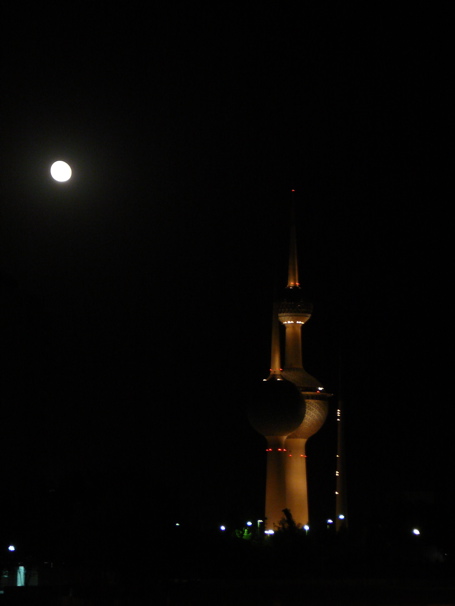
(Truly, just a lucky shot, with AdventureMan’s help)
Thank you, friends and visitors, for your visitsm your comments and your insights. Thank you for being a part of my virtual family.
The Lone Flamingo
God is so Good! Around a year ago, my husband and I saw Dolphins lazily swimming in the Gulf and so I have been half watching for them to come back again. It was such a thrill.
Today, I saw something pink flying. How many pink birds do you know? I had been taking some photos for you anyway, and had the camera in my hand.
Don’t flamingos normally fly in a group? I think he chose this beach for resting, he is poking around in the surf, I don’t know if he is catching anything but it is a ripe place for small fish.
When we lived in Doha, we would drive out to a particular lagoon to watch the flamingos. I feel like I have been given a great gift, a very special gift, having my own flamingo, even for just a few minutes.

Isn’t he beautiful?

Ramadan Futoor
I was invited to a friend’s for Iftar the other day. We played, and as the day lengthened, she napped while I read. Her husband came down yelling “get up! get up! It’s almost time!” and had the radio on so we could hear the sound of the cannon, announcing the end of the day’s fasting.
We had water and dates, and then soup. Because these are dear friends, and because they love me, we also had Kuwaiti fish!
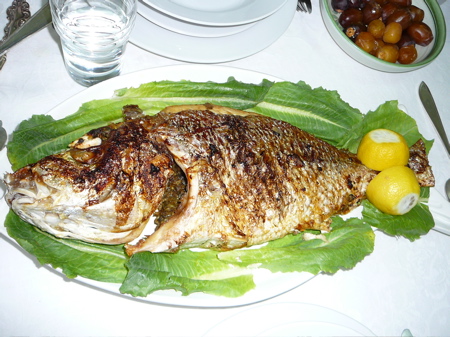
It was stuffed with parsley, onions and garlic, oh WOW. It was delicious.
As we ate, they were telling me about the thin thin pancakes you can buy at this time of the year to make a special stew. They are made on a dome shaped pan, with a very liquid dough, and evidently you can buy them at the co-op or along the side of the road (I have got to find one of these women!) because the thin pancake you can get during Ramadan is very close, I think, to the brik skin that you use for the Tuna Tunisienne which, hmmmmmm, could also be made with just about any leftover fish.
You have to be quick, because the dough is so fragile. While the photo shows all the ends tucked in, I was never that good, and neither are most Tunisiens – most of the brik I ate in Tunisia were all just folded over and fried in olive oil. So you have to have the oil hot before you put the brik in, and it sizzles, but it can’t be too hot because it has to cook long enough to cook the egg (if you add egg) or to heat the tuna through. Ohhhh, yummmm!
I was also asking about Swair’s Ramadan Soft Dumplings / Lgaimat and they were laughing and telling me how hard they are to make well, and that you have to eat them all the same day they are made, they are so fragile.
Later in the meal, as they were showing me low to roll the rice and fish into a ball together and pop it into your mouth in the old gulf way, my host mentioned the act of making that ball is called “ligma” and – – – ta da! it is the same root as Swair’s lgaimat!
I don’t know about you, but making a connection like that is like having a big light go on in my head. I love it. I can’t always remember words correctly unless I write them down, but this one – making balls to pop in your mouth/ making sweet dumplings balls – don’tcha just love it when things come together like that?
(I am posting this early in the day because you won’t feel hungry for fish this early if you are fasting – I hope – and it might give you a good idea for tonight’s Futoor!) Ramadan kareem!
A Thousand Splendid Suns
Once I picked up Khaled Hosseini’s A Thousand Splendid Suns, I barely put it down again until I was finished. I found myself thoroughly involved in the lives of Mariam and Leila, unwilling even to stop to fix dinner! The author of Kiterunner has hit another home run.
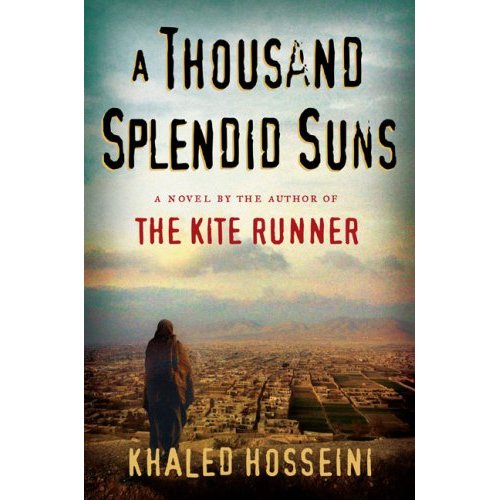
There was a time when we would listen to older state department types talk – with enormous longing – about their tours of duty in Afghanistan, pre-Soviet invasion, pre-Taliban, pre-American occupation. Have you ever read James Michener’s Caravan? There are two countries I long to vist, but the countries they are now are not the countries I heard people talk about – Afghanistan and Ethiopia. Our friends loved their times in these two countries.
A Thousand Splendid Suns opens in a small village outside Herat, and then takes us to Kabul. Mariam is born harami, a bastard, of a village cleaning woman in the house of a very wealthy man. Her father builds a small hut for her mother and herself in a remote part of the small village, and visits Mariam every week. Life is simple, and difficult, but also full of kind people who visit and who are concerned with Mariam’s welfare.
After marrying, Mariam goes to Kabul and learns a new way of life with her husband, Rasheed. What fascinates me with Hosseini is that while Rashid is one of the villians of this novel, he is just a man, doing the best he can given his own upbringing and limitations. In a sense, he is “everyman”, the strutting, domineering, sometimes brutal and abusive husband we find in every culture. But Hosseini also gives him transient bouts of kindness which blow through a little less often than the transient bouts of cruelty.
He also gives us good men, in this book, in the person of Jalil, the father of Mariam, who steps up to the plate in acknowledging Mariam and supporting her and her mother, but fails to nurture in the very real way women need nurturing from their fathers in order to reach their full potential in life. Hosseini also gives us a very strong man in the book, Tariq, who, although he has only one leg, is more wholly a man than any other man in the book. I imagine that this is not unintentional. (How Kissingerian is that for a double negative?!)
Written almost entirely in the Afghan world of women, we see through the eyes of Mariam, and later Leila, the transitions in Afghanistan and their impacts on daily life. We experience happiness with them, and peaceful scenes in quiet moments, raising the children, stepping outside into the garden at night to share a cup of tea and a shared bowl of halwa.
Between the moments of peacefulness, we also experience incoming morter rounds, explosions, marauding bands of warlords, and starvation. We go into a women’s hospital under Taliban control, where there are no medications, no running water, no instruments, and an Afghani female doctor does a C-section with no anaesthesia and is required to keep her burqa on. We watch a mother abandon her role and take to her bed when her two sons are killed fighting the Soviets, we experience betrayal and we experience helplessness, and we experience a Kabul women’s prison. A Thousand Splendid Suns is a rich feast of experiences, juxtaposing the everyday chores of women around the world – cooking, raising children, laundry – with events on the world stage.
(Available from Amazon for $14.27 plus shipping.)
Not Too Bright
In yesterday’s Kuwait Times was a very dramatic telling of a drug bust. Police had sighted someone suspicious in a car, upon approaching, the suspect ran, the police chased. Now, it becomes very cinematic, as the police chase, the man runs up into a building and jumps off a second floor balcony, and the policeman follows him, injuring himself. Another policeman picks up the chase and eventually the suspect is captured, only to slip right through the fingers of the police.
Pretty exciting so far, huh?
In today’s Kuwait Times, the saga continues:
Escaped Drug Dealer Chats into Custody
Following up yesterday’s on foot chase of a drug dealer in Salwa where Lt. Hamad Al-Zuwayyed was injured when he jumped off a second floor balcony to catch up with the suspect, Al-Zuwayyed never thought that the second accomplice who managed to escape arrest would be his hospital roommate. Security sources explained that while receiving treatment at Adan hospital, another patient arrived and was placed in the bed next to Al-Zuwayyed’s. Then, on chatting at night to kill time, the man told Al-Zuwayyed that he was hit by a car while being chased by a policeman in Salwa. Al-Zuwwayed immediately called the police who raided the hospital and arrested the suspect.
Don’tcha just love it???
K-Ville premiers tonight
Notice today from Amazon:
we thought you’d like to know that K-Ville, the new crime action series starring Anthony Anderson and Cole Hauser, premieres Tonight at 9/8c on FOX.
From writer and executive producer Jonathan Lisco (NYPD Blue, The District) comes K-Ville, a new police drama set and filmed in New Orleans. Marlin Boulet (Anthony Anderson) is a brash veteran of the NOPD’s Felony Action Squad, the specialized unit that targets the most-wanted criminals. He also held his post during Hurricane Katrina, spending days in the water saving lives and keeping order, even after his partner deserted him. Boulet’s new partner, Trevor Cobb (Cole Hauser), was a soldier in Afghanistan before joining the NOPD. Though committed to his new job, he’s less than comfortable with Boulet’s methods – and is harboring a dark secret.
Here is the official website:
I don’t know how to get these things and it just isn’t that important to me, but you tech-savvy people might have some fun with this. And it IS New Orleans! The music is worth a visit, just to view “Anthony gives Cole some advice about gumbo.” 😉
Peter Bowen: Wolf, No Wolf
“You have to take this. You’ll really like it,” Sparkle insisted as I inwardly groaned, thinking of the TWO stacks of unread-must-reads by the side of my bed, and my already bulging suitcases.

“I know it doesn’t sound like something you’ll like,” she went on, slightly frustrated with me, with herself, “but once you start reading, you’ll get into it.”
Not exactly a ringing endorsement, but good enough for me. I always KNOW what I think she will love, and she has done me many a favor in return, introducing me to authors and series worth reading.
“It’s about Montana. The main character is mixed Indian and French and some other things, a grandfather, and it all takes place in a small town in Montana . . . ” she sort of fizzles out. “I’m really not doing a very good job of making this interesting.”
And she sighs in frustration.
So, about a month later, just because I love my sister, I pick the book up and start reading while waiting for my husband to get home for dinner. As it turns out, he is very very late – and I am very very glad. I don’t want to stop reading!
When you first jump into Wolf, No Wolf by Peter Bowen, it takes you a minute to adjust your ear to the way they talk. These aren’t people most of us have met before. Gabriel DuPre´ is m´etis, a mixed blood. His ancestors are French who came early to the great continent that is now the US, Canada and Mexico, and they trapped and hunted, married native American wives, and developed a culture all their own. His language pattern is similar to that of the Cajun in Louisiana.
He is a cattle brand inspector in this small Montana town. His children are grown, he has so many grandchildren he can’t remember all their names. Every now and then, he pins on his deputy sherrif badge to solve a mystery in the small town of Toussaint, Montana.

Here is how Wolf, No Wolf opens:
Du Pre´ fiddled in the Toussaint Bar. The place was packed. some of Madelaine’s relatives had come down from Canada to visit. It was fall and the bird hunters had come, to shoot partridges and grouse on the High Plains.
The bird hungers were pretty OK. The big game hunters were pigs, mostly. The bird hunters were outdoors people; they loved it and knew it, or wanted to. The big game hungers wanted to shoot at something big, often someone’s cows.
Bart had bought a couple thousand dollars’ worth of liquor and several kegs of beer and there was a lot of food people had brought. Everything was free.
Kids ran in and out. The older ones could have beers. Bart was tending bar. Old Booger Tom sat on one of the high stools, cane leaned up against the front of the bar.
“You do that pretty good for someone the booze damn near killed,” said Booger Tom. “I know folks won’t be in the same room with the stuff.”
“Find Jesus,” said Bart. “It’s not too late to save your life.”
He went down to the far end of the bar and took orders. Susan Klein, who owned the saloon, was washing glasses at a great pace.
One of Madelaine’s relatives was playing the accordion, another an electric guitar. They were very good.
Du Pre´ finished. He was wet with sweat. The place was hot and damp and smoky, so smoky it was hard to see across the room. The room wasn’t all that big, either.
Madelaine got up from her seat, her pretty face flushed from drinking the sweet pink wine she loved. She threw her arms around Du Pre´ and kissed him for a long time.
“Du Pre´,” she said, “you make me ver’ happy, you play those good songs.”
. . …
Someday this fine woman marry me, thought Du Pre´, soon as the damn Catholic church, it tell her OK, your missing husband is dead now so you can quit sinning, fornicating with DuPre´.
I’ve never hung out in a bar in Montana, fiddled, or had a girlfriend named Madeleine (!), but already I feel like I know these people and this life. Peter Bowen is the Donna Leon of Montana, introducing us to the kind of crimes that happen in those sleepy looking towns we drive past on the superhighways, glancing at, or stopping to fill our gas tanks.
DuPre´ is a good man, and, like many a good man, sometimes has to do a bad thing to protect those he is sworn to protect. Policing is not pretty business.
The first story has to do with the re-introduction of wolves back into the Montana highlands, something not at all popular with those who have been raising cattle there. The second book in this two-book collection has to do with serial killers, how they stay under the radar, and how very difficult it is to catch them.
In both books, it is as much about a new way of living and thinking as it is about solving the crime. DuPre´ consults often with his friend Benetsee, the local medicine man, who sees things we don’t see. One of the FBI Agents is Harvey Wallace, also more than half native American, whose real name is Harvey Weasel Fat. The books are about how men and women fight, the nature of male friendships and female friendships, and very much about the human condition wherever we may be.
Life is short. I can never live in all these places long enough to even scratch the surface of the flavor of each variety of life. But these books help, they give us glimpses into another way of thinking, another way of doing things, and stretches our little minds just a little so that we learn to think more flexibly.
So who is going to write the Kuwait detective series? Who will take us into the diwaniyyas seeking information, who will take us out on the shoowi to gather information against those delivering drugs to Kuwait, with whom will we camp in the desert, avoiding explosives left over from the Iraqi invasion? I think his name is Anwar al Kout (the light of Kuwait!) and his wife is Suhail (the Yemeni Star!) – somewhere out there is someone who can take us into Kuwait and bring it alive. Where are you?
(You were right, Sparkle. I loved it!)
Accident Management
Thunk!

The sound is unmistakable. I hear it now and then. I look out and a truck has hit a bus, on a busy corner, near a busier turn-off.
I sigh. I dial 777. Thanks be to God, they answer promptly these days and within 30 seconds, there is someone on who can speak English. She asks good questions, she is efficient, and 1 minute later I am off the phone.
34 minutes later the police show up. I am guessing they are kind of busy, it is rush hour time.
Here is my question. In the US, in the EU and in many countries where I have lived, we are required to carry warning triangles, flares, etc. and if you are in an accident, you are required to put the warnings out, like 20 meters back from the accident, to prevent further problems.
I never see that happen. Honestly, I can’t even watch, it’s too heart stopping, because an accident is just an invitation to another accident until the police come and get the accidentees out of the road.
What are the official requirements in Kuwait if you are involved in an accident, other than waiting for the police to arrive?
Second question: at the same intersection we frequently have those traffic stops where the police block traffic to a narrow flow and check papers. I see people all the time talking to police and there is a body-language thing I don’t understand. Arms held straight, raised up, elbows bent and then brought down, straight, both at the same time. It might be supplication, begging for pity, throwing themselves on the mercy of the police because they don’t have papers, but it is not a gesture I know. I never see anyone cry (a favorite ploy of speeding girls in the US) and I am wondering if crying would work here?
Levantine/Gulf/Persian Warrior Women?
I’m still reading Sarum, by Edward Rutherford, although I am nearing the end. I am still thinking back to a fictional character – I think she is fictional because when I Google’d her name, I got the name of an English queen, but not this particular Aelfgifu.
In Sarum, Aelfgifu is a warrior woman. As a young girl, she hangs out with all the guys, rides with them, hunts with them, and is accepted by them. When the Vikings raid, she fights them. The Vikings are astounded, and more than a little angry, to be fought – successfully – by a woman. Later, her father reluctantly allows her to ride with the men to counter another Viking raid – they need all the “men” they can get, and she is one of the best.
I am intrigued. History shows that these exceptional women pop up now and then, and usually just at the right time. Joan of Arc for the French, the Amazons, Apache women warriors in Native American lore, Chinese Tang dynasty warrior women, Masai warrior women in Africa. We have women in the US Army, and I often hear their commanders say “some of my best men are women.”
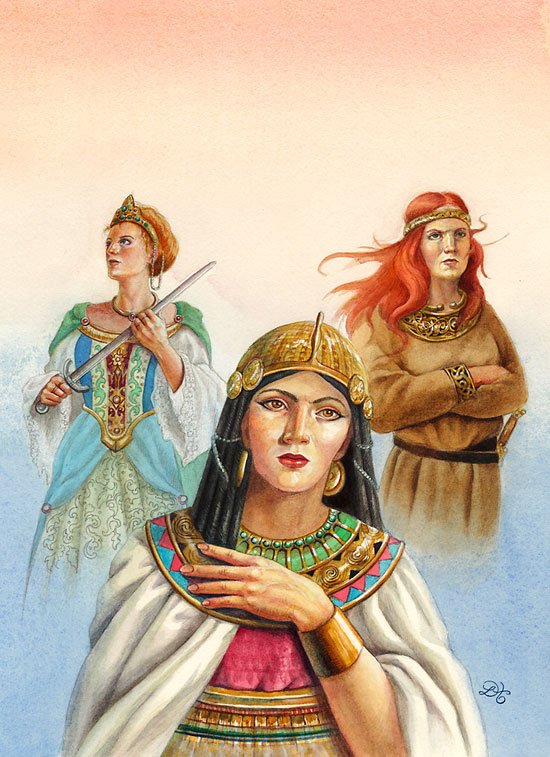
It was hard to find a good warrior women illustration which had women with their clothes on. Most of the illustrator, I guess, being men, they protray women warriors in scanty attire, and most of them have exaggerated breasts and hips, and tiny little wasp waists, and legs about twice as long as a normal woman. Sort of Barbie-doll in warrior women attire. *she snorts in disgust* Leaves a fighter a little vulnerable, don’t you think, fighting in a metal bra and tiny little loincloth? That metal would get uncomfortable in no time, and man, how can you ride a horse for very long without chafing your legs? But then reality wouldn’t sell the drawing, would it?
OK, OK, back to the real question – Warrior women pop up in all cultures. I think that is true, but when I think of the Arabian Gulf, or Persia, or the Levant, no one comes to mind, other than Sheherezad, but she triumphed by her wits, not her brawn, not her fighting skills. I remember hearing that nomadic women could be fierce; are there not legends of Bedouin women?
Is there a woman / are there women who were legendary fighters in Middle East culture? Are there women in Persian culture who fought, or held a castle, or were otherwise brave in the face of danger? Speak now!
The Street of Ramadan Lanterns
Over 15 years ago, this article appeared in the March/April edition of SaudiAramco World.

Blessed is He who made constellations in the skies and placed therein a lamp and a moon giving light; and it is He who made the night and day to follow each other: For such as have the will to celebrate His praises or to show their gratitude.
The Qu’ran, Chapter XXV (Al-Funqan, The Criterion), Verses 61-62
Written and photographed by John Feeney
No one knows for certain when the use of children’s Ramadan lanterns began, but it is a very old Egyptian tradition. Indeed, lanterns and lamps of various kinds, of many hues and degrees of brightness, and even both real and imaginary, have always been special to Egypt. For centuries before the coming of electricity, Cairo itself was noted for its spectacular use of lanterns to illuminate the city, especially during the holy month of Ramadan.
Ramadan, the ninth month of the Muslim lunar year, is a time of fasting, blessings and prayers. It also commemorates the revelation of the first verses of the Qur’an to the Prophet Muhammad.
As a way of giving thanks to God during this holy month, and as a way of unifying the worldwide community of believers, Muslims – with special exceptions for the sick, nursing mothers, pregnant women and travelers – spend the daylight hours fasting. The hours of the night, until dawn, are marked by prayers, ceremonial meals and celebration of the day’s spiritual victory over human desires. After sunset, streets and squares all over the Muslim world are thronged with people out buying food after the long day’s fast, or visiting friends, or preparing for sahur, the last meal of the night, which will be taken before dawn. It is then that young Cairenes, allowed to stay up late because of Ramadan, traditionally gather in groups of three or four to go out among the crowds, swinging their glowing lanterns and chanting their ancient song of Ramadan – just as children in other lands go caroling – hoping to receive in return a few nuts or sweets for their vocal efforts.
Passed on by children from generation to generation, the traditional song, in colloquial Egyptian Arabic, accompanies the swinging of the lanterns in the little ones’ hands. It goes like this:
Wahawi, ya wahawi
iyyahah
You have gone, O Sha’ban,
You have come, O Ramadan,
iyyahah
The daughter of the Sultan
is wearing her caftan,
iyyahah
For God the forgiver
Give us this season’s gift.
Some believe that the children’s lantern song comes all the way from Pharaonic times, like the ancient Egyptian song called O-Faleh in the Pharaonic tongue and al-Bahr Sa’id in Arabic (meaning “The River Has Risen”). In the days before the Aswan Dam was built, that song was sung by groups out in small boats on the night the Nile reached the peak of its annual flood. Certainly, the lantern song is very old, and very Egyptian.
The opening lines – “Wahawi ya, wahawi iyyahah” – have no known meaning. “You have gone, O Sha’ban” refers to the month that comes before Ramadan in the Muslims’ lunar hijri calendar, and “the daughter of the Sultan is wearing her caftan” means she is dressed in the garment worn when going out, maybe to the mosque. “Give us this season’s gift” refers to the small presents children receive from family and friends at the time of the ‘Id or holiday that follows the month of fasting.
In the days leading up to Ramadan, children become more insistent about having a lantern; many can hardly wait to start swinging and singing – for what child, from its earliest years, is not attracted by a glowing, magical lantern? Yet Cairo children may be the most “lantern-struck” of all: Recent research by Dr. Marsin Mahdi of Harvard University indicates that Scheherezade’s ‘Alaa’ al-Din (Aladdin) of the magic lamp may well have been a Cairo boy.
One week before Ramadan begins, part of Ahmad Maher Street, for most of the year a humble thoroughfare in the old medieval quarter of Cairo, is transformed. Usually home to tinsmiths, marble-cutters and makers of mousetraps, for one glorious month it becomes “The Street of the Lanterns.”
Filmmaker John Feeney, who has lived in Cairo for a quarter century, is a long-time contributor toAramco World. He wishes to thank Laila Ibrahim, renowned authority on Mamluk Egypt, for her help with this article.
This article appeared on pages 14-23 of the March/April 1992 print edition of Saudi Aramco World.
You can read the rest of this fascinating article HERE.
I love the Ramadan lanterns. I’ve been to Cairo, and found the heat and the teeming population, the gridlocked traffic and all the begging a little scary. But I would go back in a heartbeat to see this street of lanterns!
For my non-Muslim readers, I found a wonderful site while researching Ramadan lanterns that gives a simple overview of Ramadan: Hamad El Afandi’s Ramadan Kareem. It is heavily illustrated with photos.
Recent Comments
intlxpatr on Shampoo Ginger tigerbutterya0c5ff1d… on Shampoo Ginger intlxpatr on British Soldier Kidnapped, Esc… John on British Soldier Kidnapped, Esc… intlxpatr on British Soldier Kidnapped, Esc… Wikipedia Donate Button

Amazina


Early Voting in Florida


