


Lisey’s Story: Stephen King
Mostly I wait for books to come out in paperback, so that they don’t hurt me if I fall asleep while I am reading (!), but for a few authors I will make an exception. One, James Lee Burke, I told you about in a previous post He Had Me From Hello.
My most recent exception was for Lisey’s Story, the newest novel out by Stephen King. It’s a departure from Stephen King as we know him, and yet, there are resonances and echoes of earlier writings. Stephen King is brilliant at capturing the terrors of childhood, and the diaphanously thin membrane separating reality as we know it (not that we agree on what “reality” is! 😉 ) from the “otherworld”. In the Dark Tower series, the otherworld was where all the bad things were created and passed over to this side through leaks, places where the membrane holding worlds apart thinned and even disappeared.
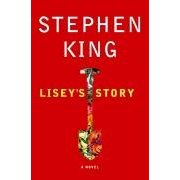
This book is covered with flowers, bright pink and fushia and purple peonies, lupin and daisies, shading into blacks, whites and greys at the top, so that the holleyhocks are only faintly blue. It’s a very odd cover for a Stephen King book, but this is a very odd book. Early reviews say it is about as autobiographical a book by Stephen King as he has ever written, and I believe it. Stephen King writes what he knows – from Misery, written shortly after his nearly fatal accident as he was walking along a road near his Vermont farm and was hit by a van and nearly crippled for life, to this one, Lisey’s Story, in which we spend a lot of time in a dead author’s writing loft in an old barn in – you guessed it – Vermont.
As Lisey’s Story opens, we learn that she is the widow of an author (an author a whole lot like Stephen King) who has made a fortune writing fantasy/horror books. As the book unfolds, we walk with her through her devastating grief, bitter anger, and the endless exhaustion of trying to clear out her husband’s study. Every time she tackles the task, she is distracted by vivid and disturbing memories, memories she has tried to keep deeply buried because of their troubling implications.
King is writing on multiple levels. On one level, it is about a widow coming to terms with the death of her life partner. On another level, it is about a woman who doesn’t know her own strength and who comes to understand more about herself and about her relation to the world, and to her family of sisters. We’re there. We walk with her. If you’ve ever had sisters, you will particularly appreciate King’s treatment of how sisters relate to one another, and how that relationship both stays strong and loyal, and also evolves as sisters become adult people facing adult crises.
Throughout the book are whispers reminding us that the dead are all around us, leaving hints and reminders that their reality, too, is only a thin membrane away from our own.
And, on the most obvious level, King is writing about a boy and the source of his nightmares, the same source of his healing powers, the real life nightmares that haunt us all, and how with bravery and goodness and tools we don’t even know we have, we can triumph over evil.
Stephen King taps into the child within us all. He knows the terrors of our childhood, and he knows that evil gains power from the ability to terrify. Stephen King believes good can triumph over evil – when good people band together, evil can be beaten. In every book, there is a moment when one has to make a choice to stand against evil or be crushed by evil, and while his heroes and heroines are flawed and human – they are good, and they choose to stand against the evil. They may come out scarred and bloody, but they also come out triumphant.
It may not be great literature, but it’s a fine read. Stephen King’s books also are great vocabulary builders. He uses unusual and precise words to paint his word pictures.
Addiction and Amy Tan
“I’ll just go in to get the birthday cards,” I said to myself, but the moment I opened the large brass-handled swinging doors, my heart started pounding, my breath came faster and like a moth to the flame, I headed straight toward that huge pile of “Best Sellers” just inside the door.
Mentally slapping myself and forcing myself back on the planned path, I forced myself away from the new arrivals and towards the cards. But oh, the temptations along the path . . . new sudoku. . . .oh a new Gregory Maguire . . . oh! oh! oh!
With great discipline, I manage to buy the cards and only two new books, a new Stephen King book, hot off the press, (my son had mentioned it and that it was getting great reviews) and the new Amy Tan book. Rationalization – I am returning to Kuwait and it is a looooooooooooonnnnnngggggg trip, easily a two book trip. But when you have an addiction, any excuse will do.
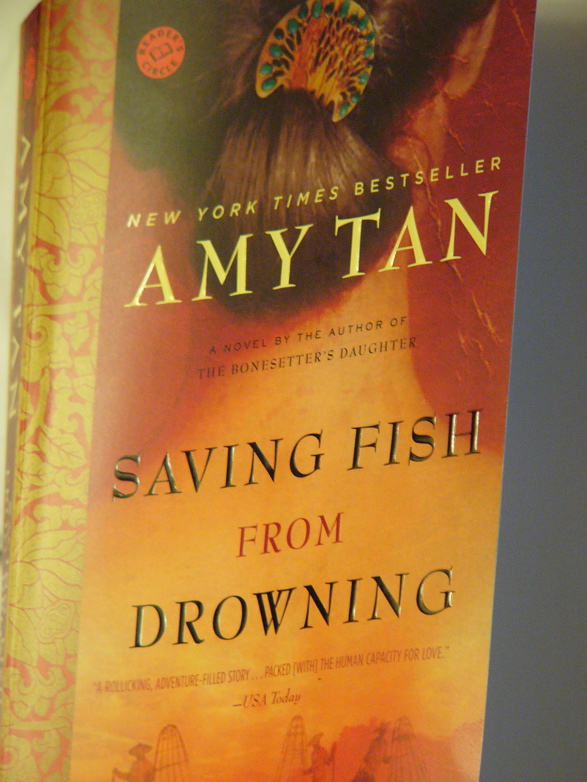
Amy Tan is always a rollicking good read. For one thing, her books focus on that big favorite theme of mine, cross cultural communication – and miscommunication. She has a keen eye, rapier sharp wit, and filets her characters neatly, but humanely.
Saving Fish from Drowning is about a tour group en route to China and Burma, told from the point of view of the tour group organizer – an art and museum patron who dies before the trip begins! She is with the group, however, in spirit – able to see everything, know what people are thinking, but not to intervene. Without her guidance, the group goes desperately awry – and it is funny, but also very very scary. You know something BAD is going to happen, and it isn’t going to be pretty.
Tan writes some great prose. Here is an excerpt about the main character, as she looks back over her life:
“But I ask myself now – was there ever a true great love? Anyone who became the object of my obsession and not simply my affections? I honestly don’t think so. In part, this was my fault. It was my nature, I suppose. I could not let myself become that unmindful. Isn’t that what love is – losing your mind? You don’t care what people think. You don’t see your beloved’s faults, the slight stinginess, the bit of carelessness, the occasional streak of meanness. You don’t mind that he is beneath you socially, educationally, financially and morally – that’t the worst I think, deficient morals.
“I always minded. I was always cautious of what could go wrong, and what was already “not ideal.” I paid attention to the divorce rates. I ask you this: What’s the chance of finding a lasting marriage? Twenty percent? Ten? Did I know any woman who excaped from having her heart crushed like a recyclable can? Not a one. From what I have observed, when the anesthesia of love wears off, there is always the pain of consequences. You don’t have to be stupid to marry the wrong man.”
Whew! Amy! You said a mouthful!
Dubai 2010
My niece (Little Diamond aka adiamondinsunlight) doesn’t have her own blog yet. Until she does, I get to share all the information she shares with me.
This one is from New Left Review and is a fascinating article about the Dubai of the Future, a playground for the rich and idle, with unimaginable luxuries – but at what cost?
Hiking With Robin Pope in Zambia (4)
We hear the drums waking us the next morning and we are SO ready. We have met with Robin Pope, who oriented us with maps to the area of the Mupamadze River we will trek, and has given us all kinds of hints as to how we will need to dress and to take care of ourselves and one another.
After breakfast, we load into a land cruiser specially built in Tanzania on a Toyota truck base. It is sturdy, tough, and very practical. We choose our seats, we tuck our long pants into our socks, we pull our sleeves down over our hands, and wrap our kikoy around our faces – we will be heading into tzetze fly territory.
From the very beginning, we understand what is so special about travelling with Robin Pope. This man knows so much. We stop every kilometer – here is a bird rarely seen, and here is a lion track, and here is a lagoon where we might see . . . ! Things we might pass right by without knowing anything are examined and are illuminated; we see the world in a tiny pond, and we see the miracles in a leaf.
We come to a great sand river, full in the rainy season but empty and sand-filled now. Robin gets a running start, but still, almost to the other side, we bog down. Yes, I am taking the photo, but as soon as I took it, I had to go and push, too. . . .

these trips aren’t for the lazy bones! It took all of us pushing and Robin rocking the truck back and forth to get it going again, and get us to the other side of the sand river. Great exercise!
Almost to the camp, we saw a family or warthogs and five little warthog babies along the right side of the road, and and a duiker kill on the left side of the road – two more stops. It’s waaaaayyyyyy late when we get to camp, but . . . who cares? Vultures circle – and we learn to identify five different kind. We are having a ball.
These temporary camps are not so elaborate as the camps at Tena Tena, Nkwali and Nsefu – they are put together and taken apart as we hike along the river. We stay one night at the first camp, two nights at the second camp and two nights at the third camp. The tents are small, but still tall enough to stand up in. There is a nightstand between the two camp beds, with a candle, matches and mosquito coil. Each bed has a folding type stand for a piece of luggage. Outside, there is your washing stand, two camp chairs, a mat, places to put your toiletries, and places to hang your wash.
There are separate “long-drop” toilets for the men and for the women, a shovel and a bucket of sand as part of the etiquette so that whoever comes next won’t be grossed out. The shower is a gravity drop shower, with nice warm water. We have to arrange with one another how we will schedule our shower time.
At lunch the first day, they serve a green salad, spinach crepes, pumpkin, onion bread, beef salad, potato salad, melon and cookies (biscuits). Amazing – out here in the middle of nowhere, a beautiful table, nice wines, tablecloths, napkins and great food. Best of all is that we have good travelling companions, and the conversation is fast and furious and a lot of fun.
We travelled lightly, so almost every day we have to wash and hang socks or a shirt, or even once a pair of jeans. They dry very quickly in the hot hot sun of late August. The days start out chill, rising around six to be on the path by six thirty, but by the time we get to our next stop for lunch, it is hot hot hot. Although we are hiking six hours in the morning and a couple hours in the afternoon, it is easy hiking, maybe some brisk walking but always stopping as Robin spots a martin, or a rare bird, or hears buffalo, or even – spots a lion!
After a rest and time for settling in, we take a late game walk with Robin to the top of a nearby hill where we can look off into the far away hills, and watch the river meander out of sight. He points out where we will trek the next day, and we head back for camp.

The plan for the trip is to do about 10 km a day – we hike for six or so hours in the morning and then another two in the afternoon. OK, here is the truth – I am an introvert, and I don’t like to feel rushed about taking my shower, so I skip the afternoon walk just to have some quiet time and a leisurely shower. The walks are not rigorous – during the mornings, we may hike, but we stop so often to look at things or to take photos that we never feel pushed or tired.
My very favorite part of the hiking is crossing the river. Robin finds a safe, not-too-deep place, away from the crocodiles, and we all strip off our shoes and socks and carry them as we wade across the nice, cool river. Early in the morning we see herons, and buffalo as well as crocodile, and it all has an unearthly feel to it. Robin knows where all the good paths are, so we will cross and spend a while on one side, and then cross back over to see something special on the other side.
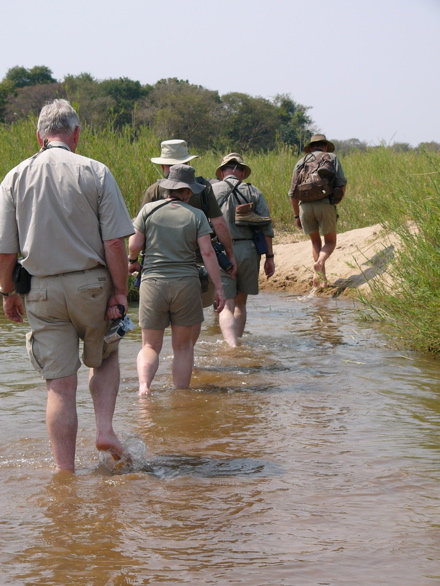
Sometimes after the morning hike, we find ourselves at the next camp. Only twice were we at the same camp two nights in a row.
The food was absolutely amazing. Beef Wellington. Tilapia. Wonderful sweet desserts. And once, oh what a treat, a selection of locally made Zambian cheeses, chevres, a brie-like cheese, a Cantal like cheese – oh my heaven.
On the last night, I scurried with the crew to meet the hikers down the road about three kilometers by the river. When we got there, the crew set up deck chairs in the shallows of the river, and the hikers got there just as the sun started to go down. There was a huge Goliath heron fishing nearby. There were hot hors d’ouevres, there were mixed drinks and good wine, and a great big full moon rising as the sun went down. Sitting there in that river came a sudden self-awareness: “How cool is this, sitting in the river with Robin Pope watching the sun go down after five days of trekking? Life is good.” It was a thrill.
Dinner that night around the campfire – I think it was fish curry and vegetable curry, a caprese salad (tomatoes with Zambian mozzarella di bufalo), a big green salad with toasted sesame seeds, and something sweet and chocolate for dessert. The meal itself is hazy – the conversation was so good, so much fun, we had a lot of fun with Robin and with our fellow trekkers. And then. . . as the embers started to die down, we could hear a drum, off in the distance, and singing. We could hear clapping. And it came closer. We all fell silent, wondering what this was?
The entire crew approached slowly, all dressed in their best clothes, singing in multi-part harmony, singing Zambian songs, some gospel songs, bush songs. . . moon glowing overhead, the smell of woodsmoke, after a great meal – the singing was haunting and magical, and utterly unforgettable. We were all sad to be ending this adventure, and the beauty and delight of this Mupamadzi concert put it all over-the-top.
The concert ended and we drifted off to bed.
The next day, we broke camp, leaving the Mupamadzi and heading back for Tena Tena. Travelling with Robin Pope, the adventure continues – a huge old boabab tree here, hills they are exploring for future walking treks over there, and uniting it all, Robin’s gentle wry humor and keen observations. Time has no power over Robin, it is the moment and the opportunity that are all important, and our last day is every bit as great an adventure as the first.
There is a lot of world out there – and yet. We know we will be heading for the Robin Pope camps in the South Luangwa Valley again and again.
The link to Robin and Jo Pope’s home page is here.
In addition RPS puts out a wonderful weekly newsletter all about happenings at the camps – new animal babies, leopard killings, flood season, what’s going on at the Kawazaa school, and daily life in the year-round camps. You can subscribe to “It’s Monday” here.
Hiking with Robin Pope in Zambia (3)
There’s a lot of world to see, and we never intended to repeat a trip. The Robin Pope camps are so exceptional that – we made an exception. The very next year, we are back in Zambia, and eager – we are going hiking with Robin Pope himself.
Who is Robin Pope? He is a native African, and a staunch Zambian. He knows so much about wildlife that he probably doesn’t even know how much he knows. He is quietly and dryly funny. He started guiding as a very young man, and then, together with his wife Jo, began building a very particular kind of tourist experience. When you reach the Robin Pope camps, Nkwali, Nsefu and Tena Tena, you become like family. Well, family who live very luxuriously – the cabins are large and spacious, and beautifully appointed, with fine linens, mosquito netting, shelves, toiletries, all the comforts – a million miles from anywhere.
Each camp holds only a very limited number of campers, supported by enthusiastic and knowledgeable staff. They grow their own vegetables, or buy from local farmers. They employ people from the nearby villages. Black and white people work together equally.
One of the things we were able to do was to visit Kawazaa village, to visit the schools re-built and supplied by Robin Pope Safaris, to visit the local clinic, to visit with local villagers. We can’t wait to go back. The second trip, we bring one big suitcase full of school supplies – calculators, books, paper, pens, pencils . . . it was fun for us to find these things, having met the students who would use them, and the teachers who would benefit by having resources. Everywhere we go, we have to sign a book – the villagers get specific monetary credits for every visitor they entertain.
There are six of us who will trek with Robin Pope, and we meet in the Land Rover that picks us up at Mfuwe International Airport. I love that name – don’t you just see big jets flying in and out? In reality, it is a tiny little airport, handling only small planes. There is one small arrivals gate and one equally small departures gate. Because it also gets an occasional flight from Malawi, it can call itself “international.” We arrive at Nkwali, enchanted once again to find the hippo pod right under our window.
Lunch – how do they do it? Fish cakes with lemon mayonnaise, leek quiche, potato salad, avocado salad, green salad, cheesy corn rolls and butter, finishing with coffee and tea.
On our game drive the next morning, Jacob takes us out to see Thornicroft giraffe, and we see lots of elephants and baby elephants, and a herd of over 300 buffalo. After lunch, it is hot and we fall into a dead sleep, awakening in time for our afternoon game drive which starts with a boat ride across the river.
And what a boat ride! The hippos have spread out, and we THINK we are safely past when one of them lunges at the boat, missing us by a thread.
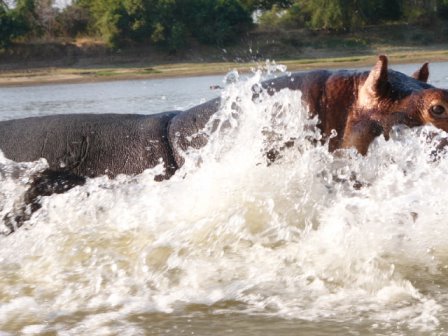
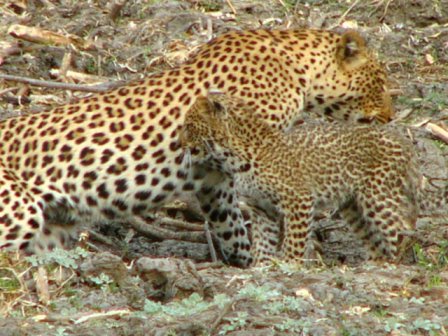
Thank God, it is hot for another hour, as we are all totally soaked, but also energized by the huge jolt of adreneline shooting through our veins at escaping unhurt from that lunging hippo. On our drive, we see leopard, genet cats, civet cats and a great big lumbering porcupine.
We have dinner down by the river, under the stars, with napkins folded like guinea fowl. It starts with spinach soup, and then there is pork tenderloin, pumpkin, mange-tout peas, cauliflower with a cheese sauce, lentils and for dessert, butterscotch pie. Somehow, we manage not to gain weight – we can’t figure out how.
Amazing Race Kuwait: Dying Laughing
The funniest part of all is watching the contestants on the Amazing Race Kuwait trying to find Souk Soulabiyya. The funniest thing of all is watching them look at the maps and say “it isn’t on here!” No kidding!
The coolest thing of all the the gracious people who help, even dropping their own errands to lead them in the right direction.
And the most amazing to me, is that one member of each team had to climb up the outside of the Kuwaiti water towers – holy smokes. Even those who had a terrible fear of heights were determined to make it. I was in awe of how they faced their fears and prevailed.
But oh, watching them try to navigate the roads – dying laughing! If you don’t laugh, you’re gonna cry.
Thought I had published this last night, but found it this morning in drafts. Drat!
Hiking With Robin Pope in Zambia (2)
The days pass too quickly. Our bags catch up with us on the third day – one day to get from J-burg to Lusaka, one day to get from Lusaka to Mfuwe, and one day to get to the camp at Nkwali. We never had a moment’s concern; they kept us informed every step along the way.
Here is what the day looks like – early early you hear a knock on the door and someone says “Good morning!” and you struggle out of bed. It is still the middle of winter below the equator, so it is cold. You jump into your clothing and head for the campfire, where breakfast is served. Toast is being heated on the grill, there is hot cereal and cold cereal, and some mornings there is even bacon. There is always hot coffee and hot tea. You can socialize or not, as your morning nature indicates, then grab your gear and load up. Usually it is you and your traveling partner, maybe another couple, and the guide. Every day you take off to a new area, sometimes for the whole day so you can see outlying areas, and sometimes just for three to five hours.

There is never a game drive where you don’t see something. Most of the people who show up at the Robin Pope camps are good safari travelers – good at spotting movement, as excited to see a bat eared fox as another lion, people who will sit and watch giraffe, or hippos, or storks . . . people who know when not to talk, and people who are considerate of one another when shooting photos or movies.

We move on to Nsefu, where the cabins are round! There is a big outdoor BBQ that night, lots of fun, down by the marsh where there is always something happening. We saw a huge Pell’s Fishing Owl, a great thrill, and several varieties of eagle. Watching the raptors is a huge thrill.
And then – our favorite camp – Tena Tena. They put us in the very end cabin, and oh, we like that very much. Tena Tena is rebuilt every year – you get there by boat. Tent-cabins are rebuilt once the rains stop and the floodwaters recede. The cabins are fabulous – during the day, they are totally open to the outdoors. Big huge king sized beds, flat woven carpeting with pile carpet accents, a large dressing area with shelves so you can really unpack and move in, and a huge outdoor shower and toilet and sink area to be shared with the stars and moon shining down on you. At night, the tents are closed, and an electrified fence prevents too much chance of invasion. The marsh area in front of the camp teems with life – after dinner one night, we have to wait until the leopard leaves before the guide will take us to our tent.
On our very favorite game drive at Tena Tena, we were out on the night of a full moon, and came across a pride of lions hunting. We spent nearly an hour just watching breathlessly as the lions tracked their victims, spreading out, sharing the responsibilities in the pack. There is no ambient light at all, so the sky is black as ink, and the stars are sparkling brighter than the finest diamonds. The moon casts a ghostly glow on the surroundings – enough light I can shoot photos without a flash. It is magical, and unforgettable.
My husband tells this story of Tena Tena:
“One night, I heard a loud sound and I couldn’t figure out what it was. I opened the tent flap and not two feet away was a hippo, eating a bush, and it was the loud chewing that I heard. What a thrill! The hippo was huge! I watched spellbound; I woke my wife. . .it was awesome. Two feet away! And then, the second night, he was back. What a thrill – he chews so loudly! The third night he was back again – ‘that damn hippo! I can’t sleep!’”
Hiking with Robin Pope in Zambia (One)
Today it is rainy and cold, and I have “miles to go before I sleep.” In my mind, I fly back to a happier time, and today I choose to be back in Zambia.
We fell in love with Zambia our first time there. We flew in to Lusaka, and our bags didn’t make it. We called frantically from the Holiday Inn and got a different answer every time we called. First we heard that our bags would be in on a later flight that day – which was what we wanted to hear, as we were leaving early the next morning. Later, the harried British Air office told us with clear annoyance in her voice that there were no more flights from Johannesburg, and our bags would catch up with us . . . Catch up with us? We were off to the bush for two weeks!
I was in a skirt. It was cold in the bush, and we had nothing with us but our camera equipment (Thank God!) and a change of underwear. We looked at each other and said “Holy smokes. We’re screwed. What do we do now?”
It was five o’clock at night. We grabbed a taxi and asked him to take us to a place with stores with clothing. He took us to a small strip mall, and waited for us while we ran in and searched desperately for socks, pants, sweatshirts and spare underwear. It was . . .fun! Almost everything we found was from China, but we managed to find it all pretty much in green. The underwear was really cheap stuff and wouldn’t wear well, but it just had to last until our bags caught up with us. Part of what was fun was that we had read Lusaka was dangerous at night, but at least here in the shops area there seemed to be plenty of security and the shops took Visa cards. Within an hour, we had jeans, sweatshirts, socks and enough to live on until the bags came.
At five the next morning we headed back to the airport and out to Nkwali, the first stop in the Robin Pope series of camps. Our large cabin at Nkwali overlooked a huge pod of hippos, and all night we could hear them talking to one another, and occasionally having a huge, very noisy family argument. The food at Nkwali was delicious, and we loved getting to see the kitchen and meet the people who prepared the foods. They grow a lot of their own produce, and have agreements with local farmers to supply much of what they cook up for the guests.
At Nkwali, they provided beautiful linen bathrobes for us to wear after our showers in our enclosed outdoor shower, and kikoy, a multi-purpose shawl/wrap thing in wonderful colors that you can use as headgear, neck gear, wet down to keep cool in the heat of the afternoon, as a wrap – they are both big – maybe 150 cm long by 110 cm wide – and lightweight, very flexible.
Nkwali is such a cool camp. Every detail is managed. The camp manager visited us and assured us they were in contact with British Air, and our bags would reach us the next day. Relieved of that worry, we went out on our first game drive, saw leopard and lion and a million gorgeous birds, and had drinks at sundown overlooking a field full of wildlife action. After dinner, we went to bed to the sound of the soft grunting sounds of the hippo. Paradise, here on earth.

The Fraud Syndrome
When I finally got to graduate school, I was in shock. There was me, one other woman, and a classroom full of men. It might sound like heaven, but it was testosterone-city. We were studying national security affairs, a sub-group of International Relations, and most of my classmates were in different branches of the military.
My professor, a former military intelligence colonel, was knowledgable, and good at presenting his lessons. He was very professional, very businesslike. Not exactly cold, but neither was he collegial.
In any graduate courses, there is a whole new vocabulary to master. I felt like I had grabbed onto a train that was leaving the station; I was holding on for dear life. I read all my assignments, made sure I copies all my notes, and . . . never said a word in class for the first two weeks. I was too scared. All the guys were blah blah blah and I just hoped they wouldn’t figure out that I barely had a clue.
One of my fellow students came up to me on break. He was nice. He asked if I had seen a recent article in the paper on The Fraud Syndrome, and I said “no” that I hadn’t. He just happened to have a copy of it with him, which he gave to me.
Here is what Wikipedia has to say about the Fraud Syndrome:
The Impostor Syndrome, or Impostor Phenomenon, sometimes called Fraud Syndrome, is not an officially recognized psychological disorder, but has been the subject of a number of books and articles by psychologists and educators. Individuals experiencing this syndrome seem unable to internalize their accomplishments. Regardless of what level of success they may have achieved in their chosen field of work or study, or what external proof they may have of their competence, they remain convinced internally that they do not deserve the success they have achieved and are really frauds. Proofs of success are dismissed as luck, timing, or otherwise having deceived others into thinking they were more intelligent and competent than they believe themselves to be. This syndrome is thought to be particularly common among women, particularly women who are successful in careers typically associated with men, and among academics.
When time came to take our first test, I studied and studied. I knew I wasn’t getting any credit for participating in class, so I really needed a good grade on the test. I did my best. I hoped to pass.
When the professor gave us back our tests, he put the scale on the board. The lowest grade was a C-. I had passed! Even if I got the C-, I had passed! Then he started talking about all the mistakes, including one really bad one – a person who had used a quote, and the quote was not accurate.
My heart fell. I had quoted George Kennan on deterrence, quote marks and everything. I thought I had it word perfect, but I must have screwed it up. I was so embarrassed.
One paper, he said, had no red marks on it. He said he has never had a paper before on which he didn’t make a single correction, that this was a first in his history of teaching. I barely paid attention – I had passed, even if I blew the Kennan quote.
Yeh – the paper with NO red marks was mine. I thought there must have been some mistake, but the professor held me after class, and told me that for my next homework, he wanted me to speak up in class. And he congratulated me on the test. Only one guy guessed it was my paper with no corrections – the same guy who had told me about the fraud syndrome. Through our two years in grad school, we became good friends, and would share notes with one another if one of us had to be out of town on assignments.
It was October. I remember there was fog on the road, and a great big full round white moon glowing through the fog on my drive home. I had so much adreneline pumping through me that I howled “Wooooooooo Hoooooooooo!” at the moon that night.
Recent Comments
intlxpatr on Shampoo Ginger tigerbutterya0c5ff1d… on Shampoo Ginger intlxpatr on British Soldier Kidnapped, Esc… John on British Soldier Kidnapped, Esc… intlxpatr on British Soldier Kidnapped, Esc… Wikipedia Donate Button

Amazina


Early Voting in Florida


