Hemingway and A Movable Feast

After reading The Paris Wife, I had to read Hemingway’s A Movable Feast. I wanted to see how he saw his Paris years, and how his version integrated with the fiction version of Hadley’s. I was prepared to not like the book.
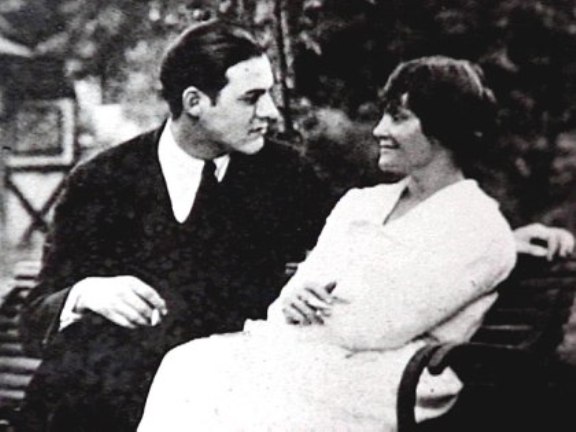
I was not prepared to like it as much as I did. Hemingway writes of the years when he was young, newly married and wildly happy, living a stimulating and lively life with lively friends. They were poor, but he was following his dream. They had a lot of fun.
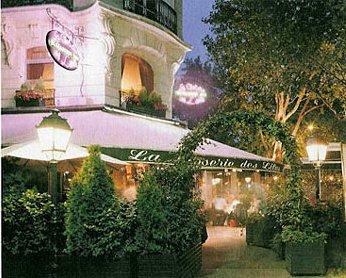
Hemingway wrote this book, full of stories of their Paris life, full of names you know – Ezra Pound, Scott and Zelda Fitzgerald, Picasso, Closerie des Lilas, Les Deux Magots, Brasserie Lipp, the Louvre . . . and as you read it, you are there. He writes in the moment; you are right there experiencing it along with him. He writes of people he likes, and people he doesn’t like. He writes about his own vices – an addiction to horse racing, for example – and he writes with enormous sadness about how he came to be distracted from his marriage and lost the most wonderful relationship that ever happened to him. He blames it on the careless rich. He takes some responsibility.
He also writes very frankly and openly about people he doesn’t like and why. I couldn’t help but think it is a heady thing, being an acclaimed author, where you can take revenge by putting people you dislike in your books. Hemingway uses real names and real people and often portrays them in a distinctly unflattering light. It made me wonder if he was planning to commit suicide all along; that or he just didn’t care what people think, and it seems he might have been the kind just not to care.
Just after finishing this book, and talking one last time with his first wife, Hadly, Hemingway committed suicide. It leaves me wondering if he was driven to suicide by regret, or by fears that his bigger-than-life life of adventure, travel, high life and travel was over, or if he had serious bouts of depression all his life, and this was just another, deeper depression?
It is a great read, especially paired with Paula McLain’s book, The Paris Wife. I thought it might be “he said – she said,” but Hemingway and the fictional Hadley in The Paris Wife both agree that they had a love and marriage that was very special, that Paris was a wonderful stimulating, alive environment, and that it was a great tragedy when the marriage ended. A Movable Feast seems to say that destroying his marriage to Hadley was one of a cocktail of self-destructive behaviors over which he tried to ride herd (gambling on the horse races, drinking, drugs, a coterie of star-struck sex partners outside of marriage, inability to focus on his work, a curmudgeonly nature . . .)

It’s also an easy read. I particularly enjoyed reading it on the iPad because you can do that swirly-finger-thing and find out what words mean or see the street locations as he walks Paris, see whether a cafe or restaurant in Paris still exist. It would be a good airline read – keeps your attention and finishes quickly.
As little as I like Woody Allen, it was fun to see Midnight in Paris, and to have some visuals of this go-go inter-war era.
Two things that stuck out for me: Hemingway loved walking in Paris, as do I. He also talks here and there about the benefits of being hungry. There were times when money was tight; they wore old shabby clothes, and there were times they didn’t have much food. He talks about hunger sharpening your other senses. On the other hand, very quickly when he has money, he has a great meal and a drink – or two – or three.
Bottom line, I’m glad I read this book. It’s given me a lot to think about.
Rain for Ramadan
Frequent commenter Daggero asked for photos of clouds and rain to help him get through the long hot days of Ramadan in Kuwait. Yesterday I published cloud photos; today we had a downpour, so here are some rain photos:

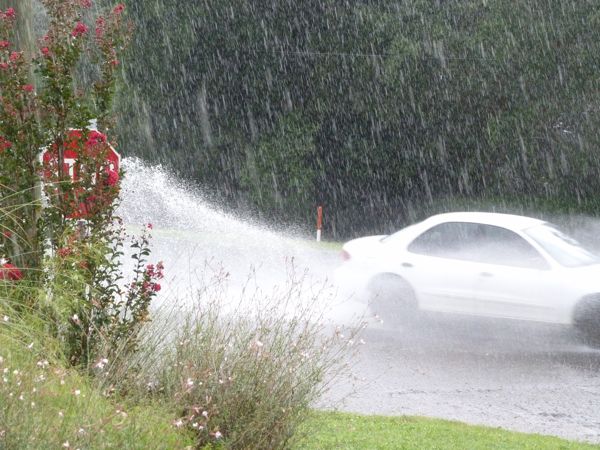





First thing I learned is that it’s not that easy to shoot rain drops. You have to shoot them against a darker background, and you have to shoot them at a slower speed, else you don’t see them at all.
This was great exercise. Now I want to go to Paris in November for more practice. Paris gets lots of rain in November, fewer tourists, it’s more the real Paris. It would also be great for shooting in black and white, people holding umbrellas, bent against the wind-driven rain, great architectural and textured backgrounds . . . 🙂
A Swallowtail is Born
“Come down! Come down!” AdventureMan is calling me from the garden, and I can tell it is something special.
“Look! He just came out of the chrysalis! He’s still wet!”
It is a beautiful new swallowtail butterfly. When the eggs are laid – it takes a mere second, a mere brush-by as the tiny egg is placed on the fennel – they are a mere 1/32 of an inch, you can barely see them with your bare eyes.

It is 78° in the cool of the morning, the best part of the day. The sun is coming up, and a new swallowtail is drying off, preparing to fly away to a new life.

James Lee Burke and the Creole Belle
James Lee Burke is number one on my guilty-pleasures list.

I first met his main character Dave Robicheaux in A Morning For Flamingos, a book I picked up in a military library at Lindsay Air Station, a post that doesn’t even exist any more. In the cold dark endless winter in Wiesbaden, Germany, James Lee Burke lit up my life. I had thought I was picking up just another escapist mystery novel, but when James Lee Burke puts words together to describe the way a storm moves in over the bayou, prose becomes poetry.
There is a downside. Whether it is his character Dave Robicheaux, the former New Orleans cop, now head homicide investigator in New Iberia, Louisiana, or his Hackberry Holland series set in West Texas, James Lee Burke’s books are filled with extreme violence and disturbing images that live in your head for a long time.
I’ve recommended James Lee Burke to friends, some of whom have said “Why do you read this trash??? It is HORRIBLE! It is full of over-the-top violence!”
And then again . . . he is writing about some really really bad people. They are out there. There are people who exist who inflict cruelty. I don’t understand it, I can’t begin to fathom where the urge would come from, but I’ve seen it. It’s out there. James Lee Burke pulls up that rock and exposes the dark happenings underneath.
On one level, as I started reading Creole Belle, I thought “Oh James Lee Burke, stop! Stop! It’s the same old formula! A downtrodden victim (often a beautiful woman) cries for help. You and Clete start looking for information and end up beating people up and then they retaliate by threatening your family! There is a rich, beautiful woman who seems vulnerable and who you kind of like, but she is complicated. There are rich amoral people who keep their hands clean, but who are calling the shots and never go to jail! Stop! Stop!”
Well, I should say that, and maybe I should stop. Then he starts talking about the smoke from the sugar cane fields and the bridge over the Bayou Teche, and the big Evangeline oak in St. Martinsville, and I am a goner. I’m sucked in, I’m hooked.
I detest the violence and the images. I keep coming back because James Lee Burke has some important things to say.
I’d love to have him to dinner. I’d love for him and our son to have a chance to talk about Law Enforcement. Here is what James Lee Burke has to say in Creole Bell:
There are three essential truths about law enforcement: Most crimes are not punished; most crimes are not solved through the use of forensic evidence; and informants product the lion’s share of information that puts the bad guys in a cage.
My son hates shows like CSI, and Law and Order, where the evidence convicts the criminals. He says it raises unreal expectations in juries, and makes it harder to get a conviction.
We watched a Violation of Parole hearing, or actually a series of hearings, where the judge asked each individual whose parole was about to be revoked what had happened when he or she was re-arrested. In each case, the parolee had done something stupid; drove a car with an expired license, drove to another state, was arrested driving drunk, etc. EVERY time. The judge made his point, I believe.
From Creole Belle:
But if Caruso was the pro Clete thought she was, she would avoid the mistakes and geographical settings common to the army of miscreants and dysfunctional individuals who constitute the criminal subculture of the United States. Few perpetrators are arrested during the commission of their crimes. They get pulled over for DWI, an expired license tag, or throwing litter on the street. They get busted in barroom beefs, prostitution stings, or fighting with a minimum-wage employee at a roach motel. Their addictions and compulsions govern their lives and place them in predictable circumstances and situations over and over, because they are incapable of changing who and what they are. Their level of stupidity is a source of humor at every stationhouse in the country. Unfortunately, the pros – high end safecrackers and jewel thieves and mobbed-up button men and second story creeps – are usually intelligent, pathological, skilled in what they do, middle class in their tastes and little different in dress and speech and behavior from the rest of us.
And then there are paragraphs like this that discuss the human experience, and have a far wider application than the book:
No one likes to be afraid. Fear is the enemy of love and faith and robs us of all serenity. It steals both our sleep and our sunrise and makes us treacherous and venal and dishonorble. It fills our glands with toxins and effaces our identity and gives flight to any vestige of self-respect. If you have ever been afraid, truly afraid, in a way that makes your hair soggy with sweat and turns your skin gray and fouls your blood and spiritually eviscerates you to the point where you cannot pray lest your prayers be a concesion to your conviction that you’re about to die, you know what I am talking about. This kind of fear has no remedy except motion, no matter what kind. Every person who has experienced war or natural ctastrophe or man-made calamity knows this. The adrenaline surge is so great that you can pick up an automobile with your bare hands, plunge through glass windows in flaming buildings, or attack an enemy whose numbers and weaponry are far superior to yours. No fear of self-injury is as great as the fear that turns your insides to gelatin and shrivels your soul to the size of an amoeba.
Last, but not least, this is what keeps me coming back to James Lee Burke, so much so that I buy the book almost as soon as it is released. James Lee Burke isn’t afraid to take on the big guys. He “gives voice to those who have no voices.” (Proverbs 31:8) His focus is always on the dignity of the common man, the dignity of hard work, done well, and on the dignity of doing unexpected kindnesses to those who have no expectation of kindness.
. . . All was not right with the world. Giant tentacles of oil that had the color and sheen of feces had spread all the way to Florida, and the argument that biodegradation would take care of the problem would be a hard sell with the locals. The photographs of pelicans and egrets and seagulls encased in sludge, their eyes barely visible, wounded the heart and caused parents to shield their children’s eyes. The testimony before congressional committees by Louisiana fisher-people whose way of life was being destroyed did not help matters, either. The oil company responsible for the blowout had spent an estimated $50 million trying to wipe their fingerprints off Louisiana’s wetlands. They hired black people and whites with hush-puppy accents to be their spokesmen on television. The company’s CEO’s tried their best to look ernest and humanitarian, even though the company’s safety record was the worst of any extractive industry doing business in the United States. They also had a way of chartering their offshore enterprises under the flag of countries like Panama. Their record of geopolitical intrigue went all the way back to the installation of the shah of Iran in the 1950’s. Their even bigger problem was an inability to shut their mouths.
They gave misleading information to the media and the government about the volume of oil escaping from the blown well, and made statements on worldwide television about wanting their lives back and the modest impact that millions of gallons of crude would have on the Gulf Coast. For the media, their tone-deafnessness was a gift from a divine hand. Central casting couild not have provided a more inept bunch of villains.
James Lee Burke has a voice, and he uses it. He could just cash in on his reputation as an Edgar Award winning author, but he uses his voice to speak out against injustice and corruption. He is a champion of the people. I’ve written several book reviews, and taken some trips just because I wanted to see James Lee Burke country; if you are interested in those, you can read them here.
I have a concern about this series, in that this book ended differently than all the others. So differently it made me seriously question whether Burke intends to continue writing about Dave Robicheaux or if Dave is about to hang up his shield and call it a day. He’s a guilty pleasure I am not yet ready to give up.
Ramadan Statistical Anomaly
Ramadan Mubarak! May God Almighty bless your sacrifices and lighten your burdens during your holy month of Ramadan. May you love God with all your heart, and love your neighbor as yourself. 🙂
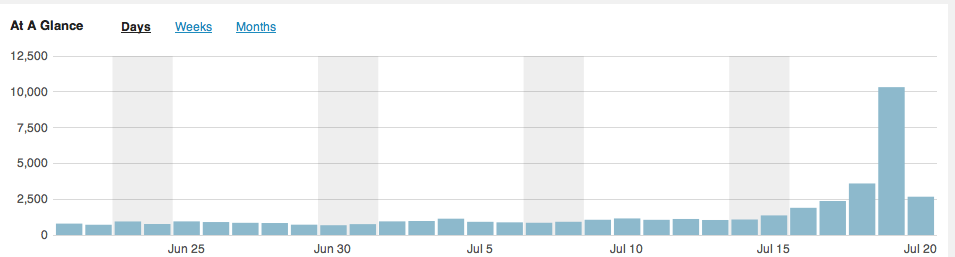
Because I’ve been wishing you well for six years, I had a surge in stats this week, climaxing with what will probably be my all-time high for one day, even if I blog until I am 104 years old, which could happen; my grandmother lived to be 104. Only God knows. 🙂
Here is what my stats look like:
And here are the primary posts:
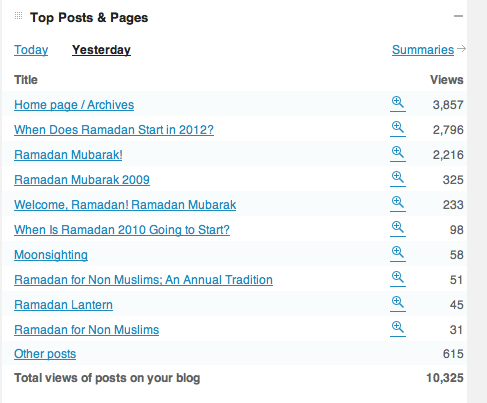
WordPress gives you an hourly count indicator; the highest was 778 per hour. There have been Saturdays when I would have bee thrilled with 778 total for the day, LOL.

I try not to live by stats. I try not to pander to ratings. I try to write this blog with integrity, focusing on issues and news and goodwill to all. There is a little part of me, however, who stayed up late last night to see if the statistical count for the one day would top 10,000 . . . not a part I’m proud of, but hey, I’m human.
Reading Eight Months on Ghazzah Street by Hilary Mantel
When I told my niece I had become thoroughly engrossed in Hilary Mantel’s Wolf Hall and Bring Up The Bodies, she asked me if I had read her book Eight Months on Ghazzah Street. I hadn’t.

Meanwhile, I had started re-reading George R.R. Martin’s A Storm of Swords, so I’ll be ready when HBO does Season Three, and while there is no redeeming value, I sure enjoy the escape, and like my sister Sparkle, sometimes I forget it isn’t the real world, it’s not history, it’s FICTION. I enjoy every minute.
But now I am reading Eight Months on Ghazzah Street, and from the opening pages – where the main character is living in Zambia – I have been totally engrossed.
Frances and her husband Andy move to Saudi Arabia. It’s 1985, Andy is going to build a Saudi ministry headquarters, but it might well been the late nineties, when we lived there. Her flight into Saudi Arabia whipped me back to those days, and to all the loud-mouthed drinkers who kept the rest of us awake.
Frances goes in with preconceptions, but also with a spirit of adventure, and is quickly stifled by the claustrophobic apartment, the limited social opportunities and the lack of free movement as a woman. The heat is oppressive, the clothing rules arbitrary and annoying, and Frances finds all the cockroaches good company during her long lonely days while her husband works.
Her situation was not mine. I lived on a compound, with bus routes that took women shopping every day, twice many days. We had a pool, and a small store, and a video rental kiosk. I had more options, and I probably had more fun. AdventureMan was good about taking me down to the souks at night; it was exotic and interesting. It was also, as Frances describes it, stultifying. It was oppressive. Sometimes the phone worked just fine. Sometimes your dial-up access to the internet functioned. Even on a compound, where some women did drive, walking on your own invited ogling and comments from non-Western men. Living in a country where your sponsor holds on to your passport, and where you need to ask permission to leave the country, and where laws are enforced sometimes, and sometimes not, and where women cannot drive but 12 year old boys have their own cars – it’s La La Land, it’s crazy-making.
Even though I had options and friends, Hilary Mantel captures the time alone. You spend a lot of time alone. In my case, I got used to it . . . we also had a lot of time on our own in Qatar and in Kuwait, where you are more free, where women can drive, but where you can only go to the malls and souks so many times; even when the heat isn’t enough to knock you over, there really just isn’t that much to do. You learn to amuse yourself, you develop a talent for creating, you learn to like your own company.
Then you get back to the USA and the availability of so many options makes you feel semi-autistic, bombarded by so much stimulation you quail and retreat.
I haven’t even gotten to the meat of the plot; I’m about a third of the way in, and I’m feeling hot and sticky and restless and she has totally taken me back to expat life in Saudi Arabia.
Hot Rain For Pensacola Blue Angels

It’s the biggest week for Pensacola and Pensacola Beach, it’s Blue Angels week, and people come from all over the USA to watch our home team do arial acrobatics. It’s always a thrill, driving to an appointment, when suddenly the Blue Angels appear in the sky, flying in close formation. Their practices are a weekly delight to Pensacolians.
It’s a funny week, though, a week when we have had rain almost every day. It makes summer in Pensacola different from summer in Kuwait and Qatar. In Pensacola, rain is a good thing, sometimes we don’t get enough. This year, we have been deluged; one area of our city flooded while we were in Zambia, and even our house suffered from the hurricane-force wind-driven rain.
It’s not a cold rain, it’s a hot rain, the rain falls and the temperatures are in the 90’s, falling to the high 80’s. We are planning to go out to the beach to watch the big practice on Friday (we do not plan to go for the full show on Saturday! Maybe someday when we can book a hotel room for that time) hoping the beach breezes keep the mosquitos at bay. Thundershowers are forecast for the entire week, through Saturday, but, when they come, they don’t last too long, an hour at most, and then the air is clear and clean. Not crisp, but clear and clean and HUMID!

The mosquitos are thriving. It was forecasted when we had such a mild winter that the insect population would rocket, and already, barely midsummer, or at least mid-heat of summer, and dengue fever has hit in New York, Miami, and other mosquito-borne illnesses are showing up throughout Florida. Dengue fever, the article referenced above states, used to be seen only in people returning from overseas country where it was present, but now, mosquitos in the USA are carrying it. Good time to wear repellant. 🙂
Barnes and Nobles: Paradise
We’d had guests, people we really like and admire, and now I was about to take them shopping. This kind of shopping is special. It is people-on-limited-budget shopping by people-who-may-never-visit-the-United-States-again and who have a lot of people hoping they will bring something back for them. We know this feeling – we’ve been those people on a limited budget who want to delight our family and friends with some exotic treasure.
I had a plan. Truthfully, I should know by now how it is going to work out, but I always plan bigger, just in case. This time, we started at TJ Maxx and The Dollar Store.
We park in a highly visible place. I know it sounds rude, but I escort them in, explain a few little things, then I go back to the car. I have a book with me, and Sudoku; they get to shop at their own pace without feeling like they are inconveniencing me. They have my phone number, and they know where the car is parked. Some groups come back and forth, many times, they bring packages, drop them, and head back again. This time, I didn’t see them, so after two hours, I went in and found them and told them this was their “one hour warning.” I had promised to have them back at their hotel by seven.
Almost on the minute one hour later, they came out, entered the car, and were so excited. One said she had finished all her shopping; she had something just right for everyone. The other said “Look! My friend wanted Bicycle cards! They had Bicycle cards!” They had found special gifts for all their friends and family, but the price was high. They had wanted to go to the Barnes and Noble store, but we had run out of time.
Deep sighs.
“It’s totally worth it,” the older one said, “I really really needed to have the peace of knowing my shopping was done. But . . . I’ve never seen the Barnes and Noble, only heard about it. Maybe I’ll have another chance at our next city . . . ”

I couldn’t bear it.
“The Barnes and Noble is only a short distance away,” I gave in, “I will take responsibility for getting you back late IF you promise me to only go in and look, just take a quick look, and come back out to the car.”
“Yes! Yes!” they both promised enthusiastically.
They were gone for twenty minutes. When they came back out, their faces were stunned. They got in the car, so silent I was afraid there was a problem.
The youngest leaned over, buried her head in her hands. She looked like she was going to be sick.
“What’s the matter?” I asked, alarmed.
“I almost feel sick,” she said. “So many books! We walked everywhere, but I stayed most of the time in the Business Management section; they had EVERYTHING. They had Who Moved My Cheese. Oh! They had so many good books, not the blah-blah-blah you get in textbooks, but the way they teach in parables, it’s so easy to understand their point. I can’t carry all the books I wanted to buy. I’m feeling shocked. All those books, right there where anyone can buy them! I want them all and I can’t have them.”
“You could order them, have them sent,” the older girl offered, and then remembered that no, she couldn’t have things sent in her country. She would never get them.
All the way to the hotel we had a great conversation about the flow of ideas, about censorship and the internet and cable television and Twitter, and how ideas flow more freely everywhere in the world, in spite of those who would try to restrict what their citizens might access. We also talked about freedom to travel – or the lack of freedom. We talked about families, caring for the elderly, and family responsibilities. We talked about what we’ve learned from one another, the truths travel teaches you about your prejudices and opinions, about others, and about yourself.
As I dropped them off, we all hugged, sadly realizing that we may never see one another again. Nonetheless, no regrets. Just the time I had with these two impressive young women was a great gift, and seeing the Barnes and Noble through their eyes – I will never again take a book shop for granted.
Rio Nuevo in Alpharetta, GA
Alpharetta, GA is a bedroom community of Atlanta, with a nice big mall with a Macy’s.
(Pensacola does not have a Macy’s.)
When we got to Alpharetta, it was 7 pm because we had lost an hour between Pensacola and Atlanta; we got settled and then we decided to look for a place to eat. I checked with TripAdvisor and Yelp, but we really didn’t see anything that interested us until we checked one of the sattelite strips around the Northpoint Mall, and found Rio Nuevo.
Rio Nuevo is a relatively new Mexican restaurant. I loved the hostess, who essentially looked at me and said “I don’t think you’re from around here” LOL; her Mother is European and she pegged me for European, too. She was surprised when I told her I am an Eskimo (not really true) and that I am a born Alaskan (true).
I loved the light fixtures. I wish I had the courage to put one of these gorgeous sparkly lights up in my entry hall instead of the traditional chandelier I have there, now. These light fixtures really give life to the restaurant; they sparkle!

It gave me something to think about besides the menu. The problem with the menu: too many good things to choose from, and a lot of them I have never heard of before, but they sound really really good.
Very good selection of beers and wine 🙂 I had ordered a Chateau Ste. Michelle Cabernet, but ended up with the house cab – and it was just fine.

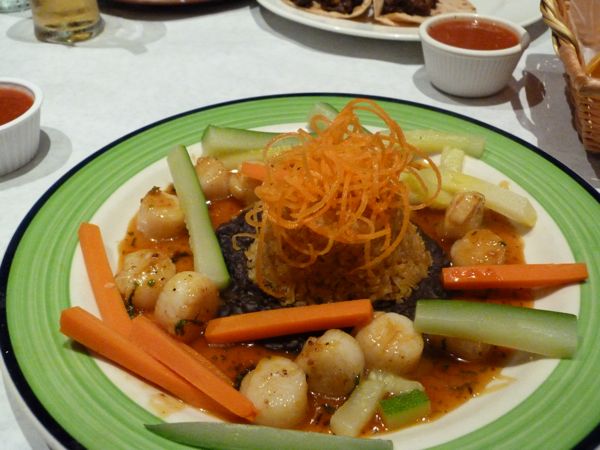
I ordered the Chili Seared Scallops. They were beautiful, and tasty, and surrounded by lovely vegetables, so I felt doubly good, eating tasty scallops AND vegetables. I was just a tiny bit taken aback that the chili sauce was sweet, so it reminded me a little of Thai food; I think I would prefer them sharp and salty, rather than sweet. They were, however, beautiful and delicious.
AdventureMan, however, was the big winner. He ordered a la carte Mexican tacos, one with a Pastore filling and one with a Barbacoa filling.
Here is what Wikipedia says about Tacos al Pastore:
A similar dish is served in Mexico known as tacos al pastor or “tacos de trompo”. The cooking is different from that of the kebab. The meat is cooked and then sliced into a corn tortilla. They can be found all over Mexico, especially in street corners. They are not new to Mexico, and it is unknown if there is a direct relationship with the Turkish Kebab. In Puebla, this was introduced by the numerous Middle-Eastern immigrants, mostly from Lebanon and Syria, but also Turkey and Iraq, in the early 1920s.[42] Since then, it has become a traditional dish of the city, locally known as taco árabe, “Arabian taco”, sold in taquerías orientales, “[Middle-]Eastern taco stands”.[43] Nonetheless, it is now usually made with beef and lamb and served either in pitas –locally called pan árabe, “Arabian bread”–, leavened bread –locally called torta árabe, “Arabian baguette”, also called cemita–, or simply in flour tortillas.
It is usually accompanied tahini and labneh –locally called jocoque–[44] even though the skhug (or kharif) has been replaced with a thick chipotle-garlic sauce.[45] In other parts of the country, most notably in Mexico City, the dish has adapted to the Mexican cuisine by replacing the pita with corn tortillas, in what is now called a taco al pastor, “shepherd taco”.[45] Unlike a taco árabe, the taco al pastor is served with pineapple, cilantro, chopped onions and green or red salsa, and marinated with annatto sauce.
Regardless of local adaptations, authentic middle eastern shawarma is available in the many middle eastern restaurants and kosher taquerias that cater to the large Mexican Lebanese and Mexican Sephardim communities. German style Doner Kebab can be found too but is not common, although is gaining popularity.
In some places of Northern Mexico, such as Nuevo Leon, Durango, Chihuahua, these are usually called Tacos de Trompo if served on maize flour tortillas, and gringas if they are served on wheat flour tortillas with cheese.
A similar dish is called Tacos Árabes, which originated in Puebla in the 1930s from Lebanese-Mexican cuisine. Tacos Árabes use shawarma-style meat carved from a spit, but are served in a pita bread called pan arabe. These tacos have been brought by Mexican immigrants to the United States in the past few years and have become popular in cities like Chicago and Los Angeles, the two largest Mexican and Mexican-American population centers in the United States.[46]
LLOOLLL – an Arab taco! Filed under doner kebab! And made with PORK! Well, they are delicious, and they have this taste like I imagine you could buy on a street in Mexico 😉 I have to imagine. I have never been to Mexico. Not yet 🙂
Here is what Wikipedia says about Barbacoa:
Throughout Mexico, from pre-Mexican times to the present, barbacoa (the name derives from the Caribbean indigenous Taino barabicu) was the original Mexican barbecue, utilizing the many and varied moles (from Nahuatl molli) and salsa de molcajete, which were the first barbecue sauces. Game, turkey, and fish along with beans and other side dishes were slow cooked together in a pit for many hours. Following the introduction of cattle, domestic pigs, goats, sheep, and chickens by the Spanish, the meat of these animals was cooked utilizing the traditional indigenous barbacoa style of cooking.
“Barbacoa” actually has its origins in all the countries that Tainos and other Indian populations inhabited, not just Mexico. The Tainos themselves were pre-Columbian Indians located throughout the Caribbean and which some believe included the Arawak Indians who especially dominated the most leeward Caribbean islands themselves.
The Arawak were first and foremost those who historically used the green and fire resistant flexible limbs of the hanging branches of the giant Bearded Fig Tree (Los Barbadoes) to cook meats and fish over an open fire while first marinating their foods in tropical herbs and spices found naturally throughout the southern islands to South America.
Unlike latter variations, the original and most authentic “Barbacoa” used herbs and spices, such as island prepared “cassareep” (derived from the root of the cassava plant), not only to enhance the natural flavors of meats, fish and vegetables, but preserve their cooked foods from spoiling in the heat of the tropics. The Arawak Indians called their preparations “Barbacoa,” accordingly, as these methods proved to be a boon of protection for keeping their foods from prematurely spoiling.
Rio Nuevo also had two different Mole’s I am dying to try, but when we went back for lunch the next day . . . . after hours at the Mall on the hottest day in Atlanta history ever, we BOTH ordered the tacos-a-la-carte: al pastore and barbacoa. They were SO good, served with bowls of fresh cilantro and chopped onion to sprinkle on – divine!
Service both times was excellent. This is not fast food, but there were a lot of people eating lunch there who were in and out quickly. The owner came by both times we ate there, and there are still things on the menu I would love to try.

Zambia Black and White
I suspect this is true of most people, and I suspect this due to the fact it is true of me and was true of the three people with whom I traveled – even if you buy a new camera months before a major trip, you spend a lot of time on the trip exploring what your camera can do. You’d think that we would spend some major time educating ourselves before we go, but life intrudes, with demands and time consuming errands, and the focus just isn’t on learning your camera and its capabilities.
For me, the truth is even worse. AdventureMan gave me the new Lumix for Christmas, and I took a few photos with it, and really used the earlier Lumix with which I am now very familiar. I could always count on it to get great shots.
There are two things I love about this camera. I used to carry a big huge Nikon everywhere – Kenya, Tanzania, Botswana, Nabimia – backpack full of lenses and cleaning supplies, having to change lenses, and often not having enough light. . . the Lumix fits in my purse, and is easily cleaned. You don’t switch lenses; it has a lot of versatility, and it takes photos in very low light. In fact, I often have two in my purse; I bought a smaller one for everyday-in-a-hurry photos. I use it when you might use your phone camera.
This time, early on, I discovered the Scenic mode: sunset. It allowed me to shoot exactly what I was seeing, those stunning colors of the African sunset (LOL, during burning season, the atmosphere is full of particulate, and that gives it those amazing colors.)

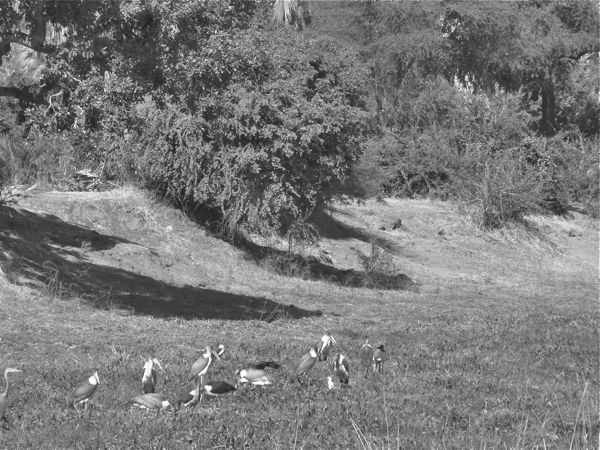
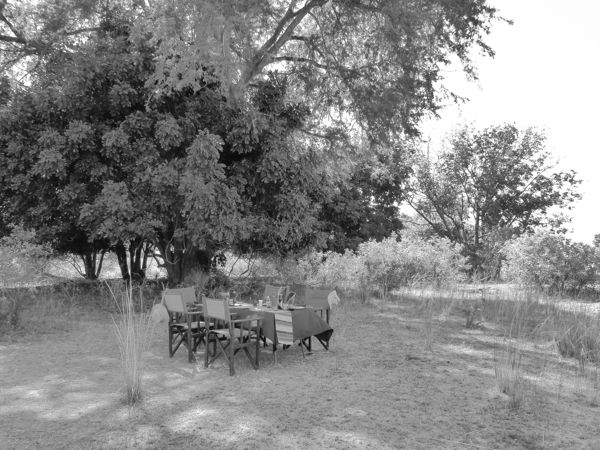
At Nsefu Camp, the oldest Robin Pope Camp, they have decorated with old black and whites, and there is a romance to some of those very old photos that intrigued me. I have a wall in my office, a wall no one else can see, and I think it would be fun to have a romantic Africa series, black and white, so I decided to use my Color Mode: Dynamic Black and White. It gave me exactly what I was looking for, and I also learned that to get that old time look, I needed NOT to use the zoom, but to take the photos in context.
The bright sun, reflecting off the tusks, the backs of the hippos, the water, palm leaves, contrasting with the deeper darks of the green bushes, trees and foliage, is what makes them pop. I took a lot of mediocre shots; I won’t bore you with them, it’s a lot like the leopard, bad things can happen, or there just isn’t enough contrast to make it a good photo.
These are the ones I am enjoying. I’ll probably choose 4 – 6 of them to have printed 🙂
This is where we had coffee/tea in Chongwe; doesn’t it look early 1900’s to you?




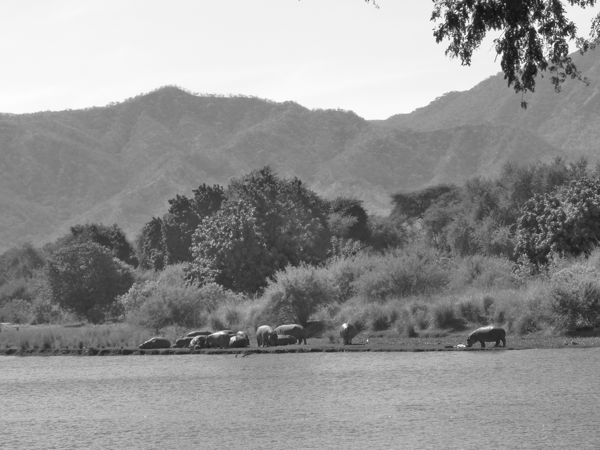
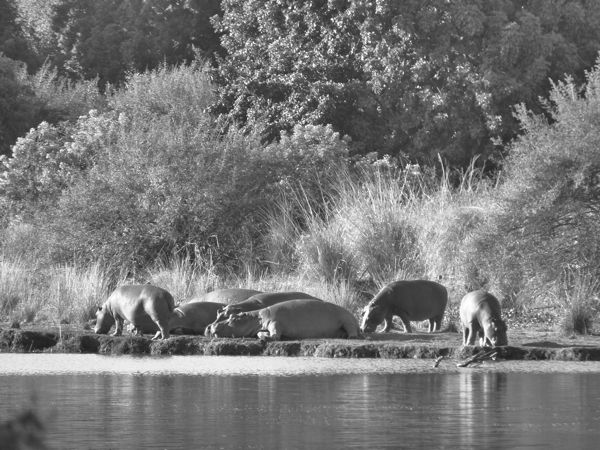

I love this one; I think it is a matter of perspective:
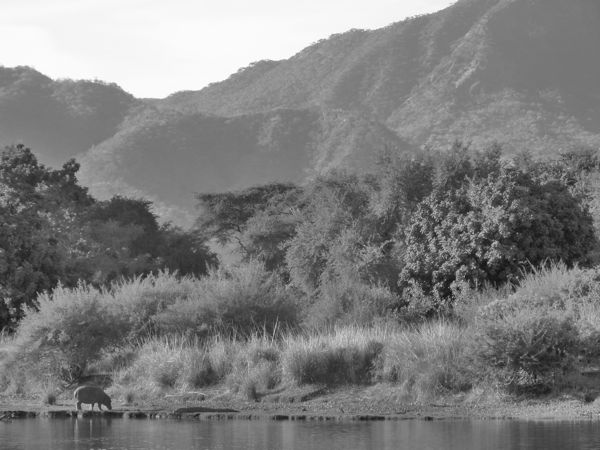
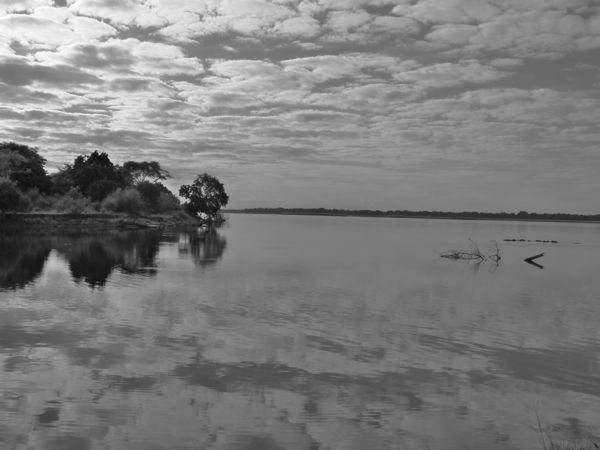
It sounds funny, but it helps to be a quilter. When you are doing a quilt, you have to have a focus, and you need contrast to make the quilt effective.
Recent Comments
intlxpatr on Shampoo Ginger tigerbutterya0c5ff1d… on Shampoo Ginger intlxpatr on British Soldier Kidnapped, Esc… John on British Soldier Kidnapped, Esc… intlxpatr on British Soldier Kidnapped, Esc… Wikipedia Donate Button

Amazina


Early Voting in Florida


