The Day I Might Have Died
“I have a photo you might want.” my Mom said, rummaging under the bed in the office, where I am sleeping while I have a working holiday here in Seattle, running errands and helping her with things she can no longer do easily for herself. I have two sisters living here who take good care of Mom, and I want to do some small part, too.
She pulled out an envelope and looked through it.
“No, not this one, but you might want this one,” and she handed me this photo.

I know to you it looks like a very strange photo; it looks like a very strange photo to me, too. Old photo, probably taken with some kind of brownie box camera, you cannot tell anything, it looks misty and indistinct.
It was taken at an airport ‘lake,’ like a water retention pond, in Juneau, Alaska, when I was around three. In Juneau, the lakes and ponds might stay very cold the entire summer, but these man-made lakes were fairly shallow, and might warm up a little when the temperatures reached the 70’s (F), like in July or August.
What I remember is dropping off, but not being afraid. I was under water, but my eyes were open, and the colors were beautiful and I was just watching the play of color and light, and I just kind of bobbed along.
My aunt tells me that she saw me drop out of sight and not return. She ran out into the water, found me, and pulled me to the shore. She saved my life. Later, when I was grown, she told me the old Chinese adage that if you save a person’s life you are responsible for them as long as you – or they – live. I always felt a special connection to that sweet aunt.
I wonder now if my memory is as I have always remembered it? I can still see the green and gold flickering, just as clearly as when it was happening. I can remember the shock of being grabbed, and hustled to shore, and fussed over, as everyone wanted to make sure I was OK. I remember having to stay on the blanket for what seemed like a lifetime, and then only being allowed to play in the very shallow water. And I wonder if I remember it all, or if I have heard the story so many times that I just think I remember it?
I love this photo. I love the indistinct nature, and mistiness. It is a metaphor for my memory of that day, and I am delighted that a photo exists.
Flying Out of Pensacola International Airport
No. No, there are not any flights to any cities outside the United States. I thought there was a rule! I remember other small airports that called themselves “international” but they always had at least one flight like to Mexico, or some Caribbean island . . . I didn’t know you could name an airport Pensacola INTERNATIONAL Airport just because you thought it sounded cool. Guess the joke is on me.
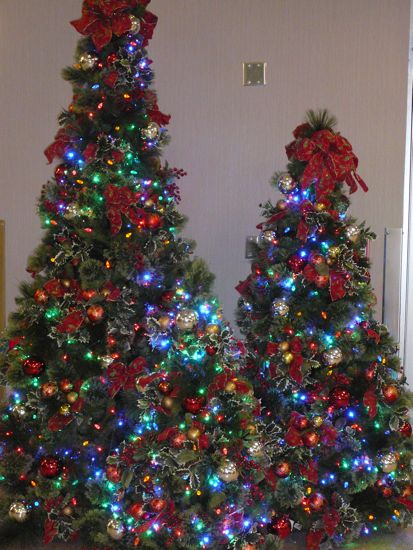
(Have you noticed how much more dominant blue bulbs are now? They used to just fade into obscurity, but now they are brilliant. These trees decorate Pensacola International Airport.)
So as I check in – at the curbside, YES! I am appreciating how much easier flying is when you are not flying to Kuwait or Qatar, or even Germany. You can drop your luggage right at the curb, you already have your boarding passes; you checked in and printed them at home (none of this is possible if you are flying to the Middle East) so you can go straight to your gate . . . oh yeh, forgot, you still have to go through security.
There is a LONG line and I overhear one of the security guards say to a Pensacola friend “Yeh, you can’t just get here an hour before your flight any more and expect to catch your flight . . . ” and I am thinking “Holy Smokes! I thought getting there an hour before your flight was overkill in Pensacola!”
As soon as I get through security (no more ‘special’ treatment, now that I am not flying to Kuwait or Qatar, no more pat downs, no more extra questions) I get to my flight, which is already boarding, and both my flights, early early on a Sunday morning are PACKED, every seat is booked. I cannot imagine.
The good news is that every flight leaves on time, lands on time, and the flights are uneventful. I love ‘uneventful.’
I find that I don’t get as much reading done as I used to when I was flying two, three, four times a year from the Middle East to Seattle. I used to be able to read three or four books in each direction, now I am down to one book and maybe a little Sudoku.
Beautiful flight:

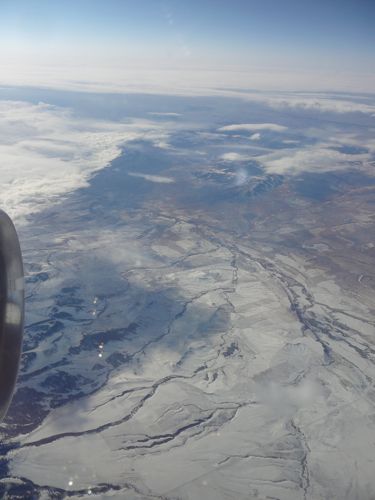
When we get near Seattle, you can see five mountains in a row, from Mount Rainier looking south, including the remains of Mount Saint Helens. The weather in Seattle is cool and brisk, my car is waiting and the roads out Edmonds are clear and dry, Wooo HOOOOO!
Deb Roy: The Birth of a Word
Come back when you have some time – you’ll need about twenty minutes to watch this TED video about communication. I love this – but then you know I am a word nerd, and I love the way concepts are born and grow.
Computers have aided language analysis and taken it to lengths that were previously inconceivable. First, Deb Roy shows – with videos, graphs and cloud analysis – how his son learned to speak his first word.
He goes from there to what I would call “buzz analysis”, taking program content from cable television and correlating it to comments on public media – blogs, FaceBook, all kinds of public forums. The results are astonishing, and a great tool to understand the national psyche and how we think and process. This is amazing stuff.
The Travellers’ Dilemma
The restaurants were full this Saturday in Pensacola, all the nice restaurants; there is a Beth Moore conference in town and all the ladies are out to lunch. We were lucky, we walked in just before the crowd and snagged a table at one of our favorite Pensacola restaurants, The Fish House. Great meal, great service, great conversation, and we were out in under an hour. Wooo HOOO.
Have you noticed many of the good restaurants don’t take reservations these days, not unless you are a large group, like six or more? Maybe as the economy starts to lift again, that will change. It’s just odd.
Meanwhile, I have a couple flights tomorrow, and now that I am not flying overnight, or half the world, and now that we are retired, I am flying sardine class. And the airlines don’t serve food. If you buy food in the airport, your choices are limited, and expensive, and it can be messy.
So I’ve been thinking about what to take. I need something nutritious. I need something that tastes good. I need something that can be eaten sort of subtly; now that there is not a real meal time, you might be eating with people who don’t have anything. So you also need something you can share.
It can’t have an offensive smell. We love those Japanese crackers, but in a confined space, all of a sudden you notice how FISHY they smell. Ditto sushi, LOL. Can’t eat Wasabi peas, either, because they are also odor causing, in their own way. No garlic; some people cannot abide garlic or onions.
It can’t be something that might leak in my carry on. It can’t be something that needs a utensil. It can’t be too salty, or carry too many calories. It can’t be loudly crunchy, like carrots or celery.
Do you see the problem?
AdventureMan says “You worry about things like that?” He is genuinely puzzled. But yeh, I think about these things, and try to anticipate a problem so that there ISN’T a problem.
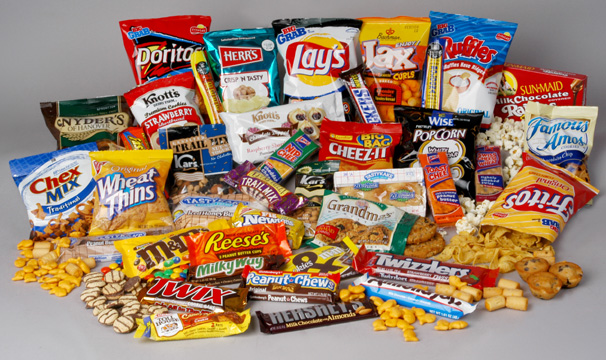
I finally decided on some Chex Mix, and some trail mix (nuts and fruits). You can eat a little at a time, you can share.
I figure I can pick up some coffee at the airport where I change flights. I love the seasonal Peppermint Mochas, Gingerbread Lattes, etc. It’s a most wonderful time of the year 🙂

What do you take on a long flight when you will not be provided a meal?
Feeding the Goats
The Happy Toddler’s other grandfather is always full of hilarious ideas. After breakfast, he said “let’s go feed the goats!”
We had NO idea. Like we thought we’d walk down a little road to some place where someone had two or three goats.
No. We got in cars and drove about five minutes, and when we stopped, at an abandoned factory, there were something like a couple hundred goats, all sizes, including one female who started birthing a baby goat as we watched (in horror!)
Happy Toddler didn’t even notice. He had a bucket of corn to feed the goats, and he made every grain count – the goats were so aggressive!
We all got to feed the goats. They would eat right out of your hand. They also had big bales of hay or grain of some kind, but they sure loved the corn!

My Life in France by Julia Child with Alex Prud’homme
I wish I had more self-discipline, and read more heavy weight books, but what I find is that when I read heavy non-fiction these days, it falls over when I fall asleep. Mostly, I read the New Yorker, or catch up with my news online, while listening to NPR.
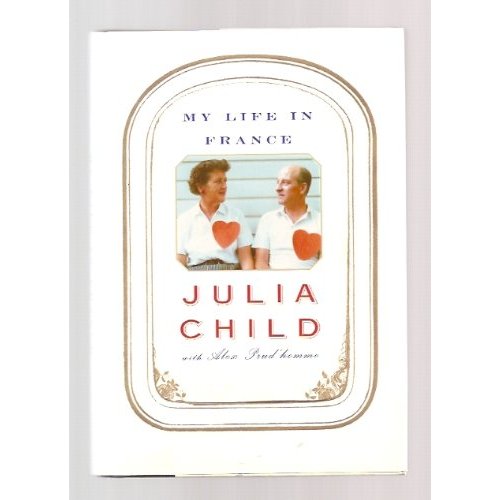
I don’t know how I got My Life in France, if I ordered it or if I bought it in B&N. I’ve had it for a while. We’ve always loved Julia Child; her programs were a hoot, and she was an accomplished woman who never took herself too seriously. I will never forget one time I saw her on a Martha Stewart Christmas Special; they were doing a tall Croquembouche, and at one point, Julia was not throwing on the caramelized sugar strings the way Martha wanted her to and she grabbed the little thrower-thing out of Julia’s hand to show her how. I gasped! That is like grabbing a spoon from the Queen of England, no! No! You can’t grab a spoon from Julia Childs! You can’t show Julia Childs how to do it, Martha, you BOW to Julia Childs!
Julia Childs, classy woman that she was, just watched Martha with fascination and never showed an ounce of annoyance.
The book is hilarious. While alive, she worked with her grandson, Alex Prud-homme, gathering correspondence – she was a copious letter writer, and people in those days kept their snail mail to refer back to, the way we keep e-mails. They sat in her sunny garden, and he would ask her a few questions, and off she would go, regaling him with stories of people, places, occasions, parties, and especially FOODS.
Julia Childs worked for the OSS in World War II, the forerunner to the CIA. Stationed in India, she met her husband, and after the war ended, they married. Stifled in her California life, and and Paul jumped at a chance to live overseas. Imagine – Paris! She had to adapt to a totally different way of life, totally different living space, a totally different way of shopping for food, and she had to learn to cook. Since she was in Paris, and because she is the woman she is, she signed up for cooking classes at the Cordon Bleu, where she worked hard to master the techniques to successfully produce the sauces and delicate flavors which makes French cuisine so delicious.
She also moves to Marseilles, to post-war Germany, and to Norway, and manages to produce two books, each of which took, literally, years to finalize, because of her attention to detail, and wanting to make sure that women using her books could understand exactly what to do, and when to do it.
This is a really fun book. I would have loved to know this adventurous, courageous woman, who meticulously tested every recipe for Mastering the Art of French Cooking and changed the lives of serious cooks in America. No, I have never cooked from her book. No, I don’t have her book. I have a Larousse Gastronomique, from which she worked to get the ‘true’ Frenchness of French cooking, but I don’t have any cook books by Julia. I have put out a hint, though, and I am hoping to get one for Christmas. 🙂 Not just for me – AdventureMan is making serious inroads into adventurous cooking. He has mastered blackened fish tacos, and seared tuna, woo hoooo! He is working on the ultimate cornbread. Just wait until I get him started on the quintessential French Onion Soup, or even – maybe – French bread!
Cajun Country Swamp Tours
The Cajun Country Swamp Tour out of Breaux Bridge, LA, was such a highlight of our trip that we did it twice, once at sunset, and then again in full daylight the next day. The first night, we were with Butch, the owner, and the next day with Shaun, his son. Both were great trips.
Now here is the thing – there is more than one swamp tour company, and you have to be sure to get the right one (this one is the right one.) It’s not like Florida, where you look for the sign. When you get to Lake Martin, where this tour takes place, there is no kiosk, nothing except a tour boat coming in, but even this boat doesn’t have a sign on it. You have to know who you are looking for.
These people were so helpful in getting us booked. We really wanted to be with an eco-tour kind of exploration; some of the swamp tours are purely awful, and exploitive, hard on the animals, disruptive of the environment. We read the reviews; Cajun Country Swamp Tours is the group we wanted to be with. Our sunset cruise was delightful, just us, Butch, who is a wealth of information, and a family of five, the youngest of whom fell asleep almost as soon as the boat left the tie-up. The second day we took a private tour, and they gave us a good price. We like being able to watch the birds, watch the light change, wait for the right shot – it’s worth it to us.
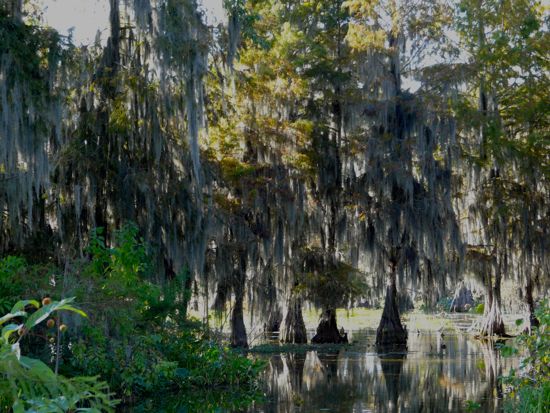
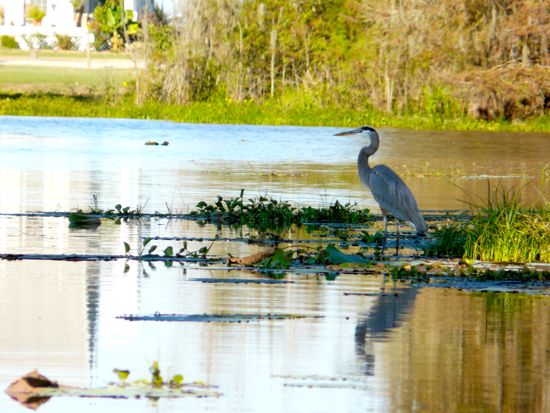
Lake Martin is beautiful, in a lowlands kind of way (it looks a lot like parts of Pensacola.) Taking photos was fun, and also a challenge. Here is the challenge; sometimes the camera doesn’t really understand what it is supposed to focus on, so you think you are shooting a heron, and the camera is busy focusing on the tree two feet behind the heron. Sometimes you want to capture this exact light, but the camera sees ‘this exact light’ a little differently than you do.
This is what the tour boat looks like – very shallow, so it can get into very shallow places, and so it can drift over logs in the swampy areas:

Focus examples:


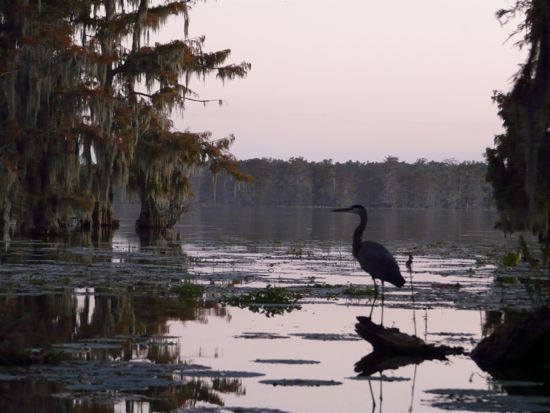
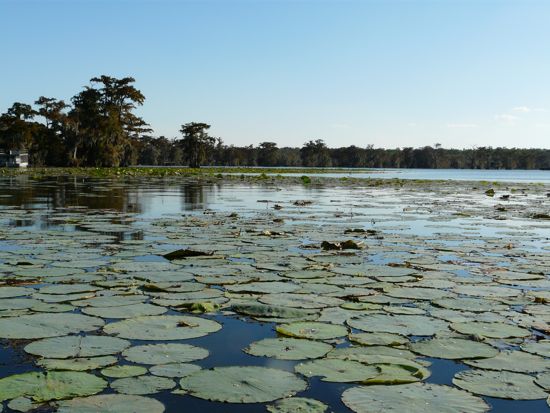
Now, just settle back in your seat and enjoy the swamp and bayous with us on St. Martin’s Lake:
This is a special bird, the Black Crowned Night Heron, only rarely at St. Martin’s Lake:
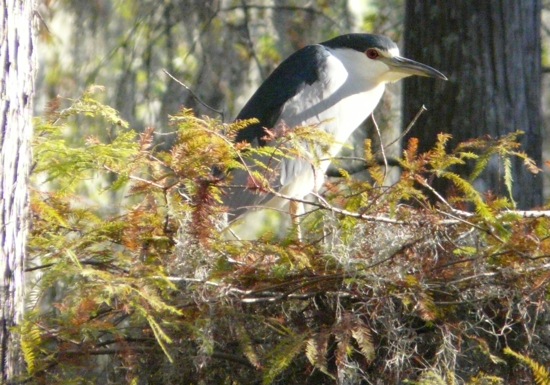
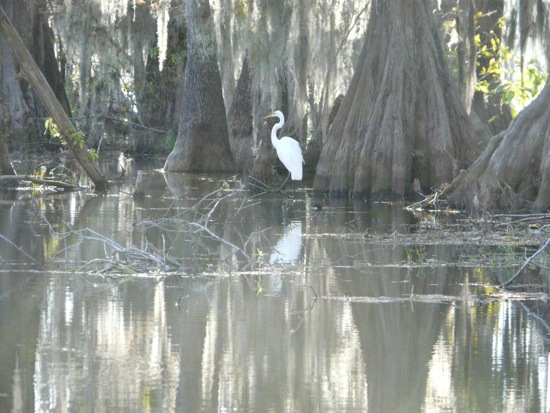
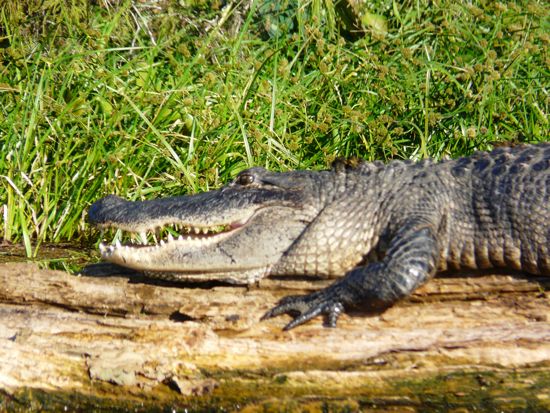
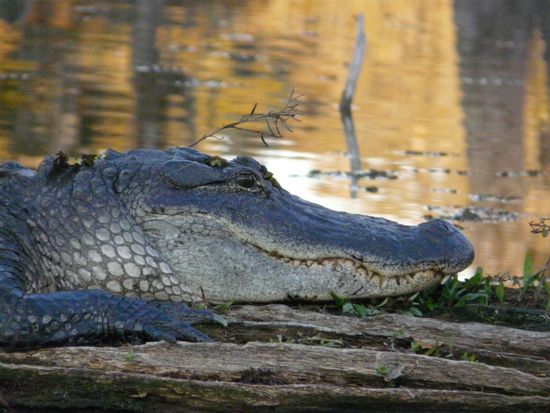
Lots of gators, soaking up sun before their long winter’s hibernation:

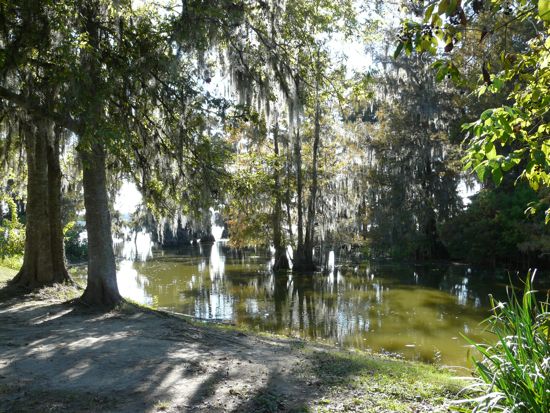

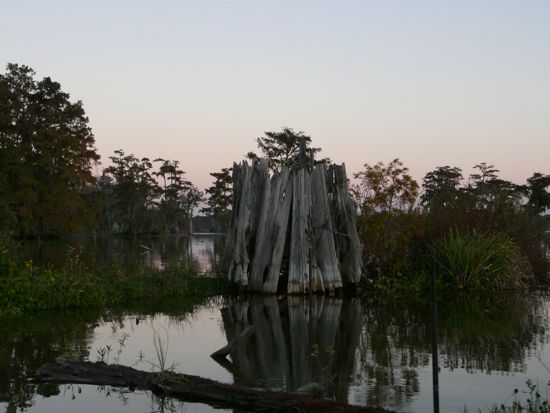
You might think this is a stump, but you would be wrong. This is Shaun’s duck hide; he built it himself:




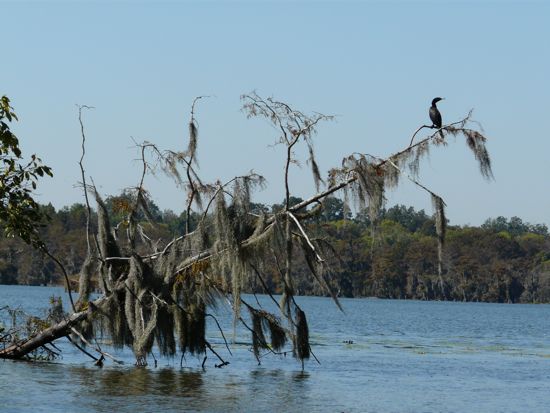
This little anhinga lost one wing, probably to an alligator, but has figured out how to climb this tree and then plunge down when he sees a fish. He can’t really fly anymore, but he is managing:
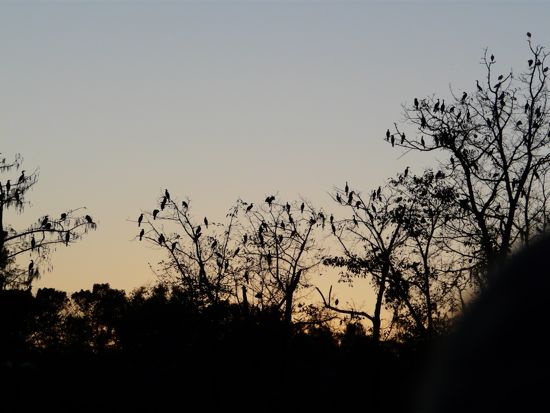
Thousands of birds perched in these trees, the ‘rookery:’
Avery Island and Tabasco Sauce
Sometimes it’s funny why people make the choices they do. We knew one of the first things we wanted to do on this trip was to visit Avery Island. There are a lot of little reasons. First, was that when AdventureMan was young, he was sent to a far away country, Vietnam, to fight for his country. Most of his time was spent out in the jungle, and they carried most of their food on their backs. They ate something called C-rations, little meals, like with cans of food, and the Avery/McIlhenny Tobasco company made little tiny bottles of tabasco sauce to include with each meal package. It’s a small thing, but those little bottles of tabasco sauce made a difference to those soldiers.
Later, as we flew in and out of the Middle East, Delta had a special short feature on Avery Island. Long story short, we’ve always wanted to visit there, and now we had the opportunity.

(You have to see this mosquito statue to appreciate it; it must be about 5 feet long and 4 feet high, and there are several of them. )
It was a beautiful morning, and the drive was beautiful, too, cool and lovely. Avery island is surrounded by a kind of river/moat, so it really is an island that once used to be a sugar cane plantation. As soon as we opened our car doors, the mosquitos came at me; I am a mosquito magnet.

The tour of the factory had already started, so I scooted over to the country store, which is a really run place. Who would think there could be so many products devoted to Tabasco Sauce?
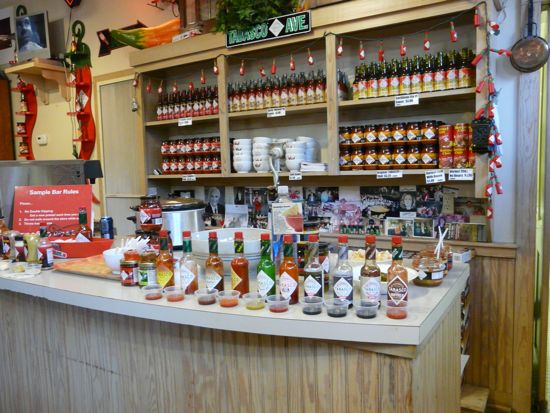


Oops! Time to get back over to the factory for our tour, which is like 5 minutes, then a 10 minute movie. Just before the movie starts, the guide (who also works in the gift shop while the movie is running) gives each person tiny sample bottles of several Tabasco products – cool!

After the movie, we get to tour alongside the factory and go into the museum. Very cool. Thousands and thousands of tobasco bottles being filled, and each day they post which country(ies) they are sending this batch to. Today is Ireland.
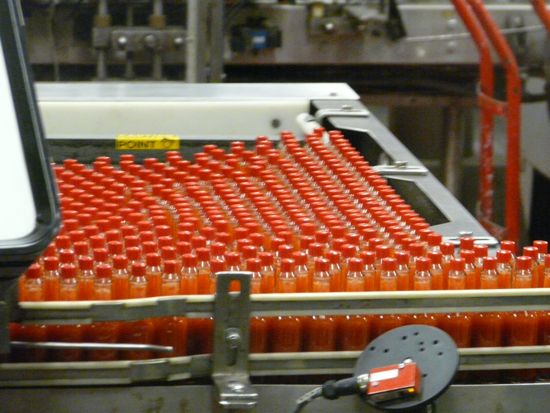
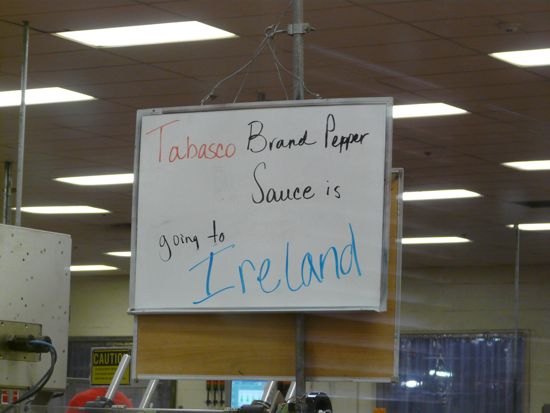
Tabasco is made with a secret formula of specially grown tabasco peppers, vinegar and salt. Lucky for them, they have their own salt mine on the property. Just about everything they need to make tabasco sauce, right at their fingertips. This was a fun tour to take, and one of our dreams was fulfilled.

A Visit to Cajun Country in Louisiana
I guess I might have mentioned a time or two that I read an author named James Lee Burke. I remember the very first book I read – A Morning For Flamingos. I remember where I found it – the US Forces library on Lindsay Air Station. I remember it was late winter in Germany, the time when you think Spring will never come, that it will be grim and grey and cold for the rest of your life. I sought escape, which Mysteries/Detective novels provide, but I never expected poetry. From the very first page of A Morning for Flamingos, I was spellbound. While his novels have some horrific violence in them, and his detective Dave Robicheaux is a recovering alcoholic with some seriously self-destructive issues, you can sort of skim through the bad parts; there will be more poetry soon.
He is one of the few authors I will buy in hard cover.
I’ve been waiting. I wanted to see New Iberia, but I had to find a time when all the universal factors would line up – AdventureMan would be in the same country as me, the weather would be cool enough that travel would be enjoyable, and there was a low likelihood of running into a lot of tourists. The stars aligned, and off we went, a mere five hours away, to Cajun Louisiana.
We drove to New Orleans, first, visiting the welcome station to pick up brochures and figure out what we wanted to see and where we wanted to stay.

The welcome center was clean and well stocked, lots of bathrooms available for the visitors, lots of visitors, and ladies behind the counters full of first hand information about where we should go, where we should eat and where we might stay.
I have a thing about bridges. I had an accident on a bridge once, and I’m still a little nervous about bridges. This is the kind of bridge I hate:

This southernmost part of Louisiana is lowland, and there are bridges everywhere. Some of them are bridges like I have never seen anywhere else:

We arrived in the middle of the sugar cane harvest. I didn’t know what fields of sugar cane looked like; now I do:

There were big huge carts full of cane, all going to be processed on the same day they were cut:

All this time we were looking at sugar cane, we were getting hungrier and hungrier, but it was Sunday, and a lot of places were already closed, if they had been open at all. We finally found a restaurant in New Iberia, Pelicans, where I shocked my husband by ordering the vegetable plate – but it was all deep fried vegetables; asparagus, green beans, broccoli and carrots. He had a BBQ sandwich.

I think we were the only tourists in the place. The bar was full; the restaurant was empty, except for us.
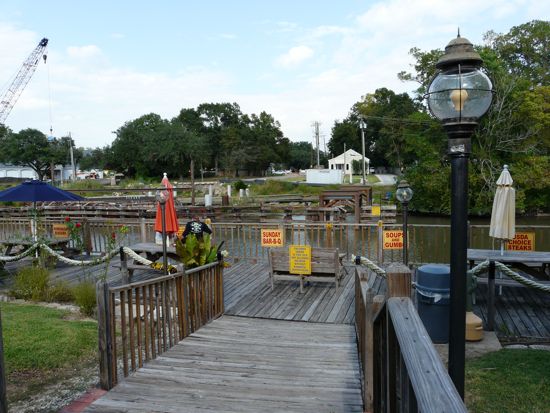


We wanted to find someplace really fun to stay, full of character, and I had been looking at some cabins in Breaux Bridge. When we got ready to check them out, we discovered that the people who ran it were gone! There was a phone number, which we called, and the very kind owner called back and told us to go take a look, and which cabins were available.
You know, things just aren’t the way they used to be. I remember my Mom and Dad’s house, the first one they bought. The closet in the Master bedroom was only about 4 feet by 3 feet deep, with one bar and with a shelf. People had fewer clothes then, even in Alaska, where they also had heavy coats and ski pants and stuff. Bathrooms were small, only what was necessary, not like the spa-bathrooms people want now (me included.)
These cabins were cute. They were built right out over the bayou, and you could fish off your own balcony, each cabin separate and free standing. The place was clean. It was also really small, with small beds and small bathrooms. I don’t have asthma, but there was a musty smell, and I was worried I wouldn’t be able to breathe. We also like a good mattress, so we can sleep well. I looked at AdventureMan, who was looking at me. We were both on the same track; we couldn’t stay there. I called the lady back. “The cabins are really nice,” I said, “But we’re old and have allergies. We can’t stay here.” My husband was looking at me in a mixture of horror and hysteria. As we got in the car, his shoulders were shaking. He put a quiver in his voice (my voice did NOT quiver) and started saying “We’re o-o-o-o-ld, and we . . .” We were both rolling with laughter. I just didn’t know what else to say. We used to stay in places like this, but now we put a higher value on sleep.
We headed for a tried and true Marriott – actually, two of them – in Lafayette, only to discover that there was an oil and gas conference starting this week and there were NO rooms at the Marriott. We headed back toward New Iberia and settled into a Hampton Inn – nice, clean, roomy, and no character, we could have been in Seattle or Pennsylvania, but we could breathe.
Babies and Bilingualism
Fascinating article from The New York Times on babies and language development:
Hearing Bilingual: How Babies Sort Out Language
By PERRI KLASS, M.D.
Published: October 10, 2011
Once, experts feared that young children exposed to more than one language would suffer “language confusion,” which might delay their speech development. Today, parents often are urged to capitalize on that early knack for acquiring language. Upscale schools market themselves with promises of deep immersion in Spanish — or Mandarin — for everyone, starting in kindergarten or even before.
Yet while many parents recognize the utility of a second language, families bringing up children in non-English-speaking households, or trying to juggle two languages at home, are often desperate for information. And while the study of bilingual development has refuted those early fears about confusion and delay, there aren’t many research-based guidelines about the very early years and the best strategies for producing a happily bilingual child.
But there is more and more research to draw on, reaching back to infancy and even to the womb. As the relatively new science of bilingualism pushes back to the origins of speech and language, scientists are teasing out the earliest differences between brains exposed to one language and brains exposed to two.
Researchers have found ways to analyze infant behavior — where babies turn their gazes, how long they pay attention — to help figure out infant perceptions of sounds and words and languages, of what is familiar and what is unfamiliar to them. Now, analyzing the neurologic activity of babies’ brains as they hear language, and then comparing those early responses with the words that those children learn as they get older, is helping explain not just how the early brain listens to language, but how listening shapes the early brain.
Recently, researchers at the University of Washington used measures of electrical brain responses to compare so-called monolingual infants, from homes in which one language was spoken, to bilingual infants exposed to two languages. Of course, since the subjects of the study, adorable in their infant-size EEG caps, ranged from 6 months to 12 months of age, they weren’t producing many words in any language.
Still, the researchers found that at 6 months, the monolingual infants could discriminate between phonetic sounds, whether they were uttered in the language they were used to hearing or in another language not spoken in their homes. By 10 to 12 months, however, monolingual babies were no longer detecting sounds in the second language, only in the language they usually heard.
The researchers suggested that this represents a process of “neural commitment,” in which the infant brain wires itself to understand one language and its sounds.
In contrast, the bilingual infants followed a different developmental trajectory. At 6 to 9 months, they did not detect differences in phonetic sounds in either language, but when they were older — 10 to 12 months — they were able to discriminate sounds in both.
“What the study demonstrates is that the variability in bilingual babies’ experience keeps them open,” said Dr. Patricia Kuhl, co-director of the Institute for Learning and Brain Sciences at the University of Washington and one of the authors of the study. “They do not show the perceptual narrowing as soon as monolingual babies do. It’s another piece of evidence that what you experience shapes the brain.”
The learning of language — and the effects on the brain of the language we hear — may begin even earlier than 6 months of age.
Janet Werker, a professor of psychology at the University of British Columbia, studies how babies perceive language and how that shapes their learning. Even in the womb, she said, babies are exposed to the rhythms and sounds of language, and newborns have been shown to prefer languages rhythmically similar to the one they’ve heard during fetal development.
In one recent study, Dr. Werker and her collaborators showed that babies born to bilingual mothers not only prefer both of those languages over others — but are also able to register that the two languages are different.
In addition to this ability to use rhythmic sound to discriminate between languages, Dr. Werker has studied other strategies that infants use as they grow, showing how their brains use different kinds of perception to learn languages, and also to keep them separate.
In a study of older infants shown silent videotapes of adults speaking, 4-month-olds could distinguish different languages visually by watching mouth and facial motions and responded with interest when the language changed. By 8 months, though, the monolingual infants were no longer responding to the difference in languages in these silent movies, while the bilingual infants continued to be engaged.
“For a baby who’s growing up bilingual, it’s like, ‘Hey, this is important information,’ ” Dr. Werker said.
Over the past decade, Ellen Bialystok, a distinguished research professor of psychology at York University in Toronto, has shown that bilingual children develop crucial skills in addition to their double vocabularies, learning different ways to solve logic problems or to handle multitasking, skills that are often considered part of the brain’s so-called executive function.
These higher-level cognitive abilities are localized to the frontal and prefrontal cortex in the brain. “Overwhelmingly, children who are bilingual from early on have precocious development of executive function,” Dr. Bialystok said.
Dr. Kuhl calls bilingual babies “more cognitively flexible” than monolingual infants. Her research group is examining infant brains with an even newer imaging device, magnetoencephalography, or MEG, which combines an M.R.I. scan with a recording of magnetic field changes as the brain transmits information.
Dr. Kuhl describes the device as looking like a “hair dryer from Mars,” and she hopes that it will help explore the question of why babies learn language from people, but not from screens.
Previous research by her group showed that exposing English-language infants in Seattle to someone speaking to them in Mandarin helped those babies preserve the ability to discriminate Chinese language sounds, but when the same “dose” of Mandarin was delivered by a television program or an audiotape, the babies learned nothing.
“This special mapping that babies seem to do with language happens in a social setting,” Dr. Kuhl said. “They need to be face to face, interacting with other people. The brain is turned on in a unique way.”
Recent Comments
tigerbutterya0c5ff1d… on “Who Would Do Such a… intlxpatr on A Lawless, Authoritarian … Kuwait Someday on A Lawless, Authoritarian … intlxpatr on Oh Thank You, Amazon! Rivergirl on Oh Thank You, Amazon! Wikipedia Donate Button

Amazina


Early Voting in Florida


 Here There and Everywhere