Excitement at the Apple Market
“This is what happens when you live in a state where every other person is carrying a handgun,” AdventureMan grumbled as we left the Apple Market.
We had been to see the new Sherlock Holmes Movie, Game of Shadows, (really action packed, by the way, and entertaining) when we remembered we needed milk. The Publix parking lot, shared with Toys R Us, is totally gridlocked on this Wednesday night before Christmas, and we figure the Winn Dixie, shared with Target, Michaels, etc. will be another gridlock. Although the Apple is out of the way, we always love to stop at the Apple Market.
As we are heading into a light, we hear sirens. We pull over (it’s the LAW) and two police cars go wailing past.
“I hope it’s not the Apple Market,” I say.
The fog is thick as pea soup, and we drive a lot more slowly than usual. As we near the Apple market, we can see lots of lights – but they are at the CVS next door, four squad cars with their lights twinkling blue.
“Think it’s OK to go into the Apple Market?” I ask AdventureMan.
“Yeh – I see customers going in and out; I think it must be OK.”
We go in, make our purchases. As we are checking out, we overhear one customer telling another that “someone saw a guy breaking into a car and started yelling at him to stop. He got into his car and tried to run down the other guy but the guy SHOT at him!”
At this point, I don’t know who shot at whom. I don’t know if the situation was under control. There was a part of me that wished we weren’t at the Apple Market, because if there are people shooting guns (and did I mention it is really foggy?) some innocent bystander-customer could get hurt . . .

The Tourist; Olen Steinhauer

Haven’t I read this book before? Or didn’t I see a movie, The American, with George Clooney? You know, depressed assassin? Thinking about suicide? In some villa along the Mediterranean or is it the Adriatic? Some enigmatic handler, and who do you trust? And then The Tourist swerves off in another direction and while this particular thread of plot is new, it still seems vintage LeCarre, only maybe a little less solid information. Lots of jumping from place to place with little motivation, lots of shifts in trust, and betrayals.
While I like books where reality keeps shifting, this one had a few too many shifts for me. I have a feeling that spying is a lot less about fast cars and shooting someone so they won’t give away a secret, and lot more about the dull, painstaking work of stitching together swatches of information in ways that form a meaningful pattern, trying hard not to create patterns that don’t exist. I imagine that there is a big problem today with the huge volume of information, sifting through to figure out what matters, and what is mere distraction.
This book is a good airplane read, holds the interest, but give me LeCarre for the grim grey world of spies and their work any day.
Kisses From Katie by Katie Davis

This is a photo from Katie’s blog: Kisses From Katie.
Do you believe in God? Do you believe that God believes in you? Then how do you live your life? Do you commit 100% to God and trust him to provide as you leave all your riches behind and follow him, serving the poorest of the poor, speaking for those who have no voices?
I will warn you, this unforgettable book has a lot of talk about God in it. A part of me watches in horror, wondering how long Katie can continue to serve God with all her heart, with all her soul, and with all her mind? How long she can work against all odds, trusting in God to lift her and provide for her and her children. This is a true story, an ongoing life. A part of me fears a terrible crash, but the greater part of me prays for Katie, and stands in awe of her courage and her commitment.
I don’t know who told me about Kisses for Katie, the blog. As soon as I started reading it, I was addicted.
Now for the shocker: Katie is only 23 years old. A year before she graduated from high school, she felt an undeniable call to do a 6 week mission teaching in a school in one of the poorest parts of Uganda. At the end of her six weeks, she couldn’t bear to leave. She returned, finished out her senior year in high school (HIGH SCHOOL!) but she never felt entirely ‘home,’ her heart was with the children of Uganda, the poorest of the poor.
Although her parents had her doubts, the strength and consistency of Katie’s belief that she was called to serve in Africa brought them around, and they agreed she could go work for a year in this small, poor village, before starting university. At eighteen, Katie was teaching, raising money for food, tuition and uniforms for over 100 children, and working to prepare all the meals, bathe all the children, and teach them about the love of Jesus.
When I saw, a month ago, that Katie had a book published, I had to buy it. Kisses from Katie is inspirational and unforgettable. Her story continues on her blog, but the book lays all the groundwork, the heartaches and the joys, the delights of her 13 adopted daughters, the horrors of the Ugandan bureaucracy, Katie’s dogged day-by-day fight to claim and save lives. She is a remarkable young woman, powered by an awesome God.
If Katie were going to burn out, I think it would have happened earlier, as she suffered terrible disappointments, and made truly amazing sacrifices to raise her girls, to be their “mommy” and to insure the educations of over a hundred children. With a growing foundation, Amazina, and a growing group of contributors, she carries on, and the miracle of this book is that she doesn’t seem to sense the amazing woman that she is at all, she seems to believe that she is a simple woman following God’s will for her life, and reveling in it, joyfully surrounded by her 13 adopted daughters and frequent foster babies. She feels blessed to have the life that God created her to live.
I stand in awe.
You can order this book from Amazon.com for $12.49 plus shipping. It might even change your life, or how you view your life. Yes, I own stock in Amazon.com. No, I make no money from recommending this book. 🙂
First Flash Mob in Doha, Qatar
Thank you, my friend Hayfa, for sending this flash mob from City Center Mall; very nice;
But this one dates from May 2011, and I love the energy!
And one more, this time at Villagio! Wooo HOOOO, Qatar!
I’m eager to see one done at the Souk al Waqif!
I think Qatar’s National Day is December 18th, and the Qataris know how to party. It would be lovely to see a Qatari flash mob.
Christmas Time in Pensacola
Christmas in Pensacola starts just after Thanksgiving, for most people. I saw a very few decorations go up around Veteran’s Day (11 November) but very few. Most started going up around Thanksgiving. Because we are having some work continuing on our house, I couldn’t do the same decorations I did last year, so I did something new; my goal in the week before I left was to get SOME Christmas up, inside and out.
This year, AdventureMan is here, too, and it makes all the difference. Last year, he left for Kuwait just before Christmas, and I was so sad that it was hard to put a lot of effort into decorating. I did it, mostly because I am too proud not to. (No. I will not let adversity get me down!) But mostly, it takes a lot of energy to fight depression, so this year, I am appreciating just how good it is to have a ‘normal’ Christmas, i.e. my husband is on the same continent as me, in the same country, even the same state, same city, and same residence. It’s all good. 🙂
Our tree this year is smaller – and higher – that other years, and all the ornaments on it are unbreakable. Yes. Happy Baby, now Happy Toddler, will be coming by and I want to protect him – and the tree. Over the years we have collected so many wonderful ornaments that I have a lot to work with, and still manage to have a nice tree; the angel on the top is a traditional angel from Nurnberg, and we bought it the first year we were married. It’s nice to have her high on the top of the tree once more.

Under the tree, covering the table, is a special wool sefsari we bought when we lived in Tunisia, bright red with bands of gold trim. These were everywhere when we lived there, especially in the cold winters, but when we visited, I no longer saw them in any stores. Covering the tree stand, I have one of my smaller Damascus tablecloths; I treasure these coverings, and beads, Pensacola parade beads.
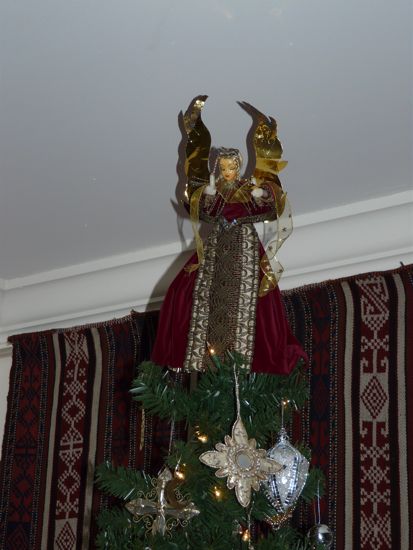

“Beads!” we shouted to Happy Toddler as we put them over his head.
“Beads!” the crowd shouted as the floats went by at the Pensacola Christmas Parade last night.
Last year, even as a Happy Baby, the parade was an enthralling event. What baby wouldn’t love a parade that starts with flashing lights, and motorcycles, and a loudly wailing, lights fashing FIRE TRUCK?? What Happy Toddler wouldn’t love the bands with the throbbing drums, and trumpets, and tubas, and trombones? And the dancing girls, and oh yes – the BEADS! Life is sweet at the Pensacola Christmas Parade.
The parade starts at 5:15 and we get there about 5:14. Here is what I love about Pensacola; you can get there at 5:14 and get a place to park only about 1/2 a block from the parade and be there when the spectacle begins. It is a laid back kind of parade, still a community parade, you see your friends there. It is sort of a Christmas parade, you see some Santas, and some reindeer, and snowmen, and there is usually at least one float with angels, but it is also sort of Mardi Gras, with all the Krewes (local social groups focused on Mardi Gras) on floats with their buds throwing beads, coins, toys and candy out into the waiting, dancing crowd.
Technically, I know this isn’t a great photo because you can’t even really tell what it is, but it is the beginning of the parade, and I love the motion of it all:
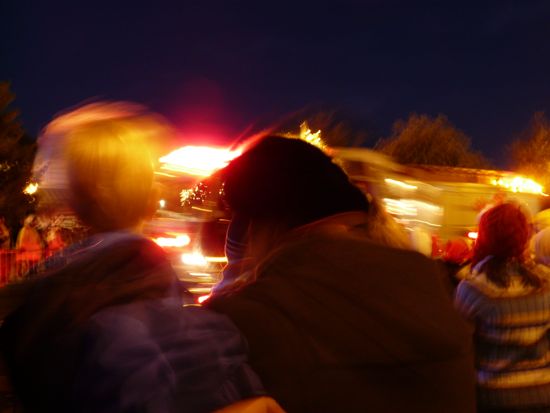

As it turned out, we were in a pretty good spot for catching beads, and we loaded down the Happy Toddler, put a few on each of us, and shared the bounty with some of the babies standing behind us. There were some people in front of us who caught a LOT of beads, and as soon as they caught them, they stashed them in a bag; they caught LOTS. Maybe they sell them back or something.
Last week, we took Happy Toddler to Boats on the Bayou, where boats decorated with Christmas lights gather near the bridge and then come parading to the park, and people gathered there sing Christmas Carols. Happy Toddler loves going to the park; the boats were interesting for about five seconds, and then he got to swing and play on the playground, which mattered a whole lot more to him:

It was just a really fun, community thing, and it was pretty, too.
Lunch at the Fish House, always a treat, and their tree is BLUE!

The Pensacola Christmas Parade attracts around 50,000 people every year. Imagine! It is so much fun. What I love about it is that there are so many floats, so many bands, so many civic heroes – you know how I feel about giving back to your community. These people are doing it. On one of the coldest nights of the year, they are on the Krewe floats throwing beads, they are patrolling behind the dog clubs, cleaning up, they are making sure the floats make the turn at Wright and Palafox, they are marching with bare legs in the cold, windy night – and it is so much fun.
Who would think that 50,000 people gathered in one place, competing for beads, would keep it all so civil? There is no place for ‘special people;’ we are all Pensacola citizens, there to enjoy a family evening, and it is just that, it is a great Pensacola evening, one of my favorite of the year.
Best of all was watching the Happy Toddler take it all in. The lights! The sirens! The beads, and the scrambling to catch them! The loud music, the pounding drums! It was all so much fun, and that fun was doubled watching him try to figure it all out. I can hardly wait ’till next year. 🙂
Leaving Seattle
It is so much easier now, now that I am not flying to Qatar or Kuwait or even Germany. I kept a storage locker in Seattle all those years, with boxes and mailing materials, with Christmas wrap, with winter sweaters and boots and coats for Decembers, and shamelessly sleeveless tops and dresses for summer that I couldn’t wear in the more conservative countries where I was living. I kept spare make-up, a back-up hairdryer, shampoos, paper towels, coffee filters, detergent – things I didn’t want to have to keep buying every time I flew into Seattle, which one year was six times.
My last day was always a mad dash to the storage locker to put away all the stuff that stayed behind, maybe mail one last box or two with exotic items like grainy organic cornmeal, quilting supplies, Tony Chachere Jambalaya Mix, or peppermint candies for Christmas cookies (yes, they got them in Kuwait and Qatar, but sometimes not until February) and then there was the rush to the airport, check in the rental car, and go through the drill at check-in.
Yes, I have a special visa, right there. No, you probably can’t read it; it’s largely in Arabic, but trust me, it’s the right visa. Yes, I like living there. Yes, you would be surprised how kind the people are! No, I don’t have any problems. Yes! We do have a church! No, Moslems don’t hate Christians! Not the ones I know!
Before the big downturn, I was usually trudging two big bags, packed to bursting, full of books and things I couldn’t get so easily. By the grace of God, I never lost a bag.
So, this time it is SO much easier. Because it is Christmas, I am still trudging two check-in bags, but they are not so heavy, and not packed to the bursting point. No hassles; I have my printed-out check in, all I have to do is turn in my baggage, piece of cake, woooo HOOOO!
And I have time! I don’t have to get up too early, I have a little time with Mom in the morning, and then I head out for a leisurely drive to the airport.
Uh oh!
This is what I see when I am inside my car:
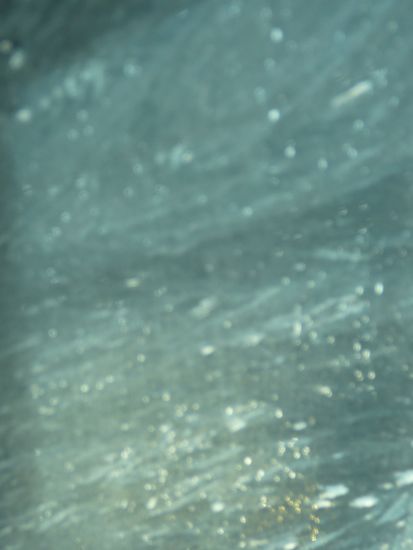
It bites into my time, just a little, but I warm the car up, flick on the heat and blowers to clear the frost off the windows, and shortly I am driving along the mildly icy-frosty streets to the airport. I’ve missed the peak of rush hour, traffic is still zipping along, and I make the trip to the airport in no time, even glimpsed sunshine a moment or two.
Love flying through Memphis, perfect timing, I get there for dinner and get to grab a Memphis BBQ, oh yum. One of my favorite airports.
Home again, home again, it takes nearly a full day, and it feels so good to be home.
The Tiger’s Wife by Tea Obreht
The Tiger’s Wife was the perfect book to get me from Pensacola to Seattle, and through the Atlanta airport, full of bustle on a Sunday, packed flights, no quiet, no privacy. Thank God for a good, engrossing book, that takes you totally out of where you are to a world where things are not always what they seem.

The book is set in an unnamed country in East Europe which has just come out of a war, and the main character and her best friend are en route across a border which did not exist before the war, on an aid mission to immunize children who were once neighbors, and are now in a different country.
The primary relationship in the book is the bond between a young girl and her grandfather, and the stories he tells her as they walk up to the zoo, the Jungle Book he reads to her as they visit the animals, and the stories she finds for herself as she participates in the post-war rebuilding. It is a fascinating book because what she is writing about is not always what she is really writing about; the stories and legends and experiences are metaphors for another reality and a life lesson.
I don’t want you to think that this is one of the mindless airport books I sometimes tell you about. If it were, I would tell you “this is not great literature; this is an airport read.” Not this book. This book is literature. This book has meaning, and events you will think about and talk over with other readers long after you have finished the book.
In the back of The Tiger’s Wife is an interview in which one of my favorite new authors, Jennifer Egan (A Visit From the Good Squad) interviews Tea Obreht about her writing process, her life, her vision, etc. Fascinating reading, too, and also reader’s guide questions help you see things you might need to see and might otherwise miss.
Boss Oyster in Apalachicola
Many years ago, Boss Oyster was our favorite place to go in Apalachicola. One time we went there and just ate oysters. Oyster stew, a whole variety of raw and steamed oysters, then some fried oysters. That was lunch. When dinner came, we didn’t even want any dinner, oysters are so rich.
This time, we didn’t pig out. 🙂 And we still love Boss Oyster 🙂

I don’t know any word to describe it but funky. It isn’t all modern and it is not pristine. It’s funky. It has character. It has charm. Some people would hate it, some would turn up their noses at it. Not us. We love Boss Oyster.
This is our table:

And here is what I ordered this time: Gouda Gouda Oysters. Oh Yummm.

I barely remembered to take a picture of the oysters. I totally forgot to photograph anything else. Sorry! We just got carried away having a good time!
The Day I Might Have Died
“I have a photo you might want.” my Mom said, rummaging under the bed in the office, where I am sleeping while I have a working holiday here in Seattle, running errands and helping her with things she can no longer do easily for herself. I have two sisters living here who take good care of Mom, and I want to do some small part, too.
She pulled out an envelope and looked through it.
“No, not this one, but you might want this one,” and she handed me this photo.

I know to you it looks like a very strange photo; it looks like a very strange photo to me, too. Old photo, probably taken with some kind of brownie box camera, you cannot tell anything, it looks misty and indistinct.
It was taken at an airport ‘lake,’ like a water retention pond, in Juneau, Alaska, when I was around three. In Juneau, the lakes and ponds might stay very cold the entire summer, but these man-made lakes were fairly shallow, and might warm up a little when the temperatures reached the 70’s (F), like in July or August.
What I remember is dropping off, but not being afraid. I was under water, but my eyes were open, and the colors were beautiful and I was just watching the play of color and light, and I just kind of bobbed along.
My aunt tells me that she saw me drop out of sight and not return. She ran out into the water, found me, and pulled me to the shore. She saved my life. Later, when I was grown, she told me the old Chinese adage that if you save a person’s life you are responsible for them as long as you – or they – live. I always felt a special connection to that sweet aunt.
I wonder now if my memory is as I have always remembered it? I can still see the green and gold flickering, just as clearly as when it was happening. I can remember the shock of being grabbed, and hustled to shore, and fussed over, as everyone wanted to make sure I was OK. I remember having to stay on the blanket for what seemed like a lifetime, and then only being allowed to play in the very shallow water. And I wonder if I remember it all, or if I have heard the story so many times that I just think I remember it?
I love this photo. I love the indistinct nature, and mistiness. It is a metaphor for my memory of that day, and I am delighted that a photo exists.
Flying Out of Pensacola International Airport
No. No, there are not any flights to any cities outside the United States. I thought there was a rule! I remember other small airports that called themselves “international” but they always had at least one flight like to Mexico, or some Caribbean island . . . I didn’t know you could name an airport Pensacola INTERNATIONAL Airport just because you thought it sounded cool. Guess the joke is on me.

(Have you noticed how much more dominant blue bulbs are now? They used to just fade into obscurity, but now they are brilliant. These trees decorate Pensacola International Airport.)
So as I check in – at the curbside, YES! I am appreciating how much easier flying is when you are not flying to Kuwait or Qatar, or even Germany. You can drop your luggage right at the curb, you already have your boarding passes; you checked in and printed them at home (none of this is possible if you are flying to the Middle East) so you can go straight to your gate . . . oh yeh, forgot, you still have to go through security.
There is a LONG line and I overhear one of the security guards say to a Pensacola friend “Yeh, you can’t just get here an hour before your flight any more and expect to catch your flight . . . ” and I am thinking “Holy Smokes! I thought getting there an hour before your flight was overkill in Pensacola!”
As soon as I get through security (no more ‘special’ treatment, now that I am not flying to Kuwait or Qatar, no more pat downs, no more extra questions) I get to my flight, which is already boarding, and both my flights, early early on a Sunday morning are PACKED, every seat is booked. I cannot imagine.
The good news is that every flight leaves on time, lands on time, and the flights are uneventful. I love ‘uneventful.’
I find that I don’t get as much reading done as I used to when I was flying two, three, four times a year from the Middle East to Seattle. I used to be able to read three or four books in each direction, now I am down to one book and maybe a little Sudoku.
Beautiful flight:

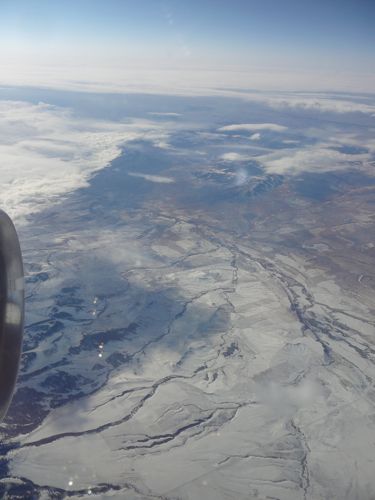
When we get near Seattle, you can see five mountains in a row, from Mount Rainier looking south, including the remains of Mount Saint Helens. The weather in Seattle is cool and brisk, my car is waiting and the roads out Edmonds are clear and dry, Wooo HOOOOO!
Recent Comments
intlxpatr on Shampoo Ginger tigerbutterya0c5ff1d… on Shampoo Ginger intlxpatr on British Soldier Kidnapped, Esc… John on British Soldier Kidnapped, Esc… intlxpatr on British Soldier Kidnapped, Esc… Wikipedia Donate Button

Amazina


Early Voting in Florida


