Hemingway’s on Pensacola Beach
“How about Peg Leg Pete’s?” I asked, as we were contemplating where to eat lunch.
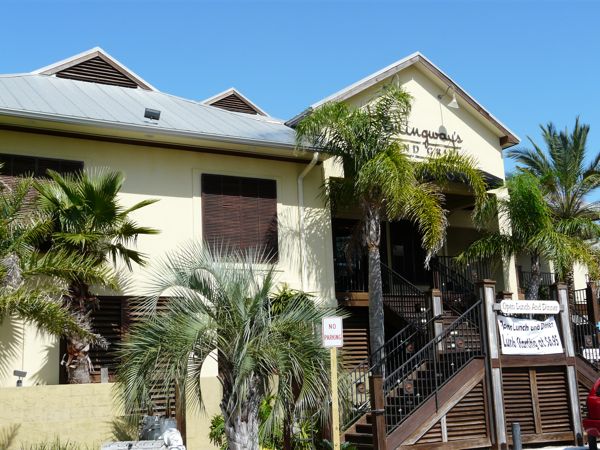
“We haven’t eaten at Hemingway’s for a while,” he responded, “let’s go back there.”
I had to grin. There is so much that goes into where a person chooses to eat, and I suspect my husband is yearning, on some deep level, for some exotic taste of the life we left behind. Hemingway’s is built like a lodge, could be a hunting lodge in Montana or a hunting lodge in Africa, you know, a lot of wood, open construction, heavy wood beams in a high gently peaked roof, a vast balcony (like where you could have a Samburu Sunset and watch game wandering in to the watering hole)
Hemingway’s it was. As we waited for our meals to arrive, we tried to figure out when the last time we had eaten there had been, and we think it was back . . . more than five years ago, when our son was getting married. We had flown into town a week early to have time to get adjusted to local time and to arrange for a rehearsal dinner. We flew in, had a weekend with our son and his bride-to-be, including a meal at Hemingway’s, and then we headed up the coast to make our arrangements, and to get out of their hair during an exceptionally busy and stressful pre-wedding week.
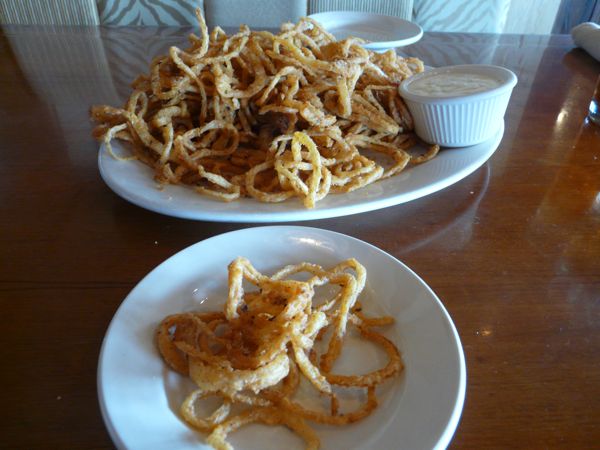
I love that Hemingway’s has some really good special menus for lunch; AdventureMan had the Hurricane Shrimp and I had the Salmon Caesar. We started with the onion straws, but there was so much, we barely touched them. They were the thin little onions, so each tiny little ring was a lot of crisp batter and fat, and not a lot of onion. A little tasty, but not a lot. Most of the taste was in the Ranch Dressing type dip that accompanied them. I’d skip them next time.
I made a mistake; there was a Caesar salad with something and there was a spinach salad with salmon, so I asked for a Salmon Caesar and he said “Oh! Yes, we can do that, just put it on Caesar instead of the spinach.” I like that flexibility, and I found their Caesar salad very tasty; not bland.

AdventureMan really enjoyed his Hurricane Shrimp and particularly loved the way they were skewered, so that on the grill, you can flip them without shrimp slipping off.


At the end, we succumbed to sharing a rum brownie, very delicious. I wish I could say we didn’t finish it, but we did leave most of the whipped cream behind. 😉

All in all, a nice meal in a great atmosphere. Service was attentive without being too intrusive. We will probably go back soon and take our son and his wife. 🙂
Pumpkin Patch Frenzy
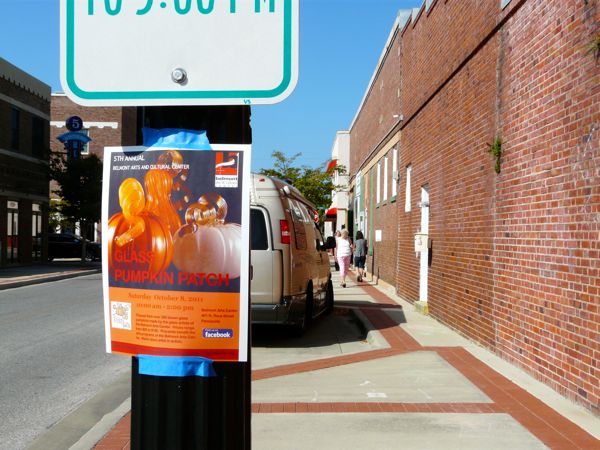
We’ve had the most wonderful Saturday. You’d think we’d be sleeping in, but we surprised ourselves – awake and happy at seven in the morning, out the door by eight. Our second stop was the Pumpkin Patch, an annual arts event featuring glass pumpkins.
“Why pumpkins?” you might ask. It’s pumpkin season. Pumpkins are traditional for Halloween. These are beautiful, made of glass, nice for a Fall seasonal decoration in your house. It’s an arts fest, held in the Belmont Arts and Cultural Center. (If you look closely, you can see 5 Sisters Blues Cafe across the street.)
BIG mistake. No parking spots, so AM let me off to fight the crowds while he looked for a parking spot. There had been a huge line; none left as I get close to the door, but inside, it is a frenzy and it is a turgid stream of people. Many are carrying boxes and people are grabbing at pumpkins, beautiful glass pumpkins of all colors, but I knew I wanted a big orange pumpkin. I only found one orange pumpkin, a small pumpkin, but I never did see a big pumpkin, so this one will have to do.
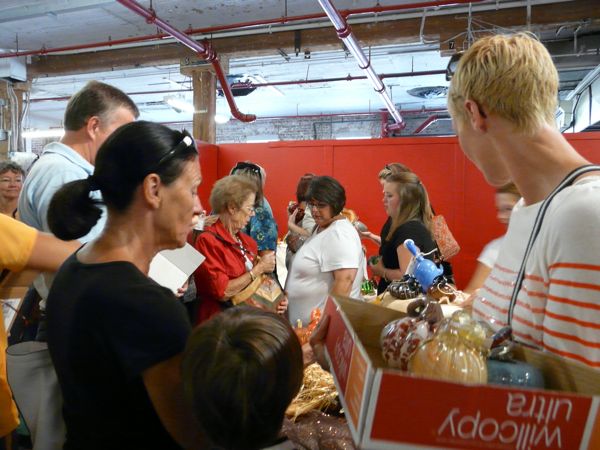
You cannot imagine; this was not a nice crowd. This was a mob, this was the worst shopping crowd I have ever been in, and I have been in some frenzied shopping crowds in my life. This one was rude and pushy and many of the pushiest were also very vulgar, and used vulgar language as they tried to push others out of their way.
I went straight to the “pay with cash or check” line, which moved fairly quickly. At one point, a guy called for anyone paying by check, and I could do either so I got in that line figuring it to be faster. I was at the end of the line, and the very last guy at the “pay with cash” table said “if you can pay with cash, I can take you here, now.” I said “YES!” and whipped our my cash and was out in a flash.
I’m going to have to find another strategy for finding a large orange pumpkin. I’m not going to that Pumpkin Patch Sale again.
Here is my little orange pumpkin:
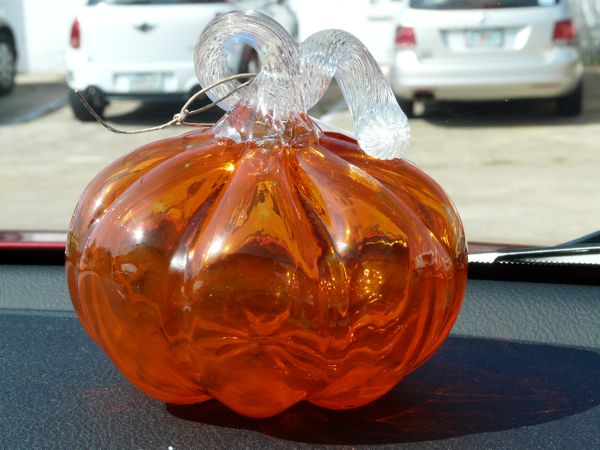
And here it is, with the little green pumpkin I bought last year, on my beautiful green Damascus tablecloth in the dining room:

Harlan Coben: Long Lost

This totally light weight mystery was just right for a beach read. It was light on motivation, light on character description, light on substance – it was a very fluffy mystery.
Long lost love calls and says “come to Paris; I need you” and doltish hero heads off. Confusing plotting calls for some irrational police interaction, some unknown bogeymen, and a truly thin story line.
You can read it in about an hour, though, or stretched out between beach activities, it might be good for a weekend. Not only lightweight, but forgettable.
Weekend At the Beach
We didn’t go far – just out to the beach, Pensacola Beach, for a weekend. It was so much fun. It rained our entire drive to the beach, LOL all twenty minutes it took to get there:

But it started clearing, and with all the clouds, the sunset was spectacular:
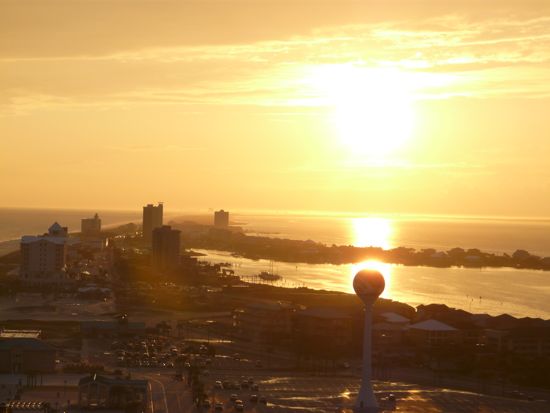

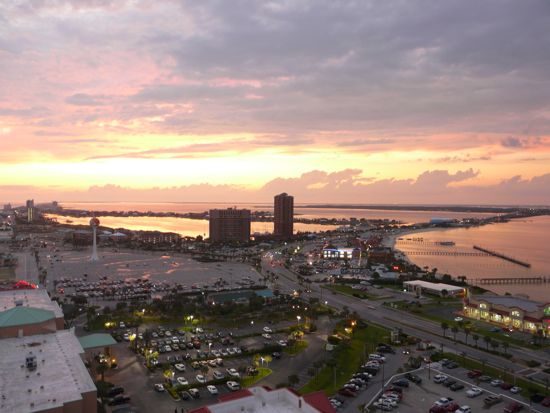
We all have such a good time together. We took a drive out to Fort Pickens and I saw so many butterflies!

We had to watch THE game later in the day, which the Happy Baby calls “buttball,” LLOOLLL!
Here he is at breakfast with his BaBa:

It was a beautiful day, with another beautiful sunset:


AdventureMan asked me if I wanted a house overlooking the Gulf. I said ‘no, it would never be so interesting as Kuwait.’ In Florida, I think I would want a house up high over a bayou, where there are birds and wildlife. High enough to not flood when there is a hurricane or a storm surge. . . It still was a thrill to spend a couple days high above the beach, and watch the sun set. 🙂
It’s funny the things that make a marriage succeed. It’s the little things. We both wanted to go to Barnes and Nobles because the 2012 calendars are out and we like to have calendars we love to look out through the year. You can take a chance on waiting until New Year’s week, and sometimes you get a cool calendar at 50% off, but mostly the one you really wanted is already gone gone gone, woe woe woe.
Besides that, we always like to get what we want, then the other one hides it until Christmas. By then, we’ve forgotten what we picked out, so it is a really good surprise. 😉
I told AM that I was going to have to have a chocolate fix and he said he would have to have a chocolate fix, too. We decided we could share an Oreo cake:

It was a fun idea, but it didn’t taste as good as it looked. We didn’t even finish it, it just wasn’t that great.
Uyen Nichole Duong: Mimi and Her Mirror
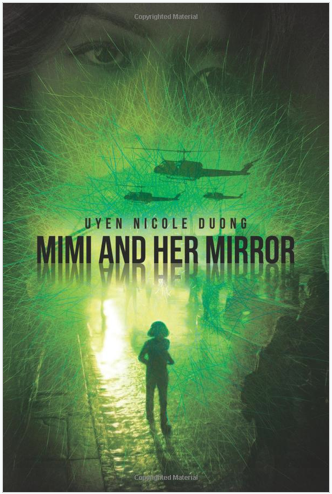
I must be on a streak. I really wanted to like this main character, Mi Chou (Mimi) but I found her obsessive, impulsive, overly emotional, self-absorbed and boastful. Her strongest relationship in the book is with her three way mirror. She specifically claims not to be narcissistic, and I think the story tells us otherwise.
The book is supposed to be fictional, and I truly hope some parts are fictional, but the strengths of the book lie in the ‘coming to America’ experience, which she captures well. She has a strong eye for ironies, hypocrisies and cultural differences. Her beginnings are vague, as is often the case when an immigrant goes through the shell-shock of being cut off from their own culture and grafted into another. I believe the author drew strongly on her own experiences to write this part of the book, and to me, it is the strongest part.
Mi Chau and her family leave Viet Nam during the great evacuation, and are given a spot on the planes that should have gone to someone else. Her entire family, mother, father, sister and brother all escape together, leaving behind a beloved grandmother who refuses to leave. Their entry into the US goes smoothly. They are the first wave of Vietnamese, the lucky ones. They have support, they have jobs. They have lost their own world, and they struggle. All this is part of the normal immigrant experience.
Neither is it abnormal that the children thrive through their struggles, and achieve excellent eduations. What is distracting to me in the book is how Mimi bases her self worth first on her academic excellence, and later in life on what she owns, and on her status. She has accomplished so much, she owns high-status symbols, but she is miserable and her life is empty.
Is it because of her experience as she evacuates out of Vietnam? Is it a character defect? There are no meaningful relationships in her life, she lives an empty and soulless existence, focusing on work and accomplishment and status symbols. Her major problem, as I see it, is an unwillingness to connect, to step out of herself and see through other’s eyes.
It’s an interesting book. There are, in my opinion, better books about the Vietnamese coming-to-America experience, and one is Anne Fadiman’s The Spirit Catches You and You Fall Down about immigrant Hmong, which is rich in cultural teachings, rich in relationships, and I still remember details more than ten years after I first read it. It is only available in Kindle format now, through Amazon, although they may have a used copy from time to time. Way better book than Mimi.

Emergency Message for U.S Citizens: Demonstration Notice 14-2011
Emergency Message for U.S Citizens � Demonstration Notice 14-2011
September 20, 2011
Please circulate the following message without additions or omissions
immediately to all U.S. citizens within your area of responsibility.
An anti-corruption demonstration is planned for the early evening hours at
Determination Square on Wednesday, September 21 in downtown Kuwait City. An
increased police and security presence is expected in and around the capital.
There are also reports of possible demonstrations in support of Bidoon rights on
Wednesday, September 21 in the cities of Jahra, Al-Sulaibyah and Al-Ahmadi. An
increased police and security presence is also expected in these areas.
Spontaneous and planned demonstrations take place in Kuwait from time to time in
response to world events or local developments.
At times, even demonstrations intended to be peaceful can turn confrontational and possibly escalate into violence. Do not let curiosity get the best of you; avoid the areas of demonstrations and exercise caution if within the vicinity of any large gatherings. Please stay current with media coverage of local events, be aware of your surroundings, and practice personal security awareness at all times.
For the latest security information, U.S. citizens living and traveling abroad
should regularly monitor the Department of State’s Bureau of Consular Affairs
Internet website, where the current Worldwide Caution, Travel Warnings, Travel
Alerts, as well as the Country Specific Information for Kuwait can be found.
Up-to-date information on security can also be obtained by calling
1-888-407-4747 toll-free in the United States and Canada or, for callers outside
the United States and Canada, a regular toll line at 1-202-501-4444. These
numbers are available from 8:00 a.m. to 8:00 p.m. Eastern Time, Monday through
Friday (except U.S. federal holidays). You can also download our free Smart
Traveler App for travel information at your fingertips and follow us on Twitter
and the Bureau of Consular Affairs page on Facebook as well.
The U.S. Embassy is located at Al-Masjid Al-Aqsa Street, Block 6, Plot 14,
Bayan, Kuwait. If you are a U.S. citizen in need of emergency assistance in
Kuwait, you may reach the U.S. Embassy by calling +965-2259-1001 and requesting
the duty officer.
U.S. citizens living or traveling in Kuwait are encouraged to enroll in the
Department�s Smart Traveler Enrollment Program (STEP) so that they can obtain
updated information on travel and security. U.S. citizens without internet
access may enroll directly with the nearest U.S. Embassy or Consulate. By
enrolling, U.S. citizens make it easier for the Embassy or Consulate to contact
them in case of emergency. For additional information, please refer to “A Safe
Trip Abroad”.
This message may be accessed on the Embassy website, http://kuwait.usembassy.gov
Please note that the Consular Section is closed for U.S. and most local
holidays. The current holiday schedule for 2011 is posted on
http://kuwait.usembassy.gov/holidays.html
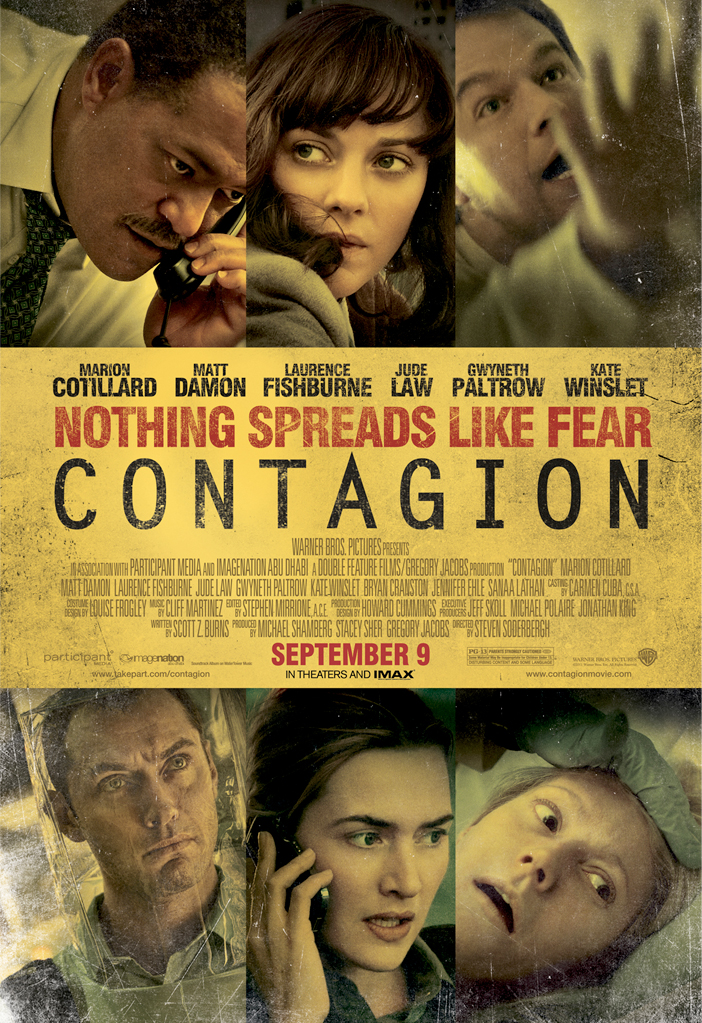
Contagion
As we rushed into the house, we both headed immediately to our bathrooms to wash our hands. Twice. And I also washed my face.
Contagion is a very intelligent movie. It is scary, but not in the Friday the 13th kind of scary, or in the Night of the Living Dead kind of scary, although come to think of it, there were some elements in common with the original Night of the Living Dead. No, what makes Contagion scary is that it could happen so easily.
I had no idea that we touch our faces, on the average, of three to five times a minute, more than 3,000 times a day, and that with every surface we touch, we transfer (germs) (bacteria) (things that could make you sick) close to an entry to your body, like your nostrils and your mouth. Once you start thinking about NOT touching your face, you become aware of how often you touch your own face, unaware. Like flipping hair out of your eyes, or covering your mouth when you laugh, or a million other things like that. You become aware of all the things you touch between the time you wash your hands and touch your food. You think about who may have touched your fork, and how well it was washed.
For me, the scariest part of the movie, beyond how quickly the virus mutated and spread, was how quickly civil society broke down when cities were quarantined, when people were concerned food was growing scarce, when people thought they had to fight for survival. The rules for avoiding spreading the virus were not to meet, not to touch, to stay apart. It’s hard to help one another when those rules are in play, but those rules make it easier for those without rules to attack and take what they can.
I liked the music in the movie, too, very edgy.
Before I ever saw this movie, I heard an interview with the author on NPR. She was saying that when they came to her wanting to make this movie, she said “it cannot start in Africa. . . (there were a whole bunch of rules, which were hilarious because they were like every plot for a movie like this ever made) I knew I needed to see this movie, to see how it could be done and still be dramatic, and follow her rules.
There is one hilarious quote. A blogger in this movie gains enormous following. As he is tracking down one of the scientists for information, the scientist says to him:
Blogging is not writing. It’s just graffiti with punctuation.
Excuse me, gotta go wash my hands again.
A Different Perspective
“It’s going to be a great weekend! We’re expecting sun and temperatures of 85°F!” my Mom enthused, from Seattle.
“We’re expecting a great weekend, too,” I enthused right back, “the temperature will be down to about 85°F and it’s going to RAIN!”
We laughed. It’s all a matter of perspective.
“We’re staying in this weekend,” said one of my co-mother-in-laws. “When it gets like this, we just hunker down.”
“We went out to the beach!” I crowed! I wanted to see the waves, and when the temperatures go down and it rains, I feel re-energied!”
We laughed. She’s married to a man from the Pacific Northwest, so this perspective is not new to her.

What was not funny was when I had just started a load of laundry, and the electricity went out. Electricity goes out all the time, or from time to time, with frequent thunder and lightning storms, but this time it went out and stayed out. Without the ceiling fans going, it wasn’t hot, but it got stuffy. We have a covered and protected area outside, so we went outside and sat and watched the gusting winds and the flying rain beating down our tomato plants. Mostly, the rain has been drizzling down, but for an hour or so, it really battered and flew about. It’s just a normal small storm, though, nothing like it could be, nothing like Hurricane Irene, which devastated the East Coast last weekend.
And it was a good thing. We have hurricane preparations, but . . . sometimes we rob the Hurricane supplies, or borrow them, and forget to put them back. While it was still daylight, I wanted to check on candles, matches, etc. and I discovered the matches had been MISPLACED. I finally found them. I gathered candles, and checked the weather station on my radio that you wind up during electrical outages (it worked fine) and started a list of additional things I want to gather to have on hand in case the electricity goes out for any length of time. It’s good to be prepared. 🙂
Electricity is back on now, adventure over.
Neighbors Key to Survival
“Americans don’t know their neighbors” my dinner guest said, in response to my asking him what surprises him most in his visit to this country. “In my country, we all know our neighbors. It’s important to know your neighbors.”
I agreed, and quoted him this article supporting his view that I heard on National Public Radio, one of those ideas I hear so often on NPR because they cover news other news sources ignore.
Below is just a portion of the story, which you can read in whole by clicking on this blue type. Even better, if you want, you can listed to the story yourself by clicking on the “Listen to the Story: All things Considered” button on this same page.

When Hurricane Katrina struck in 2005, one victim was political scientist Daniel Aldrich. He had just moved to New Orleans. Late one August night, there was a knock on the door.
“It was a neighbor who knew that we had no idea of the realities of the Gulf Coast life,” said Aldrich, who is now a political scientist at Purdue University in Indiana. He “knocked on our door very late at night, around midnight on Saturday night, and said, ‘Look, you’ve got small kids — you should really leave.’ ”
The knock on the door was to prove prophetic. It changed the course of Aldrich’s research and, in turn, is changing the way many experts now think about disaster preparedness.
Officials in New Orleans that Saturday night had not yet ordered an evacuation, but Aldrich trusted the neighbor who knocked on his door. He bundled his family into a car and drove to Houston.
“Without that information we never would’ve left,” Aldrich said. I think we would’ve been trapped.”
In fact, by the time people were told to leave, it was too late and thousands of people got stuck.
Because of his own experience in Katrina, Aldrich started thinking about how neighbors help one another during disasters. He decided to visit disaster sites around the world, looking for data.
Aldrich’s findings show that ambulances and firetrucks and government aid are not the principal ways most people survive during — and recover after — a disaster. His data suggest that while official help is useful — in clearing the water and getting the power back on in a place such as New Orleans after Katrina, for example — government interventions cannot bring neighborhoods back, and most emergency responders take far too long to get to the scene of a disaster to save many lives. Rather, it is the personal ties among members of a community that determine survival during a disaster, and recovery in its aftermath.
When Aldrich visited villages in India hit by the giant 2004 tsunami, he found that villagers who fared best after the disaster weren’t those with the most money, or the most power. They were people who knew lots of other people — the most socially connected individuals. In other words, if you want to predict who will do well after a disaster, you look for faces that keep showing up at all the weddings and funerals.
“Those individuals who had been more involved in local festivals, funerals and weddings, those were individuals who were tied into the community, they knew who to go to, they knew how to find someone who could help them get aid,” Aldrich says.
My visiting guest was from Lebanon, where neighbors have relied on one another for years as civil unrest rocks the country.
“I am guessing we move more often than your family and friends,” I ventured. “You are right, it is harder to establish long-lasting neighborly relations here where people come and go more often.”
Actually, we have settled in a fairly established neighborhood, where many people around us have lived for years and years, some all their lives. But we have only been here a year, and it takes time to build strong neighborly relations. But we are aware that connecting with our neighbors and staying connected is important in a part of the country vulnerable to life-threatening hurricanes and other natural emergencies.
You can listen to the entire report in 6 minutes and 3 seconds here.
“Is Your House Always This Clean?”
We had guests this week, visitors from overseas, and it was so much fun. One woman was full of questions. This was her first time out of her own country, and you know how it is when you are in a foreign culture, people think differently. Some of her questions bordered on impolite, according to our culture, but we could tell she was asking because she really was interested, and we didn’t let her questions bother us.
“No!” I laughed, “We cleaned because we had guests coming! My husband vacuumed and I washed all the floors!”
My daughter-in-law jumped in.
“Yes!” she laughed. “Yes, their house is always this clean!”
We all laughed.
“It’s just my husband and me,” I added, “it’s not that hard to keep it picked up and neat. We make extra effort when guests are coming.”
“Why do you do this?” she asked. “Why do you invite strangers into your home and give us dinner?”
“People have been so kind to us, in so many countries, in so many ways,” I began, “No matter how hard we try, we will never be able to repay all the kindness we have received. But we do our best.”
We were in my kitchen, which is not large, and I am trying to get dinner on the table. It is a simple, family dinner, a little chaotic, but with lots of dishes so the guests can find something they might like to eat.
“Do you clean yourself? You have no cook?” she asked.
“We clean. Both of us. We could hire help, but it is very expensive here,” I said, pulling the chicken out of the oven. “And we do our own cooking. My husband makes bread! He is very good at it.”
During the evening she continued asking questions, and now, several days later, we find ourselves thinking about the questions, and thinking . . . THIS is why we do it! We love these guests who come in with a different way of looking at things and their questions, which stimulate us to think in new ways, too, as we try to explain why we do things the way we do them.
I remember in Doha, the Philipina maids would ask me “how old are you?” because they couldn’t guess by looking at me. We never ask a woman how old they are once they are past maybe eighteen or twenty years old. We never ask how much money a husband – or wife – makes. It is culturally taboo, it just isn’t done. We never ask what kind of birth control someone is using. I am aware of these things because I have been asked, and it made me think about it.
But now I wonder what questions I have asked in foreign lands which shocked people, or made them uncomfortable?
Recent Comments
intlxpatr on Shampoo Ginger tigerbutterya0c5ff1d… on Shampoo Ginger intlxpatr on British Soldier Kidnapped, Esc… John on British Soldier Kidnapped, Esc… intlxpatr on British Soldier Kidnapped, Esc… Wikipedia Donate Button

Amazina


Early Voting in Florida


