Phoenix: One Thing Leads to Another
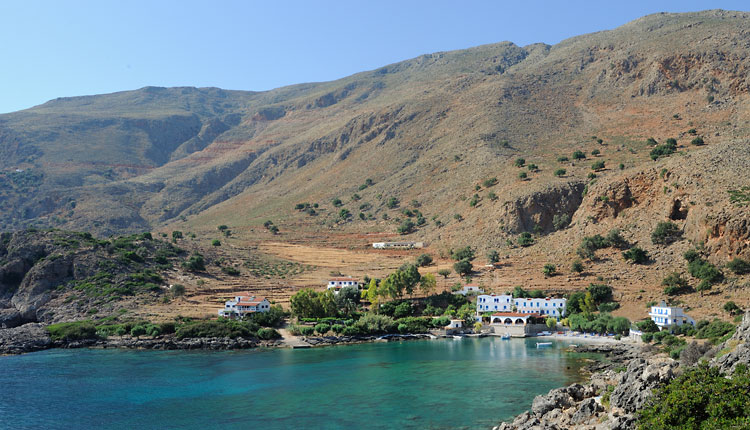
In our lectionary readings for today, St. Paul talks about a bay in Crete, facing northwest and southwest, at the west end of Crete, called Phoenix Bay. I’m a bit of a geography nerd, but with the miracle of Google Maps, and the Internet, I found the bay, and even better, I found a hotel I would love to stay in.
It’s not a fancy hotel, and it’s not expensive. It appears simple and clean. But look at the location! Alone! You can’t even get to it by driving, you either drive to a village and take a ferry boat to the hotel, or you hike overland about half and hour to get there. It is ISOLATED! (I love isolated hotels!)
The hotel is calls itself the Old Phoenix Look at its setting:
What is so special about us?
The Old Phoenix can only be reached on foot or by boat. There is no sound of traffic and everything moves at a slow and laid-back pace.
The guests come here looking for peace so they are unlikely to be noisy themselves.
All our rooms have large balconies overlooking the Libyan sea.
Our food is simple, traditional Cretan fare, cooked daily from fresh local ingredients by the family.
Despite the quietness there is a whole range of things to do including lazing on the beach, snorkeling in some of the clearest waters in the Mediterranean, easy walks to serious hiking, canoeing and excursions by boat to the neighbouring villages.
Watching the two sea turtles (Caretta caretta) that have chosen to live in our bay since 2010 is also a nice addition to the quiet entertainment that I can be had during the day.
We have stayed in the general area before, and loved it. We were in our early 50’s, and we heard of a hike that was beautiful and challenging and unforgettable, and we knew we had to do it or we never would – 20 km, starting out hiking downhill, which sounds easy but after a couple kilometers you discover muscles and weaknesses you never knew you had. The only way we completed the hike was that there was no alternative. You had to keep going because there was only one way in and one way out.
At the end, we were almost dead from exhaustion, and the next day we could barely move. It’s one of the BEST things we have ever done. 🙂 The Old Phoenix is not far from this 20 kilometer gorge.
I would really love to find this hotel and stay there four or five days, it looks special. You don’t find a lot of hotels like this one, remote, family owned, small, quiet – and every room with a gorgeous view of the sea.
The Value of the Trivial
“Be sure to use your full name, First, maiden and married, on your quilt labels,” our presenter instructed us.
Oh-oh. I’ve been lucky just to get labels on my quilts, and I haven’t used my maiden name at all.
“Years from now, if someone is trying to track you as a quilter, it will help to have your maiden name to distinguish you from other quilters who may have similar names,” she continued.
OK. So now I will include my maiden name. (For my Moslem friends, it is our custom to take our husband’s names when we marry. Some women don’t, but even now, the majority do. I know, I know, it seems backward to you, it is irrational, it is just the way it is. We also don’t have marriage contracts.)
At lunch with a long-time friend this week, she mentioned she still has her mother’s diaries. I suggested she offer them to a major university near where my friend grew up, to their historical collection, and my friend said “oh, it’s just daily weather, who’s sick, stuff like that.”
Stuff like that is just exactly what historians treasure. When I was at university, I worked for a time in the copying department of the library, and I specialized in the historical collections, many of which were from people who came west. The papers were fascinating – letters home, lists of supplies they asked to have sent West, to-do lists, old photos. The scraps of paper you and I throw away – there in the Northwest collection.
They become valuable, at least for historical research, for writing period fiction, for medical research – because we do throw them away, and so few survive.
Keeping up with this blog has become more problematic. I just don’t have the time in my life I used to have. My life is interesting to me, but now that I am no longer living in exotic locations, I don’t believe I am so interesting to others. My internal debate is whether or not to continue. I would let it go in a heartbeat and not miss the time, but . . . I think I would miss your feedback.
I’m not writing this for you. I’m sort of writing more for my own record-keeping, it’s why I include news articles and scraps of daily life (not my own) and all the oddities and irrationalities that catch my eye. I love having a place to store it all (this blog) and I love your comments, which can sometimes completely turn me around in point of view; you give me perspectives I hadn’t considered.
The point of all this is the ephemeral nature of our daily lives, and the records of our lives. There are things worth keeping.
I wish someone in Kuwait were doing oral histories on the older people who were living there ‘before oil’.
New Generation of Readers
Nothing could make me happier. The Happy Baby loves books! When he was born, one of my sisters sent a box, full of almost every classic book children love to read. Since then, AdventureMan and I have been supplementing with all our own favorites. Happy Baby loves to sit in a lap and read a book, and he is also happy reading on his own.
He LOVES trucks and buses and cars, LOL, he is all boy:
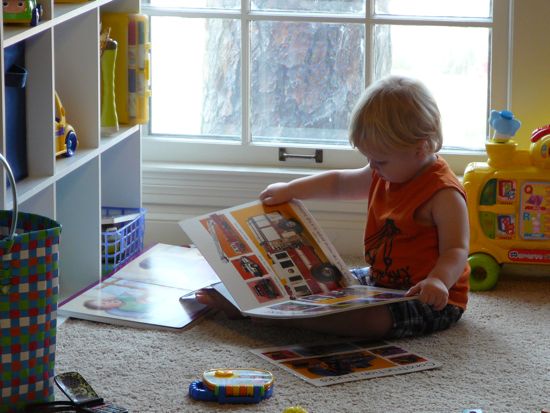
This weekend the Happy Baby discovered heaven-on-earth – the Pensacola National Aviation Museum. He loves the cockpits, with all those buttons and levers and wheels. He only screamed when it was time to move on to the next exhibit.
I was babysitting the other day and they left us with the iPad, which he also loves. I thought I knew how things worked, but I was wrong. I didn’t know anything about Angry Birds or Zombies in the Garden, and he showed me. 18 months old. I just had to laugh. Already, I am learning from him!
Arabian Gulf Legacy
In today’s Lectionary, Psalm 107, there is the following verse:
41 but he raises up the needy out of distress,
and makes their families like flocks.
My heart goes back to Qatar, and I think of “my” family there, a family who adopted me, slowly but surely. The woman, who taught me Arabic, has twelve children. “Twelve children!” I used to think, was about ten too many, but I learned so much from this woman, and from her family. Every day she and her husband would sit together. They discussed each child. No child in that family was lost or overlooked; they cared for each and every one. I, too, know each child. I was particularly close to the oldest girls, but there was one young son who hit me on my bottom during my very first visit, hard, as I was bending over to put on my shoes. While everyone else looked on in horror, he just grinned up at me, and I couldn’t help but laugh. I pray for each and every one in this family, and they pray for me. Relationships don’t get much more intimate than that, I think, that we pray for one another, and we have some idea what to pray for.
And while they are not wealthy, they have enough, and they are a happy family. When one has a need, the others sacrifice, and I never hear a grumble of a complaint. Each has an assurance that when their turn comes – as it comes to all of us – their family will be there to assist them.

We said goodbye to our Saudi friends this week, on their way back to the desert kingdom to finish Ramadan and celebrate Eid with their family. They have been such a blessing in our lives here, and we wish them well. They left a lot of last minute things for me, a coffee and tea set with coffee cups, trays for serving drinks, spices, bags – the detritus of a life of moving, there are always things which still have use but for which you have no room in your packing crate. I am starting a lending closet with them; as other families arrive, I will offer them up to new arrivals who need the same pieces for their daily life and entertaining. The spices I will share with one of my co-mother-in-laws who makes a chicken biryani they call Chicken Perlow. It is moister than biryani, but has much the same flavor. Oh yummm.
As our Saudi friends depart, we have new friends arriving and we will have them for dinner tomorrow night. We have met them, one is Algerian, the other is Omani; as the Ramadan fast ended, the Algerian was trying to eat a piece of bruschetta with a knife and form. “You are so French!” I laughed, and told him we eat this with our fingers, which greatly relieved him, as he was standing, and to try to cut a piece of French break with a fork while standing is close to impossible. Both are a lot of fun, and while we will miss our departing Saudi friends, we are looking forward to these new friends.
One thing that pleases me greatly. I asked my Saudi friend how she was received when she went out, as she is fully covered, abaya and scarf and niqab (face covering). She said she had been warned before leaving Saudi Arabia that people would be unkind to her, but never once did she run into this, that people were always kind, “in the hospital, in the Wal-Mart, in the shopping, everywhere.” It just made me so proud to be living in Pensacola.
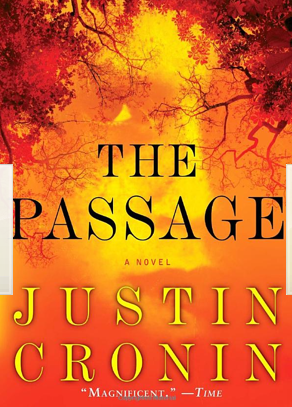
The Passage by Justin Cronin
I subscribe to GoodReads.com, and I buy books through Amazon.com, so I am not sure which one of those recommended this book for me. I held it a couple months before I read it, just wasn’t sure it was something I cared about. Once I started, however, I was hooked.
Don’t you just love summertime reading, the kind where you might even be able to grab a couple hours in a row? When you can focus like that, it’s like you are living two lives; you are in your normal existence, but a part of you is somewhere else, if the book is good enough.
Sometimes that somewhere else isn’t that great, and in The Passage, you are in a post-apocalyptic America where those military scientists have lost control of one of their experiments and life has changed forever as a result. Sorry to sound so cynical, but I started reading Sci-Fi when I was still in middle-school, so I am a little jaded about post-apocalyptic literature, but this one managed to suck me in. Also, even though you know it’s fiction, it is compelling enough to feel very real.
So before I go getting all critical about the little things, I need to tell you that when I had to put the book down, I could hardly wait to get back to it, and I probably need to look after my laundry and my floors and wash up some dishes now that I’ve finished; the book compelled my interest.
I think the author does a great job setting up the world. In order for young people to come into their own, to head out on their quest, you have to get parents out of the way, so all the young people out to solve the problems have parents who have died, or committed suicide (the living situation is a little bleak) and that kind of bugs me, even though I can see the literary usefulness of having this happen.
The survivors, 100 years after the societal meltdown, live a bleak and limited existence, mostly focused on not getting killed. (One of the very scary things is just how fast a society can melt down when faced with an overwhelming threat.)
This is a vampire-novel, but a vampire novel with a total twist, there is nothing attractive about these vampires, called virals. They are demented, and they want blood. They tear into flesh. You don’t want to be out in the open after dark, you don’t want to run into a viral. Justin Cronin makes it very very real. I’m glad my husband wasn’t traveling. I know vampires are not real, and I know there are no virals, and you know sometimes rational doesn’t matter when you hear sounds at night? These bad-guys are very very lethal and very very bad.
And here is what I like. Cronin takes you from utter fear to some compassion for the virals. I imagine this will play into the next book.
I also like his inclusion of children, and they way children perceive and the way children feel, and how those perceptions and feelings grow with the child, and, if you are very lucky or very persistent, how you can gain insights into those perceptions and understand them differently as you reach adulthood. It reminds me of another Sci-Fi author I used to read, Zenna Henderson, who wrote books about specially talented children.
Here is what I don’t like, what I find really frustrating: this is just the first volume. I am satisfied enough with this book, and I know I will have to read the next one, but I think I can see where he is going with it all. I find it frustrating; I am holding my breath for the next Game of Thrones/Fire and Ice volume to come out, and now this Passage follow up won’t be out until 2012, on AAARRGH.
It’s a dark book, but it kept me glued. The things that annoyed me didn’t annoy me enough to discourage me from reading. 🙂 It is a great summer read.
Chimamanda Ngozi Adichie: The Thing Around Your Neck

Chimamanda Ngozi Adichie has compiled a series of elegant vignettes in her most recent book, The Thing Around Your Neck. I had just read Half of a Yellow Sun, and was still wallowing in stunned admiration, when I heard an interview with the author on BBC, and learned she had written this book, The Thing Around Your Neck.
I loved Half of a Yellow Sun. I loved Purple Hibiscus. I felt I began to understand just a little bit about life in transitional Nigeria, with all the social and political forces blowing to and fro, straining the very fabric of nationhood.
In The Thing Around Your Neck, something else happens. It shares with Cutting for Stone and other books I like the impressions of those who come to live in the USA for the first time.
“Would that the wee wee giftie gi’e us, To see ourselves as others see us . . . ”
I’ve had a lot of experience going to live in foreign countries. One of the things I learned is that most of what I learn the first couple years isn’t much. You learn a lot of things wrong. You filter everything through your own cultural biases; you judge, you interpret, you try to make sense of things that just seem wrong.
I love to watch Chimamanda Ngozi Adichie’s characters do this in reverse, come to America and make judgements based on their own cultural expectations. I love to see us through these eyes.
Once, many many years ago, we entertained a Nigerian in our home, and when we served dinner, steaks, he looked at his plate and said “This would feed my family for a week.” We kind of laughed. We kind of thought he was exaggerating, or even kidding. We just didn’t know. We had never seen anyone truly hungry, we had always lived in this land of plenty. We had no idea what we didn’t know. We saw only what we knew.
Each story is a gem. Each treats the expat experience, coming here, or the reverse, coming to America and then going back and seeing Nigeria through eyes which have changed.
One story I had read before, in the New Yorker magazine and loved reading again, The Headstrong Historian. It starts with a smart woman, weaving her way among the ways of her people, whose husband’s family wants her husband to take another wife. He doesn’t want to. These two chose each other, and managed to live their lives together as best they could, by their own standards. Her son disappoints her, but her granddaughter – she sees her husband’s brave, courageous spirit in the eyes of her little grand daughter. You’ll have to read the story to find out the rest.
Other stories have to do with newlyweds, with students, with love and marriage and affairs – the full spectrum of human experience, through Nigerian expat eyes. There are settings common from all three books, the college campus at Nsukka, a prison outside of town, small villages outside the city. If you read all her books, you recognize place: “Aha! I’ve been her before, in Purple Hibiscus!” You learn how to bribe the guards so you can bring in food for your imprisoned family member, you learn to keep your eyes down to show respect, you learn how Nigeria smells when the rains come, and how dry and dusty it gets during the harmattan.
I’m just sorry there isn’t another book by this author – yet – that I can read!
I guess these books that I love deal with a theme dear to my heart – that we are culturally blind to so many things, and that as human beings we are more alike than we are different. Short of packing up all our lives and our assumptions and moving to many different countries, the best we can hope for in learning different ways of thinking is for books like these by Chimamanda Ngozi Adichie, which show us how differently we perceive things, depending on our cultures, and how alike we are in the things that we feel, as human beings.
Chimamanda Ngozi Adichie: Purple Hibiscus
A couple of years ago, when we had a great book club in Kuwait, I read Half of a Yellow Sun, by this author, and I was blown away. Some books you just read for entertainment, and some books have such a strong, compelling voice that it comes back to you, again and again, and you think about it for a long time.

So when Amazon.com recommended Purple Hibiscus, I bought it, along with The Thing Around Your Neck. Purple Hibiscus is the author’s first book, and The Thing Around Your Neck is her most recent. In 2009, I found an interview with her online; you can watch it by clicking here: An Interview with Chimamanda Ngozi Adichie. She is an enormously talented author.
When I read Half of a Yellow Sun, I became Igbo, growing up in Nigeria. While that story was told through many eyes, I was able to be a boy from the bush brought to the college campus to be a houseboy, I got to be a wife, her sister, her professor husband. We experienced the Biafran succession, the insanity of several regime changes in Nigeria, the total fog and waste of war, through the eyes of the Biafrans.
Reading Purple Hibiscus was a little different; the story is told through the eyes of a girl, Kambili, who lives in a very controlled environment. We know from the very beginning that things are not right in her wealthy, beautiful world. Her father and mother love her, take good care of her, feed her, clothe her – and that is just a part of a bigger picture. Her father has an idea of the way things should be; he attained his position and wealth through his education by the Catholic priests and he has a rigid idea of how everything must be done. Vary from his strictures, and you get beaten, or scalded, or you little finger is broken and disfigured.
Part of what makes this book so compelling is that while the environment is Nigeria, and, to us, exotic, the climate of abuse is the same everywhere. It’s a dirty little secret, even in the wealthiest of families, you keep your mouth shut to stay alive, and to protect your family’s image. Abuse is no stranger to rich or poor families, and can only stay alive because people stay silent.
Kambili, fifteen when we meet her, lives a tiny, small, scared life, following the weekly schedules her father prints out for her and her brother and posts over her desk. She hears her mother beaten over the smallest failure, imagined or real. Her mother miscarries twice due to these beatings, and her father tenderly cares for the mother whose miscarriage his beatings caused. It is crazy-world. Kambeli and her brother are expected to take first in every class; if they do not, they, too, pay a severe penalty.
Just as the political climate in Nigeria starts to tremble and fall apart, so, too, does Kambili’s life, and in the falling apart, comes new ways of doing things, new perspectives, new risks and even learning to run, to laugh, to be ‘normal’ as other children are. She is blessed to have an aunt at the university, no where near so wealthy as her family but able to cajole her father into letting the children visit with her. The aunt, Ifeoma, laughs, and encourages her children to challenge other’s opinions respectfully, and who grows the very rare Purple Hibiscus. Her heart aches for Kambili and her brother, and she tries to give them space to figure things out for themselves, and to chose what they want for themselves.
It is a scary time in Nigeria, a time when men can come to the door and take someone away, and you don’t know if you will ever see them again, or how damaged they will be if they return. Kambili’s own life is full of a similar terror, but the terror is inflicted by someone who she loves, and who loves her.
I love the soul of an author who can write a book like this, a book that makes me feel like in another life I was a Nigerian. I can’t begin to think I know much about Nigeria now, but having read three books by Chimamanda Ngozi Adichie, I have the broad outlines of the divisions which traumatize and fracture Nigeria to this day. Even better, I understand how very different the cultural expectations are from our own, and how very similar we are as human beings.
This is a great read. It is inspirational. You might even learn something. You can find it on Amazon.com.
Jeannette Walls: The Glass Castle

The Glass Castle was a hugely popular best seller in the USA, and it must have been while I was gone. A part of me remembers reading a little bit about it and deciding it wasn’t my kind of book, but after reading Half Broke Horses, I had forgotten what the subject matter was and was excited to have another Jeannette Walls book I could read.
Big mistake. This book is nothing like Half Broke Horses.
Or maybe it is. Maybe what I loved about Half Broke Horses was the voice of an amazing woman, and maybe what kept me reading The Glass Castle is the voice of an amazing child who tells a heart breaking story. Or maybe it isn’t so heartbreaking, because the children survive. They are scarred and damaged, but never so damaged or loony or self-deceived as their parents.
I don’t like reading books about kids whose parents don’t take good care of them. Oprah chose a lot of those books in her book club. These books depress me. I cannot imagine how parents can be so self-absorbed, how they can take on the responsibilities of children and then not put those children first. How can they?
The Glass Castle stars the daughter of Lily Casey Smith, who is the mother of Jeannette Walls, and her husband, who is Jeannette’s father. The book opens with little three year old Jeannette proudly cooking up a hot dog. Her mother is busy painting and has told her to find something to eat. Her nightgown catches fire, and she is terribly burned. She spends a long time in the hospital, which ends with her father taking her out in a hurry, bundling her into the car, already loaded with her family, and “doing the skedaddle” which is leaving town just in front of the bill collectors.
This is her life. From time to time, their alcoholic Dad will take a job and bring home some of the paycheck (he drinks and gambles most of it) and when he won’t work, on rare occasion, their mother will take a teaching job, but the kids have to get her out of bed in the morning, have to grade her papers and make her lesson plans. Often there is not enough for the family to eat. They don’t stay in one place; they ‘skedaddle’ before they are evicted for non-payment of rent. They eat cold food – when they eat – because the parents didn’t pay the electric bill.
The Dad is smart, charming and cajoling, and when he is sober, the kids learn amazing things from him, and educated engineer. Unfortunately, he is not often sober. He chases after alcohol and he chases after women; the people in the towns where they live know it and the children learn to know it, too, to their constant humiliation. When he wheedles money off his kids, and promises to repay, he asks “Have I ever let you down?” The answer is so stunningly obvious as to be heartbreaking – Yes. Yes, again and again and again.
The Mother is equally irresponsible. One time, when the family is starving, she is in bed and occasionally goes under the covers, where Jeannette discovers her mother has a chocolate bar hidden that she can eat – while her children go hungry.
The author’s voice is never self pitying, she just lays it all out and leaves us to draw our own conclusions. Each child escapes the family as soon as possible; the children plan and save their money to get out, first sending off the oldest sister, then Jeannette, then the son. They all head for New York, where they find work and support themselves. Like bad pennies, Mom and Dad show up in New York, cadge meals and money and join the ranks of the homeless in New York, going from food pantry to soup kitchen, and diving dumpsters for their worldly needs.
This is not a feel good novel. The good part about it is that children can survive this kind of criminal neglect, and become a successful author as Jeannette Walls has done. I am so glad I read Half Broke Horses first, because her grandmother is such an admirable character, whereas her parents are scum and I just felt so angry when I read the matter-of-fact descriptions of their behavior that I was glad they were not where I could get my hands on them.
I don’t know any parents as bad as Rose Mary and Rex Walls, but I know I believe this – if you choose to marry, and if you choose to have children, know that children require time, and love, and energy, and patience. Know that if you have grand ambitions, or an addiction, or a character flaw, you won’t be able to provide for your children’s physical, emotional and spiritual needs, unless you are willing to sacrifice your own needs and wants. While the children in the book loved their parents, they recognized that their parents were sadly lacking in the parenting roles. The way these children were neglected will make me remember this book for a long time.
Would I recommend it? Yes. It is a gripping book, at times even horrifyingly humorous, as when Jeannette figures out how to find lunch food in the garbage cans when all the other kids have finished eating. It is not a feel-good book. It is a horrifying indictment of self-absorbed, neglectful parents, parents you will love to hate.
If I sound a little overwrought, it’s because I worked with the homeless. We were able to help many, but I also ran into families like this family, families who would prefer not taking any help if it meant they had to play by the rules, you know, rules like “you have to take care of your children.” We had all kinds of classes and forums and mentors to help with learning skills, like feeding children well on a small budget, learning to discipline, simple skills, survival skills.
The problem is that these skills require self-discipline, and many of the parents would rather not take help than have to exercise self-discipline. I saw women who would sacrifice their children for their current boyfriend, a woman who was severely angry with her daughter for reporting a family member had molested her, a man who didn’t want to take a job that would ‘tie him down’ when his family was starving. I saw this, with my own eyes, and there is no way you can MAKE people take good care of their children. You have to ask if the children are better off with these parents, or ‘in the system.’ Not a pretty choice.
This book, too, is on Amazon.com. Reading it is like watching a disaster on CNN. You don’t want to believe it is happening and you can’t look away.
Jeannette Walls: Half Broke Horses
About a month ago, I picked this up off the stack of “Read Me’s” . . . ummm . . . errr . . . one of the stacks of “Read Me’s.” (If there is some sort of emoticon for mild embarrassment, insert it here; one of my fatal flaws is acquiring book I WANT to read and having more books than I have time to read.)

I think Amazon recommended Half Broke Horses to me, and I didn’t know why. They keep track of what I buy and make recommendations, which over the many years I have been using Amazon.com to buy books has become more and more relevant to the kinds of things I actually buy and read. So I bought Half Broke Horses, and another one recommended by the same author, then put them in the stack. It is only because I had read whatever I put on top of them that I ended up reading.
I casually started reading, without a lot of anticipation. The first chapter starts off in the early early days of our country, in the wilds of West Texas, as a girl and her younger brother and sister are out checking the cows, who suddenly go crazy, even jumping over fences which under almost every circumstance successfully pen them in. The young girl recognized something strange was going on and figured it was a flash flood coming, got her siblings up in the tree and keeps them awake all night, as the flood hits, hoping the tree will hold and not wash away.
What is your first thought, reading that? Mine was – Where are her parents?? No one is out searching for them?
The next day, the flood recedes enough for them to make their way home back to a primitive dwelling hollowed out in the high side of a riverbank, dirt floors, dirt crumbling down on them, dark, small, smokey. Yes, there is a mother and a father, and they love their children, but these are very different times. These are hard times, where there is no grocery store, no nearby doctor, where babies die and children have fatal accidents all the time. Life can be short and brutal. The kids have some schooling, mostly at home, they learn to read and write and add and subtract, so they can keep track of home related business. They also work hard, every child has work around the ranch that needs doing, and work comes first or the family won’t survive.
The heroine, Lily Casey Smith, is a real person, the grandmother of the author, Jeannette Walls. This is called a true-life novel. From all the stories she heard about her grandmother growing up, and from knowing her grandmother, and from all the legends about her grandmother she was able to verify, she built a skeleton, and then filled it in with conversations and even a few events that she had to imagine.
Lily Casey left her family at 15 to ride her horse 25 days across Texas to take a teaching job in a one-room schoolhouse. (My jaw dropped, too!) After several years of teaching, she goes to Chicago to become educated and licensed as a teacher, marries, annuls the marriage, returns home, finds a teaching job, races horses, marries again, has children, has a huge ranch, loses the huge ranch, manages a huge ranch . . . her story is bigger than life, but so is the person of her grandmother, who never falls apart, but looks life in the eye and copes with it. Better than coping, she dominates.
Her major opponents are tough economic times, and dramatic and devastating weather conditions. Rain can fail to fall for months, cattle can die in an unexpected cold snap. At the best of times, you have enough to eat and a roof over your head.
I never wanted the book to end, and, in a sense, it didn’t. Jeannette Walls big best seller, The Glass Castle, takes up with just a little overlap where Half Broke Horses leaves off.
Here is what I loved: I loved the voice of Lily Casey Smith. She’s the kind of woman I want for a friend. She’s smart. She has a sense of how things work in the world. She experiences tragedies, but she doesn’t let them hurt her self-confidence. She can be beaten, but she always gets up again. She’s a problem solver. She never once lets being a woman get in the way of being the person she was born to be. She overcomes. She doesn’t sugar coat; she tells it as she sees it. And you know you can count on what she says to be the truth as she believes it. I truly hated for this book to end.
You can find this book at Amazon.com used under a dollar to new hardcover around $15. It is worth every cent.
Recent Comments
intlxpatr on Shampoo Ginger tigerbutterya0c5ff1d… on Shampoo Ginger intlxpatr on British Soldier Kidnapped, Esc… John on British Soldier Kidnapped, Esc… intlxpatr on British Soldier Kidnapped, Esc… Wikipedia Donate Button

Amazina


Early Voting in Florida


