Spectacular Diamond Find
On my Christmas wish list, LLOOOLLLL!
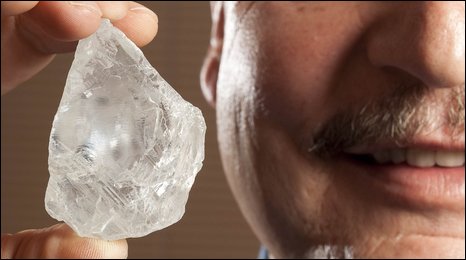
From BBC News
One of the largest, high quality diamonds discovered to date has been found at a mine in South Africa, mining group Petra Diamonds has revealed.
The 507 carat stone, which could be worth in excess of $20m (£12.5m), was found with three other large diamonds.
They were discovered at the famous Cullinan mine, where the largest diamond in history was found more than 100 years ago.
The new find is being analysed by experts to determine its true value.
A 480 carat diamond found at the end of last year fetched $18m.
“The Cullinan mine has again given the world a spectacularly beautiful and important diamond,” said Petra’s chief executive Johan Dippenaar.
“Initial indications are that it is of exceptional colour and clarity, which suggest extraordinary potential for its polished yield.”
Petra said the stone is one of the 20 biggest, high quality diamonds to have been found.
A 168 carat stone was also discovered, alongside one of 58 carats and another of 53 carats.
The largest diamond to be discovered, named the Cullinan, was 3,106 carats. It was cut into nine separate stones, many of which are in the British Crown Jewels.
Exporting Trash to Poorer Countries
From The New York Times, where you can read the entire article on exporting trash by clicking here
By ELISABETH ROSENTHAL
Published: September 26, 2009
ROTTERDAM, the Netherlands — When two inspectors swung open the doors of a battered red shipping container here, they confronted a graveyard of Europe’s electronic waste — old wires, electricity meters, circuit boards — mixed with remnants of cardboard and plastic.
“This is supposed to be going to China, but it isn’t going anywhere,” said Arno Vink, an inspector from the Dutch environment ministry who impounded the container because of Europe’s strict new laws that place restrictions on all types of waste exports, from dirty pipes to broken computers to household trash.
Exporting waste illegally to poor countries has become a vast and growing international business, as companies try to minimize the costs of new environmental laws, like those here, that tax waste or require that it be recycled or otherwise disposed of in an environmentally responsible way.
Rotterdam, the busiest port in Europe, has unwittingly become Europe’s main external garbage chute, a gateway for trash bound for places like China, Indonesia, India and Africa. There, electronic waste and construction debris containing toxic chemicals are often dismantled by children at great cost to their health. Other garbage that is supposed to be recycled according to European law may be simply burned or left to rot, polluting air and water and releasing the heat-trapping gases linked to global warming.
While much of the international waste trade is legal, sent to qualified overseas recyclers, a big chunk is not. For a price, underground traders make Europe’s waste disappear overseas.
After Europe first mandated recycling electronics like televisions and computers, two to three tons of electronic waste was turned in last year, far less than the seven tons anticipated. Much of the rest was probably exported illegally, according to the European Environment Agency.
Paper, plastic and metal trash exported from Europe rose tenfold from 1995 to 2007, the agency says, with 20 million containers of waste now shipped each year either legally or illegally. Half of that passes through this huge port, where trucks and ships exchange goods around the clock.
When we were blogging about pirates in Somalia, a Somali wrote in that part of the problem was that rich western countries were dumping toxic trash off the coast of Somalia and damaging the traditional fishing wealth of the country. Once trash is exported, there is no telling where it will be dumped, or what problems we are causing for our descendants down the road. I can’t help but think that we reap what we sow – and that we need to be paying attention to what we are dumping and where we are dumping it.
Second New Twist on an Old Scam
This one cracks me up – the names make it sound so credible, right? WRONG!
Offer Coming From U.A.E
This letter must come to you as a big surprise,
but I believe it is only a day that people meet
and become great friends and business partners.
I am Mr.Andre Sayegh, Chief Executive Officer with a reputable bank here in U. A. E. I write you this proposal in good faith, believing that I can trust you with the information I am about to reveal to you. I have an urgent and very confidential business proposition for you. On November 6, 2000, an Iraqi Foreign Oil consultant/contractor with the CHEVRON PETROLEUM CORPORATION, MR MOHAMMAD AL NASSER made a (Fixed deposit) for 36 calendar months, valued at US$17,500,000.00 (Seventeen Million Five hundred Thousand Dollars only) in my bank and I happen to be his account officer before I was moved to my present position recently.
Upon maturity in 2003, as his account officer and as well the Planning & Financial officer, it is my duty to notify him on the maturity date so I sent a routine notification to his forwarding address but the letter was returned undelivered. After sometime, I tried sending back the letter, but it was again returned and finally I discovered from his contract employers, Chevron Petroleum Corporation that .Mr. Mohammad Al Nasser died as a result of torture in the hand of Saddam Hussein (former Iraqi President) during one of his trips to his country Iraq, as he was accused of leaking information to the Americans. On further investigation, I discovered that Mr. Al Nasser’s family wife and two sons died during the Gulf War in Iraq and was the reason why he did not declare any next of kin or relation in all his official documents, including his Bank Deposit paperwork in my Bank and did not leave any WILL.
This sum of US$17,500,000.00 have been floating and placed under dormant/unserviceable account by my bank management since no one have heard from the owner since 2003. I wish to let you know that all the investigation I have made so far, my bank management is not aware of it, I am the only one that have the information. With the recent change of government in my country and with their efforts to support the United Nations in checkmating terrorism aid in the U. A. E. By end of this year, the government will pass a new financial control law which will give the government authority to interrogate account owners of above $5,000,000.00 to explain the source of the funds, making sure it is not for terrorism support. If I do not move this money out of the country immediately, by end of the year the government will definitely confiscate the money, because my bank cannot provide the account owner to explain the source of the money.
I cannot directly transfer out this money without the help of a foreigner and that is why I am contacting you for assistance. As his Account Officer to late Al Nasser, coupled with my present position and status in the bank as Head of Business Planning & Financial Control, I have the power to influence the release of the funds to any foreigner that comes up as the next of kin to the account, with the correct information concerning the account, which I shall give you. All documents to enable you claim this fund will be carefully worked out and there is practically no risk involved, the transaction will be executed under a legitimate arrangement that will protect you from any breach of law, beside U. A. E is porous and anything goes. If you accept to work with me, I want you to state how you wish us to share the funds in percentage, so that both parties will be satisfied. If you are interested, contact me as soon as you receive this message so we can go over the details.
Thanking you in advance and May God blesses you. Please, treat with utmost confidentiality. I shall send you copy of the deposit certificate issued to Al Nasser when the deposit was made for your perusal.
I wait your urgent response.
Regards,
Mr.Andre Sayegh
A New Twist on an Old Scam
Got this one – as Intlxpatr – today. Hee heee heee, I grinned thinking of a big check made out to “Intxlpatr” packed in a box marked “old African cloths.”
Good Day!
I have been waiting for you since to come down here and pick your Cashiers Cheque but did not hear from you since that time. So i went to the bank to confirm if the draft is getting close to expire and the Manager of the bank told me that before the draft will get to your address that it will expire. Then I told him to help me and cash the bank draft of $1.5 million to cash payment.
However, The Bank Manager have successfully cashed the draft and packaged your Cash in a Diplomatic Cargo box and had registered it in the FEDEX EXPRESS COURIER COMPANY here in Benin Republic because i am travelling to see my boss and will not come back soon.
You have to contact FEDEX EXPRESS COURIER COMPANY to know when they will deliver your package to your address.
CONTACT FEDEX EXPRESS COURIER COMPANY WITH THE INFORMATION BELOW/
NAME: DR UGO ODILI
CONTACT PHONE NUMBERS: +229-97555256
E-MAIL: ( fedex_ccltd@sify.com)
Please, Send them your contacts information to able them locate you immediately they arrived in your country with your Diplomatic BOX.
This is the information they need from you.
1. YOUR FULL NAME.
2. YOUR HOME ADDRESS.
3. YOUR CURRENT MOBILE NUMBER.
4. YOUR VERIFICATION CODE – (PX002)
Try to contact FEDEX EXPRESS COURIER COMPANY as soon as possible to enable them release your consignment to you. I gave them your delivering address but you have to reconfirm it to them again to avoid any mistake in the delivery.
I have paid for the delivering charges. Also ask them how much the insurance fees will cost you. The only money you have to send to them is their INSURANCE FEE to receive your package which will be a token. I could have paid for the insurance fees, but due to some prevailing circumstance beyond my control.
Note; I didn’t tell FEDEX EXPRESS COURIER COMPANY that it’s money inside the box, I registered it as a package of an African cloths/Family Valuables. This is to avoid delaying or any upfront problem during the delivery, So do not let them know that the package contents money inside until you have received it in your house address, this is the code which you will send to them for verifications (PX002).
You call the Director of the company with this line:+229-97555256
Do let me know as soon as you received your package. Contact me by email as i am travelling out side the country today.
Best Regards,
Mr Melvine Parker (ESQ)
Sudan Journalist Escapes Flogging, Chooses Jail
This spunky journalist has chosen to go to jail in the Sudan instead of paying the fine. Her lawyer is aghast, but Lubna Hussein says it will give her material to do a series on Sudanese jails, LOL! The judge had the option of sentencing her to flogging, but, wisely, abstained. You can read the entire story on AOL News
This is a follow up to an earlier story Whip Me if you Dare
Journalist Escapes Flogging in Sudan
By MOHAMED OSMAN and SARAH EL DEEB, AP
KHARTOUM, Sudan (Sept. 7) – A Sudanese judge convicted a woman journalist on Monday for violating the public indecency law by wearing trousers outdoors and fined her $200, but did not impose a feared flogging penalty.
Lubna Hussein was among 13 women arrested July 3 in a raid by the public order police in Khartoum. Ten of the women were fined and flogged two days later. But Hussein and two others decided to go to trial.
The female journalist on trial in Sudan for wearing trousers in public was convicted Monday for violating the country’s indecency law. A judge ruled that Lubna Hussein, seen above outside the courthouse after the verdict in Khartoum, will not be flogged, but must pay a $200 fine. The case has made headlines around the world.
“I will not pay a penny,” she told the Associated Press while still in court custody, wearing the same trousers that had sparked her arrest.
Hussein said Friday she would rather go to jail than pay any fine, out of protest of the nation’s strict laws on women’s dress.
“I won’t pay, as a matter of principle,” she said. “I would spend a month in jail. It is a chance to explore the conditions in jail.”
The case has made headlines in Sudan and around the world and Hussein used it to rally world opinion against the country’s morality laws based on a strict interpretation of Islam.
Galal al-Sayed, Hussein’s lawyer, said he advised her to pay the fine before appealing the decision. She refused, he said, “She insisted.”
The lawyer said the judge ignored his request to present defense witnesses.
“The ruling is incorrect,” he said, adding that the prosecution witnesses gave contradictory statements.
Al-Sayed said the judge had the option of choosing flogging, but apparently opted for fine to avoid international criticism. “There is a general sentiment in the world that flogging is humiliating.”
Ahead of the trial, police rounded up dozens of female demonstrators, many of them wearing trousers, outside the courtroom.
The London-based Amnesty International on Friday called on the Sudanese government to withdraw the charges against Hussein and repeal the law which justifies “abhorrent” penalties.
Human rights and political groups in Sudan say the law is in violation of the 2005 constitution drafted after a peace deal ended two decades of war between the predominantly Muslim north and the Christian and animist south Sudan.
The Amnesty statement said Sudan had been urged to amend the law which permits flogging, on the grounds that it is state-sanctioned torture, after eight women were flogged in public in 2003 with plastic and metal whips leaving permanent scars on the women. The women had been picnicking with male friends.
St. Moses the Black
Early early in the Seattle Friday morning, I was doing my readings from The Lectionary when I noticed that today was the Feast Day of St. Moses the Black.
St. Moses the Black? I had NEVER heard of St. Moses the Black.
Here is what it says in The Lectionary:
Saint Moses the Black (330 – 405), known as the Ethiopian or the strong, was a slave of a government official in Egypt who dismissed him for theft and suspected murder. He became the leader of a gang of bandits who roamed the Nile Valley spreading terror and violence. Attempting to hide from local authorities, he took shelter with some monks in a colony in the desert of Scetes, near Alexandria. The dedication of their lives, as well as their peace and contentment, influenced Moses deeply. He soon gave up his old way of life, became a Christian, was baptized and joined the monastic community at Scetes.
And, intrigued, I followed their link to Wickipedia where I read:

Saint Moses the Black (Coptic; 330 – 405), known as the Ethiopian or the strong, was a slave of a government official in Egypt who dismissed him for theft and suspected murder. He became the leader of a gang of bandits who roamed the Nile Valley spreading terror and violence. He was a large, imposing figure. On one occasion, a barking dog prevented Moses from carrying out a robbery, so he swore vengeance on the owner. Weapons in his mouth, Moses swam the river toward the owner’s hut. The owner, again alerted, hid, and the frustrated Moses took some of his sheep to slaughter. Attempting to hide from local authorities, he took shelter with some monks in a colony in the desert of Scetes, near Alexandria. The dedication of their lives, as well as their peace and contentment, influenced Moses deeply. He soon gave up his old way of life, became a Christian, was baptized and joined the monastic community at Scetes.
Moses had a rather difficult time adjusting to regular monastic discipline. His flair for adventure remained with him. Attacked by a group of robbers in his desert cell, Moses fought back, overpowered the intruders, and dragged them to the chapel where the other monks were at prayer. He told the brothers that he didn’t think it Christian to hurt the robbers and asked what he should do with them. The overwhelmed robbers repented, were converted, and themselves joined the community.
Moses was zealous in all he did, but became discouraged when he concluded he was not perfect enough. Early one morning, Saint Isidore, abbot of the monastery, took Moses to the roof and together they watched the first rays of dawn come over the horizon. Isidore told Moses, “Only slowly do the rays of the sun drive away the night and usher in a new day, and thus, only slowly does one become a perfect contemplative.”
Moses proved to be effective as a prophetic spiritual leader. The abbot ordered the brothers to fast during a particular week. Some brothers came to Moses, and he prepared a meal for them. Neighboring monks reported to the abbot that Moses was breaking the fast. When they came to confront Moses, they changed their minds, saying “You did not keep a human commandment, but it was so that you might keep the divine commandment of hospitality.” Some see in this account one of the earliest allusions to the Paschal fast, which developed at this time.
When a brother committed a fault and Moses was invited to a meeting to discuss an appropriate penance, Moses refused to attend. When he was again called to the meeting, Moses took a leaking jug filled with water and carried it on his shoulder. Another version of the story has him carrying a basket filled with sand. When he arrived at the meeting place, the others asked why he was carrying the jug. He replied, “My sins run out behind me and I do not see them, but today I am coming to judge the errors of another.” On hearing this, the assembled brothers forgave the erring monk.
Moses became the spiritual leader of a colony of hermits in the Western Desert. Later, he was ordained a priest. At about age 75, about the year 405 AD, word came that a group of Berbers planned to attack the monastery. The brothers wanted to defend themselves, but Moses forbade it. He told them to retreat, rather than take up weapons. He and seven others remained behind and greeted the invaders with open arms, but all eight were martyred by the bandits on 24 Paoni (July 1). A modern interpretation honors Saint Moses the Black as an apostle of non-violence. His relics and major shrine are found today at the Church of the Virgin Mary in the Paromeos Monastery.
I think I would have liked this guy. I’m glad to know about him!
Obama and Dreams From My Father
It took me 20 days, but I finished Barack Obama’s Dreams From My Father. I didn’t read it because he is President of the United States, although that would be a good reason, but I read it because our book club is reading it, and I know how busy the next few months are going to be, so I read ahead during the slower times of summer.
And the trick to finishing it was not allowing myself to read anything else until I had finished – I had a stack of really intriguing books to urge me on. “As soon as I finish, I can read . . . ” Even with all that incentive, Obama’s book is a slog.
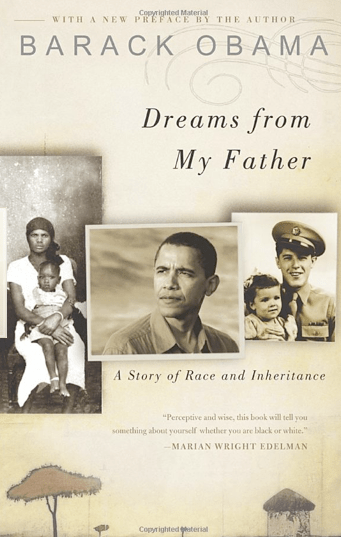
He is a gifted orator. He is a plodding writer. There is also a problem I find with autobiographies by anyone – we all fool ourselves, we all position ourselves in a better light, and we have no idea how transparent we are when we do so. Fellow bloggers, do you ever read anything you have written a couple years ago and squirm with embarrassment, or even delete? To be an author is a very very brave thing, when you have a book published, there is no going back, your transgressions are all right out there, and the public can be cruelly critical.
What I liked about the book is Obama-as-Third-Culture-Kid, a man of mixed identity. Most kids who have grown up moving or grown up in different countries from their own, or who have immigrated, can tell you, being an alien is no fun. Obama learns how to adapt, how to look for clues to fitting in, how to pass. It’s a common theme in Third-Culture-Kids.
My favorite part of the book was his return to Kenya, his openness to his African roots, the open-armed love with which his Kenyan half-brothers and sisters welcome him and his response. He had some truly extraordinary adventures, working out just who his father had been as a person. He was blessed to recognize the richness of his inheritance.
The book plods along, but it was worth the time. For all it’s flaws, I find I like that man, and I understand more about where he is coming from. (for grammarians, I understand more about from where the man is coming.) 🙂
Prickly Pear Becomes Cash Crop

The first time I ever saw these prickly pears was in Tunisia, where they were a by-product of huge prickly pear fences that kept roaming sheep, goats, even cattle out of the living areas. The prickly pear fences were everywhere. Some people made jam out of the fruit, but now, the fruit is bringing in big bucks to Moroccans.
To read the entire story, please click BBC News Africa
By Sylvia Smith
BBC News, Sbouya, Morocco
It is just after dawn in the hills above the Moroccan hamlet of Sbouya and a group of women are walking through the thousands of cactus plants dotted about on the hillside, picking ripe fruits whenever they spot the tell-tale red hue.
But these woman are not simply scraping a living out of the soil.
The cactus, previously eaten as a fruit or used for animal feed, is creating a minor economic miracle in the region thanks to new health and cosmetic products being extracted from the ubiquitous plant.
This prickly pocket of the semi-arid south of the country around the town of Sidi Ifni is known as Morocco’s cactus capital.
It is blessed with the right climate for the 45,000 hectares (111,000 acres) of land that is being used to produce prodigious numbers of succulent Barbary figs.
Every local family has its own plot and, with backing from the Ministry of Agriculture, the scheme to transform small scale production into a significant industry industry is under way.
Some 12m dirhams ($1.5m) have been pledged to build a state-of-the-art factory that will help local farmers process the ripe fruits.
The move is expected to help workers keep pace with the requirements of the French cosmetics industry which is using the cactus in increasing numbers of products.
Lucrative
Izana Marzouqi, a 55-year-old member of the Aknari cooperative, says people from the region grew up with the cactus and did not realise its true benefit.
“Demand for cactus products has grown and that it is because the plant is said to help with high blood pressure and cancer. The co-operative I belong to earns a lot of money selling oil from the seeds to make anti-ageing face cream.”
I know I have seen these growing in Kuwait – are they growing in Qatar, too?
$5000 From HSBC
As if the poor grammar and spelling weren’t enough to give this scammer away, the line “to reduce the economy meltdown posed on the continent in general” seems overly generous for a bank, especially a bank I don’t have an account with who is willing to give me 5K, LLLOOLLL.
All I have to do is send him my financial particulars – to South Africa? Right? No, no thank you!
HSBC Bank plc.
ATM Card Department
HSBC Tower, 8 Canada Square,
Canary Wharf area of East London UK.
The HSBC Bank with directive from the world bank to release
funds through the ATM VISA CARD to some beneficiaries in
view to reduce the economy meltdown posed on the Continent in
general.
The HSBC Bank London working in relationship with the World
Bank has concluded to issue you a VISA CARD with which you
can access your contract amount 5,000,000.00 USD. This card
center will send you an ATM card which you will use to withdraw
your money in any ATM machine in any part of the world, but the
maximum is FIVE Thousand Five Hundred United States
Dollars($5,500) per day. So if you like to receive your fund in this
way,please let us know by contacting the ATM payment department.
To file for your claim, please contact our ATM Dispatch personnel,
Contact Person: Mr. Dave Walker .
Email: ( hsbcatm_davewalker@yahoo.com.hk )
Tel: +44-703197-9789
and also send the following information as listed below:
1. Full name
2. Phone and fax number
3. Address were you want them to send the ATM card to (p.o box
not acceptable)
4. Age
5. occupation
6. Nationality
7. country of residence
However for the purpose of proper verification of your Identity,
and other relevant information and release of your HSBC Visa ATM
Card to yo.
NOTE: You are not to reply this sender, you are to reply directly to
hsbcatm_davewalker@yahoo.com.hk with all you information for claims.
It is important you contact the office of the Director,
Debit Card Dept for a special payment at the above listed address or
directly reply to this Email.
Sincerely,
PAUL BRIAN THUSTON
MANAGING DIRECTOR
(c) HSBC BANK 2009.
This message and attachments are subject to a disclaimer. Please refer
to http://www.it.up.ac.za/documentation/governance/disclaimer/ for full
details. / Hierdie boodskap en aanhangsels is aan ‘n vrywaringsklousule
onderhewig. Volledige besonderhede is by
http://www.it.up.ac.za/documentation/governance/disclaimer/ beskikbaar.
“Whip Me if You Dare” Sudan Woman Wears Pants
This woman doesn’t have to take the whipping – she was a UN employee, and could claim diplomatic immunity. She wears a headscarf, she wears modest clothing. She could have quietly escaped. But like Rosa Parks, the black woman in segregated America, who refused to give up her seat and move to the back of the bus, Lubna Hussein has chosen to take a stand, even take a whipping, rather than back down.
Do you think it is un-Islamic for women to wear pants?
‘Whip me if you dare’ says Lubna Hussein, Sudan’s defiant trouser woman
Lubna Hussein, the Sudanese woman who is daring Islamic judges to have her whipped for the “crime” of wearing trousers, has given a defiant interview to the Telegraph.

As the morality police crowded around her table in a Khartoum restaurant, leering at her to see what she was wearing, Lubna Hussein had no idea she was about to become the best-known woman in Sudan.
She had arrived at the Kawkab Elsharq Hall on a Friday night to book a cousin’s wedding party, and while she waited she watched an Egyptian singer and sipped a coke.
She left less than an hour later under arrest as a “trouser girl” – humiliated in front of hundreds of people, then beaten around the head in a police van before being hauled before a court to face a likely sentence of 40 lashes for the “sin” of not wearing traditional Islamic dress.
The officials who tried to humiliate her expected her to beg for mercy, as most of their victims do.
Instead she turned the tables on them – and in court on Tuesday Mrs Hussein will dare judges to have her flogged, as she makes a brave stand for women’s rights in one of Africa’s most conservative nations.
She has become an overnight heroine for thousands of women in Africa and the Middle East, who are flooding her inbox with supportive emails. To the men who feel threatened by her she is an enemy of public morals, to be denounced in the letters pages of newspapers and in mosques.
As she recounted her ordeal in Khartoum yesterday Mrs Hussein, a widow in her late thirties who works as a journalist and United Nations’ press officer, managed cheerfully to crack jokes – despite the real prospect that in a couple of days she will be flogged with a camel-hair whip in a public courtyard where anyone who chooses may watch the spectacle.
Her interview with The Sunday Telegraph was her first with a Western newspaper.
“Flogging is a terrible thing – very painful and a humiliation for the victim,” she said. “But I am not afraid of being flogged. I will not back down.
“I want to stand up for the rights of women, and now the eyes of the world are on this case I have a chance to draw attention to the plight of women in Sudan.”
She could easily have escaped punishment by simply claiming immunity as a UN worker, as she is entitled to under Sudanese law. Instead, she is resigning from the UN – to the confusion of judges who last Wednesday adjourned the case because they did not know what to do with her.
“When I was in court I felt like a revolutionary standing before the judges,” she said, her eyes blazing with pride. “I felt as if I was representing all the women of Sudan.”
Like many other women in the capital, Mrs Hussein fell foul of Sudan’s Public Order Police, hated groups of young puritans employed by the government to crack down on illegal drinkers of alcohol and women who, in their view, are insufficiently demure.
Despite their claims of moral superiority, they have a reputation for dishonesty and for demanding sexual favours from women they arrest.
Mrs Hussein was one of 14 women arrested at the Kawkab Elsharq Hall, a popular meeting place for the capital’s intellectuals and journalists, who bring their families. Most of them were detained for wearing trousers. The police had difficulty seeing what Mrs Hussein was wearing under her loose, flowing Sudanese clothes. She was wearing green trousers, not the jeans that she said she sometimes wears, and wore a headscarf, as usual.
“They were very rude,” she said. “A girl at a table near mine was told to stand up and told to take a few steps and then turn around, in a very humiliating way. She was let off when they ‘discovered’ she was not wearing trousers.”
After her arrest, on the way to a police station, she tried to calm the younger girls.
“All the girls were forced to crouch on the floor of the pick-up with all the policemen sitting on the sides,” she said. “They were all very terrified and crying hysterically, except me as I had been arrested before during university days by the security services.
“So I began to try to calm the girls, telling them this wasn’t very serious. The response of the policeman was to snatch my mobile phone, and he hit me hard on the head with his open hand.
“On the way I felt so humiliated and downtrodden. In my mind was the thought that we were only treated like this because we were females.”
Christian women visiting from the south of Sudan were among the 10 women who admitted their error and were summarily flogged with 10 lashes each. But Mrs Hussein declined to admit her guilt and insisted on her right to go before a judge.
While waiting for her first court appearance, she said she was surprised to find herself held in a single cramped detention cell with other prisoners of both sexes. “How Islamic is that?” she asked. “This should not happen under Sharia.”
Mrs Hussein is a long-standing critic of Sudan’s government, headed by President Omar al-Bashir, the first head of state to face an international arrest warrant for war crimes. Sudan has been accused of committing atrocities in the Darfur region.
Before her arrest she had written several articles criticising the regime, although she believes she was picked at random by the morality police.
The regime has often caused international revulsion for religious extremism. In 2007 British teacher Gillian Gibbons was briefly imprisoned for calling the classroom teddy bear Mohammed.
The government is dominated by Islamists, although only the northern part of the nation is Muslim. Young women are frequently harassed and arrested by the regime’s morality police.
Mrs Hussein said: “The acts of this regime have no connection with the real Islam, which would not allow the hitting of women for the clothes they are wearing and in fact would punish anyone who slanders a woman.
“These laws were made by this current regime which uses it to humiliate the people and especially women. These tyrants are here to distort the real image of Islam.”
She was released from custody after her first court appearance last week, since when she has appeared on Sudanese television and radio to argue her case – which has made headlines around the world.
She is not only in trouble with police and judges. A day after her court appearance she was threatened by a motorcyclist, who did not remove his helmet. He told her that she would end up like an Egyptian woman who was murdered in a notorious recent case.
Since then she has not slept at home, moving between the houses of relatives. She believes her mobile telephone has been listened to by the security services using scanners.
But she has pledged to keep up her fight. “I hope the situation of women improves in Sudan. Whatever happens I will continue to fight for women’s rights.”
Recent Comments
intlxpatr on Shampoo Ginger tigerbutterya0c5ff1d… on Shampoo Ginger intlxpatr on British Soldier Kidnapped, Esc… John on British Soldier Kidnapped, Esc… intlxpatr on British Soldier Kidnapped, Esc… Wikipedia Donate Button

Amazina


Early Voting in Florida


