Dharfur: The Janjaweed are Back
Lynsey Addario for The New York Times:
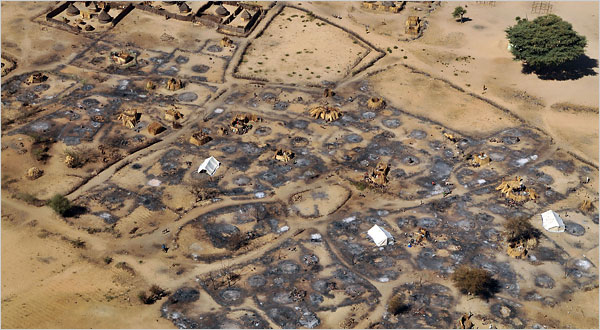
SULEIA, Sudan — The janjaweed are back.
They came to this dusty town in the Darfur region of Sudan on horses and camels on market day. Almost everybody was in the bustling square. At the first clatter of automatic gunfire, everyone ran.
The militiamen laid waste to the town — burning huts, pillaging shops, carrying off any loot they could find and shooting anyone who stood in their way, residents said. Asha Abdullah Abakar, wizened and twice widowed, described how she hid in a hut, praying it would not be set on fire.
“I have never been so afraid,” she said.
The attacks by the janjaweed, the fearsome Arab militias that came three weeks ago, accompanied by government bombers and followed by the Sudanese Army, were a return to the tactics that terrorized Darfur in the early, bloodiest stages of the conflict.
Such brutal, three-pronged attacks of this scale — involving close coordination of air power, army troops and Arab militias in areas where rebel troops have been — have rarely been seen in the past few years, when the violence became more episodic and fractured. But they resemble the kinds of campaigns that first captured the world’s attention and prompted the Bush administration to call the violence in Darfur genocide.
Aid workers, diplomats and analysts say the return of such attacks is an ominous sign that the fighting in Darfur, which has grown more complex and confusing as it has stretched on for five years, is entering a new and deadly phase — one in which the government is planning a scorched-earth campaign against the rebel groups fighting here as efforts to find a negotiated peace founder.
The government has carried out a series of coordinated attacks in recent weeks, using air power, ground forces and, according to witnesses and peacekeepers stationed in the area, the janjaweed, as their allied militias are known here. The offensives are aimed at retaking ground gained by a rebel group, the Justice and Equality Movement, which has been gathering strength and has close ties to the government of neighboring Chad.
Government officials say that their strikes have been carefully devised to hit the rebels, not civilians, and that Arab militias were not involved. They said they had been motivated to evict the rebels in part because the rebels were hijacking aid vehicles and preventing peacekeepers from patrolling the area, events that some aid workers and peacekeepers confirmed.
Please read the rest of the article HERE.
My husband and I have long supported an organization called Medecins Sans Frontiers / Doctors Without Borders. Wherever there is human misery, these brave doctors go and serve those suffering, and their life-saving work is performed under the worst possible conditions. They don’t look at politics. They look at human suffering, and do their best to alleviate it, or to do what they can. These heroic doctors are serving in Dharfur – while they can. When Medicins Sans Frontiers have to pull out, you know that the situation is as bad as it can be.
The accept donations from anyone, anywhere. Be generous.
Aidan Hartley’s Zanzibar Chest
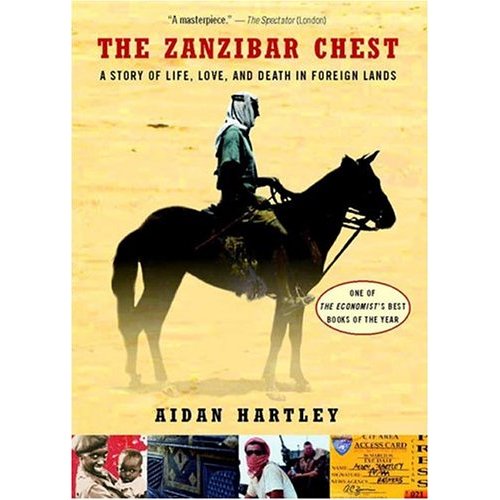
I started Zanzibar Chest in December, and could not get into it. It was interesting, but at first the tone was . . . I don’t know, maybe pompous? Something in the tone put me off, and yet I didn’t put it back on the bookshelves, nor did I give it away. It sat on my bed table while I attacked lesser works, more enjoyable fare. Then, one day, I just knew it was time to try it again, and this time, I could hardly put it down.
Born in Kenya, just before the rebellion, Aidan Hartley spent his life mostly in Africa. He skillfully interweaves three main story lines – the life of his mother and father, the life of his father’s best friend and his own life as a news correspondent.
This is not a joyful book. It is not inspirational. It is a tough, hard look at the people who cover the news, and the toll it takes on their lives. It is a story of drugs and alcohol to numb the pain of what they are observing, the comraderie of gallows humor and surviving the intensity of living through life-threatening moments together.
He covers some truly awful events. He covers the wars in Somalia, and in Rwanda. He covers Kosovo and Serbia. He is sent into some of the most dangerous and awful of places. He pays the price.
In his Zanzibar Chest, he takes us with him.
I will share a couple quotes with you, and if you are sensitive, please stop reading now. This book is not for you. It is almost not for me, except that sometimes I think we need to come face to face with just how awful reality can be to put our own lives right, to set appropriate priorities.
“I can’t put my finger on exactly how death smells. The stench of human putrefecation is different from that of all other animals. It moves us as instinctively as the cry of a newly born baby. It lies at one extreme end of the olfactory register. Blood from the injured and the dying smells coppery. After a cadaver’s a day old, you smell it before you see it. From the odor alone, I could tell how long a body had been dead and even, depending on whether brains or bowels had been opened up, where it had been hacked or shot. A body would quickly balloon up in the tropical heat, eyes and tongue swelling, flesh straining against clothes until the skin bursts and fluids spill from lesions. Flies would get in there and within three days the corpse might stink. It became a yellow mass of pupae cascading out of all orifices and the flesh literally undulated beneath the clothes. The tough bits of skin on the palms of their hands and the soles of their feet were the parts of the body that always rotted away last. As living people, these had been peasants who had walked without shoes and worked hard in the fields. A man who had been dead seven days reeks of boiling beans, guava fruit, glue, blown handkerchiefs, cloves and vinegar. After that he starts to dry out into a skeleton until he’s almost inoffensive . . .
The dead accompanied me long after Rwanda. It was months before I could order a plate of red meat served up in a restaurant. I smelled putrefaction in my mouth, or in my dirty socks, or as sweat on my body. I imagined what people I met would look like when dead. . . “
These guys all suffer from Post traumatic stress syndrome, they deaden themselves with drug and alcohol, and they are totally addicted to the adrenalin rush their job gives them. Living on adrenalin takes a huge toll – on their health, on their mental health, on their relationships, on their belief in goodness. They are the witnesses to the enormity of man’s inhumanity against one another.
In another quote, the author tells us:
“It was impossible for latecomers to comprehend the evil committed here but the British military top brass were still so scared of what their soldiers might see and what it would do to their minds that they sent a psychiatrist to accompany the forces to Rwanda. Bald Sam and I were amazed at that. We laughed about it. A shrink! It seemed extravagant. But the truth is that we stuck close to that man for days. We said it was all for a story, but really it was about us. The psychiatrist, whose name was Ian, told us his special area of interest was the minds of war correspondents. I could see Bald Sam squirming with happiness at all the attention, and I felt quite flattered myself. . . .
. . . for years I did endure some sort of payback. I have to try every day to prevent the poison that sits in my mind to spread outward and hurt the people I love. Sometimes I can’t stop it and I wonder if in some way the corruption will be passed on from me to my children.”
Toward the end of the book, the author tells us how hard it is to give up this adrenalin-news-junky life:
“Whenever I see a news headline to this day I half feel I should board the next flight into the heart of it. I’d love to get all charged up again and I could write the story with my eyes closed. I’m sure the sense that I’m missing out while others get in on a great story will never completely pass. . . The sight of people committing acts of unspeakable brutality against others fills a hole in some of us. The activity is made respectable by being paid a salary to do it, but there is a cost.”
This is not a book I really wanted to read, but it is a book I will never forget. Hartley doesn’t spare himself in the telling of this tale. He takes us with us and shows us all of it, and all of his own warts along with the tale. Would I recommend this book? Not for the sensitive, not for those who don’t want to look at the dark side. Between idyllic sequences on the beaches near Mombasa, in the hills of Kenya and Tanzania, in the dusty deserts of Yemen, there are some very intense and bloody moments. This is non-fiction, it is a documentary, it is a slice of the real life one man has seen, and that to which he has been witness. Read the book, and like him, you pay a price. You carry images in your head that you can’t forget, and a sorrow for our inability to solve our differences peaceably.
(Available in paperback from Amazon.com for $10.88. Disclosure: Yes, I own stock in Amazon.com.)
African Textiles at KTAA
If color, texture and weave are your kind of thing, there is a wonderful group in Kuwait for you. Before I even came to Kuwait, people told me about the Kuwait Textile Arts Association, and oh, what a trip.
A friend asked me if I were going to this month’s meeting. I hadn’t seen any announcements for it, and then she said “you ought to come! It’s African textiles.”
Magic words.
You know AdventureMan and I love going to Africa. And a meeting on African textiles? Woooo Hooooooo! Yes, I will admit it, I am totally a textile geek.
Africa is a huge subject to cover, when it comes to textiles, and the speaker did well – Nigeria, Tunisia, Cameroon, Mali, indigo dying, small loom weaving. . . You could teach an entire college level course on any one of those topics, and he gave a great overview.
You can join KTAA for 10KD per year, or you can attend each meeting for 2KD. Meetings are held once a month at the Sadu House, where they also have a fabulous collection of books on textiles.


The Door Into Summer
We had a cat, a street cat from Tunisia, named Cinnamon. I had taken our son to see a movie and when I got home, my husband looked funny. You know, a wife can tell. I said “what’s up?” and he gave me those big innocent Bambi eyes that tell you for SURE something is fishy, and he said “Nothing!”
Just then, we could hear loud loud miowing at the back door, the kind only a kitten can make, the kind that attracts attention. We went to the back door and there was this tiny little kitten, barely old enough to be away from her family, and she is stuck between the screen door and the back door.
“How very strange!” I said, looking accusingly at AdventureMan, who continued to try to look innocent.
“She looks cold!” he said. “Maybe we had better bring her in!”
Later he confessed, he has found her wandering around alone, wet and miowing in our backyard and had been feeding her while we were at the movie, then put her in the back door so we could “discover” her. He wanted to keep her. We already had one big cat, but we had wanted another, and here she was.
She was my Door into Summer cat. She still had all her wild instincts, even though we adopted her at such a young age. Once, in Germany, I found a dead hare on my steps, with it’s throat torn out, an offering from Cinnamon – but the hare was at least twice her size! She was always bringing us offerings of a dead nature; she was a born huntress. One time when AdventureMan got out of bed, he stepped on what he thought was a rolled up sock, but it moved! It was a badly wounded mouse!
Cinnamon hated winter. We lived in a house with a lot of doors, and when it would snow, she would go from door to door, asking us to open so she could go out. When the bitter cold with the biting wind would hit her face, she would back into the house and head for the next door – always looking for the door she remembered, the one which led out into summer.

moar funny pictures
I used to read a lot of Robert Heinlein. His books are SO politically incorrect, so sexist, he was an old engineer, but man, could he write. His writing takes you WAAAYYY out of the here and now, and makes you stretch to think in new ways.
He wrote a book called Door into Summer, in which he wrote about another cat:
“…While still a kitten, all fluff and buzzes, Pete had worked out a simple philosophy. I was in charge of quarters, rations, and weather; he was in charge of everything else. But he held me especially responsible for weather. Connecticut winters are good only for Christmas cards; regularly that winter Pete would check his own door, refuse to go out it because of that unpleasant white stuff beyond it (he was no fool), then badger me to open a people door. He had a fixed conviction that at least one of them must lead into summer weather.”
The Door into Summer – Robert A. Heinlein
You can read about Robert Heinlein on Wikipedia and you can find many of his books still in publication on amazon.com.
The Great Migration (3)
Our trip started at the Grumeti River Camp and continued on the the Serengeti Tent Camps. We have filled our eyes and ears with the sights and sounds of the Great Migration, and have had the thrills of elephants, giraffes, lions, hyenas, alligators and vultures in addition. Now it is time to head north, to the Klein’s Wilderness Camp, located near Klein’s Wilderness Lodge.
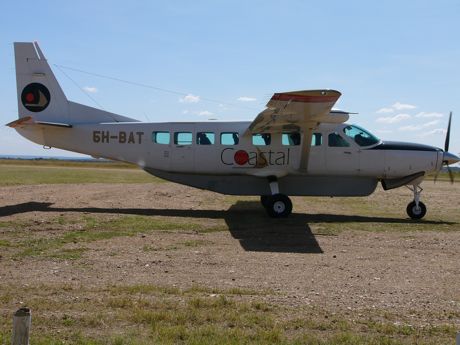
The “airport” at Serengeti, from where we are flying, is a busy little place with one open-to-the-air little cafe and a toilet down a path with two stalls. It’s the bring-your-own paper kind of place, but it’s nice there is that convenience. The landing strip itself is just a cleared piece of ground where the little two engine planes land and take off.

Our flight is larger than most we have taken, maybe 20-something people, most on the way home or to Zanzibar. First, they are dropping us off at Kleins, a short flight away. The landing field at Klein’s has a little antelope running across it when we get there, so the pilot circles and lands on the lush green landing strip. There is no one there. We wait, it is inevitable that a car come roaring around the curve any moment now, but no car comes. The pilot comes on the microphone and asks who the passengers are for Klein’s, and we raise our hands.
“I can’t leave you here,” he says.
We totally understand. There are lions around. This is a wild country.
“I have to take you to Arusha with us,” he says, “and I will bring you back on the next flight.”
I am not entirely unhappy. In the tiny little airport in Arusha, I found a vendor who is selling Masai textiles and raw gems at very good prices. He is Moslem, and astounded that I speak some Arabic. When I come back to his shop, he is delighted to see me again. (or maybe I paid too much the first time, ya think?)
I pick up a few more momentos, and head back for the airline departure desk, where there is a very loud argument going on over the telephone about who is to blame about our not being picked up at Klein’s Wilderness Camp. The Camp says the airlines never told them. The airlines say they did. It’s on our itinerary, which we have had for months, and we landed exactly when they said we would, but in Africa, you have to stay flexible, flight schedules change depending on where customers need to be dropped off. It doesn’t pay to get angry or aggressive, you learn to just go with the flow. Things will work out.
A short time later, the pilot takes us to the plane for the flight back, and whoa! We fly right over an active volcano!

This time, when we get to Klein’s, a car is waiting and the arguement between Klein’s and the airlines continues. On the way to Klein’s, we are told that they were never told when we would be arriving.
Don’t you hate it when people refuse to take any responsibility? The airlines treated us so well, the pilot said he didn’t think it was their fault but he went out of his way to make sure we felt well taken care of. This is the only time at CCAfrica that we felt the camp was not well managed, and part of that feeling came from this continual message of “it’s not our fault.” We later learned that the previous camp manager had just been fired and a new manager was starting, and there was a lot of work going on to try to get the camp back on track.
This was another beautiful location, we were high up and could see forever.
Sometimes, in the mornings, or in the late afternoon, the migrating antelope came through the camp. We could sit outside and just watch them file past.
Most of our days in this camp, we would leave early in the morning, have lunch with us so we would stop somewhere in the park, and not get back until late at night. These are the vehicles we travelled in, stopped for a break
 :
:
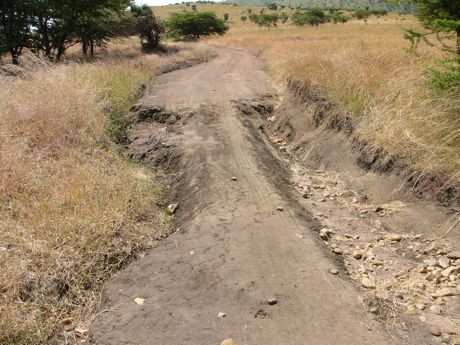
Some of the roads were barely there, were pitted, or rutted, or were raw rock:
We spent hours watching the zebra herds, and the shy antelope:
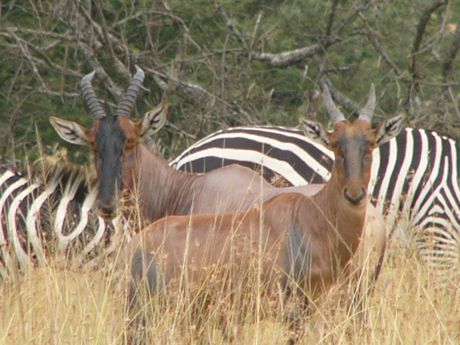
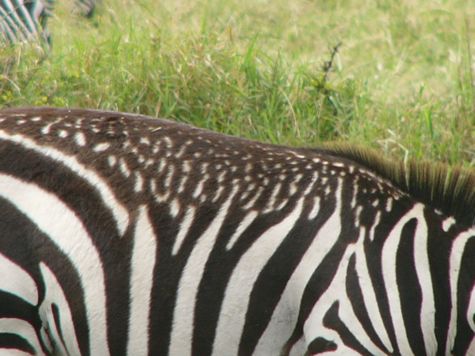
“How can you spend hours watching zebra?” you might ask. Every zebra is different. It’s particularly fun watching female zebra with their young. When they are born, the momma zebra insures that her little baby zebra sees only her coat for the first important hours of it’s life, so that the baby can recognize the momma zebra’s own unique markings:
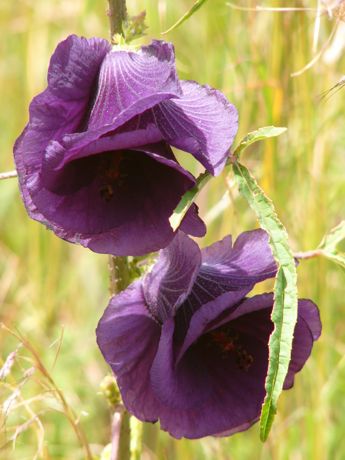
But there were other thrills as well. The nice thing about travelling in a very small group (most of the time just AdventureMan and I and the guide) was that you can ask them to stop while you photograph a beautiful purple flower:
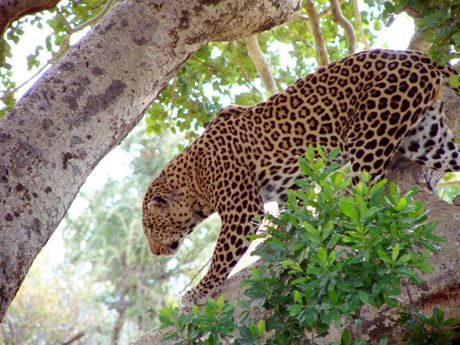
And if you see a leopard, you can just sit and watch him as long as you like:
We rarely ran into others from the camps, but this Masai was accompanying another group:

Among the thrills in this more northern camp were also the glorious birds. This is one of our favorites, a Lilac Breasted Roller:
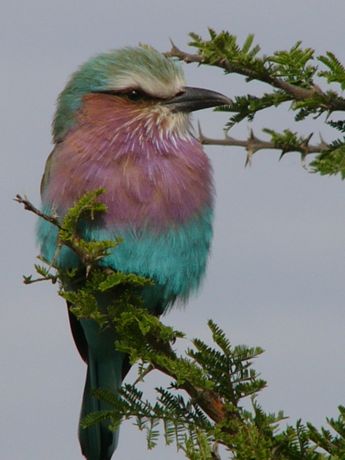
I’m not sure what this bird is, probably a common starling. His fluorescent coloring attracted my eye. AdventureMan says that the fluorescent coloring happens a lot in birds which eat excrement, but he is not sure that is true, just what he thinks he remembers:

We love travelling with CCAfrica. They specialize in eco-tourism, like the Robin Pope Safari Camps we travel with in Zambia. Our all time favorite safari with them was The Hemingway, a 14 day safari through Botswana, starting in Zimbabwe at Victoria Falls, heading south to Chobe and Moremi, Savute, the Okavango and then flying into the Kalahari. It was an all-time thrill. If January is a little slow for you and you want to read about the Hemingway Safari you can click on that blue type and it will take you to the first entry – of thirteen! I wrote it up back when I was first blogging, sort of as a discipline for myself to get it all down in writing. There aren’t a lot of photos – I wasn’t digital then – but it is a very thorough description of a trip-of-a-lifetime safari.
Even though they don’t seem to offer this particular safari anymore, CCAfrica will tailor any safari you want to your specifications. What we loved about the Hemingway was that so much of it was under canvas, so we would be sleeping right out among the animals – and listening all night.
A warning – none of these safaris are for people who HATE getting up early. The game is active in early early morning and late afternoon, so most camps get you up at 5:30 – 6:00 so you can grab a quick cup of coffee and bite to eat and then run for the jeeps/vehicles that will take you out to see the game. It can be very cold on an early morning game run, but oh – the thrills! It is SO worth it! You come back late morning, have your mid-day meal, which in these camps is always amazing, and then you have quiet time in the heat of the afternoon, when you can catch up on those zzZZZZZZZzzzzz’s you missed out on in the early morning. You wake up refreshed, ready for afternoon tea and your afternoon/evening game drive. They feed you and feed you – but we never gain weight on these trips, maybe because you are rocking around over the rough roads all day.
And, when the trip is over, and you are ready for a few days of sloth and luxury before you return to the real world, there is no better spot for transitioning than the CCAfrica private island hideaway of Mnemba, a place we dream about on a cloudy dark day in Kuwait:

That is Mnemba island in the background, viewed from the beach in Zanzibar. You take a boat to get there, and when you land, you land barefoot. You never put your shoes on the entire time you are there. It is beautiful, secluded, luxurious and infinitely private. You can have all your meals in your own banda, if you wish. They have their own marine reserve, a dive shop, snorkeling equipment and it is all included. They even have internet. 🙂
View from our Mnemba banda:

The Great Migration (2)
After two wonderful days in Grumeti River Lodge we transfer to the CCAfrica’s Serengeti Under Canvas Program, with the first camp being a short drive from the Grumeti River Lodge.
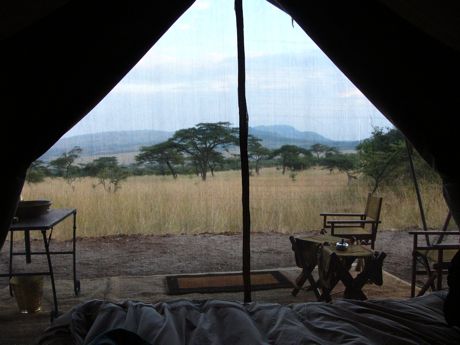
We LOVE tent camping. We used to camp out of a Volkswagon bus across the US with a baby and a cat (now that was an adventure!), in Tunisia, in Jordan. Now, I still love camping, and I particularly love it CCAfrica style – maximum 8 tents to a camp, a huge bed with good linens, an indoor shower and toilet, brass water containers, all very Hemingway in feeling. I love having coffee brought to the tent early in the morning, and I love the quiet shuuussshhhing of the wind through the high African grasses. We have our own dining tent to the side of our tent, which is high on the ridge, or we can choose to eat with the others.
Here is a view looking out from our tent across the Serengeti Plains:
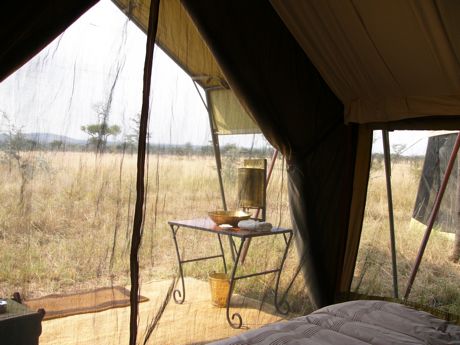
There is one little fly in the ointment – to get in and out of this camp, we drive our open vehicles through an area infested with tsetse flies. I am terribly, horribly allergic to mosquitos and to tsetse flies, and of course they find me irresistible. I am totally wrapped up in local large cotton wraps called kikoy – I look like a very colorful bedu woman, all covered except for my eyes.
But it’s worth it. I take tubes of Benedryl2 with me and lather it on morning and night to keep the size of the bites down.
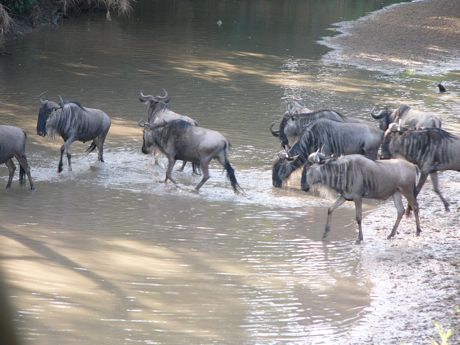
First trip out of the game camps we find gnus at a water crossing. No hungry alligators, but it’s wonderful getting to watch them crossing:
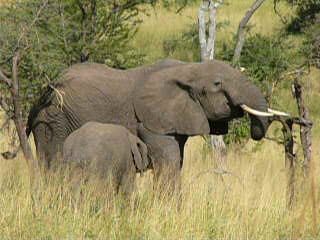
There are only four of us in the Rover, so we can spend all the time we need watching the elephants. It’s always a delight to find a mother with a baby. The elephants are so sweet with the babies:
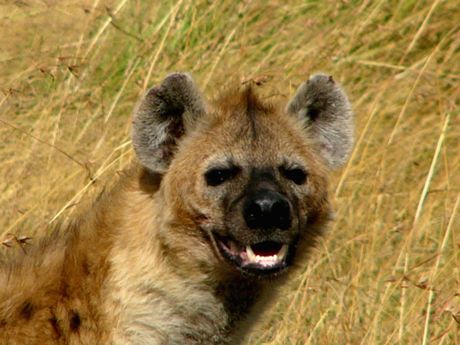
Early one morning, we catch a group of hyena:
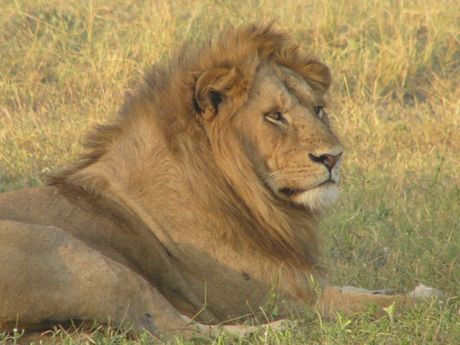
Even better, as sundown nears, we find a pride of lions, catching the last rays of the day and preparing to hunt:
I have one of the early Lumix models, an FZ10. It takes beautiful photos, even under very low-light conditions. It is small, lightweight, fairly fast, shoots movies as well as stills, captures audio, and oh – did I mention small and lightweight? It has the equivalent of a 420mm lens, in a small body. It is an amazing camera and gets amazing shots.
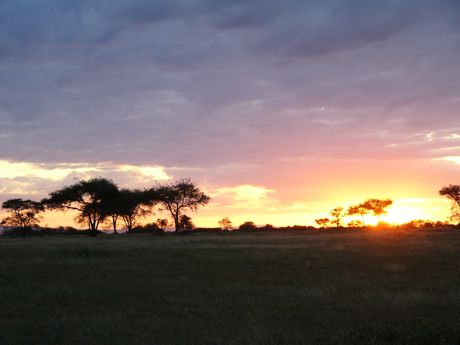
Sundown has it’s own rituals, with a stop every night for refreshments and a toast to the setting sun:
We spend two nights at the Grumeti River Camp, following the herds, photographing as they drink, as they trek, but in truth, you simply can’t imagine the scale of The Great Migration unless you see it for yourself. At one point, we sat in the center of a road as thousands of gnu and zebra filed past.
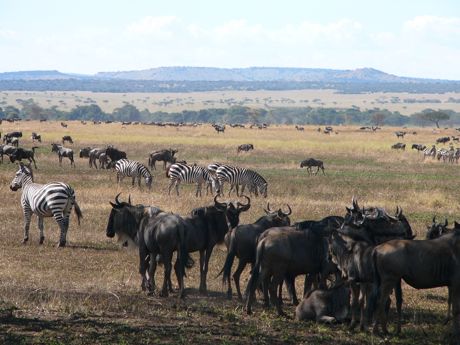
We sat for an hour, shooting stills and shooting movies, and when we left, the line just kept going. We were surrounded. Sometimes it would thin a little, and sometimes the gnu would start to gallop and they would all start to gallop and the sounds of their hooves would thunder on the ground.
Other times, we would be sitting, and we would hear the sound of the gnu just shhhhussshhh, shhuusssss, shuussshhhhhh, interspersed with the occasional “hungh? hungh? hungh?”
Watching the zebras drinking, all would be quiet and then all of a sudden one would twitch or panic or something, and then you would hear loud “SWWWOOOOOOOSSSHHHing” noises as they rushed out of the water. We loved the vastness of the Migration, the enormity of it, the huge, grand overwhelming scale of it all, but for me, it was these sounds that have stuck in my memory.
AdventureMan and I find these experiences nourish our souls. We feel close to God in the African wild. We love the sights, and the smells and the sounds. We love meeting the African people. When we get back, we can still sniff the smell of wood-burning campfires lingering in our clothing.
Next, we head for Klein’s Wilderness Camp.
The Great Migration (1)
Every year, thousands and thousands of animals roam the African plains, following the water. Huge herds of zebra, gnu, and antelopes make a grand tour, mindless of international borders. “Wouldn’t that be a sight to see?” Adventure Man and I asked each other, and decided “Yes!”
One of our favorite outfitters, CCAfricxa (for Conservation Corps Africa) offers special tented camps following the great migration, and we really enjoy travelling with them, so we book into several of the camps, and at the end, book ourselves into another of our favorite places, the CCAfrica lodge on Mnemba Island with more photos of Mnemba and Zanzibar here.
We overnighted in Arusha, then flew out of Arusha International Airport to Grumeti lodge. This is what Arusha International Airport looks like:
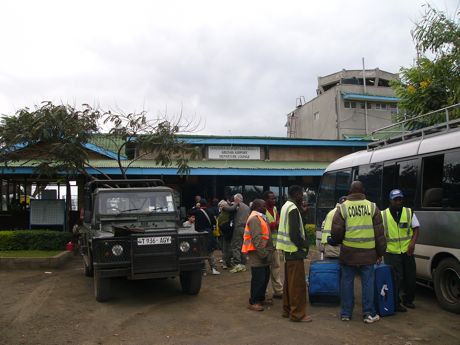
This is where you look up your flight going out:

The trip was off to a great start when we got to Grumeti Camp. The colors of Grumeti are red and purple; we go to our cabin to clean up and then we have lunch outside, down near a bog full of hippos, who grunt from time to time. This is our bed in the Grumeti Lodge:

Two days at Grumeti, and oh what fun from the very beginning. We see huge herds of Gnu. Here is what a Gnu sounds like:
Gnu: Hunnh? Hunnh? Hunnh? Hunnh?
It never varies.
Gnu: Hunnh? Hunnh? Hunnh? Hunnh? Hunnh?
Here is what a gnu looks like:

There are thousands of them. They know where they are going, and sometimes they go single file and sometimes they go in great bunches. We did get to see gnu (plural) crossing a stream, but the alligator wasn’t anywhere near and I think he had recently eaten:

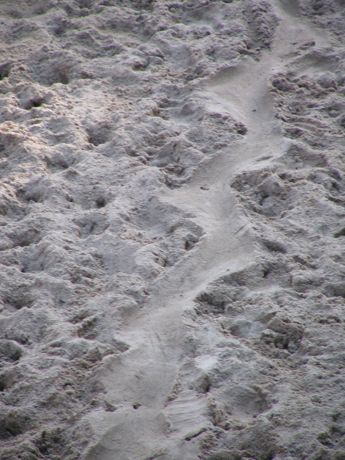
Here is something very cool. This is what the alligator’s trail looks like:
The Great Migration also includes huge herds of zebra, and the males are constantly trying to keep the females from roaming off. So zebras will all be quietly munching grass and then one male will go heee-hawing around trying to keep other young virile zebras from making off with his females until one day he gets too old and the younger zebras can steal his women, errr, zebra-females.
Thousands of zebra everywhere. . . these ones are drinking while not 100 feet away, a lion is resting. He looks like he has feasted recently, and is not too interested in the remaining thirsty zebra – not right now, anyway.


Next chapter: We go to the CCAfrica tented camps to follow the great migration.
Bloggers Changing the Face of News in the Middle East
“So are the “new media” – blogs, websites, chatrooms – now becoming the only truly independent media in the Arab world?”
This article is from today’s BBC News in Depth:
New media dodge Mid-East censors
By Robin Lustig
BBC radio presenter
It’s never easy writing about media freedom.
Even in countries where there is no official censorship, all reporters know there will always be some restraints on what they can say – editors need to be persuaded, owners need to be kept happy, the law has to be obeyed.
Where there is official censorship – where, for example, it is a crime to “bring the government into disrepute” or to publish material which “insults the dignity of the head of state” – the problems are all the greater.
No freedom is absolute, yet some media are a great deal freer than others.
In the Arab world, in general, the media have been heavily politicised.
Governments have tended to control the main media outlets – the main daily newspaper, the main TV and radio networks – and where independent media have been allowed, they have often been owned by opposition parties or by businesspeople with clear links to political organisations. (The establishment of the Qatar-based al-Jazeera TV news station was a rare special case.)
But then, one day, along came the internet. And it was as if someone had blown open a few million doors.
Egyptian successes
Now, everyone can write – weblogs, or blogs, were born, giving everyone with access to the internet exactly the same opportunity to write and publish as the most powerful media tycoon.
You can read the rest of this article by clicking here, on BBC News.
Dharfur: Cat in Charge of Protecting the Mice
Today on an interview on BBC, I heard the UN Secretary General saying that the man appointed to be the Minister for Humanitarian Affairs had been responsible for co-ordinating and authorizing many of the Janjaweed attacks on Dharful villages. It’s the kind of thing that is so stunningly outrageous that sometimes I can barely wrap my mind around it.
I found an article on BBC News: Africa in which it says the following:
ICC prosecutor Luis Moreno-Ocampo said he had strong evidence that the Sudanese Minister for Humanitarian Affairs Ahmad Harun and the leader of the pro-government Janjaweed militia, Ali Kuchayb, were involved in attacks on civilians in Darfur.
The leadership of the Sudan pretends to be co-operating, pretends to be looking for solutions and working with the United Nations, and does exactly what it pleases, which is to work toward accomplishing the extermination of the people of Dharfur.
Wind Up Lights for African Homes
My husband gave me a wind-up flashlight (British English = torch) and I love it. In movies like The Blair Witch Project or crime movies, the flickering and dying of a flashlight always foretells something really really bad is about to hapen. I love it that I have a flashlight I can keep winding up.
In our national legends, we have Abraham Lincoln doing his schoolwork on the back of a shovel, next to a flickering fire. That must have taken real dedication. Imagine what your own life would be like if we had no light after sundown. . .
From BBC News AFRICA:
The technology behind the wind-up radio could soon be helping to light up some of the poorest homes in Africa.
The Freeplay Foundation is developing prototypes of a charging station for house lights it hopes will improve the quality of life for many Africans.
The Foundation said the lights would replace the expensive, polluting and unhealthy alternatives many Africans currently use to light their homes.
Field testing of the prototypes will start in Kenya in the next few months.
Light and life
Kristine Pearson, director of the Freeplay Foundation, said few Africans in the continents most vulnerable areas had access to electricity to light homes.
“Their life stops or is very narrowed when the sun goes down,” she said. “Two extra hours of light would make a big difference to their life.”
You can read the rest of this article about developing this technology for Africa HERE
Recent Comments
ExpatAlien on What Country am I Living … intlxpatr on Yellowstone: Old Faithful to C… Michelle on Yellowstone: Old Faithful to C… Cathy on No Grown-Ups in Charge intlxpatr on Waiting for Snow Wikipedia Donate Button

Amazina


Early Voting in Florida


 Here There and Everywhere