The Great Migration (1)
Every year, thousands and thousands of animals roam the African plains, following the water. Huge herds of zebra, gnu, and antelopes make a grand tour, mindless of international borders. “Wouldn’t that be a sight to see?” Adventure Man and I asked each other, and decided “Yes!”
One of our favorite outfitters, CCAfricxa (for Conservation Corps Africa) offers special tented camps following the great migration, and we really enjoy travelling with them, so we book into several of the camps, and at the end, book ourselves into another of our favorite places, the CCAfrica lodge on Mnemba Island with more photos of Mnemba and Zanzibar here.
We overnighted in Arusha, then flew out of Arusha International Airport to Grumeti lodge. This is what Arusha International Airport looks like:
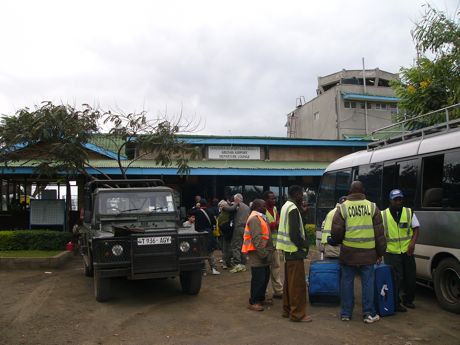
This is where you look up your flight going out:

The trip was off to a great start when we got to Grumeti Camp. The colors of Grumeti are red and purple; we go to our cabin to clean up and then we have lunch outside, down near a bog full of hippos, who grunt from time to time. This is our bed in the Grumeti Lodge:

Two days at Grumeti, and oh what fun from the very beginning. We see huge herds of Gnu. Here is what a Gnu sounds like:
Gnu: Hunnh? Hunnh? Hunnh? Hunnh?
It never varies.
Gnu: Hunnh? Hunnh? Hunnh? Hunnh? Hunnh?
Here is what a gnu looks like:

There are thousands of them. They know where they are going, and sometimes they go single file and sometimes they go in great bunches. We did get to see gnu (plural) crossing a stream, but the alligator wasn’t anywhere near and I think he had recently eaten:

Here is something very cool. This is what the alligator’s trail looks like:
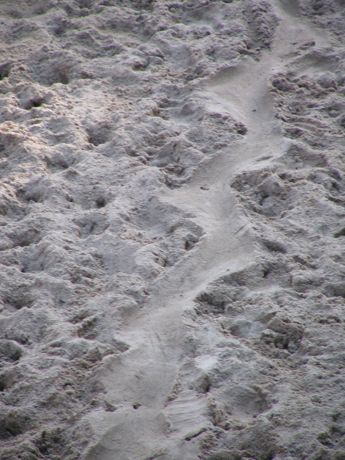
The Great Migration also includes huge herds of zebra, and the males are constantly trying to keep the females from roaming off. So zebras will all be quietly munching grass and then one male will go heee-hawing around trying to keep other young virile zebras from making off with his females until one day he gets too old and the younger zebras can steal his women, errr, zebra-females.
Thousands of zebra everywhere. . . these ones are drinking while not 100 feet away, a lion is resting. He looks like he has feasted recently, and is not too interested in the remaining thirsty zebra – not right now, anyway.


Next chapter: We go to the CCAfrica tented camps to follow the great migration.
Bloggers Changing the Face of News in the Middle East
“So are the “new media” – blogs, websites, chatrooms – now becoming the only truly independent media in the Arab world?”
This article is from today’s BBC News in Depth:
New media dodge Mid-East censors
By Robin Lustig
BBC radio presenter
It’s never easy writing about media freedom.
Even in countries where there is no official censorship, all reporters know there will always be some restraints on what they can say – editors need to be persuaded, owners need to be kept happy, the law has to be obeyed.
Where there is official censorship – where, for example, it is a crime to “bring the government into disrepute” or to publish material which “insults the dignity of the head of state” – the problems are all the greater.
No freedom is absolute, yet some media are a great deal freer than others.
In the Arab world, in general, the media have been heavily politicised.
Governments have tended to control the main media outlets – the main daily newspaper, the main TV and radio networks – and where independent media have been allowed, they have often been owned by opposition parties or by businesspeople with clear links to political organisations. (The establishment of the Qatar-based al-Jazeera TV news station was a rare special case.)
But then, one day, along came the internet. And it was as if someone had blown open a few million doors.
Egyptian successes
Now, everyone can write – weblogs, or blogs, were born, giving everyone with access to the internet exactly the same opportunity to write and publish as the most powerful media tycoon.
You can read the rest of this article by clicking here, on BBC News.
Dharfur: Cat in Charge of Protecting the Mice
Today on an interview on BBC, I heard the UN Secretary General saying that the man appointed to be the Minister for Humanitarian Affairs had been responsible for co-ordinating and authorizing many of the Janjaweed attacks on Dharful villages. It’s the kind of thing that is so stunningly outrageous that sometimes I can barely wrap my mind around it.
I found an article on BBC News: Africa in which it says the following:
ICC prosecutor Luis Moreno-Ocampo said he had strong evidence that the Sudanese Minister for Humanitarian Affairs Ahmad Harun and the leader of the pro-government Janjaweed militia, Ali Kuchayb, were involved in attacks on civilians in Darfur.
The leadership of the Sudan pretends to be co-operating, pretends to be looking for solutions and working with the United Nations, and does exactly what it pleases, which is to work toward accomplishing the extermination of the people of Dharfur.
Wind Up Lights for African Homes
My husband gave me a wind-up flashlight (British English = torch) and I love it. In movies like The Blair Witch Project or crime movies, the flickering and dying of a flashlight always foretells something really really bad is about to hapen. I love it that I have a flashlight I can keep winding up.
In our national legends, we have Abraham Lincoln doing his schoolwork on the back of a shovel, next to a flickering fire. That must have taken real dedication. Imagine what your own life would be like if we had no light after sundown. . .
From BBC News AFRICA:
The technology behind the wind-up radio could soon be helping to light up some of the poorest homes in Africa.
The Freeplay Foundation is developing prototypes of a charging station for house lights it hopes will improve the quality of life for many Africans.
The Foundation said the lights would replace the expensive, polluting and unhealthy alternatives many Africans currently use to light their homes.
Field testing of the prototypes will start in Kenya in the next few months.
Light and life
Kristine Pearson, director of the Freeplay Foundation, said few Africans in the continents most vulnerable areas had access to electricity to light homes.
“Their life stops or is very narrowed when the sun goes down,” she said. “Two extra hours of light would make a big difference to their life.”
You can read the rest of this article about developing this technology for Africa HERE
Old Fashioned Gingerbread
Sure, you can buy a packaged mix, and your gingerbread is just OK and has all those processed ingredients and preservatives. Or, you can make it yourself – it is easy, a lot of fun, and the results are SO much better than packaged. Gingerbread is especially good with French vanilla ice cream on top, or Creme Chantilly. Original gingerbread recipe came from Africa!
Old Fashioned Gingerbread
This is fun to make with children, because of the chemical reaction when you add the molasses, water and soda. It also tastes delicious!
3 cups all purpose flour
4 teaspoons freshly grated ginger
2 teaspoons cinnamon
1/4 teaspoon ground clove
2 sticks (1 cup) butter
1 cup dark brown sugar, packed in tight
1 cup blackstrap molasses
1 cup boiling water
2 teaspoons baking soda
2 large eggs
Preheat oven to 350 degrees and butter a 9 x 13 pan.
Sift together flour, cinnamon and cloves, add ginger and mix all together.
Cream butter and brown sugar in a separate bowl.
Stir molasses and boiling water in a large bowl, add in baking soda (this is the fun part, and the mixture gets all fizzy!)
Add flour and molasses mixture to butter mixture, mixing until all is smooth, then add eggs, and continue beating.
Pour batter into pan and cook 55 – 65 minutes – the smell will drive you crazy, it smells so good when it starts cooking.
Cool on a rack 10 minutes, then cut gingerbread while still soft.
Serve with whipped cream and a glass of milk. Yummmm.
African Leadership Prize to Chissano
This is from BBC News: Africa and you can read the entire article by clicking on the blue type BBC News.
Former Mozambique President Joaquim Chissano has won the first Mo Ibrahim prize rewarding a retired African head of state for excellence in leadership.
Mr Chissano, who is credited with bringing peace to Mozambique, had been seen as a frontrunner for the prize.

The prize, announced by former UN head Kofi Annan, is worth $5m (£2.5m) over 10 years, and then $200,000 a year.
Mobile phone millionaire Mo Ibrahim is funding the project in the hope it will help improve governments’ performance.
The Sudanese businessman also hopes it will increase Africa’s self-sufficiency and bring a day when the continent’s people no longer need to live on aid.
His decision not to seek a third presidential term reinforced Mozambique’s democratic maturity
Kofi Annan on Joaquim Chissano
Mr Annan chaired the panel that awarded the prize, billed as the largest of its kind.
Mr Annan praised Mr Chissano for “his most outstanding contribution” to peace and democracy.
“This remarkable reconciliation between opponents provides a shining example to the rest of the world and is testament to both his strength of character and his leadership,” Mr Annan said.
Wider role
After winning independence from Portugal in 1975 Mozambique suffered a civil war that lasted until 1992. Mr Chissano was president from 1986 to 2005. He also served as chairman of the African Union in 2003 and 2004, and has worked as a UN envoy.
Mr Annan praised Mr Chissano’s role at home and more widely in Africa.
“His decision not to seek a third presidential term reinforced Mozambique’s democratic maturity and demonstrated that institutions and the democratic process were more important than personalities,” he said.
“He was a powerful voice for Africa on the international stage and played an important role in pushing debt relief up the agenda.”
Mr Chissano is something as a rarity in Africa as a leader who has left office with his reputation intact, says BBC southern Africa correspondent Peter Biles.
My comment: I love a prize that says “I caught you doing something good.” Mr. Chissano had no idea, when he was leading Mozambique, or when he chose to step down from power, that he would be competing for this prize. He led as he led, and he stepped down from power (imagine!) because he thought it was the best thing for his nation.
Some people has scoffed, called it a patronizing award. As if every country in the world doesn’t have its corruption! Africa needs shining examples of selfless leaders who can put the interests of the country in front of their own. Africa needs leaders who can unite diverse populations, drawn into nations by colonial powers, not along lines of ethnicity or religious differences.
I love it when a person does something good, without seeking reward, and then is spot lighted for the good work they have done.
Why The Appendix?
A few years ago, Adventure Man was getting all set to cross the Sahara with a camel caravan, until he read the disclaimers and warnings, including a small item that in one of the previous crossings, a traveller had a sudden bout of appendicitus and was left, alone in the desert, to die, because there was nothing else that could be done. He chose not to go!
CNN News has published an article on scientist’s discovering the use of the appendix:
WASHINGTON (AP) — Some scientists think they have figured out the real job of the troublesome and seemingly useless appendix: It produces and protects good germs for your gut.
That’s the theory from surgeons and immunologists at Duke University Medical School, published online in a scientific journal this week.
For generations the appendix has been dismissed as superfluous. Doctors figured it had no function. Surgeons removed them routinely. People live fine without them.
And when infected the appendix can turn deadly. It gets inflamed quickly and some people die if it isn’t removed in time. Two years ago, 321,000 Americans were hospitalized with appendicitis, according to the Centers for Disease Control and Prevention.
The function of the appendix seems related to the massive amount of bacteria populating the human digestive system, according to the study in the Journal of Theoretical Biology. There are more bacteria than human cells in the typical body. Most are good and help digest food.
But sometimes the flora of bacteria in the intestines die or are purged. Diseases such as cholera or amoebic dysentery would clear the gut of useful bacteria. The appendix’s job is to reboot the digestive system in that case.
You can read the rest of the article Here.
Tuna Tunisienne
I didn’t dare publish this photo before the day’s fast had ended. Doesn’t it look just yummy?

We all know what tuna salad is all about, right? A can of tuna, maybe some pickle, and some mayo, slosh it on the bread and you’re done? If you’re getting fancy, you can grill it?
When I moved to Tunisia, I learned a whole new way to eat tuna – I still add the sweet pickle, but now, I also add a LOT of parsley, a little lemon juice, some finely chopped onion, coarse pepper and salt, and then, just a little mayo.
It has a fresh flavor. You can taste all the individual tastes, but together they are magnificent. If you have any capers, you can throw them in, too. C’est magnifique!
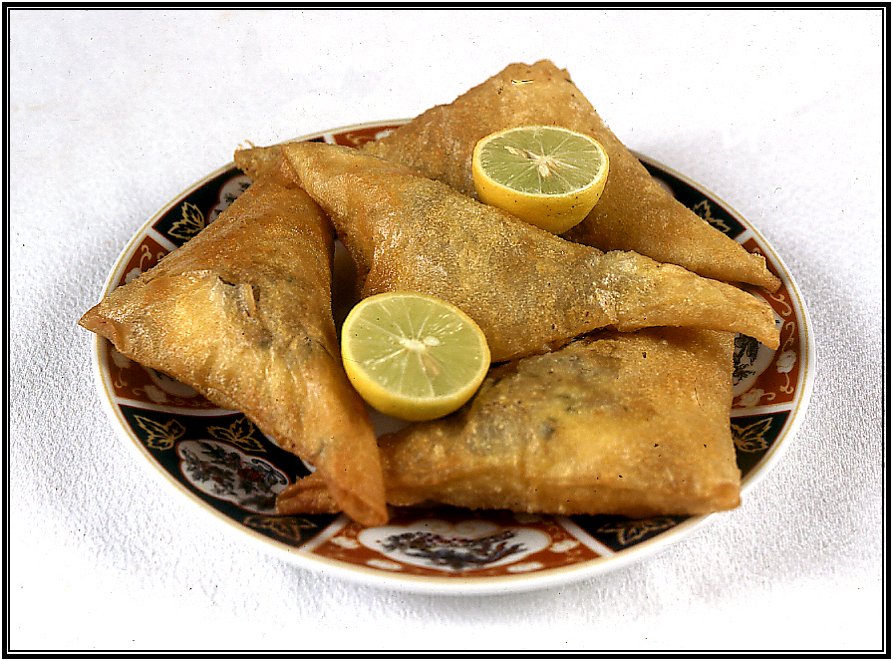
This is how the Tunisians fix their tunafish, in a very common appetizer dish called brik (breek), probably distantly related to the Turkish borek. Sometimes made with just egg, sometimes with tuna and egg, it was the inspiration for my own tuna salad sandwich.
I can actually make brik, but there is no substitute for fresh Tunisian brik, made in Tunisia, with the special very thin brik skins that fry up thin and crisp in the best Tunisian olive oil. The photo is from PromoTunisia.
A Room with a View
Kinan and I have been having an ongoing desultory conversation about views. He likes my view in Kuwait and he loves a good view in general.
I have challenged him to close his eyes, sit back and envision HIS perfect view.
And so I challenge you, my readers. Even if you have never commented before, yield to this temptation. Commenting is easy – you don’t even have to give your name, just choose any old pseudonym.
Close your eyes. Lean back in your chair. Think of what you would like to have outside your window, to look at day after day. And then – tell us about it.
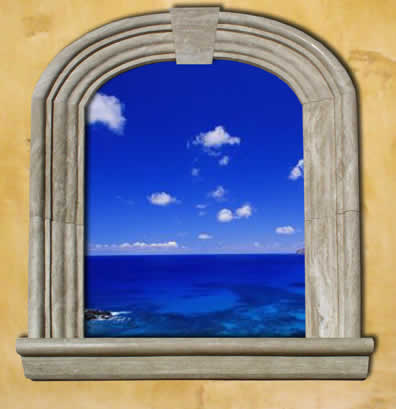
(Window frame courtesy of castelli marble)
I will tell you, for me it has to do with water, and even better, water and mountains. I love my Kuwait view, and chose a smaller living space just to have the breathtaking view. I have never, not for a heartbeat, regretted that choice. The view out over the Arabian Gulf thrills my heart, and I can lose hours watching ships, watching beachcombers, even watching fish jumping out of the Gulf waters. A beautiful view is a precious gift to the soul.
For my husband, I am would guess it would be Zambia, looking out over a hippo pool, watching elephants cross, watching the lions come down to drink – or to feed.
What view would feed your soul? What would you love to look at day after day? Speak now!
World’s Largest Camel Race
BBC has published photos from the World’s Largest Camel Race, 468 camels in Layonne, Western Sahara.

Wikipedia says:
Western Sahara (Arabic: الصحراء الغربية; transliterated: al-Ṣaḥrā’ al-Gharbīyah; Spanish: Sahara Occidental) is a territory of northwestern Africa, bordered by Morocco to the north, Algeria in the northeast, Mauritania to the east and south, and the Atlantic Ocean on the west. It is one of the most sparsely populated territories in the world, mainly consisting of desert flatlands. The largest city is El Aaiún (Laâyoune), which is home to over half of the population of the territory.

Recent Comments
intlxpatr on Shampoo Ginger tigerbutterya0c5ff1d… on Shampoo Ginger intlxpatr on British Soldier Kidnapped, Esc… John on British Soldier Kidnapped, Esc… intlxpatr on British Soldier Kidnapped, Esc… Wikipedia Donate Button

Amazina


Early Voting in Florida


