Outrage: Rape Reporting from Monrovia and Iran
My energy is back. I felt so blessed – today I started my photo albums. I had it all organized, but just couldn’t make myself DO it. Today was a new day, woke up at a reasonable hour with energy! Alhamdallah!
Back in my workshop, Qatteri Cat helping, BBC on to keep me company . . . and two separate reports come on BBC News (radio). I can sit, or I can share my outrage with you. Here I am . . .
The report from Monrovia is about the continuous rape of children, even infants under one year. They are only now documenting it is happening, and to what extent. Before, it was deny, deny, deny.
Here is a direct quote from the program: “Rape is so entrenched in the society.” They haven’t begun to study WHY it is happening, only documenting that it IS happening. To children, the weakest, least powerful segment of society. And in other African countries, societal studies have shown that there is a belief that having sex with virgins, uncontaminated, can cure AIDS. So ignorant. So selfish. And as the virgins become fewer, the victims get younger. Who would rape an infant? Who would be so desperate and so depraved? It makes me shake, it makes me so angry, this violation of the most innocent.
The second case is about an Iranian woman, Norouzi, who killed a man who was attempting to rape her. Convicted of murder, and given the death penalty, the court said she had used “too much force” in defending herself.
So, in your experience, what happens if you defend yourself but leave your attacker still capable? Your self-defense only makes him/her more angry, more lethal, and raises your probability of ending up dead yourself. Hmmmmm. . . . experience rape and likely death, or kill my attacker?? I know, in a heartbeat, which I would choose.
The family has forgiven her IF she pays the blood money of nearly $63,000 dollars. Pay $63,000 for the SCUM that tried to rape her??
Share my outrage. You can read the entire story on the BBC website, here.
A quote from this newsarticle:
Women’s rights activist and lawyer Sara Irani told The Associated Press news agency she welcomed the resolution of the case.
“Norouzi’s freedom will give new breath to women to find the courage to stand up for their rights and defend themselves,” she said.
In Iran, a married woman who is raped risks the death penalty for adultery if she cannot prove she was violated.
If she kills her attacker, she may also face the death sentence for murder.
You may wonder why I tag this a political issue. Politics is all about power. This woman, and these children are victims because 1) they are physically weaker than their attackers and 2) their attackers don’t believe there will be any repercussions; they believe they are entitled to what they take and that there will be no penalty. It’s about power. It’s political until there are laws strong enough to protect the weak and innocent against their attackers, and those laws are enforced.
January Projects
When our son and daughter-in-law were visiting, she was telling me our son has routines he adapts to insure he gets everything done. As she was telling me this, I was squirming in my chair. I am not exactly obsessive-compulsive, but because I could have a tendency to scatter my energies, I do the same thing, I have little routines I run to make sure that the important things get taken care of before I have fun.
One of these routines is to use January to get organized so that I can goof off the rest of the year. I try to get tax things in order, I try to make sure all the paperwork is filed or tossed . . . and I do photo albums for the preceding year, two albums if we went to Africa, which we have been doing nearly every year.
But last January I moved. And then, just about every other month, I was back in the States, either of a wedding or to see my parents. The albums never got done.
So yesterday, I gathered all the photos. Fortunately, I had kept them in different places, so they were not all mixed up. I have to do four albums. For the 2006 family album, I still need to get photos printed, and that alone takes time and organization. The other photos, I just needed to get in order. That took a whole day.
So this is for my friend – you know who you are – with twenty something years of photos she still hasn’t posted. I apologize! I apologize for all the times I told you how easy it is, and to just DO it. I am only one year behind, and already I can’t remember where this photo was taken, why that photo was taken, or what sequence these photos should be in. It is a daunting task, and I am only working on two years. I apologize again, dear friend, I grovel in mortification at my arrogance and lack of sympathy. God, in his mighty wisdon, has humbled me by showing me how fragile my memory is, and how unfounded my pride in organization. Aarrgh! Forgive me!
Circumcision NOT complete protecton against HIV/Aids
One of my favorite source blogs Sociolingo reports the significant news from Africa. On December 14th, he quotes a United Nations report stating that while circumcision halves the risk of HIV infection, it should not be relied upon without condoms.
“Although these results demonstrate that male circumcision reduces the risk of men becoming infected with HIV, the UN agencies emphasize that it does not provide complete protection against HIV infection,” they said. “Circumcised men can still become infected with the virus and, if HIV-positive, can infect their sexual partners.
“Male circumcision should never replace other known effective prevention methods and should always be considered as part of a comprehensive prevention package, which includes correct and consistent use of male or female condoms, reduction in the number of sexual partners, delaying the onset of sexual relations, and HIV testing and counselling,” they added.
Liberation Tower at Night and Qatteri Cat

We love going to Souk Mubarakia. Took this recently on a cool, clear night from the souks
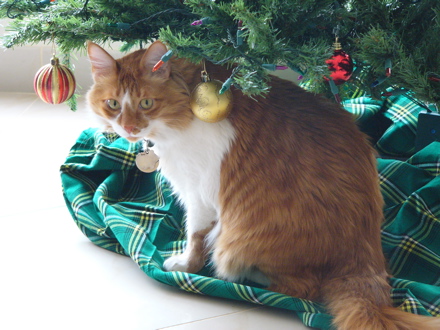
The Qatteri Cat has not lost interest in the tree, but no longer seems interested in pulling it over. The blanket is Masai, from Tanzania. Great Christmas colors!
Santa’s Wish List: Cookbooks
You might think I love to cook. You would be very wrong.
I had a great friend for many years, one of those Southern gals with a last name first name, and when one day I told her of my secret guilt – that cooking wasn’t FUN for me, she said “what we do, every day, is SURVIVAL cooking. We just meet the expectation of getting a meal on the table. That doesn’t have to be fun, it just has to be done.”
That’s pretty much what I do, and why I have been giving you all these great recipes. The truth about the recipes I am giving you is that most of them are EASY and they taste good. A few require special equipment and mastering a new skill, but it’s like swimming – once you’ve done it, it’s easy. There is nothing complicated about the recipes I am sharing with you – they are ones I use, too!
Books About Food and Eating
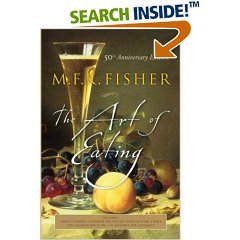
First I will share with you two books available through third party vendors at Amazon. The first is Food Lover’s Companion (A Comprehensive Definition of Over 4000 Food, Wine and Culinary Terms) by Sharon Tyler Herbst, which is available starting at $14.93, and the second is M.F.K Fisher’s The Art of Eating, also available through Amazon at $11.53. The Companion is invaluable when someone uses a term for a cooking technique or ingredient you don’t know; it has words for everything! My husband reads this book sometimes just for fun and is always sharing new information he has learned. The MFK Fisher book is just plain fun reading about food, full of information and anecdotes and stories, written in an enormously readable way.

Beginner Cookbooks
The first cookbook I used was the McCalls Cookbook – no longer in print. It had photos of how do do the things I found so intimidating, and that is where I got my earliers Christmas cookie recipes – the Russian Tea Cakes and the Candy Cane Cookies. The second was The Joy of Cooking, which I mentioned in an earlier blog entry. What is good about these books is that they keep it really simple. In Joy, they give you a long theoretical section, which you can read if you have the time, and which helps, but at the beginning it isn’t always easy to even understand the basics. That takes time. Then you can go back and read later and go “Aha! Now I understand!”
Cookbook Secrets
Actually, I love reading cookbooks. I have a huge collection. And almost all of them are Junior League Cookbooks. So here’s the secret – when you are looking for cookbooks, look for ones where women who contribute have to put their names. If their name is on the recipe, you can trust that the recipe will work, and that it will be one of their best recipes – they don’t want to be embarrassed!
The majority my cookbooks are from the South. And narrowing it down even further, most of my favorites come from Louisiana or Georgia.
The first one I ever bought was Talk About Good! And oh, it WAS good!

These recipes use ingredients like real cream and real butter and lots of salt. Southern people have some of the lowest life-expectancy rates in the United States – I suspect their eating habits have a lot to do with it. But if it isn’t a habit to eat so richly, every now and then it just tastes SO GOOD to use these ingredients. You will also notice that it has what they call a “plastic comb” binding. That means when you open it up to follow a recipe, it will lie flat. That’s a really good thing!
My second favorite is Quail Country, by the Junior League of Albany, Georgia. You would really have to scour the book stores to find this out-of-print classic, because so few people would ever want to part with it. Another gem is The Fort Leavenworth Collection, if you can get your hands on it – again, yard sales, used book stores would be your best bet.
There is a wonderful group of stores in the USA called Half Price Books. If books are not being bought as gifts, if you plan to just read a book and pass it along, or if you like to have a few on hand to pass along because you think they are so great, Half Price Books is a great place. They have the most obscure books, books you never thought you would see again. Many of their books are new, but remaindered (left over from book stores that couldn’t sell the, or from publishers who published too many copies) so they are sold at half price. They will also buy used books from you, but to me, they offer so little that I would just as soon give them away. (No, I don’t own stock in Half Price Books.)
There are some other fabulous Junior League cookbooks – the California Heritage Cookbook, the Seattle Classics, and there are other cookbooks produced by churches and charities that also have “real people” recipes that are drop-dead good. I remember once sharing a recipe for Chocolate Cheesecake from Seattle Classics. My friend told me she made it for Christmas dinner, but everyone was too full to eat dessert. But she said all night she heard doors opening and closing, as people snuck down to the kitchen to slice a little of the cheesecake and eat it, and in the morning, only a fragment was left!
Seeking out the best cookbooks can make every vacation an adventure. I have cookbooks from Kenya and Tunisia, Qatar, Jordan and Saudi Arabia . . . all full of great recipes, recipes with names attatched. I wish you a grand adventure seeking out cookbooks that will thrill your heart. Happy Hunting!
Africa’s Oldest Pupil
This is a story I saw in last week’s Kuwait Times, but I can’t get it out of my mind. This humble man, with his ongoing search for knowledge, is an inspiration to me.
Source: Reuters
(This story is part of a special report on education in Africa, issued on Nov. 15)
By Andrew Cawthorne
ELDORET, Kenya, Nov 15 (Reuters) – With his stubbly grey beard and walking stick at his side, 86-year-old Kimani Maruge looks a little out of place among the rows of children sitting behind wooden desks at Kapkenduiywo Primary School. Yet classmates 10 times his junior would be hard-pressed to match the enthusiasm of Maruge, a farmer and veteran of Kenya’s 1950s anti-colonial Mau Mau revolt, who has the distinction of being the oldest pupil on the planet.
“I will only stop studying if I go blind or die,” Maruge says at the crowded school in a poor neighbourhood outside Eldoret in Kenya’s western farmlands.
The illiterate great-grandfather – who has outlived 10 of his 15 children — jumped at a belated chance to educate himself when President Mwai Kibaki introduced free primary schooling in the east African nation in 2003.
Enrolment across Kenya shot up overnight, with 1.2 million more children going to school. Kapkenduiywo had 375 pupils before Kibaki’s measure, and now has 892.
But there are none quite like Maruge. He says his inspiration came from listening to a preacher in church and suspecting he was misinterpreting the Bible.
“I wanted to go to school to be able to read the Bible for myself,” he says, tucking his long legs under a tiny, shared desk at the front of his overcrowded classroom of 96 pupils. “And in case there is ever any compensation for us Mau Mau, I would like to be able to count my money properly at the bank,” he adds with a large grin.
PERSISTENCE PAID OFF
When he first turned up at the school gates in regulation knee-length socks, cut-off trousers and navy blue jumper, Maruge was greeted with laughter. Teaching staff tried at first to direct him to adult education classes. But when he returned again and again, they realised he would not be deterred, and anyway there is no legal age-limit for primary school entrance in Kenya.
“Inside me, when I saw him there, I felt he was serious,” says headmistress Jane Obinchu. “And look at him now. Nearly three years later, he’s still here. He’s over the most difficult part, he won’t drop out now.”
In the classroom, Maruge’s favourite subjects are Swahili and maths, but he struggles with English which is new and strange to him. He is treated like any other schoolboy except for one privilege: tea at break. Fellow pupils treat him with care and respect, and love to listen to his tales of Kenyan history between classes.
“He tells us about the Mau Mau,” says Ireen Wairimu, 11. “And about the time when white kids used to go to school under a roof while African kids sat under trees.”
Hobbling on a foot he says was disfigured when he was tortured by British colonial captors during the Mau Mau revolt, Maruge cannot keep up with all the playground games. But he watches with relish and is always surrounded by chattering kids.
“They are my friends, they love me, they help me walk home,” he says. “I want to break the barriers between old and young.”
INTERNATIONAL POSTER-BOY
Known in his neighbourhood as “Mzee” – a Swahili term of respect for an elder – Maruge is happy to show off his new knowledge, reading passages of the Bible slowly and clearly in front of his house after school. Although still living humbly, Maruge has become a national celebrity and something of a poster boy for free education campaigners worldwide. Last year, he was feted at the United Nations in New York. This year, a Hollywood crew are working on a film about him.
“School has changed him. He looks younger and happier, rejuvenated by getting a second chance in life,” says headmistress Obinchu. “He calls me his mother, but I am the age of his daughters. He is an inspiration to all of us.”
Despite his advanced years, Maruge has plenty of dreams for the future. “I won’t stop. I want my name one day to be Professor, Doctor Kimani!,” he says, holding his books close to his chest. “Liberty is learning, you know.”
Google Earth – It Just Keeps Getting Better
This morning I had an e-mail from my nephew at GoogleEarth. There are days I feel like one of the luckiest women in the world – my sisters and I have the most interesting children, now young adults, and they are all working in areas where they feel useful – stressed, working too hard – but greatly satisfied, greatly productive.
How cool is it to love Geography, and to be working for GoogleEarth? I grin every time I think of my nephew, who loves the work he is doing.
His e-mail a couple weeks ago reminded me that the new GoogleEarth was out and to be sure to upgrade. You can be sure I did. Today, he tells me about another blog that always has the most up-to-date goodies from GE – Google Earth Blog.
On November 12, Frank Taylor, the blog author, says:
Google has quietly introduced four new Featured Content Layers today. Go to the Layers on the lower left and look for “Featured Content”. Open the folder and look for the new layers at the top. Each is marked with a red “New!”. Here’s a brief overview of the new layers:
Rumsey Historical Maps – This is a collection of historical maps which you can overlay over their location on Earth. If you are not running Google Earth 4, you will not see this layer. Open the folder and turn on the map that interests you. The first link shows you the locations of the different map and each description gives you a few details. You can then turn on each map and they will be overlayed in GE. The maps are “regionated” which means they will load more detail as you get closer (it also means the images are scanned at a very high resolution). I’m sure some of my mapping friends like Jonathan Crowe will be curious to see these.
Tracks4Africa – this is my favorite of the new layers. There are maps of places to go in Africa built by compiling data from GSP tracks. The layer also has lots useful information and photos. Zoom in closer to see more detail. You can read more, and buy the maps for your GPS, by going to Tracks4Africa’s web site.
Spotlight on Africa – This is a collection of placemarks showing the flag of each country of Africa. The placemark description includes an overview of basic information of each country from the CIA World Factbook. The placemarks were developed by the National Geographic My Wonderful World campaign to help kids become more geographically aware. This is nicely done, but you can see the whole world done in a similar fashion in this collection.
European Space Agency – this layer shows ESA logo placemarks of different locations where a satellite photo can be viewed of that location. A small picture is in the placemark description, and a link to a page where you can see a larger picture. I am disappointed that you can’t just view the larger pictures overlayed in Google Earth though.
I am blown away by all the new Africa content. On a day when the sky has turned yellow in Kuwait, there are waves cresting out in the Gulf and the air smells like impending squalls, it is a perfect day to spend in Africa, via Google Earth!
Frank Taylor has all kinds of useful information on GE, and I am adding him to my blogroll.
myafrica September Statistics
I like Africa anyway, but this blogger, Cerengeti, goes way outside the Africa box. He has gathered statistics from all over the world – and he gives all the references – that are amazing, horrifying, fascinating – from abortion in India to plagiarism in the United States – take a look at Myafrica’s Index for September 2006.
Hiking With Robin Pope in Zambia (4)
We hear the drums waking us the next morning and we are SO ready. We have met with Robin Pope, who oriented us with maps to the area of the Mupamadze River we will trek, and has given us all kinds of hints as to how we will need to dress and to take care of ourselves and one another.
After breakfast, we load into a land cruiser specially built in Tanzania on a Toyota truck base. It is sturdy, tough, and very practical. We choose our seats, we tuck our long pants into our socks, we pull our sleeves down over our hands, and wrap our kikoy around our faces – we will be heading into tzetze fly territory.
From the very beginning, we understand what is so special about travelling with Robin Pope. This man knows so much. We stop every kilometer – here is a bird rarely seen, and here is a lion track, and here is a lagoon where we might see . . . ! Things we might pass right by without knowing anything are examined and are illuminated; we see the world in a tiny pond, and we see the miracles in a leaf.
We come to a great sand river, full in the rainy season but empty and sand-filled now. Robin gets a running start, but still, almost to the other side, we bog down. Yes, I am taking the photo, but as soon as I took it, I had to go and push, too. . . .

these trips aren’t for the lazy bones! It took all of us pushing and Robin rocking the truck back and forth to get it going again, and get us to the other side of the sand river. Great exercise!
Almost to the camp, we saw a family or warthogs and five little warthog babies along the right side of the road, and and a duiker kill on the left side of the road – two more stops. It’s waaaaayyyyyy late when we get to camp, but . . . who cares? Vultures circle – and we learn to identify five different kind. We are having a ball.
These temporary camps are not so elaborate as the camps at Tena Tena, Nkwali and Nsefu – they are put together and taken apart as we hike along the river. We stay one night at the first camp, two nights at the second camp and two nights at the third camp. The tents are small, but still tall enough to stand up in. There is a nightstand between the two camp beds, with a candle, matches and mosquito coil. Each bed has a folding type stand for a piece of luggage. Outside, there is your washing stand, two camp chairs, a mat, places to put your toiletries, and places to hang your wash.
There are separate “long-drop” toilets for the men and for the women, a shovel and a bucket of sand as part of the etiquette so that whoever comes next won’t be grossed out. The shower is a gravity drop shower, with nice warm water. We have to arrange with one another how we will schedule our shower time.
At lunch the first day, they serve a green salad, spinach crepes, pumpkin, onion bread, beef salad, potato salad, melon and cookies (biscuits). Amazing – out here in the middle of nowhere, a beautiful table, nice wines, tablecloths, napkins and great food. Best of all is that we have good travelling companions, and the conversation is fast and furious and a lot of fun.
We travelled lightly, so almost every day we have to wash and hang socks or a shirt, or even once a pair of jeans. They dry very quickly in the hot hot sun of late August. The days start out chill, rising around six to be on the path by six thirty, but by the time we get to our next stop for lunch, it is hot hot hot. Although we are hiking six hours in the morning and a couple hours in the afternoon, it is easy hiking, maybe some brisk walking but always stopping as Robin spots a martin, or a rare bird, or hears buffalo, or even – spots a lion!
After a rest and time for settling in, we take a late game walk with Robin to the top of a nearby hill where we can look off into the far away hills, and watch the river meander out of sight. He points out where we will trek the next day, and we head back for camp.

The plan for the trip is to do about 10 km a day – we hike for six or so hours in the morning and then another two in the afternoon. OK, here is the truth – I am an introvert, and I don’t like to feel rushed about taking my shower, so I skip the afternoon walk just to have some quiet time and a leisurely shower. The walks are not rigorous – during the mornings, we may hike, but we stop so often to look at things or to take photos that we never feel pushed or tired.
My very favorite part of the hiking is crossing the river. Robin finds a safe, not-too-deep place, away from the crocodiles, and we all strip off our shoes and socks and carry them as we wade across the nice, cool river. Early in the morning we see herons, and buffalo as well as crocodile, and it all has an unearthly feel to it. Robin knows where all the good paths are, so we will cross and spend a while on one side, and then cross back over to see something special on the other side.
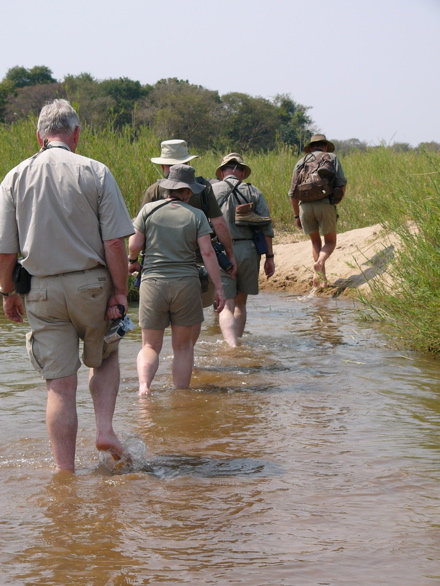
Sometimes after the morning hike, we find ourselves at the next camp. Only twice were we at the same camp two nights in a row.
The food was absolutely amazing. Beef Wellington. Tilapia. Wonderful sweet desserts. And once, oh what a treat, a selection of locally made Zambian cheeses, chevres, a brie-like cheese, a Cantal like cheese – oh my heaven.
On the last night, I scurried with the crew to meet the hikers down the road about three kilometers by the river. When we got there, the crew set up deck chairs in the shallows of the river, and the hikers got there just as the sun started to go down. There was a huge Goliath heron fishing nearby. There were hot hors d’ouevres, there were mixed drinks and good wine, and a great big full moon rising as the sun went down. Sitting there in that river came a sudden self-awareness: “How cool is this, sitting in the river with Robin Pope watching the sun go down after five days of trekking? Life is good.” It was a thrill.
Dinner that night around the campfire – I think it was fish curry and vegetable curry, a caprese salad (tomatoes with Zambian mozzarella di bufalo), a big green salad with toasted sesame seeds, and something sweet and chocolate for dessert. The meal itself is hazy – the conversation was so good, so much fun, we had a lot of fun with Robin and with our fellow trekkers. And then. . . as the embers started to die down, we could hear a drum, off in the distance, and singing. We could hear clapping. And it came closer. We all fell silent, wondering what this was?
The entire crew approached slowly, all dressed in their best clothes, singing in multi-part harmony, singing Zambian songs, some gospel songs, bush songs. . . moon glowing overhead, the smell of woodsmoke, after a great meal – the singing was haunting and magical, and utterly unforgettable. We were all sad to be ending this adventure, and the beauty and delight of this Mupamadzi concert put it all over-the-top.
The concert ended and we drifted off to bed.
The next day, we broke camp, leaving the Mupamadzi and heading back for Tena Tena. Travelling with Robin Pope, the adventure continues – a huge old boabab tree here, hills they are exploring for future walking treks over there, and uniting it all, Robin’s gentle wry humor and keen observations. Time has no power over Robin, it is the moment and the opportunity that are all important, and our last day is every bit as great an adventure as the first.
There is a lot of world out there – and yet. We know we will be heading for the Robin Pope camps in the South Luangwa Valley again and again.
The link to Robin and Jo Pope’s home page is here.
In addition RPS puts out a wonderful weekly newsletter all about happenings at the camps – new animal babies, leopard killings, flood season, what’s going on at the Kawazaa school, and daily life in the year-round camps. You can subscribe to “It’s Monday” here.
Hiking with Robin Pope in Zambia (3)
There’s a lot of world to see, and we never intended to repeat a trip. The Robin Pope camps are so exceptional that – we made an exception. The very next year, we are back in Zambia, and eager – we are going hiking with Robin Pope himself.
Who is Robin Pope? He is a native African, and a staunch Zambian. He knows so much about wildlife that he probably doesn’t even know how much he knows. He is quietly and dryly funny. He started guiding as a very young man, and then, together with his wife Jo, began building a very particular kind of tourist experience. When you reach the Robin Pope camps, Nkwali, Nsefu and Tena Tena, you become like family. Well, family who live very luxuriously – the cabins are large and spacious, and beautifully appointed, with fine linens, mosquito netting, shelves, toiletries, all the comforts – a million miles from anywhere.
Each camp holds only a very limited number of campers, supported by enthusiastic and knowledgeable staff. They grow their own vegetables, or buy from local farmers. They employ people from the nearby villages. Black and white people work together equally.
One of the things we were able to do was to visit Kawazaa village, to visit the schools re-built and supplied by Robin Pope Safaris, to visit the local clinic, to visit with local villagers. We can’t wait to go back. The second trip, we bring one big suitcase full of school supplies – calculators, books, paper, pens, pencils . . . it was fun for us to find these things, having met the students who would use them, and the teachers who would benefit by having resources. Everywhere we go, we have to sign a book – the villagers get specific monetary credits for every visitor they entertain.
There are six of us who will trek with Robin Pope, and we meet in the Land Rover that picks us up at Mfuwe International Airport. I love that name – don’t you just see big jets flying in and out? In reality, it is a tiny little airport, handling only small planes. There is one small arrivals gate and one equally small departures gate. Because it also gets an occasional flight from Malawi, it can call itself “international.” We arrive at Nkwali, enchanted once again to find the hippo pod right under our window.
Lunch – how do they do it? Fish cakes with lemon mayonnaise, leek quiche, potato salad, avocado salad, green salad, cheesy corn rolls and butter, finishing with coffee and tea.
On our game drive the next morning, Jacob takes us out to see Thornicroft giraffe, and we see lots of elephants and baby elephants, and a herd of over 300 buffalo. After lunch, it is hot and we fall into a dead sleep, awakening in time for our afternoon game drive which starts with a boat ride across the river.
And what a boat ride! The hippos have spread out, and we THINK we are safely past when one of them lunges at the boat, missing us by a thread.
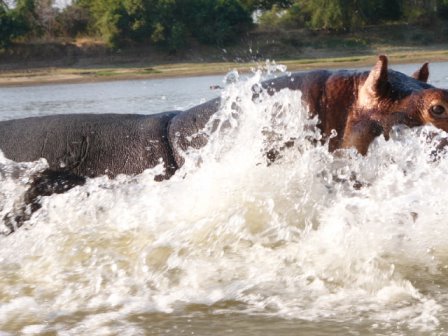
Thank God, it is hot for another hour, as we are all totally soaked, but also energized by the huge jolt of adreneline shooting through our veins at escaping unhurt from that lunging hippo. On our drive, we see leopard, genet cats, civet cats and a great big lumbering porcupine.
We have dinner down by the river, under the stars, with napkins folded like guinea fowl. It starts with spinach soup, and then there is pork tenderloin, pumpkin, mange-tout peas, cauliflower with a cheese sauce, lentils and for dessert, butterscotch pie. Somehow, we manage not to gain weight – we can’t figure out how.
Recent Comments
Cathy on No Grown-Ups in Charge intlxpatr on Waiting for Snow intlxpatr on Waiting for Snow Abou Tabblouleh on t… on Waiting for Snow Abou Tabbouleh on in… on Waiting for Snow Wikipedia Donate Button

Amazina


Early Voting in Florida


 Here There and Everywhere