Google Earth – It Just Keeps Getting Better
This morning I had an e-mail from my nephew at GoogleEarth. There are days I feel like one of the luckiest women in the world – my sisters and I have the most interesting children, now young adults, and they are all working in areas where they feel useful – stressed, working too hard – but greatly satisfied, greatly productive.
How cool is it to love Geography, and to be working for GoogleEarth? I grin every time I think of my nephew, who loves the work he is doing.
His e-mail a couple weeks ago reminded me that the new GoogleEarth was out and to be sure to upgrade. You can be sure I did. Today, he tells me about another blog that always has the most up-to-date goodies from GE – Google Earth Blog.
On November 12, Frank Taylor, the blog author, says:
Google has quietly introduced four new Featured Content Layers today. Go to the Layers on the lower left and look for “Featured Content”. Open the folder and look for the new layers at the top. Each is marked with a red “New!”. Here’s a brief overview of the new layers:
Rumsey Historical Maps – This is a collection of historical maps which you can overlay over their location on Earth. If you are not running Google Earth 4, you will not see this layer. Open the folder and turn on the map that interests you. The first link shows you the locations of the different map and each description gives you a few details. You can then turn on each map and they will be overlayed in GE. The maps are “regionated” which means they will load more detail as you get closer (it also means the images are scanned at a very high resolution). I’m sure some of my mapping friends like Jonathan Crowe will be curious to see these.
Tracks4Africa – this is my favorite of the new layers. There are maps of places to go in Africa built by compiling data from GSP tracks. The layer also has lots useful information and photos. Zoom in closer to see more detail. You can read more, and buy the maps for your GPS, by going to Tracks4Africa’s web site.
Spotlight on Africa – This is a collection of placemarks showing the flag of each country of Africa. The placemark description includes an overview of basic information of each country from the CIA World Factbook. The placemarks were developed by the National Geographic My Wonderful World campaign to help kids become more geographically aware. This is nicely done, but you can see the whole world done in a similar fashion in this collection.
European Space Agency – this layer shows ESA logo placemarks of different locations where a satellite photo can be viewed of that location. A small picture is in the placemark description, and a link to a page where you can see a larger picture. I am disappointed that you can’t just view the larger pictures overlayed in Google Earth though.
I am blown away by all the new Africa content. On a day when the sky has turned yellow in Kuwait, there are waves cresting out in the Gulf and the air smells like impending squalls, it is a perfect day to spend in Africa, via Google Earth!
Frank Taylor has all kinds of useful information on GE, and I am adding him to my blogroll.
myafrica September Statistics
I like Africa anyway, but this blogger, Cerengeti, goes way outside the Africa box. He has gathered statistics from all over the world – and he gives all the references – that are amazing, horrifying, fascinating – from abortion in India to plagiarism in the United States – take a look at Myafrica’s Index for September 2006.
Hiking With Robin Pope in Zambia (4)
We hear the drums waking us the next morning and we are SO ready. We have met with Robin Pope, who oriented us with maps to the area of the Mupamadze River we will trek, and has given us all kinds of hints as to how we will need to dress and to take care of ourselves and one another.
After breakfast, we load into a land cruiser specially built in Tanzania on a Toyota truck base. It is sturdy, tough, and very practical. We choose our seats, we tuck our long pants into our socks, we pull our sleeves down over our hands, and wrap our kikoy around our faces – we will be heading into tzetze fly territory.
From the very beginning, we understand what is so special about travelling with Robin Pope. This man knows so much. We stop every kilometer – here is a bird rarely seen, and here is a lion track, and here is a lagoon where we might see . . . ! Things we might pass right by without knowing anything are examined and are illuminated; we see the world in a tiny pond, and we see the miracles in a leaf.
We come to a great sand river, full in the rainy season but empty and sand-filled now. Robin gets a running start, but still, almost to the other side, we bog down. Yes, I am taking the photo, but as soon as I took it, I had to go and push, too. . . .

these trips aren’t for the lazy bones! It took all of us pushing and Robin rocking the truck back and forth to get it going again, and get us to the other side of the sand river. Great exercise!
Almost to the camp, we saw a family or warthogs and five little warthog babies along the right side of the road, and and a duiker kill on the left side of the road – two more stops. It’s waaaaayyyyyy late when we get to camp, but . . . who cares? Vultures circle – and we learn to identify five different kind. We are having a ball.
These temporary camps are not so elaborate as the camps at Tena Tena, Nkwali and Nsefu – they are put together and taken apart as we hike along the river. We stay one night at the first camp, two nights at the second camp and two nights at the third camp. The tents are small, but still tall enough to stand up in. There is a nightstand between the two camp beds, with a candle, matches and mosquito coil. Each bed has a folding type stand for a piece of luggage. Outside, there is your washing stand, two camp chairs, a mat, places to put your toiletries, and places to hang your wash.
There are separate “long-drop” toilets for the men and for the women, a shovel and a bucket of sand as part of the etiquette so that whoever comes next won’t be grossed out. The shower is a gravity drop shower, with nice warm water. We have to arrange with one another how we will schedule our shower time.
At lunch the first day, they serve a green salad, spinach crepes, pumpkin, onion bread, beef salad, potato salad, melon and cookies (biscuits). Amazing – out here in the middle of nowhere, a beautiful table, nice wines, tablecloths, napkins and great food. Best of all is that we have good travelling companions, and the conversation is fast and furious and a lot of fun.
We travelled lightly, so almost every day we have to wash and hang socks or a shirt, or even once a pair of jeans. They dry very quickly in the hot hot sun of late August. The days start out chill, rising around six to be on the path by six thirty, but by the time we get to our next stop for lunch, it is hot hot hot. Although we are hiking six hours in the morning and a couple hours in the afternoon, it is easy hiking, maybe some brisk walking but always stopping as Robin spots a martin, or a rare bird, or hears buffalo, or even – spots a lion!
After a rest and time for settling in, we take a late game walk with Robin to the top of a nearby hill where we can look off into the far away hills, and watch the river meander out of sight. He points out where we will trek the next day, and we head back for camp.

The plan for the trip is to do about 10 km a day – we hike for six or so hours in the morning and then another two in the afternoon. OK, here is the truth – I am an introvert, and I don’t like to feel rushed about taking my shower, so I skip the afternoon walk just to have some quiet time and a leisurely shower. The walks are not rigorous – during the mornings, we may hike, but we stop so often to look at things or to take photos that we never feel pushed or tired.
My very favorite part of the hiking is crossing the river. Robin finds a safe, not-too-deep place, away from the crocodiles, and we all strip off our shoes and socks and carry them as we wade across the nice, cool river. Early in the morning we see herons, and buffalo as well as crocodile, and it all has an unearthly feel to it. Robin knows where all the good paths are, so we will cross and spend a while on one side, and then cross back over to see something special on the other side.
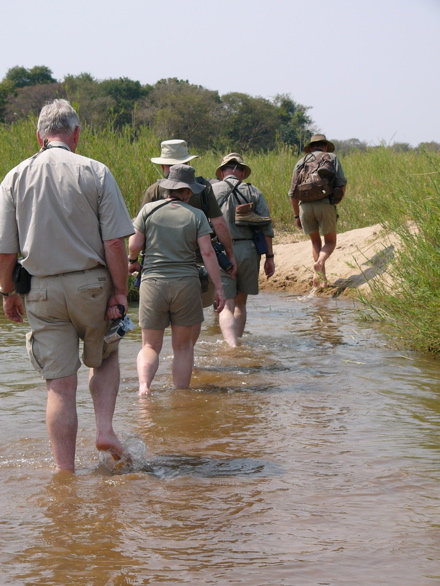
Sometimes after the morning hike, we find ourselves at the next camp. Only twice were we at the same camp two nights in a row.
The food was absolutely amazing. Beef Wellington. Tilapia. Wonderful sweet desserts. And once, oh what a treat, a selection of locally made Zambian cheeses, chevres, a brie-like cheese, a Cantal like cheese – oh my heaven.
On the last night, I scurried with the crew to meet the hikers down the road about three kilometers by the river. When we got there, the crew set up deck chairs in the shallows of the river, and the hikers got there just as the sun started to go down. There was a huge Goliath heron fishing nearby. There were hot hors d’ouevres, there were mixed drinks and good wine, and a great big full moon rising as the sun went down. Sitting there in that river came a sudden self-awareness: “How cool is this, sitting in the river with Robin Pope watching the sun go down after five days of trekking? Life is good.” It was a thrill.
Dinner that night around the campfire – I think it was fish curry and vegetable curry, a caprese salad (tomatoes with Zambian mozzarella di bufalo), a big green salad with toasted sesame seeds, and something sweet and chocolate for dessert. The meal itself is hazy – the conversation was so good, so much fun, we had a lot of fun with Robin and with our fellow trekkers. And then. . . as the embers started to die down, we could hear a drum, off in the distance, and singing. We could hear clapping. And it came closer. We all fell silent, wondering what this was?
The entire crew approached slowly, all dressed in their best clothes, singing in multi-part harmony, singing Zambian songs, some gospel songs, bush songs. . . moon glowing overhead, the smell of woodsmoke, after a great meal – the singing was haunting and magical, and utterly unforgettable. We were all sad to be ending this adventure, and the beauty and delight of this Mupamadzi concert put it all over-the-top.
The concert ended and we drifted off to bed.
The next day, we broke camp, leaving the Mupamadzi and heading back for Tena Tena. Travelling with Robin Pope, the adventure continues – a huge old boabab tree here, hills they are exploring for future walking treks over there, and uniting it all, Robin’s gentle wry humor and keen observations. Time has no power over Robin, it is the moment and the opportunity that are all important, and our last day is every bit as great an adventure as the first.
There is a lot of world out there – and yet. We know we will be heading for the Robin Pope camps in the South Luangwa Valley again and again.
The link to Robin and Jo Pope’s home page is here.
In addition RPS puts out a wonderful weekly newsletter all about happenings at the camps – new animal babies, leopard killings, flood season, what’s going on at the Kawazaa school, and daily life in the year-round camps. You can subscribe to “It’s Monday” here.
Hiking with Robin Pope in Zambia (3)
There’s a lot of world to see, and we never intended to repeat a trip. The Robin Pope camps are so exceptional that – we made an exception. The very next year, we are back in Zambia, and eager – we are going hiking with Robin Pope himself.
Who is Robin Pope? He is a native African, and a staunch Zambian. He knows so much about wildlife that he probably doesn’t even know how much he knows. He is quietly and dryly funny. He started guiding as a very young man, and then, together with his wife Jo, began building a very particular kind of tourist experience. When you reach the Robin Pope camps, Nkwali, Nsefu and Tena Tena, you become like family. Well, family who live very luxuriously – the cabins are large and spacious, and beautifully appointed, with fine linens, mosquito netting, shelves, toiletries, all the comforts – a million miles from anywhere.
Each camp holds only a very limited number of campers, supported by enthusiastic and knowledgeable staff. They grow their own vegetables, or buy from local farmers. They employ people from the nearby villages. Black and white people work together equally.
One of the things we were able to do was to visit Kawazaa village, to visit the schools re-built and supplied by Robin Pope Safaris, to visit the local clinic, to visit with local villagers. We can’t wait to go back. The second trip, we bring one big suitcase full of school supplies – calculators, books, paper, pens, pencils . . . it was fun for us to find these things, having met the students who would use them, and the teachers who would benefit by having resources. Everywhere we go, we have to sign a book – the villagers get specific monetary credits for every visitor they entertain.
There are six of us who will trek with Robin Pope, and we meet in the Land Rover that picks us up at Mfuwe International Airport. I love that name – don’t you just see big jets flying in and out? In reality, it is a tiny little airport, handling only small planes. There is one small arrivals gate and one equally small departures gate. Because it also gets an occasional flight from Malawi, it can call itself “international.” We arrive at Nkwali, enchanted once again to find the hippo pod right under our window.
Lunch – how do they do it? Fish cakes with lemon mayonnaise, leek quiche, potato salad, avocado salad, green salad, cheesy corn rolls and butter, finishing with coffee and tea.
On our game drive the next morning, Jacob takes us out to see Thornicroft giraffe, and we see lots of elephants and baby elephants, and a herd of over 300 buffalo. After lunch, it is hot and we fall into a dead sleep, awakening in time for our afternoon game drive which starts with a boat ride across the river.
And what a boat ride! The hippos have spread out, and we THINK we are safely past when one of them lunges at the boat, missing us by a thread.
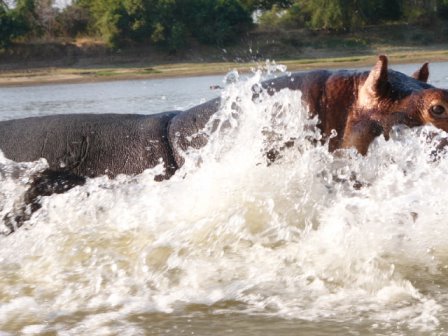
Thank God, it is hot for another hour, as we are all totally soaked, but also energized by the huge jolt of adreneline shooting through our veins at escaping unhurt from that lunging hippo. On our drive, we see leopard, genet cats, civet cats and a great big lumbering porcupine.
We have dinner down by the river, under the stars, with napkins folded like guinea fowl. It starts with spinach soup, and then there is pork tenderloin, pumpkin, mange-tout peas, cauliflower with a cheese sauce, lentils and for dessert, butterscotch pie. Somehow, we manage not to gain weight – we can’t figure out how.
Hiking With Robin Pope in Zambia (2)
The days pass too quickly. Our bags catch up with us on the third day – one day to get from J-burg to Lusaka, one day to get from Lusaka to Mfuwe, and one day to get to the camp at Nkwali. We never had a moment’s concern; they kept us informed every step along the way.
Here is what the day looks like – early early you hear a knock on the door and someone says “Good morning!” and you struggle out of bed. It is still the middle of winter below the equator, so it is cold. You jump into your clothing and head for the campfire, where breakfast is served. Toast is being heated on the grill, there is hot cereal and cold cereal, and some mornings there is even bacon. There is always hot coffee and hot tea. You can socialize or not, as your morning nature indicates, then grab your gear and load up. Usually it is you and your traveling partner, maybe another couple, and the guide. Every day you take off to a new area, sometimes for the whole day so you can see outlying areas, and sometimes just for three to five hours.

There is never a game drive where you don’t see something. Most of the people who show up at the Robin Pope camps are good safari travelers – good at spotting movement, as excited to see a bat eared fox as another lion, people who will sit and watch giraffe, or hippos, or storks . . . people who know when not to talk, and people who are considerate of one another when shooting photos or movies.

We move on to Nsefu, where the cabins are round! There is a big outdoor BBQ that night, lots of fun, down by the marsh where there is always something happening. We saw a huge Pell’s Fishing Owl, a great thrill, and several varieties of eagle. Watching the raptors is a huge thrill.
And then – our favorite camp – Tena Tena. They put us in the very end cabin, and oh, we like that very much. Tena Tena is rebuilt every year – you get there by boat. Tent-cabins are rebuilt once the rains stop and the floodwaters recede. The cabins are fabulous – during the day, they are totally open to the outdoors. Big huge king sized beds, flat woven carpeting with pile carpet accents, a large dressing area with shelves so you can really unpack and move in, and a huge outdoor shower and toilet and sink area to be shared with the stars and moon shining down on you. At night, the tents are closed, and an electrified fence prevents too much chance of invasion. The marsh area in front of the camp teems with life – after dinner one night, we have to wait until the leopard leaves before the guide will take us to our tent.
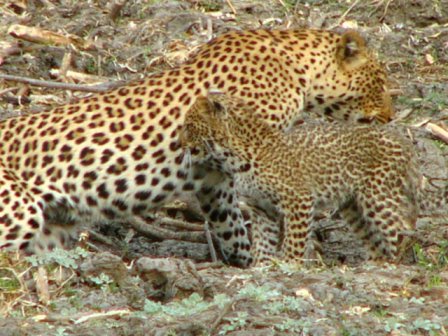
On our very favorite game drive at Tena Tena, we were out on the night of a full moon, and came across a pride of lions hunting. We spent nearly an hour just watching breathlessly as the lions tracked their victims, spreading out, sharing the responsibilities in the pack. There is no ambient light at all, so the sky is black as ink, and the stars are sparkling brighter than the finest diamonds. The moon casts a ghostly glow on the surroundings – enough light I can shoot photos without a flash. It is magical, and unforgettable.
My husband tells this story of Tena Tena:
“One night, I heard a loud sound and I couldn’t figure out what it was. I opened the tent flap and not two feet away was a hippo, eating a bush, and it was the loud chewing that I heard. What a thrill! The hippo was huge! I watched spellbound; I woke my wife. . .it was awesome. Two feet away! And then, the second night, he was back. What a thrill – he chews so loudly! The third night he was back again – ‘that damn hippo! I can’t sleep!’”
Hiking with Robin Pope in Zambia (One)
Today it is rainy and cold, and I have “miles to go before I sleep.” In my mind, I fly back to a happier time, and today I choose to be back in Zambia.
We fell in love with Zambia our first time there. We flew in to Lusaka, and our bags didn’t make it. We called frantically from the Holiday Inn and got a different answer every time we called. First we heard that our bags would be in on a later flight that day – which was what we wanted to hear, as we were leaving early the next morning. Later, the harried British Air office told us with clear annoyance in her voice that there were no more flights from Johannesburg, and our bags would catch up with us . . . Catch up with us? We were off to the bush for two weeks!
I was in a skirt. It was cold in the bush, and we had nothing with us but our camera equipment (Thank God!) and a change of underwear. We looked at each other and said “Holy smokes. We’re screwed. What do we do now?”
It was five o’clock at night. We grabbed a taxi and asked him to take us to a place with stores with clothing. He took us to a small strip mall, and waited for us while we ran in and searched desperately for socks, pants, sweatshirts and spare underwear. It was . . .fun! Almost everything we found was from China, but we managed to find it all pretty much in green. The underwear was really cheap stuff and wouldn’t wear well, but it just had to last until our bags caught up with us. Part of what was fun was that we had read Lusaka was dangerous at night, but at least here in the shops area there seemed to be plenty of security and the shops took Visa cards. Within an hour, we had jeans, sweatshirts, socks and enough to live on until the bags came.
At five the next morning we headed back to the airport and out to Nkwali, the first stop in the Robin Pope series of camps. Our large cabin at Nkwali overlooked a huge pod of hippos, and all night we could hear them talking to one another, and occasionally having a huge, very noisy family argument. The food at Nkwali was delicious, and we loved getting to see the kitchen and meet the people who prepared the foods. They grow a lot of their own produce, and have agreements with local farmers to supply much of what they cook up for the guests.
At Nkwali, they provided beautiful linen bathrobes for us to wear after our showers in our enclosed outdoor shower, and kikoy, a multi-purpose shawl/wrap thing in wonderful colors that you can use as headgear, neck gear, wet down to keep cool in the heat of the afternoon, as a wrap – they are both big – maybe 150 cm long by 110 cm wide – and lightweight, very flexible.
Nkwali is such a cool camp. Every detail is managed. The camp manager visited us and assured us they were in contact with British Air, and our bags would reach us the next day. Relieved of that worry, we went out on our first game drive, saw leopard and lion and a million gorgeous birds, and had drinks at sundown overlooking a field full of wildlife action. After dinner, we went to bed to the sound of the soft grunting sounds of the hippo. Paradise, here on earth.

Dharfur: We can No Longer Pretend We Don’t Know
Today, in his blog, Ogle Earth, which discusses new developments with Google Earth, Stefan Geens says the following about the new hi-res maps of the Sudan made public today in Google Earth:
Those circles aren’t animal pens. They’re burned-down gottias, circular mud huts that had straw roofs, and they’re what’s left of Dalia, a village in Sudan’s Darfur region, one of hundreds of villages that have been destroyed by the Janjaweed in a program of depopulation that has killed perhaps 400,000 civilians since 2003.
Today, Google added recent high resolution imagery of Darfur to Google Earth, taken by DigitalGlobe in January-March 2006. It serves as an unequivocal indictment of the Janjaweed, and of the Sudanese government whose implicit support it has enjoyed, because in these new images each and every burned-out gottia is visible. This is the kind of evidence that puts paid to the claims still coming out of Khartoum that the ethnic cleansing is not widespead, and that accusations of genocide are a mere pretext to wrest sovereignty away from Sudan with the deployment of UN peacekeepers.
Read the blog entry for yourself here.
He goes on to say “we can no longer pretend we don’t know.”
He’s right. It’s there, in high resolution, for all to see.
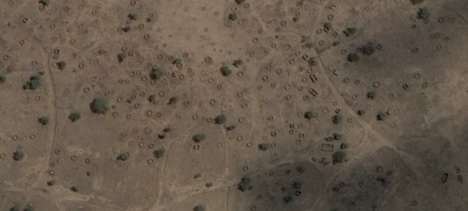
Props to the hard working young man at Google Earth who has been slaving to get all the detailed maps together. It’s a fine mission, ibn uckti, and we are all so proud of you and the hours you put in to make this possible.
The No. 1 Ladies’ Detective Agency, and more
If you enjoyed the trip through Botswana and would like to read more about Botswana, if you think you might go there someday, or if you think you might never go there – you need to read a wonderful series of books by Alexander McCall Smith.
The first book is The No. 1 Ladies’ Detective Agency. You meet the main character, and heroine, Mma Precious Ramotswe, the founder and owner of the only women’s detective agency in Botswana, and her assistant, Mma Grace Makutsi (who can’t resist a handsome pair of shoes), and the love of her Mma Ramotswe’s life, Mr. J. L. B. Matekone. Mma Ramotswe describes herself as “a woman of traditional build” and drives a very old, small white truck. She has a way of looking at things differently – and she solves her mysteries in ways you or I wouldn’t think of.
The books are short, and deceptively simple. They are “feel good” books, giving you smiles and warming your heart as you read. At the same time, you find yourself thinking back to these books, some of the issues, some of the characters, some of the plots – long after you have finished the book. That’s a sign of a good read!
As different as the thinking and culture is, the books are so full of grace and good humor and tolerance and forgiveness that when the book finishes, you can hardly wait to start the next one. You feel like Precious is your sister, a very smart sister, not without her flaws, but a woman to be respected, a woman of good character and who can make tough decisions.
She also makes mistakes, and has to live with the consequences. You will find the books addictive. The entire series is:
The No. 1 Ladies Detective Agency
Tears of the Giraffe
Morality for Beautiful Girls
The Kalahari Typing School for Men
The Full Cupboard of Life
In the Company of Cheerful Ladies
Blue Shoes and Happiness
Jeffrey Deaver’s mysteries, on the other hand, are intricate and woven through with arcane information, but you always learn something. He has a series about a quadriplegic, Lincoln Rymes, a criminologist, who solves cases in a very Sherlock Holmes kind of way, by thinking about the evidence and the patterns that it presents. He has a girlfriend, Amelia, who is a policewoman, and works with him on many of the cases. The books that have these two characters are:
The Bone Collector
The Coffin Dancer
The Empty Chair
The Stone Monkey
The Vanished Man
The Twelfth Card
Last – and least, for The Devil Wears Prada crowd is Linda Fairstein, who almost always has a book on the New York Times best seller list. Her heroine is Manhattan sex-crimes prosecutor (District Attorney) Alexandra Cooper, whose dad made a fortune on an artificial heart device, allowing her to work in the public service sector and still wear fabulous clothes, have weekly manicures and hair stylings at the best salons and eat at the coolest restaurants in town, and she tells you all about them.
They make great airplane reading for the trendy. The plots are formulaic – an astounding, mysterious crime is committed, Alexandra gets involved, along with her detective side-kicks, the criminal involved somehow focuses on Alexandra and she has to spend the night at her friends’ houses. You don’t read these mysteries for the astounding plots, you read them because they are funny and superficial and a quick read that doesn’t require much thinking.
Happy reading!
Hemingway Safari: Leaving the Kalihari Lions (Part 11)
Our last morning hearing “Good morning” and zip zip, as our water is delivered. The big full moon is still up as we get our coffee around the campfire, hating to go. But, all too soon, it is time to load our bags into the truck and head for the airstrip. It is cold. I have my sweater on over my dress. Both Godfrey and Paul, at separate times, admire my long Saudi dress, and tell me with approval that I look like an African woman. I am just glad that there are also blankets available in the truck, as it is really, really cold in the desert.
I am even more glad for the blanket a couple hours later, when Godfrey slows the truck, and then stops. In the middle of the road, not 100 yards away, are two lions. Big young male lions. They show no fear, and, in fact, one starts walking purposefully toward the truck. He eventually turns back, but as we begin to leave, he turns back for another look. Now, there are three of them. The biggest keeps walking toward us, and walks to the side of the truck, the side where I am sitting. Godfrey tells us just to keep still, and all that he has taught us about lions goes through my mind. Sit still, look him in they eye so he will know you are dominant and not afraid.
We’ve seen lions before, in Chobe, in Moremi, and in these more heavily travelled game parks, I think the animals know you aren’t a threat. Most of the time, they just tolerate you presence, or slowly walk away. And, my friends, I am looking this lion in the eye. He is four feet from me. And I know sees me. And I don’t think he thinks I am a part of the diesel and rubber smell, he looks amused, and intrigued, and . . .hungry.
I have seen my cats look at little mice the same way. And I am aware that we have no gun, and no real weapon. There is a shovel, but it is attached to the front bumper. The jack is on the rear bumper. There are thermoses, but they are in the wicker baskets. I am sitting her with nothing but a blanket and a camera, and this big interested looking lion is within pouncing distance. And he doesn’t think I am dominant. And he is very, very close. “Godfrey, DRIVE” I say, and I can hear AH and Angela breathe again; we’ve all been holding our breaths. Godfrey drives, very slowly, and the three young males lope along behind us.
I will add, that while I was sitting motionless with terror, eye to eye with the Kalihari lion, my husband was sitting just behind me, shooting photos over my shoulder.
What if we had had the flat tire in the middle of all this, we wonder? How would we change a tire? Godfrey says, you just wait until they go away. Waiting out a lion could take a LONG time, and it would seem even longer.
Then, out in front of the truck steps a female, and she has wounds. Godfrey drives very slowly, very carefully, for a wounded lion is a far less predictable lion. We are nearly giddy with relief when we finally get free of the lions, who lope along behind us for quite a while. The road is sand, and we can’t drive very fast.
My Adored Husband is totally annoyed that he ran out of film in the middle of the episode; I had film but I didn’t want to shoot while I was busy maintaining eye contact with the lion. (As it turns out, he did get one really good shot of the lion, a very beautiful shot, the lion is light gold against the white wheat of the background, and I love the shot.) The adreneline is still pumping. We made it to the airstrip just in time, in spite of the time we spent with the Kalihari lions.
Time to say goodbye to Godfrey, climb aboard our last little Cessna and leave the bush. What a way to go! Our flight to Maun is uneventful. Maun is a funny little airport, very small. We find a couple gift shops – we haven’t been spending anything out in the bush – and we deliver a message to Afro-Ventures from Godfrey, telling them he needs more information on his next safari. He has a full contingent of seven for the safari, a reverse of ours, starting in the Kalihari, just hours after we leave. They promise they will radio him the information.
We are not the same people as before we went to Botswana. We miss our camp. We loved this trip. You have to be able to endure the bumps and lumps of the overland drive to handle this particular trip, Afro Ventures’ Botswana a la Hemingway, but there are other ways, there are trips where you fly from destination to destination, and stay mostly in lodges. You would still experience much of what we experienced, just not the camping portion.
AfroVentures and CCAfrica merged, and we don’t think you can get a better combination of knowledgeable guides and gracious accomodations. Every single day of our journey exceeded expectations. It was a grand adventure. Thanks for coming along.

This lion is actually a Grumeti lion from Tanzania, but I wasn’t digital yet when we travelled Botswana.
Recent Comments
intlxpatr on Shampoo Ginger tigerbutterya0c5ff1d… on Shampoo Ginger intlxpatr on British Soldier Kidnapped, Esc… John on British Soldier Kidnapped, Esc… intlxpatr on British Soldier Kidnapped, Esc… Wikipedia Donate Button

Amazina


Early Voting in Florida


