Google Earth Adds New Layers
Google earth, according to OogleEarth has just added some new layers, one in particular of which highlights what is going on in Dharfur, and ties it to the United States Holocaust Memorial Museum, which tracks deaths, attacks, and refugees in the Dharfur region.
Many thanks to my source at GoogleEarth and greetings, Earthling! (I love saying that!)
Mediawatch: Covering the new Darfur default layer in Google Earth
Wednesday, April 11, 2007 (10:38 UTC)
Hundreds of media organizations carried news about the new Darfur layers in Google Earth — and that’s just in English. In Sweden alone, over 40 papers ran the news (an example). In the US, many local news organizations and papers ran the AP or Reuters story. Here’s a rundown of links to some of the larger and/or more interesting ones, with some observations at the end:
Using their own correspondents: The Los Angeles Times (business), BBC (front page feature), CNET (front page, and as a top headline for media 2.0), CNN (technology), Washington Times (business), PC World, ABC News (world news) and a good article/blog in Wired.
Reuters: Australia’s The Age (under technology), New Zealand Herald (world news), The Australian (world news) and Scientific American (science news).
AP: Seattle Post Intelligencer (business), MSNBC (technology), The Guardian (world news), Sydney Morning Herald (technology), the Houston Chronicle (markets), Seattle Times (world news), CBS News (technology), Baltimore Sun (world news), Washington Post (technology), San Jose Mercury News (breaking news), San Francisco Chronicle (business), Denver Post (world news), International Herald Tribune (Americas??) and the Sudan Tribune (which is a great resource for Darfur news, it turns out — pity they don’t have RSS).
AFP: Times of India (world news), iAfrica (technology) and Baku Today (technology).
IDG News service: IT World and InfoWorld.
What’s interesting is that there is no consensus among news editors as to where such a story belongs: Is the story’s most important news component the fact that there is a genocide being perpetrated in Darfur (world news), that new technologies are being employed to educate people about Darfur (technology), or that Google is involved (business)? In a sense, the situation in Darfur is not itself a “news” story, in that we all already (should) know what’s going on there. (If anything, the news is that it’s getting worse at the moment, and people I know who work there are doing so without much hope of a resolution anytime soon.) But putting the story in the technology section relegates it to a spot not followed by the people that the technology is most aiming to reach.
I think this is above all a story about how new technology is letting us all be witnesses to a genocide in progress, and how that raises our own responsibilities — so perhaps this is a story best also told in the glossy Sunday newspaper magazines, read when people have more time to play with Google Earth and where there is more room for long-form stories about larger technology trends coupled to humanitarian crises such as Darfur, but also Katrina/New Orleans and the Pakistan quake from 2005. How about it, New York Times?
My opinion: This has got to be one of the greatest blogs on earth. And he emphasis added in the above paragraph is mine.
Mosquito Magnet
I am a mosquito magnet. Adventure Man and I go to Africa almost yearly, on safari, sometimes walking, and we love it. But oh, the price I pay! Two or three times a day, I have to tend my wounds – putting antihistimine creams on my bites, which swell and throb and itch until it nearly drives me crazy.
In Tanzania last year, I had no sooner put some serious DEET on when a TseTse fly landed on me and bit me – right where I had just sprayed the repellent!
So every step scientists take to develop a repellent which will truly repel, I applaud.
Mosquitoes Target Exhaled Breath
The mechanism mosquitoes use to zero in on their targets has been discovered by scientists in New York. It is already known that the insects are very sensitive to carbon dioxide in exhaled breath.
Now a team led by Rockefeller University has found that they sense the gas using protein receptors in the structure extending from their jaws.
Writing in Nature, they say the discovery could aid the fight against insect-born diseases, such as malaria.
Read the rest of the article at BBC Health News.
I’m not ready to stop breathing! But maybe they could develop a gum I could chew that would mask the carbon dioxide I exhale?
Offices Full of Germs: Women the Worst
From – I am not kidding – The Nigerian Tribune.
(A recent) study pointed out that for a woman, her office desk may harbour far more bacteria than the workplace restroom and the office desk of men. In fact, women have three to four times the number of bacteria in, on and around their desks, phones, computers, keyboards, drawers and personal items than men do, the study by University of Arizona Professor Charles Gerba found. Gerba, a Professor of Soil, Water and Environmental sciences, tested more than 100 offices on the UA campus and in New York, Los Angeles, San Francisco, Oregon and Washington, D.C. in a study commissioned by the Clorox Co.
The researchers swabbed the offices of 59 women and 54 men in New York City, Los Angeles, San Francisco, Oregon, and Washington, D.C. They sampled eight sites in each office: the phone, desktop, computer mouse, computer keyboard, exclamation key on the computer keyboard, pen, bottom of desk drawer, and handle of desk drawer. The researchers also swabbed workers’ personal items at the office, including personal digital assistants (PDAs), women’s purses and makeup cases, and men’s wallets and found women have more germs on their office desks than men.
“I thought for sure men would be germier,” Gerba said. “But women have more interactions with small children and keep food in their desks. The other problem is makeup.” The tendency is high to doubt this statement. But much as a woman’s desks may typically look cleaner, the germs are likely to be more abundant. Cosmetics and hand lotions make prime germ-transfer agents, Gerba said. Makeup cases also make fine germ homes, along with phones, purses and desk drawers. Food in desk drawers also harbour lots of microorganisms, and it is more abundant among female office workers to have food in their desks and munch while on an assignment, on the computer or even picking a call.
Then, they tend to be around children more often than men, and we all know how easily kids transmit germs. And finally, they use makeup, which tends to absorb germs. Then it rubs off the face or gets scattered by brushes and sponges. The news was not all negative for females though. Gerba in the study found the worst office germ offender is men’s wallets. The back pocket is nice and warm; it’s a great incubator for bacteria. Another hot spot for bacteria in men’s offices: the personal digital assistant.” Men tend to play with their palm pilots more, thinking they’re playing video games or something,” Gerba said.
The top three bacteria hot spots in women’s offices, in order of germs amount : Makeup case, phone, and purse and in men’s offices starting from the highest to the least: Wallet, personal digital assistant and phone. Though a similar study by the Clorox Company, a manufacturer of disinfectant in February 2006, reported that in a study of nine office-based jobs, teachers had the work space with the highest amount of germs and lawyers had the least, Gerba said everyone should arm their office with a germ arsenal that includes: disinfectant wipes, disinfectant spray, paper towels and fruit (for drawer).
According to Gerba, people should clean cell phones and desk phones to get rid of bacteria. “You need to use a disinfectant wipe, or spray disinfectant on a paper towel, and clean the phone off. Never directly spray disinfectant cleaner on phone,” he said. “Do not use soap and water — that just pushes the germs around.” “We recommend that you use a wallet or purse that can be easily wiped off — like leather. A fabric bag is harder to clean and just holds more germs.”
Finally, Gerba said office knickknacks and accessories should be given the same thorough cleaning as everything else , explaining that “people tend to touch and pick up the germs on their desks. It’s a vicious cycle of germs transferring from hands to objects to desks. Hand sanitizers are great in eliminating the transfer of germs from your hands.” The level of germs on office desktops and telephones came in gender neutral; women had three to four times more germs on their keyboards and computer mice than their male counterparts. Desk drawers at women’s desks contained seven times more germs than men’s. Surprisingly, the research showed that the average office desktop has 400 times more bacteria than the average office toilet seat.
What Gerba found among the bacteria was coliform — intestinal bacteria generally found in human waste — on the restroom handles and faucets, in the kitchen sink and sponge, and even in candy basket. That “indicates to me somebody’s not washing his or her hands after coming back from the bathroom,” Gerba said.
That’s why Gerba found hundreds of thousands of bacteria on hot spots like a printer button and the button for the first floor in the elevator, touched by hundreds of fingers each day. Even though none of the bacteria Gerba found was life-threatening, they could lead to more colds and flu.
Prof Oluwole Adebo, a cardiothoracic surgeon commenting said this is a study Clorox, maker of a disinfectant commissioned and is motivated at helping them sell more of their products.” Without being in an office, the surface of our hand picks up germs throughout the day, but you don’t get infected by them because the skin is a barrier against germs. Some of the germs are not in a state to infect, especially in places that are dry and hot, but where humid, it can incubate bacteria. So when you are to eat, wash your hands because there are bacteria on your hands. These bacteria are not in a position to harm us and therefore these is no reason to clean with disinfectants.
“America is full of studies like that. They study everything and make money out of it. The fact is this, in the air you breathe in, there are bacteria in it. Do you sterilize it? No, the body is sufficient to keep the germs at bay. It is all out to pursue people to buy their product”, he concluded.
My Comment: Remember Lies, Damn Lies and Statistics where we talked about who structures the survey? It works the same for studies. The sponsor of this study is Clorox, who make Clorox bleach and multiple cleaning disinfectants. It is in their interest for Professor Gerba to find a very germy environment. The more disinfectants we buy, the higher their profits soar. Prof Oluwole Adebo is right! Germs are everywhere, and we survive, and even develop immunities to them. This study is purely to sell more Clorox products by convincing us we have an epidemic of uncleanliness.
On the other hand . . . it may be time to clean out the make up case and throw away that candy bar . . . 🙂
Egypt blogger jailed for ‘insult’
From BBC News:
An Egyptian court has sentenced an internet blogger to four years’ prison for insulting Islam and the president.
Abdel Kareem Soliman’s trial was the first time that a blogger had been prosecuted in Egypt.
He had used his weblog to criticise the country’s top Islamic institution, the al-Azhar university and President Hosni Mubarak, whom he called a dictator.
A human rights group called the verdict “very tough” and a “strong message” to Egypt’s thousands of bloggers.
Mr Soliman, 22, was tried in his native city of Alexandria. He blogs under the name Kareem Amer.
A former student at al-Azhar, he called the institution “the university of terrorism” and accused it of suppressing free thought.
The university expelled him in 2006 and pressed prosecutors to put him on trial.
During the five-minute court session the judge said Soliman was guilty and would serve three years for insulting Islam and inciting sedition, and one year for insulting Mr Mubarak.
Egypt arrested a number of bloggers who had been critical of the government during 2006, but they were all freed.
“This is a strong message to all bloggers who are put under strong surveillance that the punishment will very strong,” Hafiz Abou Saada of the Egyptian Human Rights Organisation told Associated Press.
Outrage: Rape Reporting from Monrovia and Iran
My energy is back. I felt so blessed – today I started my photo albums. I had it all organized, but just couldn’t make myself DO it. Today was a new day, woke up at a reasonable hour with energy! Alhamdallah!
Back in my workshop, Qatteri Cat helping, BBC on to keep me company . . . and two separate reports come on BBC News (radio). I can sit, or I can share my outrage with you. Here I am . . .
The report from Monrovia is about the continuous rape of children, even infants under one year. They are only now documenting it is happening, and to what extent. Before, it was deny, deny, deny.
Here is a direct quote from the program: “Rape is so entrenched in the society.” They haven’t begun to study WHY it is happening, only documenting that it IS happening. To children, the weakest, least powerful segment of society. And in other African countries, societal studies have shown that there is a belief that having sex with virgins, uncontaminated, can cure AIDS. So ignorant. So selfish. And as the virgins become fewer, the victims get younger. Who would rape an infant? Who would be so desperate and so depraved? It makes me shake, it makes me so angry, this violation of the most innocent.
The second case is about an Iranian woman, Norouzi, who killed a man who was attempting to rape her. Convicted of murder, and given the death penalty, the court said she had used “too much force” in defending herself.
So, in your experience, what happens if you defend yourself but leave your attacker still capable? Your self-defense only makes him/her more angry, more lethal, and raises your probability of ending up dead yourself. Hmmmmm. . . . experience rape and likely death, or kill my attacker?? I know, in a heartbeat, which I would choose.
The family has forgiven her IF she pays the blood money of nearly $63,000 dollars. Pay $63,000 for the SCUM that tried to rape her??
Share my outrage. You can read the entire story on the BBC website, here.
A quote from this newsarticle:
Women’s rights activist and lawyer Sara Irani told The Associated Press news agency she welcomed the resolution of the case.
“Norouzi’s freedom will give new breath to women to find the courage to stand up for their rights and defend themselves,” she said.
In Iran, a married woman who is raped risks the death penalty for adultery if she cannot prove she was violated.
If she kills her attacker, she may also face the death sentence for murder.
You may wonder why I tag this a political issue. Politics is all about power. This woman, and these children are victims because 1) they are physically weaker than their attackers and 2) their attackers don’t believe there will be any repercussions; they believe they are entitled to what they take and that there will be no penalty. It’s about power. It’s political until there are laws strong enough to protect the weak and innocent against their attackers, and those laws are enforced.
January Projects
When our son and daughter-in-law were visiting, she was telling me our son has routines he adapts to insure he gets everything done. As she was telling me this, I was squirming in my chair. I am not exactly obsessive-compulsive, but because I could have a tendency to scatter my energies, I do the same thing, I have little routines I run to make sure that the important things get taken care of before I have fun.
One of these routines is to use January to get organized so that I can goof off the rest of the year. I try to get tax things in order, I try to make sure all the paperwork is filed or tossed . . . and I do photo albums for the preceding year, two albums if we went to Africa, which we have been doing nearly every year.
But last January I moved. And then, just about every other month, I was back in the States, either of a wedding or to see my parents. The albums never got done.
So yesterday, I gathered all the photos. Fortunately, I had kept them in different places, so they were not all mixed up. I have to do four albums. For the 2006 family album, I still need to get photos printed, and that alone takes time and organization. The other photos, I just needed to get in order. That took a whole day.
So this is for my friend – you know who you are – with twenty something years of photos she still hasn’t posted. I apologize! I apologize for all the times I told you how easy it is, and to just DO it. I am only one year behind, and already I can’t remember where this photo was taken, why that photo was taken, or what sequence these photos should be in. It is a daunting task, and I am only working on two years. I apologize again, dear friend, I grovel in mortification at my arrogance and lack of sympathy. God, in his mighty wisdon, has humbled me by showing me how fragile my memory is, and how unfounded my pride in organization. Aarrgh! Forgive me!
Circumcision NOT complete protecton against HIV/Aids
One of my favorite source blogs Sociolingo reports the significant news from Africa. On December 14th, he quotes a United Nations report stating that while circumcision halves the risk of HIV infection, it should not be relied upon without condoms.
“Although these results demonstrate that male circumcision reduces the risk of men becoming infected with HIV, the UN agencies emphasize that it does not provide complete protection against HIV infection,” they said. “Circumcised men can still become infected with the virus and, if HIV-positive, can infect their sexual partners.
“Male circumcision should never replace other known effective prevention methods and should always be considered as part of a comprehensive prevention package, which includes correct and consistent use of male or female condoms, reduction in the number of sexual partners, delaying the onset of sexual relations, and HIV testing and counselling,” they added.
Liberation Tower at Night and Qatteri Cat

We love going to Souk Mubarakia. Took this recently on a cool, clear night from the souks
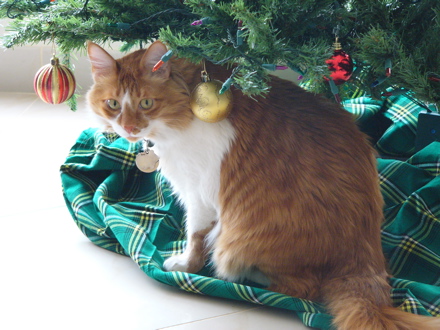
The Qatteri Cat has not lost interest in the tree, but no longer seems interested in pulling it over. The blanket is Masai, from Tanzania. Great Christmas colors!
Santa’s Wish List: Cookbooks
You might think I love to cook. You would be very wrong.
I had a great friend for many years, one of those Southern gals with a last name first name, and when one day I told her of my secret guilt – that cooking wasn’t FUN for me, she said “what we do, every day, is SURVIVAL cooking. We just meet the expectation of getting a meal on the table. That doesn’t have to be fun, it just has to be done.”
That’s pretty much what I do, and why I have been giving you all these great recipes. The truth about the recipes I am giving you is that most of them are EASY and they taste good. A few require special equipment and mastering a new skill, but it’s like swimming – once you’ve done it, it’s easy. There is nothing complicated about the recipes I am sharing with you – they are ones I use, too!
Books About Food and Eating
First I will share with you two books available through third party vendors at Amazon. The first is Food Lover’s Companion (A Comprehensive Definition of Over 4000 Food, Wine and Culinary Terms) by Sharon Tyler Herbst, which is available starting at $14.93, and the second is M.F.K Fisher’s The Art of Eating, also available through Amazon at $11.53. The Companion is invaluable when someone uses a term for a cooking technique or ingredient you don’t know; it has words for everything! My husband reads this book sometimes just for fun and is always sharing new information he has learned. The MFK Fisher book is just plain fun reading about food, full of information and anecdotes and stories, written in an enormously readable way.


Beginner Cookbooks
The first cookbook I used was the McCalls Cookbook – no longer in print. It had photos of how do do the things I found so intimidating, and that is where I got my earliers Christmas cookie recipes – the Russian Tea Cakes and the Candy Cane Cookies. The second was The Joy of Cooking, which I mentioned in an earlier blog entry. What is good about these books is that they keep it really simple. In Joy, they give you a long theoretical section, which you can read if you have the time, and which helps, but at the beginning it isn’t always easy to even understand the basics. That takes time. Then you can go back and read later and go “Aha! Now I understand!”
Cookbook Secrets
Actually, I love reading cookbooks. I have a huge collection. And almost all of them are Junior League Cookbooks. So here’s the secret – when you are looking for cookbooks, look for ones where women who contribute have to put their names. If their name is on the recipe, you can trust that the recipe will work, and that it will be one of their best recipes – they don’t want to be embarrassed!
The majority my cookbooks are from the South. And narrowing it down even further, most of my favorites come from Louisiana or Georgia.
The first one I ever bought was Talk About Good! And oh, it WAS good!

These recipes use ingredients like real cream and real butter and lots of salt. Southern people have some of the lowest life-expectancy rates in the United States – I suspect their eating habits have a lot to do with it. But if it isn’t a habit to eat so richly, every now and then it just tastes SO GOOD to use these ingredients. You will also notice that it has what they call a “plastic comb” binding. That means when you open it up to follow a recipe, it will lie flat. That’s a really good thing!
My second favorite is Quail Country, by the Junior League of Albany, Georgia. You would really have to scour the book stores to find this out-of-print classic, because so few people would ever want to part with it. Another gem is The Fort Leavenworth Collection, if you can get your hands on it – again, yard sales, used book stores would be your best bet.
There is a wonderful group of stores in the USA called Half Price Books. If books are not being bought as gifts, if you plan to just read a book and pass it along, or if you like to have a few on hand to pass along because you think they are so great, Half Price Books is a great place. They have the most obscure books, books you never thought you would see again. Many of their books are new, but remaindered (left over from book stores that couldn’t sell the, or from publishers who published too many copies) so they are sold at half price. They will also buy used books from you, but to me, they offer so little that I would just as soon give them away. (No, I don’t own stock in Half Price Books.)
There are some other fabulous Junior League cookbooks – the California Heritage Cookbook, the Seattle Classics, and there are other cookbooks produced by churches and charities that also have “real people” recipes that are drop-dead good. I remember once sharing a recipe for Chocolate Cheesecake from Seattle Classics. My friend told me she made it for Christmas dinner, but everyone was too full to eat dessert. But she said all night she heard doors opening and closing, as people snuck down to the kitchen to slice a little of the cheesecake and eat it, and in the morning, only a fragment was left!
Seeking out the best cookbooks can make every vacation an adventure. I have cookbooks from Kenya and Tunisia, Qatar, Jordan and Saudi Arabia . . . all full of great recipes, recipes with names attatched. I wish you a grand adventure seeking out cookbooks that will thrill your heart. Happy Hunting!
Africa’s Oldest Pupil
This is a story I saw in last week’s Kuwait Times, but I can’t get it out of my mind. This humble man, with his ongoing search for knowledge, is an inspiration to me.
Source: Reuters
(This story is part of a special report on education in Africa, issued on Nov. 15)
By Andrew Cawthorne
ELDORET, Kenya, Nov 15 (Reuters) – With his stubbly grey beard and walking stick at his side, 86-year-old Kimani Maruge looks a little out of place among the rows of children sitting behind wooden desks at Kapkenduiywo Primary School. Yet classmates 10 times his junior would be hard-pressed to match the enthusiasm of Maruge, a farmer and veteran of Kenya’s 1950s anti-colonial Mau Mau revolt, who has the distinction of being the oldest pupil on the planet.
“I will only stop studying if I go blind or die,” Maruge says at the crowded school in a poor neighbourhood outside Eldoret in Kenya’s western farmlands.
The illiterate great-grandfather – who has outlived 10 of his 15 children — jumped at a belated chance to educate himself when President Mwai Kibaki introduced free primary schooling in the east African nation in 2003.
Enrolment across Kenya shot up overnight, with 1.2 million more children going to school. Kapkenduiywo had 375 pupils before Kibaki’s measure, and now has 892.
But there are none quite like Maruge. He says his inspiration came from listening to a preacher in church and suspecting he was misinterpreting the Bible.
“I wanted to go to school to be able to read the Bible for myself,” he says, tucking his long legs under a tiny, shared desk at the front of his overcrowded classroom of 96 pupils. “And in case there is ever any compensation for us Mau Mau, I would like to be able to count my money properly at the bank,” he adds with a large grin.
PERSISTENCE PAID OFF
When he first turned up at the school gates in regulation knee-length socks, cut-off trousers and navy blue jumper, Maruge was greeted with laughter. Teaching staff tried at first to direct him to adult education classes. But when he returned again and again, they realised he would not be deterred, and anyway there is no legal age-limit for primary school entrance in Kenya.
“Inside me, when I saw him there, I felt he was serious,” says headmistress Jane Obinchu. “And look at him now. Nearly three years later, he’s still here. He’s over the most difficult part, he won’t drop out now.”
In the classroom, Maruge’s favourite subjects are Swahili and maths, but he struggles with English which is new and strange to him. He is treated like any other schoolboy except for one privilege: tea at break. Fellow pupils treat him with care and respect, and love to listen to his tales of Kenyan history between classes.
“He tells us about the Mau Mau,” says Ireen Wairimu, 11. “And about the time when white kids used to go to school under a roof while African kids sat under trees.”
Hobbling on a foot he says was disfigured when he was tortured by British colonial captors during the Mau Mau revolt, Maruge cannot keep up with all the playground games. But he watches with relish and is always surrounded by chattering kids.
“They are my friends, they love me, they help me walk home,” he says. “I want to break the barriers between old and young.”
INTERNATIONAL POSTER-BOY
Known in his neighbourhood as “Mzee” – a Swahili term of respect for an elder – Maruge is happy to show off his new knowledge, reading passages of the Bible slowly and clearly in front of his house after school. Although still living humbly, Maruge has become a national celebrity and something of a poster boy for free education campaigners worldwide. Last year, he was feted at the United Nations in New York. This year, a Hollywood crew are working on a film about him.
“School has changed him. He looks younger and happier, rejuvenated by getting a second chance in life,” says headmistress Obinchu. “He calls me his mother, but I am the age of his daughters. He is an inspiration to all of us.”
Despite his advanced years, Maruge has plenty of dreams for the future. “I won’t stop. I want my name one day to be Professor, Doctor Kimani!,” he says, holding his books close to his chest. “Liberty is learning, you know.”
Recent Comments
intlxpatr on Shampoo Ginger tigerbutterya0c5ff1d… on Shampoo Ginger intlxpatr on British Soldier Kidnapped, Esc… John on British Soldier Kidnapped, Esc… intlxpatr on British Soldier Kidnapped, Esc… Wikipedia Donate Button

Amazina


Early Voting in Florida


