Hiking With Robin Pope in Zambia (2)
The days pass too quickly. Our bags catch up with us on the third day – one day to get from J-burg to Lusaka, one day to get from Lusaka to Mfuwe, and one day to get to the camp at Nkwali. We never had a moment’s concern; they kept us informed every step along the way.
Here is what the day looks like – early early you hear a knock on the door and someone says “Good morning!” and you struggle out of bed. It is still the middle of winter below the equator, so it is cold. You jump into your clothing and head for the campfire, where breakfast is served. Toast is being heated on the grill, there is hot cereal and cold cereal, and some mornings there is even bacon. There is always hot coffee and hot tea. You can socialize or not, as your morning nature indicates, then grab your gear and load up. Usually it is you and your traveling partner, maybe another couple, and the guide. Every day you take off to a new area, sometimes for the whole day so you can see outlying areas, and sometimes just for three to five hours.

There is never a game drive where you don’t see something. Most of the people who show up at the Robin Pope camps are good safari travelers – good at spotting movement, as excited to see a bat eared fox as another lion, people who will sit and watch giraffe, or hippos, or storks . . . people who know when not to talk, and people who are considerate of one another when shooting photos or movies.

We move on to Nsefu, where the cabins are round! There is a big outdoor BBQ that night, lots of fun, down by the marsh where there is always something happening. We saw a huge Pell’s Fishing Owl, a great thrill, and several varieties of eagle. Watching the raptors is a huge thrill.
And then – our favorite camp – Tena Tena. They put us in the very end cabin, and oh, we like that very much. Tena Tena is rebuilt every year – you get there by boat. Tent-cabins are rebuilt once the rains stop and the floodwaters recede. The cabins are fabulous – during the day, they are totally open to the outdoors. Big huge king sized beds, flat woven carpeting with pile carpet accents, a large dressing area with shelves so you can really unpack and move in, and a huge outdoor shower and toilet and sink area to be shared with the stars and moon shining down on you. At night, the tents are closed, and an electrified fence prevents too much chance of invasion. The marsh area in front of the camp teems with life – after dinner one night, we have to wait until the leopard leaves before the guide will take us to our tent.
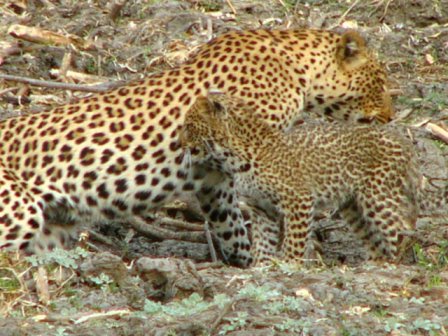
On our very favorite game drive at Tena Tena, we were out on the night of a full moon, and came across a pride of lions hunting. We spent nearly an hour just watching breathlessly as the lions tracked their victims, spreading out, sharing the responsibilities in the pack. There is no ambient light at all, so the sky is black as ink, and the stars are sparkling brighter than the finest diamonds. The moon casts a ghostly glow on the surroundings – enough light I can shoot photos without a flash. It is magical, and unforgettable.
My husband tells this story of Tena Tena:
“One night, I heard a loud sound and I couldn’t figure out what it was. I opened the tent flap and not two feet away was a hippo, eating a bush, and it was the loud chewing that I heard. What a thrill! The hippo was huge! I watched spellbound; I woke my wife. . .it was awesome. Two feet away! And then, the second night, he was back. What a thrill – he chews so loudly! The third night he was back again – ‘that damn hippo! I can’t sleep!’”
Hiking with Robin Pope in Zambia (One)
Today it is rainy and cold, and I have “miles to go before I sleep.” In my mind, I fly back to a happier time, and today I choose to be back in Zambia.
We fell in love with Zambia our first time there. We flew in to Lusaka, and our bags didn’t make it. We called frantically from the Holiday Inn and got a different answer every time we called. First we heard that our bags would be in on a later flight that day – which was what we wanted to hear, as we were leaving early the next morning. Later, the harried British Air office told us with clear annoyance in her voice that there were no more flights from Johannesburg, and our bags would catch up with us . . . Catch up with us? We were off to the bush for two weeks!
I was in a skirt. It was cold in the bush, and we had nothing with us but our camera equipment (Thank God!) and a change of underwear. We looked at each other and said “Holy smokes. We’re screwed. What do we do now?”
It was five o’clock at night. We grabbed a taxi and asked him to take us to a place with stores with clothing. He took us to a small strip mall, and waited for us while we ran in and searched desperately for socks, pants, sweatshirts and spare underwear. It was . . .fun! Almost everything we found was from China, but we managed to find it all pretty much in green. The underwear was really cheap stuff and wouldn’t wear well, but it just had to last until our bags caught up with us. Part of what was fun was that we had read Lusaka was dangerous at night, but at least here in the shops area there seemed to be plenty of security and the shops took Visa cards. Within an hour, we had jeans, sweatshirts, socks and enough to live on until the bags came.
At five the next morning we headed back to the airport and out to Nkwali, the first stop in the Robin Pope series of camps. Our large cabin at Nkwali overlooked a huge pod of hippos, and all night we could hear them talking to one another, and occasionally having a huge, very noisy family argument. The food at Nkwali was delicious, and we loved getting to see the kitchen and meet the people who prepared the foods. They grow a lot of their own produce, and have agreements with local farmers to supply much of what they cook up for the guests.
At Nkwali, they provided beautiful linen bathrobes for us to wear after our showers in our enclosed outdoor shower, and kikoy, a multi-purpose shawl/wrap thing in wonderful colors that you can use as headgear, neck gear, wet down to keep cool in the heat of the afternoon, as a wrap – they are both big – maybe 150 cm long by 110 cm wide – and lightweight, very flexible.
Nkwali is such a cool camp. Every detail is managed. The camp manager visited us and assured us they were in contact with British Air, and our bags would reach us the next day. Relieved of that worry, we went out on our first game drive, saw leopard and lion and a million gorgeous birds, and had drinks at sundown overlooking a field full of wildlife action. After dinner, we went to bed to the sound of the soft grunting sounds of the hippo. Paradise, here on earth.

Dharfur: We can No Longer Pretend We Don’t Know
Today, in his blog, Ogle Earth, which discusses new developments with Google Earth, Stefan Geens says the following about the new hi-res maps of the Sudan made public today in Google Earth:
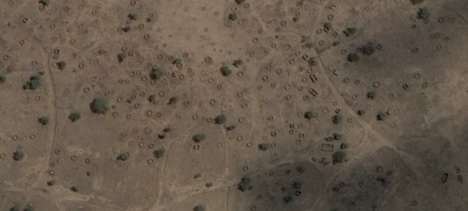
Those circles aren’t animal pens. They’re burned-down gottias, circular mud huts that had straw roofs, and they’re what’s left of Dalia, a village in Sudan’s Darfur region, one of hundreds of villages that have been destroyed by the Janjaweed in a program of depopulation that has killed perhaps 400,000 civilians since 2003.
Today, Google added recent high resolution imagery of Darfur to Google Earth, taken by DigitalGlobe in January-March 2006. It serves as an unequivocal indictment of the Janjaweed, and of the Sudanese government whose implicit support it has enjoyed, because in these new images each and every burned-out gottia is visible. This is the kind of evidence that puts paid to the claims still coming out of Khartoum that the ethnic cleansing is not widespead, and that accusations of genocide are a mere pretext to wrest sovereignty away from Sudan with the deployment of UN peacekeepers.
Read the blog entry for yourself here.
He goes on to say “we can no longer pretend we don’t know.”
He’s right. It’s there, in high resolution, for all to see.
Props to the hard working young man at Google Earth who has been slaving to get all the detailed maps together. It’s a fine mission, ibn uckti, and we are all so proud of you and the hours you put in to make this possible.
The No. 1 Ladies’ Detective Agency, and more
If you enjoyed the trip through Botswana and would like to read more about Botswana, if you think you might go there someday, or if you think you might never go there – you need to read a wonderful series of books by Alexander McCall Smith.
The first book is The No. 1 Ladies’ Detective Agency. You meet the main character, and heroine, Mma Precious Ramotswe, the founder and owner of the only women’s detective agency in Botswana, and her assistant, Mma Grace Makutsi (who can’t resist a handsome pair of shoes), and the love of her Mma Ramotswe’s life, Mr. J. L. B. Matekone. Mma Ramotswe describes herself as “a woman of traditional build” and drives a very old, small white truck. She has a way of looking at things differently – and she solves her mysteries in ways you or I wouldn’t think of.
The books are short, and deceptively simple. They are “feel good” books, giving you smiles and warming your heart as you read. At the same time, you find yourself thinking back to these books, some of the issues, some of the characters, some of the plots – long after you have finished the book. That’s a sign of a good read!
As different as the thinking and culture is, the books are so full of grace and good humor and tolerance and forgiveness that when the book finishes, you can hardly wait to start the next one. You feel like Precious is your sister, a very smart sister, not without her flaws, but a woman to be respected, a woman of good character and who can make tough decisions.
She also makes mistakes, and has to live with the consequences. You will find the books addictive. The entire series is:
The No. 1 Ladies Detective Agency
Tears of the Giraffe
Morality for Beautiful Girls
The Kalahari Typing School for Men
The Full Cupboard of Life
In the Company of Cheerful Ladies
Blue Shoes and Happiness
Jeffrey Deaver’s mysteries, on the other hand, are intricate and woven through with arcane information, but you always learn something. He has a series about a quadriplegic, Lincoln Rymes, a criminologist, who solves cases in a very Sherlock Holmes kind of way, by thinking about the evidence and the patterns that it presents. He has a girlfriend, Amelia, who is a policewoman, and works with him on many of the cases. The books that have these two characters are:
The Bone Collector
The Coffin Dancer
The Empty Chair
The Stone Monkey
The Vanished Man
The Twelfth Card
Last – and least, for The Devil Wears Prada crowd is Linda Fairstein, who almost always has a book on the New York Times best seller list. Her heroine is Manhattan sex-crimes prosecutor (District Attorney) Alexandra Cooper, whose dad made a fortune on an artificial heart device, allowing her to work in the public service sector and still wear fabulous clothes, have weekly manicures and hair stylings at the best salons and eat at the coolest restaurants in town, and she tells you all about them.
They make great airplane reading for the trendy. The plots are formulaic – an astounding, mysterious crime is committed, Alexandra gets involved, along with her detective side-kicks, the criminal involved somehow focuses on Alexandra and she has to spend the night at her friends’ houses. You don’t read these mysteries for the astounding plots, you read them because they are funny and superficial and a quick read that doesn’t require much thinking.
Happy reading!
Hemingway Safari: Leaving the Kalihari Lions (Part 11)
Our last morning hearing “Good morning” and zip zip, as our water is delivered. The big full moon is still up as we get our coffee around the campfire, hating to go. But, all too soon, it is time to load our bags into the truck and head for the airstrip. It is cold. I have my sweater on over my dress. Both Godfrey and Paul, at separate times, admire my long Saudi dress, and tell me with approval that I look like an African woman. I am just glad that there are also blankets available in the truck, as it is really, really cold in the desert.
I am even more glad for the blanket a couple hours later, when Godfrey slows the truck, and then stops. In the middle of the road, not 100 yards away, are two lions. Big young male lions. They show no fear, and, in fact, one starts walking purposefully toward the truck. He eventually turns back, but as we begin to leave, he turns back for another look. Now, there are three of them. The biggest keeps walking toward us, and walks to the side of the truck, the side where I am sitting. Godfrey tells us just to keep still, and all that he has taught us about lions goes through my mind. Sit still, look him in they eye so he will know you are dominant and not afraid.
We’ve seen lions before, in Chobe, in Moremi, and in these more heavily travelled game parks, I think the animals know you aren’t a threat. Most of the time, they just tolerate you presence, or slowly walk away. And, my friends, I am looking this lion in the eye. He is four feet from me. And I know sees me. And I don’t think he thinks I am a part of the diesel and rubber smell, he looks amused, and intrigued, and . . .hungry.
I have seen my cats look at little mice the same way. And I am aware that we have no gun, and no real weapon. There is a shovel, but it is attached to the front bumper. The jack is on the rear bumper. There are thermoses, but they are in the wicker baskets. I am sitting her with nothing but a blanket and a camera, and this big interested looking lion is within pouncing distance. And he doesn’t think I am dominant. And he is very, very close. “Godfrey, DRIVE” I say, and I can hear AH and Angela breathe again; we’ve all been holding our breaths. Godfrey drives, very slowly, and the three young males lope along behind us.
I will add, that while I was sitting motionless with terror, eye to eye with the Kalihari lion, my husband was sitting just behind me, shooting photos over my shoulder.
What if we had had the flat tire in the middle of all this, we wonder? How would we change a tire? Godfrey says, you just wait until they go away. Waiting out a lion could take a LONG time, and it would seem even longer.
Then, out in front of the truck steps a female, and she has wounds. Godfrey drives very slowly, very carefully, for a wounded lion is a far less predictable lion. We are nearly giddy with relief when we finally get free of the lions, who lope along behind us for quite a while. The road is sand, and we can’t drive very fast.
My Adored Husband is totally annoyed that he ran out of film in the middle of the episode; I had film but I didn’t want to shoot while I was busy maintaining eye contact with the lion. (As it turns out, he did get one really good shot of the lion, a very beautiful shot, the lion is light gold against the white wheat of the background, and I love the shot.) The adreneline is still pumping. We made it to the airstrip just in time, in spite of the time we spent with the Kalihari lions.
Time to say goodbye to Godfrey, climb aboard our last little Cessna and leave the bush. What a way to go! Our flight to Maun is uneventful. Maun is a funny little airport, very small. We find a couple gift shops – we haven’t been spending anything out in the bush – and we deliver a message to Afro-Ventures from Godfrey, telling them he needs more information on his next safari. He has a full contingent of seven for the safari, a reverse of ours, starting in the Kalihari, just hours after we leave. They promise they will radio him the information.
We are not the same people as before we went to Botswana. We miss our camp. We loved this trip. You have to be able to endure the bumps and lumps of the overland drive to handle this particular trip, Afro Ventures’ Botswana a la Hemingway, but there are other ways, there are trips where you fly from destination to destination, and stay mostly in lodges. You would still experience much of what we experienced, just not the camping portion.
AfroVentures and CCAfrica merged, and we don’t think you can get a better combination of knowledgeable guides and gracious accomodations. Every single day of our journey exceeded expectations. It was a grand adventure. Thanks for coming along.

This lion is actually a Grumeti lion from Tanzania, but I wasn’t digital yet when we travelled Botswana.
The Hemingway Safari: The Kalihari (Part 10)
The next morning, we take it easy, late breakfast, get all packed up and are ready for our short trip to the airstrip. Our pilot is Collin McAlister, again, which we find delightful. And this time, I don’t even feel the least bit claustrophobic. I LIKE flying this way, where you stow your own bag, you get on, fly, get off, grab your bag – it is SO efficient!
This flight is totally different from the last one, in that we go from the lushness of the Okavango Delta into the dry Kalihari. Now the Kalihari airstrip seems remote enough when we see Godfrey there to meet us, but we still have a four hour drive in front of us to the Deception Valley camp site. Godfrey has put the canvas top over the wagon which protects us from the hottest part of the sun, but still we can see out.
Godrey points out to us the tiny melons growing along the side of the road, and says that the lions eat them for water, as there is no source of water in the middle of the desert. There were some pumps, but there was an earthquake and the pipes broke. Later, on one of our game drives, we see a crew out in the middle of way-far-out-nowhere, and they are repairing the pipes so that one day the water holes will function again. We also see a tiny green desert hibiscus flower.
We have never seen such a bleak landscape. It is hard to believe that this land can support any life at all, but . . . Godfrey shows us wonders. One of the first is an entire herd of gigantic male kudus, very large deer-like animals with beautiful twisted antlers. They can bound over very high fences, and make it look easy. We saw this, on the long drive to our camp site, the fences were over 7 feet high, and these huge antelope sailed over at a gallop. It takes our breath away.
We also saw ostrich, many of them, male and female, and they always run away when we get close. When they run, they really bounce from side to side, and look very comical, like ballerinas running off-stage.
We have to stop several times to go through gates into the Kalihari game reserve. We want to see the lions, the lions of the Kalihari, the great, very wild lions we have heard about. We don’t see any on the four hour ride to our camp, but we have seen so much that it hardly matters. And we are grateful to sink into our familiar beds in our familiar tents, to have a hot shower, and a rest before the afternoon game drive.
As we come into camp, John and Richard are leaving in the big truck, to go get water. We use water very sparingly, but supporting life out on the desert means you have to bring in everything. John and Richard will drive a couple hours to the water station, will fill and drive back. The water is a little red. We don’t drink it, and we keep our mouths shut when we shower.
During our late afternoon game drive, we see a Cape Fox running through a herd of steinbok, and just as the light is failing, Godfrey spots a cheetah walking through the grass a few hundred yards away. We watch until darkness falls and we can’t see it any longer.
By this time, our ears have adjusted and we can understand Godfrey almost perfectly. When he says the steinbok dig for “tubas”, we know it is not musical instruments, but tubers. When he says “maybe he feign-ed illness, I don know”, we understand that maybe Paul was sick and maybe he wasn’t. We know that the “red boo boo shirke” is the red breasted shrike. We have come to admire and respect Godfrey immensely. He has so much knowledge of the animals and birds and trees and flowers, and also he manages the staff so well, keeps them operating smoothly under very extreme conditions AND keeps all the equipment well maintained.
We admire his driving ability. You would have to see the roads we are on to understand, the narrow, one lane, unpaved roads. Sometimes rocky, mostly sandy and always rutted and full of holes. In the Kalihari, there is the additional challenge of aardvark holes. The aardvark loves digging in the roads, as the roads are clear of brush. But aardvarks dig HUGE holes.
Back in camp, the lanterns are glowing in front of our tents, Dorcas meets us with hot washcloths, and oh, glory, there is a huge full moon rising over our camp. Here we are in the Kalihari desert, and we never want to leave.
I DO miss the sound of the elephants and hippos, and I don’t hear any lions. Even the birds are quieter here, no owls. It is very, very quiet. And then, there is that huge, full moon. We are in heaven. For dinner that night, Sky serves chicken in peanut sauce, and oh, it is delicious. The next morning when we stop for mid-morning tea and coffee, we find he has made sandwiches with the leftovers, and we are delighted. On this morning’s game run we see mongoose, an aardwolf, and a bat-eared fox. Four days in the Kalihari, and where are the lions?
We take a full day game drive to far away places. We see a solitary giraffe, and wonder how on earth he survives? He is very old, you can tell by his very dark color, Godfrey tells us. We set up for lunch under a huge tree. Godfrey looks up, and while we don’t see a leopard, we know a leopard has been there, as there is a dessicated springbok carcass high in the tree, where the leopard left it.
We get to see the springbok springing, which is a lot like the pronking of the impala, and we see a red haartebeast, and a brown hyena, all very rare, but still, no lions. We do see lion poop, Godfrey tells us we know it is lion poop because it has fur in it.
On our way back to the camp, at the end of a long day, we have the first, and only, flat tire of our trip, and the cause is a thorn. Not just any old thorn, this thorn is as thick and strong as an iron spike. It is astonishing how fast Godfrey and Paul change the tire. The tires are big, thick, sturdy tires, and we are amazed that this is the first and only one we have had. And at the same time, we haven’t seen anyone else for hours. If we didn’t have a spare, or if we lost a tire AND a second tire, we would be very very isolated out here in the middle of the desert. It is a soboring thought. The kind of thought you don’t think before you make a trip like this or you might not make the trip at all! 😉
We are back in camp this last night of our journey about 5, early for us, but we have been out all day, and we have to be packed to leave the next morning BY seven, in order to make it to the airstrip for our pickup.
Godfrey prides himself on being reliable, and says if you get a bad reputation for not being on time the bush pilots can refuse to do your pick ups. Not only does he deliver people promptly, but he always has tea/coffee/sodas and sandwiches available to offer to the pilots, and from talking with Collin, we know that this is exceptional and remarkable. But Godfrey is a very unusual person, and we have watched him now for two weeks, and learned that a lot of his success comes from taking his time with people, talking with them, building relationships and consensus. We kid him that one day he will probably be president of Botswana, but Godfrey says he will be happy to be president of the Tour Guide association.
The Hemingway Safari: Nxabexa (Part 9)
The next morning we are going on the mokoro ride. The mokoro is a very narrow little canoe, and they are going out into the swamp with men who use poles to take the canoes on a shallow water safari. You don’t want to get into too deep water, as there are hippos, who are very mean and ugly when you get into their territory. They are also very fast for creatures their size, and lethal. There are also mosquitos.
All in all, I just figure I NEED a quiet morning to myself. I love my sweet husband, and from time to time I just NEED some alone time. Coffee and tea, and small cookies are delivered in a wicker basket at 6:30, even small flasks of milk. AH pours me coffee and gets ready to leave. I am looking forward to a leisurely shower, wash my hair – I know there is a hair dryer. So I go to the shower (zip zip zip zip) and then discover there is no conditioner so I have to go back into the cabin, already dripping wet (zip zip zip zip – zip zip zip zip) and I have to laugh; it is a good thing I am not in a hurry!
I spend the morning reading magazines, updating my little notebook, and I can hear voices as they sail off in front of the cabin in their little Mokoros. There are all sorts of odd noises, including a crashing sound on my tent at odd intervals. As it warms up, I sit out on my deck and meet a young monkey friend. We play a game, he bobs his head up and down and I bob back. Who is imitating whom? He scrambles up the tree, drops onto my tent and slides down, grabs another branch and within seconds is back bobbing at me. Now I understand that crashing sound!
One of the nicest things at Nxebega is that throughout the day, you can hear singing coming from various parts of the camp. There is a safe in our cabin, but since we left Victoria Falls, there have been no locks, just tent flaps – zip zip zip zip. After a while, we no longer even thought about it. Nothing is taken. We even have gotten used to the whole tent flap thing – zip down, zip sideways, step in, zip sideways, zip up. At night, you also zip the outer flaps, so then you have four zips to get in and another four to close back up. And you just do it.
At dinner this night there are two tables, as Nxebega has it’s full capacity of guests- 20 people. AH and I and Angela sit with Ashleigh and Steve, and an Italian couple. It is a lovely evening, full of great conversation. Dinner is a roasted tomato soup, a lamb tagine with couscous (which even AH loves, and he doesn’t usually like lamb) and dessert is a brownie with caramel sauce.
We love being at Nxebaga. We love the genuine hospitality and the beauty of the place. At night, you hear a tinkling sound, it is the painted green frog. Each frog has a slightly different pitch, and when they all sing together, it sounds like wind chimes, or some very modern kind of music. I just love the sound.
In the middle of the night, we can hear elephant sounds, loud loud trumpeting, more than one elephant. The next day, Steve tells us that it sounded like a bull elephant in “must”, but that when a lion attacks an elephant baby, and all the elephants wail and wail, it is truly a horrible sound. We hope never to hear such a tragic sound.
The Hemingway Safari: Moremi & Nxabexa (Part 8)
On the next morning’s game run, we see TWO cheetas, and oh my, are they lovely. They pose for us, get up and walk around for us. Well, not really for us, but as if we aren’t there, which is what we really like. We watch as long as we can, and then go watch the hippos.
For lunch, Sky has fixed vegetable crepes. Now is this living, or what? That afternoon, we go to the other side of that rickety bridge to game hunt. As we near the Gametrackers lodge, we see two little boys walking along. They stop Godfrey and ask “have you seen lions?” These guys DON’T want to see lions, they are afraid of the lions. Godfrey assures them we haven’t seen anything between them and the village. They are barefoot, and I hope they can run really fast if they see the lion.
When we return, we have a guest for dinner, Natalie, who is taking over the camp site with her crew on the next day, for another touring group. It is fun having a fresh face, and fresh stories to hear around the dinner table. Sky has fixed roast beef with fried rice, a green salad and pears poached in port!
Early the next morning, Godfrey hands us vouchers for our flights and for our stay at Nxebega Lodge. We drive over the rickety bridge one last time (I’m praying my way over this bridge every time we cross) and leave Moremi, heading toward an air strip. We get there a few minutes early, and watch our little plane arrive, with Collin, our pilot. First he shows us on a map where we will be flying, and goes over a few safety rules. We stow our bags and climb in – it is a Cessna 210 and only seats four comfortably, although two more could crowd into the very back.
Collin is one of the happiest people I have ever met – he has a sandwich and soda which Godfrey has offered him, and then we take off. This is the part of the trip I have dreaded, the flight in the small plane, but Collin McAlister is very confidence inspiring. He is small and lean, and one of those people we have met, one of many, who loves Africa and loves what he is doing. Mostly, his air service is like a taxi, taking eco-tourists from remote airstrip to remote airstrip. I’m not at all worried about his competence, but I DO find myself feeling a little claustrophobic once we get in the air. I shut my eyes, lean back, pray for a calm spirit, and within minutes, all is well.
I really love taking photos of the changing landscape. In a mere 45 minutes, we see Nxebexa spelled out in sandbags, and we land. Pick up our bags, say goodbye to Collin and meet Tsabo, who is waiting with the jeep to pick us up and take us to the lodge. At the lodge, we are met with hot washcloths, a refreshing big glass of guava juice, and a warm welcome.
Steve, the manager, takes us to our cabins, we drop our bags and come back for lunch, which, once again, has been held late for us. At this point, however, we understand how very gracious this is, as lunch is most often served at 11:30 and tea at 3 or 3:30, so when they hold lunch late for us, it puts the staff behind on setting up for tea.
Lunch includes pizza! It is breakfast food and lunch food, and there is both a buffet AND they are asking us what we would like from the kitchen. There is so much good stuff on the buffet, pizza, good vegetables, salads, etc, and we are just fine without special ordering anything.
Every now and then, you can look at life and see a pivotal moment. Our time at Nxebega was pivotal on our journey. Until now, we are just awed by the total experience. At Nxebega, we begin to understand more clearly that something unusual is happening in our lives. That “x” after the “n” in Nxebega is actually not an “x” as we say it in English, but a glottal stop. Most English speakers actually pronounce it Na’ah-beh-ha.
As AH and I sit down to eat our lunch, Anne comes by to chat with us, hospitably, as is the custom in these very small, intimate lodges. We ask her to join us, and have a 15 minute conversation. We learned a lot in that 15 minutes. Anne had a grant to study the impact of high end/eco tourism on the environment, and has been comparing that impact in Nepal, Antarctica and Botswana. You can see by her interactions with Steve, the manager, and the staff, that she has fallen totally in love with Botswana, and she has misgivings about eco-tourism.
Botswana’s focus on high end tourism, protecting the game to attract tourists and providing luxurious surroundings to cosset them as opposed to the Kenya model, going for the groups and high volume travel, is enlightened, but Anne has some reservations about the impact on the Botswanan people. For example, she says, none of the tourists take the time to learn even a few words in Setswana. They address all the help in English.
Just the night before, AH had asked Godfrey for a few words, and, thank God, wrote them down. He has even used them – saying hello and thank you in Setswana, but now I try really hard to learn them, too, and feel really really really bad that I haven’t. Other places we go, we speak the languages, or at least a few phrases. How could we have been so rude? Listening to Anne is fascinating.
Steve, the manager of the lodge joins us too (this is one of the amazing things about the hospitality in Botswana, this kind of personal time and attention) and we learn SO much that puts our experiences in perspective. One of the neatest things of all is that almost every time we ask the question “How did you get here?” we got an answer that knocked our socks off. When I asked Steve how he got there, he laughed and said “I fought and clawed my way to be here!” Later, when we had another opportunity to chat, we learned that he has worked in many places around the world, born in South Africa, but loves Botswana and wants to be a part of it’s future. And this is what we are beginning to learn, from Godfrey and his family, from Steve, and Ashleigh, and Anne, from the kitchen workers, from the game trackers, from the gate keepers and the soldiers – they love Botswana, and they believe in the future of Botswana, and will fight and work their bottoms off to be a part of what they believe, with all their hearts, will be Botswana’s future success.
What we didn’t know, until just minutes later, was that this was Anne’s last day. As we were exploring Nxebega, we heard singing, and when we found it, at the entrance to the lodge, we found Anne being seranaded by the Nxebega staff, singing they love her and will miss her. Anne was sitting on the jeep waiting to take her to the air strip, and sobbing. As we watched the very heartfelt farewells, we believed with all our hearts that Anne is another one of the true believers, who will be back to do her part to ensure that Botswana has a positive future.
Physically, let me tell you what Nxebega looks like. It is stunning. It looks a lot like the Florida Everglades, it is swampy and marshy and full of life. In the middle of a hot and arid country, a river flows great volumes until it just disappears. Most rivers run into the ocean; this river flows into a desert and evaporates.
We were visiting at the end of the rainy season, when it is all greatly green and watery, and it is nothing short of stunningly beautiful. Think palm trees and palmettos, think high grasses and lots and lots of wildlife. Herds of elephants, giraffe, baboons, leopards, cheetahs, lions, and oh, that is just the beginning. The area is really known for it’s beautiful birds!
We have a tent with a wooden floor, covered with coir carpeting. To get into the bath area, which is open to the out of doors, you have to unzip the two zippers of the inner flap and the two zippers of the outer flap. If you don’t keep these zipped, you have flies, or snakes or . . . baboons! You might have something else, thirsty or hungry! So you very conscientiously zip zip zip zip every time you need to go into the toilet/shower/sink/ dressing room area.
They have a generator, like at Savute, it is buried and soundproofed with sandbags, so that you can’t hear it. The generator comes on at 5 in the morning and goes off at 11:00 at night. Your bedside lights are run off batteries, so you CAN use them after 11, but you run down the batteries if you do. Besides, we are so exhausted every day that it is lights out for us by 9:30 or 10:00 every night. We have a terrace on our tent, looking out over the swamp. And a beautiful shower, Nxebega is SO clean. No insects in our tent, not a smudge. Lots of great magazines to read, and materials about Botswana, South Africa and Namibia. There is even a very good gift shop, with lots of fun things.
While we are picking up a few things, we talk more with Steve and Ashleigh about eco-tourism, about the politics in an emerging country, and about the difficulty of maintaining a resource intensive luxurious bush lodge way out in the middle of nowhere. All supplies have to be brought in from Maun, a safari jumping off place. Much of the produce is brought into Maun from South Africa. They never know for sure what they will get or not get, so their menu planning has to be flexible, and they have to be able to fix a lot of things themselves. The employees often come from far away, and they live right at the lodge, and go into Maun, or home only every now and then.
Keeping trained employees is a constant concern. One time, Steve, the manager, was going into Maun, 6 hours away, to pick up supplies and had a breakdown with his truck. As it was just a quick go-into-Maun, pick-things-up-and-come-back kind of trip, he didn’t even grab a water bottle on his way out, and ended up passing out from dehydration along the side of the road. Meanwhile, people in Maun had seen a truck a lot like his, and so everyone thought he really was in Maun. By the time someone passed him on the road and got him to a hospital, he was nearly dead. Now, he never goes anywhere without a water bottle! And a radio!
There is no electric fence around Nxebega to keep the animals out, and we are told that sometimes the game trackers go out looking and looking for leopard, and while they are out, a pair of leopards will walk right through the camp. One day recently, a family of monkeys were playing around the swimming pool and a baby monkey fell in. The monkeys were screeching and screaming and they can’t swim, so the baby was just drowning, and Steve fished it out with the skimmer.
Ashleigh, the assistant manager, says they have to keep the menus flexible. They have a two week revolving menu, but she likes to find new recipes to try so that the staff doesn’t get bored and stale. I have four of her recipes; the food at Nxebega was knock-your-socks off good! We went out for a game drive with our guide, Sami, who looked and sounded like a teacher, if teachers looked like Morgan Freeman (American actor).
We had a great time, At sundown, we stopped for drinks – and to watch the giraffes gracefully crossing the setting sun. Later our guard picks us up for dinner and we gather in the lounge, discussing the day, your game drives, etc. with the other guests.
There is a man from South Africa, with his three very lovely college-age daughters, and a South African couple, us, the Italians . . . and that’s it! Nine people. They make drinks or serve wine, and they have big servers full of hot mixed nuts. Then, dinner is served and all go into the dining room where one long table is set with candles. Dinner the first night was parsnip soup, beef sassouie (sort of stew) polenta, grilled peppers and for dessert, a walnut baklava with ginger ice cream. By the end of the ginger ice cream (total WOW) we just want to fall into our beds.
We are handed our wool covered hot water bottles on our way out. In the middle of the night, I wake up and I need to use the toilet, but I can’t find my flashlight. I’m not desperate, but I am a little scared, and I know that AH will wake up eventually, which he does, and when he goes into the bathroom (zip zip zip zip), I go too, but when he leaves he takes the light with him! I do NOT want to be alone in the bathroom with no light! It is very very dark, there is no ambient light in the sky. So I make him come back in, I finish and then zip zip zip zip, back to bed.
The Hemingway Safari: Moremi (Part 7)
We are eager, we are awake early, it was barely dawn, so AH and I decided we could walk to breakfast without an escort. Just as we hit the main path to the lodge, we heard “ROOAAAAARR Roooaaaaarrrr, ROOOOOOAAAAARRRR” and I can tell you, it sounded like they were right on our heels. The earth shook! AH laughed as I nearly ran all the way to the lodge, even though Godfrey has told us not to run from lions, but to stop still and look them right in the eye. When lion roars, there is no more frightening sound on the earth. I would like to think I would have the presence of mind to stop and look one calmly in the eye, so he would know I am dominant, but when I hear that roar, my resolve melts away. I don’t think I want to find out if I am that brave.
We depart for Moremi, where we were camping once again. Savute was dry and golden, but driving into Moremi, we are passing branches of a river and ponds, and it is lush and green.
Before we get into Moremi, we have to stop at the North Gate, where two truck loads of French tourists are stopped, and have been stopped for four hours, as an impasse has developed. The entry fee to the park must be paid in Botswanan pula, but all these tourists have is American dollars. The Drifter’s guide and the gate guard have established their positions, and won’t budge. The tourists sit and swelter. Godfrey talks the gate officials into taking a promissary note from the company, saying they can collect from the company in Maun. Godfrey thinks outside the box. He sees solutions and possibilities where others see problems and dead ends.
Once he has resolved the French Tourists problems, we cross the bridge into Moremi. There aren’t a lot of times on this trip when I feared for my life, but this was one of them – and we ended up crossing this bridge several times. It was made of skinny trees, tied together. Some were stuck in the swamp we were crossing, vertically, and then the rest were tied, horizontally, together. You could hear them breaking as we crossed. The bridge was tippy. Our big truck was heavy. Godfrey knew what he was doing, but he told us that last week a rough camping truck had gone off the bridge.
There are hippos is this area, and crocodiles. I DON’T want to go off this bridge, this tippy, creaking, cracking bridge.
Now for all that I loved Savute Elephant Camp, we all agreed that we loved our own little camp as much. AH and our travelling companion are even saying they like our own camp better, and I have to agree, I really like the smallness and intimacy of our own private little camp, too. And, even better, as we drive up, lunch is all set up out under a couple trees. Sky, the cook, has joined the team, and is feeling better, and has fixed a wonderful lunch, including a curried banana salad and a rice salad and cold cuts and cheeses. We have time for lunch, time for a shower and some rest before tea and our afternoon game drive.
As we are resting, however, I can hear crashing around, and I can hear hippos grunting. Hippos have a very low, resonant grunt. Now, granted, when it is cold, sound travels, but this is the heat of the afternoon, and I hear hippos.
Oh yes, Godfrey tells us, we are near the hippo pond. Isn’t this a great camping site, one of his favorites! When we leave for our afternoon game drive, we find that the hippo pond is not 300 meters away from us! But we are in an official camp site, and we just have to trust that our tents are not on a hippo path.
Hippos are not cute. They are huge, and bad tempered, and very territorial. I really really don’t want to run into a hippo, and I don’t want a hippo to run into our tent. I love the sounds they make, though, and grow to love having them as neighbors.
We search and search for leopards and cheetas, to no avail. We see duiker, a tiny little antelope, and more zebras. We see comical Secretary birds, and marabu storks. We see lots of hippos.
Arriving back at our camp is nearly magical, driving in to see all the kerosene lamps lit and our chairs around the fireplace. A little like coming home. There is enought hot water in our shower that AH and I can both take showers, and then dinner – Sky has fixed fish curry! tiny new potatoes! Chinese snow peas! Crispy cooked carrots! And, oh my, creme caramel. Here we are in what AH calls Nowhere squared, and we are eating this incredible meal.
AH and Godfrey decide to solve some of the world’s problems over cognac, and I crawl off to my hot water bottle. We are all tucked in and sound asleep by 9:30 most nights, breathing fresh air, listening to the sounds of our neighboring hippos.
Recent Comments
ExpatAlien on What Country am I Living … intlxpatr on Yellowstone: Old Faithful to C… Michelle on Yellowstone: Old Faithful to C… Cathy on No Grown-Ups in Charge intlxpatr on Waiting for Snow Wikipedia Donate Button

Amazina


Early Voting in Florida


 Here There and Everywhere