New Normal at the YMCA
“You think it’s safe?” my good friend asked me, not hiding her concern. “It’s not too soon?”
“It might be,” I replied, “And I really NEED to swim.”

There is a new system for the new normal, I discovered as I arrived a little early for my reservation. Yes, reservations open two days in advance for a 45 minute swim in the lap pool. Today, when I walked in, past the blue lines marked on the floor to keep us six feet apart, there was a man waiting at the door with a little thermal gun-like object which he pressed close to my forehead (I was holding my mask in my hand, LOL), before I could get through to the membership card kiosk. Chatted briefly with a friend who recently lost her husband (old age, not Covid) and then headed for the main desk, to check in for my reservation.
She pointed out the new entry for the pool, a door I had never seen anyone use before, and when I got into the pool area, I was greeted with more information on the new way things were being done. I dropped my bag, marked my lane with my equipment, and showered.
Even though I arrived early, there were two swimmers there before me, and it was still fifteen minutes before the reserved time – no one waited. We all went right to swimming.

I felt so blessed. This morning, as I opened my shades, the huge Flower Moon was setting over toward the west, the sky was clear and it was glorious. Now, in my favorite lane, as I swam toward the far end of the pool I swam into shimmering sunlight, and then back into the darker area, back and forth. My first lap was a little rocky, I lost my breath. It’s been two months since I last swam. With the extra 15 minutes, I might come close to my mile, a goal I had reached earlier this year only after months of build-up.
Slowly, the rhythm returned, and I was going back and forth, in and out of the sunlight, and building speed. Around eight, an old swimming comrade arrived and signaled to ask if it was OK if we share a lane. He is always considerate, and sensitive to boundaries, and I was happy to be sharing with him.
Six swimmers in four lanes, and two women exercising in the nearby exercise pool – eight people total, sharing this wonderful, clean, sunny space. What luxury. I felt safe.
I came so close! I came within one lap of completing my mile. It was 8:45 and while no one was pushing me out, everyone else was leaving, so good little lamb that I am, I left too, so the crew can do whatever it is they need to do before the next swimmers arrive, for the 9:00 slot. I didn’t go into the changing room, just dried as best I could and wrapped a Zambian kikoy around me for the drive home, using my towel to protect the seat of the car.

This is not me, this is a photo I found online to show how kikoy can be worn to get one quickly and modestly home rather than having to dry off and change.
I thought I would be tired, exercising hard after two months of no swimming, but no! I had energy! I tackled the linen closet, organized medical kit, linens, boxes of supplies for the upcoming move, and boxed up excess for people who might need them.
An Unexpected Day
When I printed out my boarding pass, I got a bad surprise. I had only forty-one minutes from my landing time to the departure of my next flight, and no idea how close the gates would be. I had already committed to trying this trip with one carry on bag – not an easy decision for a person who plans for all contingencies, and packs to meet them.
AdventureMan got me to the airport early, and as no one was waiting at the baggage counter, I asked if there were any seats on the flight leaving earlier. “Check at the gate” she told me.
I got on the flight. Problem solved. Plenty of bin space, my other perennial concern. Even got an aisle seat. All is well.
In Atlanta, I am so glad I made this decision, both the carry-on and the earlier flight. I have to change areas, from A to T, and it would not have been possible. As I walked to the T gate, my mind was fully blown.
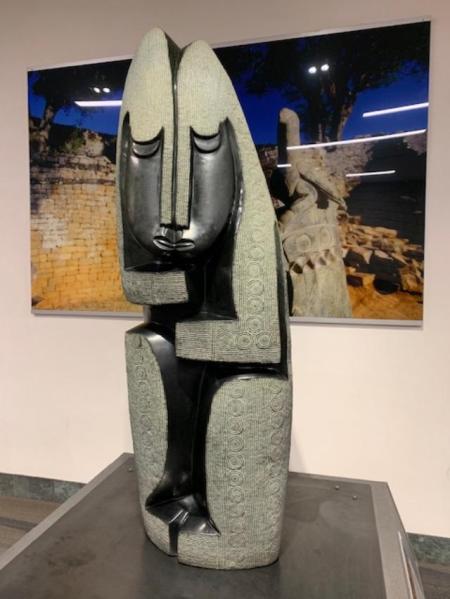
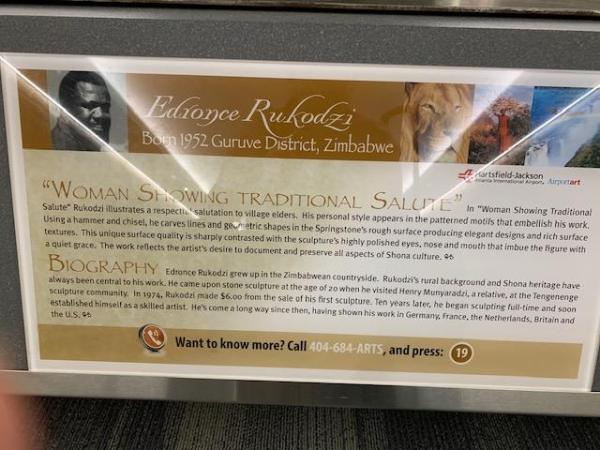
The Atlanta airport often has wonderful art exhibits in the underground walkways between different wings of the airport. This time – oh WOW, it is a Zimbabwean exhibit of stone sculptors.
If you have the capability, go in close to these sculptures and look at the fine texture incised in the stone. This twenty minutes made my day.

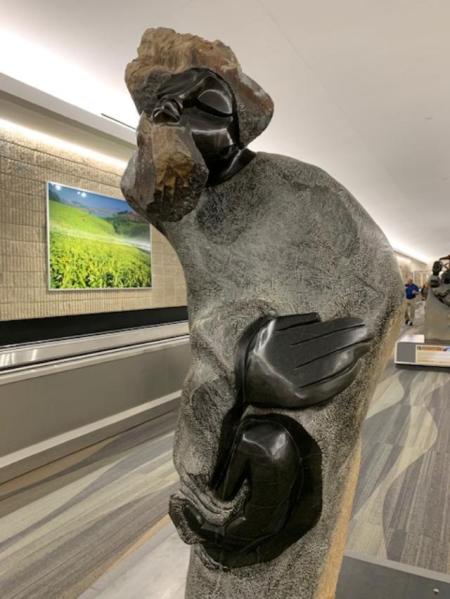


This one above is called The Conversation 🙂

Look at her hair! It is frothy, and there are holes you can see through. Stone made liquid and light!


Who Will Care for the Child? A comment on the AIDS epidemic and the loss of family and care-taking.
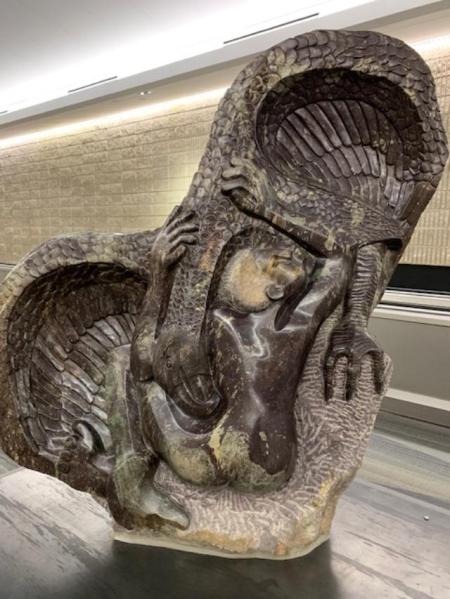
Take a minute to look at the textures!


These masks and motifs may be African, but they also remind me very much of the Alaskan First Nation art and costumes.

LOL, I couldn’t help but laugh. The artist truly captured the eccentric quality of the Secretary Bird.
Air travel can be so dehumanizing, herded from arrivals to departures, herded on the plane, cramped into tinier and tinier seats, using tinier restrooms. And then, all of a sudden, a gift of beauty to make you stop and catch your breath and divert your thoughts from the negative to the positive. Woo HOOO on you, Atlanta Airport.
“Do You Have a Heartbeat?”
This morning in Pensacola the temperature was a cool 71 degrees F. and the humidity was low. It makes all the difference in the world.
“How’s your day?” I asked my friend in the pool at the YMCA, and she grimaced. “I’m off to a bad start,” she said, “I hung my suit and towel and shoes on the line outside, and after the rain last night, everything was soaked this morning.
(We really needed the rain, and we got a soaker of a storm. Today, everything is blossoming in our yard and happy, moonflowers, African Irises, Ginger, plumbago, roses – they respond to a good soaking by blooming in delight.)
I grinned at her. “Did you wake up this morning? Do you have a heartbeat? Are you breathing? Are you here at the YMCA?” I was heartless, and persistent. She laughed.
I talked about the countries I’ve lived in; how in my first African country, Tunisia, back in the day, people competed for our garbage. My cleaning lady asked permission to take glass jars with lids, to take tuna cans. She asked that I give her any clothes I didn’t want. In the Middle East, there were restaurants where people waited near parked cars to beg for the leftovers we carried. Anything. Anything would do.
Some people didn’t have a towel, much less a swim suit, or shoes to hang on a line.
We live in the midst of plenty. Even Tunisia, when we went back twenty five years later, didn’t have the poverty we saw when we lived there. We didn’t see clubbed feet, we didn’t see hunched backs, we didn’t see crossed eyes. The little villa we had lived in had a second floor. There were signs everywhere of prosperity. We didn’t see any beggars, not one.
When I get all wrapped around the axel about the state of civility in my country, about our abuses at the border, about our increasing bureaucratic hardness-of-heart toward the least of these, I need to stop and take a deep breath and spend time acknowledging how very blessed we are. It gives me strength to go on fighting.
Columbia Gorge Discovery Center and Museum
“She shows us the same things,” you might complain, and again I say “I write this blog for myself and for the love of writing about the things I love. You are welcome, all are welcome, and if you are not happy, you are welcome to go elsewhere!”
I’ve lived an odd life, a life I would’t trade with anyone. I grew up in Alaska, on an island with a lot of native Americans as my fellow students in my little elementary school. I grew up with Alaskan art, Indian artifacts, masks, baskets, and the hand made costumes, red and black images, sparked with trimming of white shirt buttons. I went to high school in Germany, traveling far and wide with my family or with friends through that continent, visiting more than a few churches and museums, even making special trips to see an exhibit or two.
Then a big change, life in the Middle East and Africa, where I learned to see things through a very different set of eyes and experiences, but something strange started happening, as I noted the differences, I could also see amazing similarities.
I love women’s handwork. I love the nomadic textiles, often made on very narrow looms that could be mostly a couple sticks and yarn from sheep or goats you’ve raised and slaughtered, died with whatever you could get your hands on. And, oddly, the weavings and patterns from Native American baskets and weavings have a lot in common with weavings from the Middle East, West Asia (the ‘Stans) and Africa. There is a love of working with black, white and red, for example, and a similarity to the structure of the animals, even when the animals themselves differ.
If you are interested in the work women do with their hands, you never lack for conversation wherever you go. There are always groups where women are teaching one another new techniques. I’ve met wonderful, creative women in Germany and in Kuwait and in Tunisia, all finding new and innovative ways to create, and also exploring preservation of early and ancient techniques.
So this Museum, the Columbia Gorge Discovery Center and Museum was richly rewarding for both AdventureMan and myself; it was rich in history, in interviews and movies showing early salmon runs, for example, and interviews with early Native Oregonians. It was also rich in exploring the techniques of early basket making and cooking techniques, preservation of salmon by drying and salting, etc. We spent hours in this museum, and we heartily recommend that you do, too 🙂 It is also a very gorgeous museum, rich in sensory impact, unforgettable.
I will show you pictures, and every now and then I will put in a little explanation.

Below is a dugout canoe, created from one very large cedar tree trunk, carved out by hand

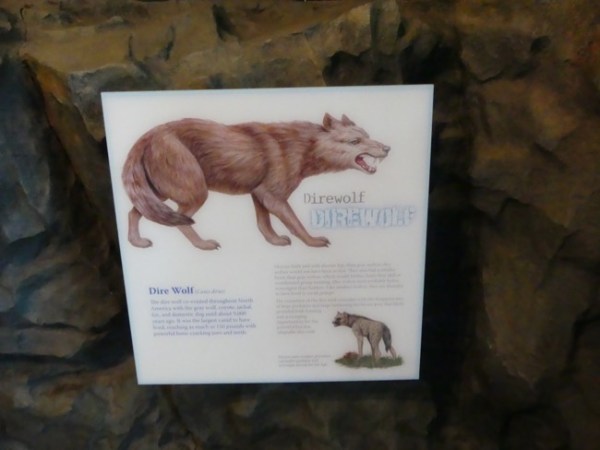
There were really Direwolfs? GOT didn’t make them up?


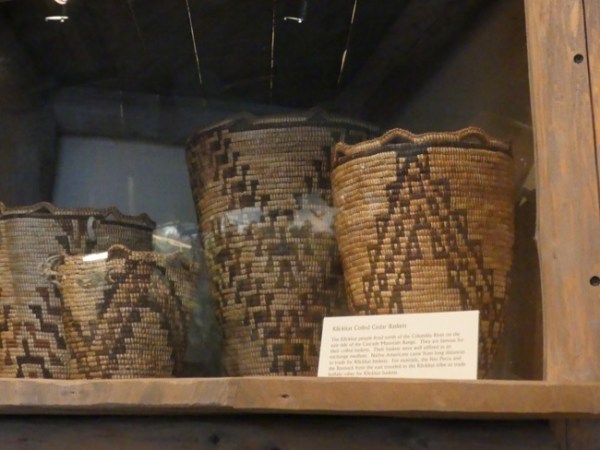
Look at the motifs on these baskets! African? Azerbaijani? Kazakh? Kuwaiti?




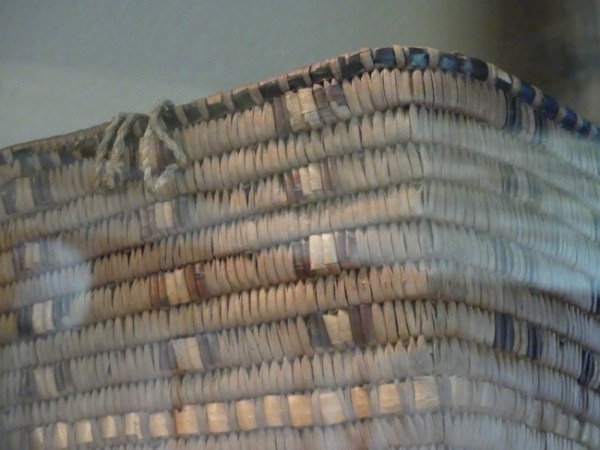


For grinding chestnuts into paste, then the paste is cooked into a kind of meal like oatmeal. The morter and pestle is the same in so many places.
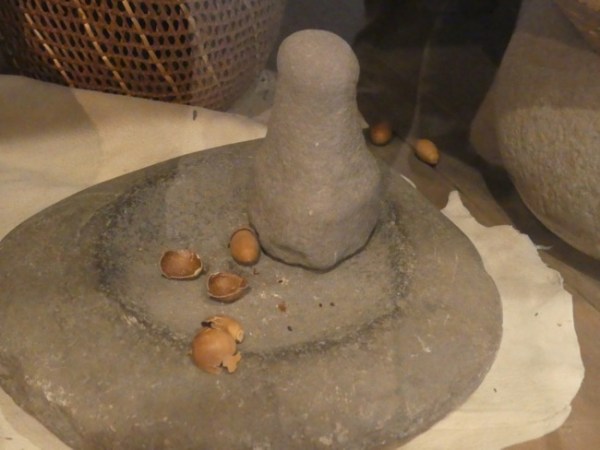
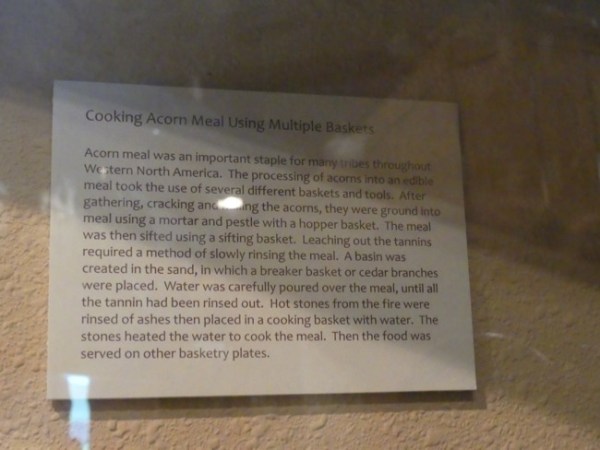
The round cooking stones, heated in fires, dropped into the meal, fished out once they start losing their heat, washed, reheated and put in again until the meal reaches a boil, all in this tightly woven basket.


Activity in the Children’s exploration area

We love the creativity and persistence of humans who preserve our heritage and traditions for future generations. It is particularly delightful when the preservation is in a museum conceived and manifested with beautiful elements and natural materials.
The Martyrs of Sudan
Today the church remembers the martyrs of Sudan.
I have met one, personally, a wonderful journalist in the Sudan, who told us his story one December, just before Christmas. I have never forgotten him; we are still friends on FaceBook. He spent mot of his youth running from those attacking his village. As a child, sometimes he would be separated from his family for months. Although a treaty has been signed, the persecution continues in South Sudan, as even heavily pregnant women have to run for the swamps, or the nearest border, when the lawless janjaweed attack. South Sudan has oil.

The Christian bishops, chiefs, commanders, clergy and people of Sudan declared, on May 16, 1983, that they would not abandon God as God had revealed himself to them under threat of Shariah Law imposed by the fundamentalist Islamic government in Khartoum. Until a peace treaty was signed on January 9, 2005, the Episcopal Church of the Province of the Sudan suffered from persecution and devastation through twenty-two years of civil war. Two and a half million people were killed, half of whom were members of this church. Many clergy and lay leaders were singled out because of their religious leadership in their communities. No buildings, including churches and schools, are left standing in an area the size of Alaska.
Four million people are internally displaced, and a million are scattered around Africa and beyond in the Sudanese Diaspora. Twenty-two of the twenty-four dioceses exist in exile in Uganda or Kenya, and the majority of the clergy are unpaid. Only 5% of the population of Southern Sudan was Christian in 1983. Today over 85% of that region of six million is now mostly Episcopalian or Roman Catholic. A faith rooted deeply in the mercy of God has renewed their spirits through out the years of strife and sorrow.
(From the Lectionary, Martyrs of Sudan, for May 16, 2018)
This is the prayer for the Martyrs of Sudan:
O God, steadfast in the midst of persecution, by your providence the blood of the martyrs is the seed of the Church: As the martyrs of the Sudan refused to abandon Christ even in the face of torture and death, and so by their sacrifice brought forth a plentiful harvest, may we, too, be steadfast in our faith in Jesus Christ; who with you and the Holy Spirit lives and reigns, one God, for ever and ever. Amen.
Gojo Ethiopian Food on Alberta Street in Portland
As if the easy access and the great hotel weren’t enough, within four minutes of our hotel is a delightful little Ethiopian restaurant, and we can’t get Ethiopian food in Pensacola. There were two or three groups already eating, and the smells drove us wild.
We ordered quickly, a vegetable combination plate and Doro Wat, a spicy chicken that always comes with a thick, hot sauce and a hard boiled egg. Actually, I don’t care that much about the chicken or the egg, it’s that thick hot spicy sauce I love. We also loved the smokey green beans and the vinegary greens, the pickled cabbage, the beet colored potatoes and the red and green lentils – it was all good, and not dumbed down.

Our meal:

Extra injera:
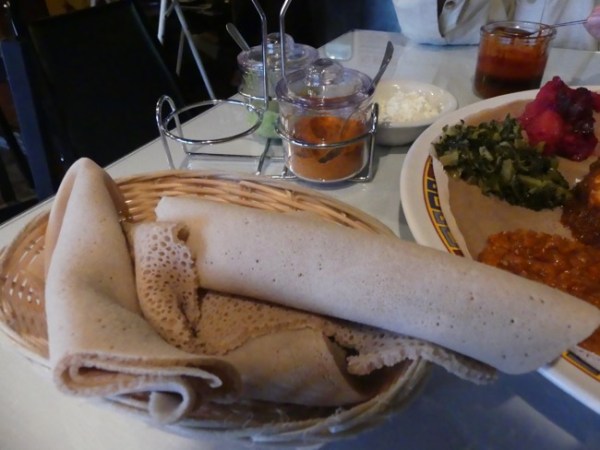
There are so many good possibilities for good food in Portland, but we are so stuffed we think we will never eat again!
Tough Times in 2017
It’s been a strange year. I fought depression a lot of the year, faced with a political administration that is rolling back everything I believe to be good about my country. I watched our culture degrade, environmental protections roll back, air pollution standards roll back, financial institutions restrictions roll back, oversight disappear, the State Department erode, and truth become astonishingly irrelevant, civility hard to find. I also found friends, who, like me, welcome immigrants, fight against those who would restrict voting rights only to people a whole lot like them, and who support equal rights and the belief that we are called to be better people, and to do what we can to lift people, rather than to stomp on them.
One great wonderful event happened this year, my grandchildren were baptized. It was a private event, with friends and well-wishers, and it was joyful, and very funny. If I want a big smile, I think back on that precious day.
At that same time, two people we know were diagnosed with cancer, diagnosed in the very prime of their lives. One was the father of our dear daughter-in-law. He and his wife welcomed our son, and then us, into his sweet family, a family full of women as wild and wacky as I am. We laugh, my daughter-in-law and I, about how our relationship is “unnatural.” We are supposed to be hostiles, but in truth, we genuinely love one another and we enjoy one another’s company. I admire her, as a wife, a mother and an environmentalist. We enjoy her parents, and we spent two weeks in Zambia traveling with her father and his wife. We had a great time with them.

Her father was a poster boy for chemotherapy. He smiled and laughed his way through it, cheering up those around him who were trying to cheer him on. If he ever had moments of self-pity, we never saw it. He chose to spend his time loving others, and continuing to make this world a better place.
In November, he caught a cold, and then pneumonia. The family gathered, and he rallied for a while, and then sank slowly, unable to get enough oxygen into his lungs. Before Thanksgiving, he was gone.
Yes, I am faithful, and I also have a hard time accepting that it was this man’s time to go. I am guessing that part of it is being unable to accept my own powerless to stop this horrible thing from happening, this good man, cut down in his prime. He was just making plans to retire, to travel. He and his wife were excited. I couldn’t help it, his death made me angry, it was such a waste. Yes, you can be faithful and be really mad at God.
This man loved his grandchildren.


He loved fishing, and spent time teaching his grandchildren, nieces and nephews to love fishing, too. Here he is on the Zambezi, seeing what he might catch.
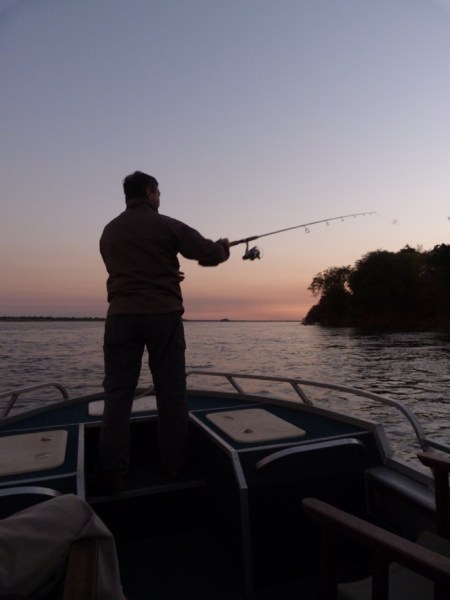
Every life he touched, he left better for it. He was a fine man, and I grieve for my sweet daughter-in-law, for this terrible, painful loss.

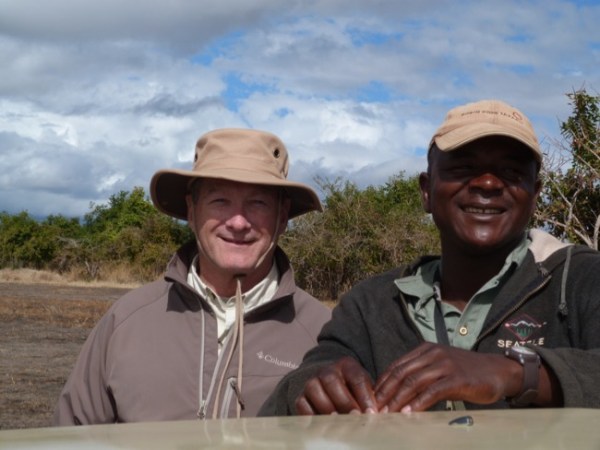

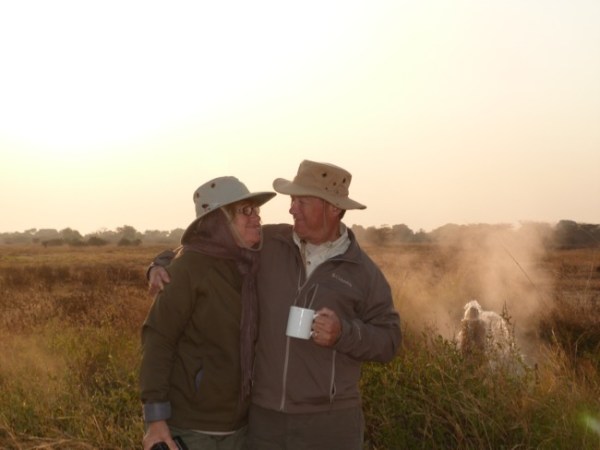

Here is hoping for a better year to come.
In the Wadi
A lovely quiet Saturday morning; the cats let me sleep in a little bit, I rise relaxed and happy to feed them and to read The Lectionary before my day gets fully underway.
The Old Testament story is David and Goliath.
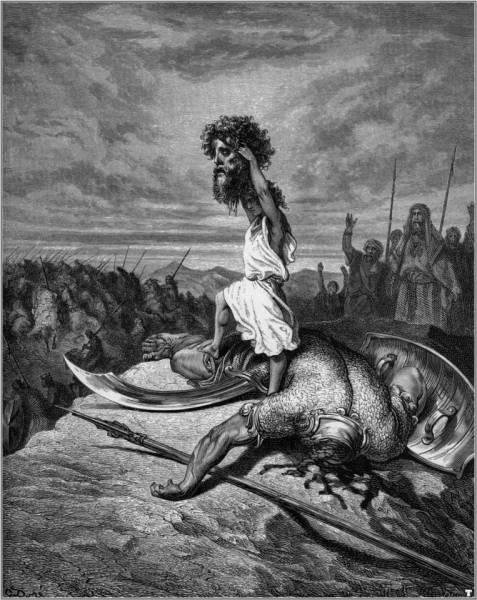
1 Samuel 17:31-49
31 When the words that David spoke were heard, they repeated them before Saul; and he sent for him. 32David said to Saul, ‘Let no one’s heart fail because of him; your servant will go and fight with this Philistine.’33Saul said to David, ‘You are not able to go against this Philistine to fight with him; for you are just a boy, and he has been a warrior from his youth.’ 34But David said to Saul, ‘Your servant used to keep sheep for his father; and whenever a lion or a bear came, and took a lamb from the flock, 35I went after it and struck it down, rescuing the lamb from its mouth; and if it turned against me, I would catch it by the jaw, strike it down, and kill it. 36Your servant has killed both lions and bears; and this uncircumcised Philistine shall be like one of them, since he has defied the armies of the living God.’ 37David said, ‘The Lord, who saved me from the paw of the lion and from the paw of the bear, will save me from the hand of this Philistine.’ So Saul said to David, ‘Go, and may the Lord be with you!’
38 Saul clothed David with his armour; he put a bronze helmet on his head and clothed him with a coat of mail. 39David strapped Saul’s sword over the armour, and he tried in vain to walk, for he was not used to them. Then David said to Saul, ‘I cannot walk with these; for I am not used to them.’ So David removed them. 40Then he took his staff in his hand, and chose five smooth stones from the wadi, and put them in his shepherd’s bag, in the pouch; his sling was in his hand, and he drew near to the Philistine.
41 The Philistine came on and drew near to David, with his shield-bearer in front of him. 42When the Philistine looked and saw David, he disdained him, for he was only a youth, ruddy and handsome in appearance. 43The Philistine said to David, ‘Am I a dog, that you come to me with sticks?’ And the Philistine cursed David by his gods. 44The Philistine said to David, ‘Come to me, and I will give your flesh to the birds of the air and to the wild animals of the field.’ 45But David said to the Philistine, ‘You come to me with sword and spear and javelin; but I come to you in the name of the Lord of hosts, the God of the armies of Israel, whom you have defied.46This very day the Lord will deliver you into my hand, and I will strike you down and cut off your head; and I will give the dead bodies of the Philistine army this very day to the birds of the air and to the wild animals of the earth, so that all the earth may know that there is a God in Israel,47and that all this assembly may know that the Lord does not save by sword and spear; for the battle is the Lord’s and he will give you into our hand.’
48 When the Philistine drew nearer to meet David, David ran quickly towards the battle line to meet the Philistine. 49David put his hand in his bag, took out a stone, slung it, and struck the Philistine on his forehead; the stone sank into his forehead, and he fell face down on the ground.
So it’s an interesting story, and, as it turns out, plausible. When we lived in Tunis and in Amman, we often saw young men with slings, and they were amazingly proficient.
What caught my eye in this reading was that David picked up five smooth stones from the wadi, and that one work brought back so many associations. We often camped, in Tunis, and in Jordan, and from time to time we set up camp in a wadi. It always made me nervous, thinking that a sudden, unexpected, unseasonal, and, frankly, totally unlikely storm could come along and wash us to a tragic death. That kind of timidity came with motherhood, and an understanding of how little control I had as a mother, protecting children from all the possible ways children can be injured, sometimes fatally. Lucky for me (she says wryly) she was always outvoted by the testosterone in the family, and the dearth of likely camping spots.
In Tunisia, the Tunisia before Tunisia became developed, we would drive around to old ruins, Roman, pre-Roman, ancient ruins, and camp. There were no toilets, no showers. We had a Volkswagon bus. From time to time when nature called, I would turn to AdventureMan and say “I need a wadi.”
He knew what I meant. He would find a bridge over a wadi in a seemingly deserted place, and I would jump out, pee quickly, and run for the bus. I always wore a wrap skirt or a jean skirt, so much quicker.
“Why the hurry?” you might ask.
We learned, from the very beginning, that no matter how deserted a place might appear, that within two minutes of stopping curious children would begin to show up. Mostly they were just interested that something different was happening, sometimes they wanted “bonbon.” We always carried a package of hard candy; anything else would melt in the heat, in these days before Volkswagen buses had air conditioning.
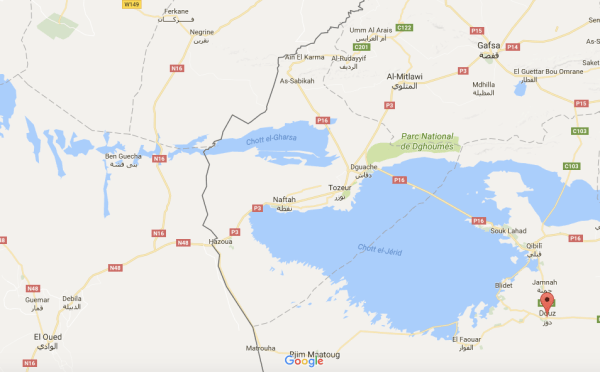
As for showering – we didn’t. At least most of the time, we didn’t. One time, one December, just after Christmas, there was a desert festival in Douz, and we went on a week-long camping trip. We camped in an oasis / field just outside of Douz, and right next to the Bedouin campers, who would come to sit with us around the campfire. During the day, there were parades of camels, and at night, huge bonfires and poetry contests.
The desert nights were cold, so bitterly cold I’ve never been colder, not even in Alaska. I zipped two sleeping bags together and had my son in mine with me; the cold was so intense it robbed the heat right out of our bodies, and I could protect him with mine. AdventureMan said it was the only time in his life that he considered peeing in his sleeping bag rather than leaving it’s small protection to walk outside the camp (he braved the walk!)
When the festival ended, we drove across the Chott al Jerid, a great salt flat, huge and empty, and then up into the mountains. I think we headed to Al Mitlawi, and from there, followed a crude map to a waterfall, near which we camped. On New Year’s Eve day, we got up early and headed to the waterfall, which we had all to ourselves, for a shower. It’s one of the most amazing memories I have, showering under that waterfall in a dry and arid part of the world. It was so early, and so remote, no children showed up. 🙂
Update: As I am reading the news, I see that in May the U.S. Department of State issued a travel warning for Tunisia, specifically the southeastern and mountainous parts, because of terrorism.
The Badass Librarians of Timbuktu
I saw this today on the NPR Books section, and as one great admirer of librarians, I wanted to share it with you. These librarians are my kind of badass! They are providing a service to humanity.
Timbuktu’s ‘Badass Librarians’: Checking Out Books Under Al-Qaida’s Nose

Handout picture dated 1997 and released in 2012 by the UN shows ancient manuscripts displayed at the library in the city of Timbuktu. Al-Qaeda has destroyed ancient texts it considers idolatrous.
Evan Schneider/AFP/Getty Images
For hundreds of years, Timbuktu has had a place in the world’s imagination. Located on the southern edge of the Sahara desert, the city flourished as a center of Islamic culture and scholarship in the 13th through 16th centuries. It was placed on the UNESCO World Heritage List in 1988, recognized for the University of Sankore, which had as many as 25,000 students who studied the Quran, as well as the historic Djingareyber and Sidi Yahia mosques.

The Bad-Ass Librarians of Timbuktu
And Their Race to Save the World’s Most Precious Manuscripts
Timbuktu was a center of the manuscript trade, with traders bringing Islamic texts from all over the Muslim world. Despite occupations and invasions of all kinds since then, scholars managed to preserve and even restore hundreds of thousands of manuscripts dating from the 13th century.
But that changed when militant Islamists backed by al-Qaida arrived in 2012. The hardline Islamists didn’t see these texts as part of their Islamic heritage, but as idolatry, contradicting their interpretation of Islam. They set about destroying important cultural icons, including 15th-century mausoleums of Sufi Muslim saints. Librarians feared the city’s prized medieval collections of manuscripts would be next.
Librarian Abdel Kader Haidara organized and oversaw a secret plot to smuggle 350,000 medieval manuscripts out of Timbuktu. Joshua Hammer chronicled Haidara’s story in the book The Bad-Ass Librarians of Timbuktu. Hammer spoke with NPR’s Michel Martin about how a librarian became an “operator.”
Interview Highlights
Why these manuscripts were so important
These volumes — and we’re talking hundreds of thousands of them — at the point at which al-Qaida invaded Timbuktu, there were something like 370,000 manuscripts amassed in libraries in Timbuktu. And they portrayed Islam as practiced in this corner of the world as a blend of the secular and the religious — or they showed that the two could coexist beautifully. And they did in this city.
So it was tremendously important for Haidara and those who supported him to protect and preserve these manuscripts as evidence of both Mali’s former greatness and the tolerance that that form of Islam encouraged.
On Abdel Kader Haidara’s background
Abdel Kader Haidara was a son of a scholar and he grew up in an intellectual environment in Timbuktu. He was not a wealthy person. After his father’s death in the early 1980s he inherited the family’s centuries-old manuscript collection.
So in 1984 the head of the Ahmed Baba Institute, the government-owned library in Timbuktu, called on Haidara and said, “Hey, we’re having trouble getting off the ground, we need to find manuscripts. We know they’re out there, they’re hidden away in the desert, in river towns. Can you undertake this job of traveling around northern Mali, tracking down these manuscripts that have been lost — buried, disappeared — over generations? Gather them up, we’ll give you money. And we want this library to be splendid. We want this to be something that people from all around the world will come to visit. So go out, do your best, find books for us.”
He was reluctant at first, but the call of duty and the curator’s constant pressure prevailed. And in 1984 he began this what turned into a 12-year really amazing quest to ferret out these manuscripts all across Mali.
How Libya changed Mali
In 2011, the Arab Spring breaks out. Gadhafi’s downfall, the arsenals of Libya — in the chaos of Gadhafi’s murder and the disintegration of the Libyan state — are opened for the taking. Then you’ve got these various rebel groups in Mali. You’ve got Islamic radicals all descending on Libya — on these arsenals. Walking in, loading up their pickup trucks with heavy weaponry, driving through the dust across the desert back to Mali. And so these heavily armed rebels sweep across the desert and in three months have captured two-thirds of the country.
Why he decided to do what he did
The first thing that Abdel Kader was worried about, frankly, was looting. In the first few days after the rebels took over Timbuktu and the army and the police had fled, there was total disorder. That’s when he kind of began to scheme — “Hey, the great treasures of Timbuktu are being held in these very ostentatious libraries.” He said, “These are going to be targets.”
The looting subsided pretty quickly. But as it subsided, you had this growing radicalism, you had Islamic police roaring through the streets, stopping people, throwing them in jail, grabbing cigarettes out of their mouths, whipping them in public. He just foresaw that this was going to get worse, and that the manuscripts, which as we already said expressed values that were anathema to fundamentalist Islam — to Wahhabi Islam — were in danger. That sooner or later, these manuscripts are going to be held hostage. They’re going to become political tools, they could be destroyed in an act of vengeance, caught up in military action. We’ve got to protect them.
So that’s when Abdel Kader and a small group of his supporters, friends, relatives got together and began what ended up being a three-stage effort to protect, and essentially smuggle to safety, all of these manuscripts.
Becoming a ‘badass’
Let’s remember that Abdel Kader was more than a librarian, this guy had spent 12 years as a badass explorer, as an adventurer. He was traveling on camels across the Sahara, on riverboats, going to small villages, finding these manuscripts. So he was an operator. So when the time came, he just knew what to do.
He said, “The first thing we’re going to do is get them out of these big libraries. We’re going to take trunks, we’re going to pack them into trunks at night when the rebels are asleep. And then we’re going to move them in the dead of night by mule cart to these various houses — safe houses, scattered around the city. We’re going to stick them in there and hopefully they’ll be safe for the duration of this occupation.” Which of course, nobody knew when that was going to end.
Why it’s important
One of the things that I think is important to draw from it is to realize that there is this whole strain of Islam that is moderate, that celebrates intellectuality, that celebrates culture, that celebrates diversity, secular ideas, poetry, love, human beauty. I think that is lost in this debate that’s going on. We tend to really kind of turn against Islam because of the actions of this particularly violent group.
But I think in fact that the Islam represented by those in Timbuktu and the badass librarians is in fact more representative of what Islam is. And these people [who] were the real victims of extremism in this part of the world are fellow Muslims. They were the ones who really suffered. They were the ones who had their hands and feet chopped off, who had to live through the horror of daily occupation.
For the most part, we see this from afar, but these people are on the front lines and they are living through the horror of radicalism every day and every minute.
Where the manuscripts are now
He hopes that he’ll be able to return them to Timbuktu. They are in about a dozen climate-controlled storage rooms in Bamako, the capital of Mali. And as far as moving them back, he’s waiting. I mean, these are very hard people to root out. But Timbuktu is a ghost town — tourists aren’t going there, flights aren’t going there. It’s very sad. And I don’t know and he doesn’t know if those glory days can ever be recaptured, given the strength of the Islamists — the terrorists in that area, in that part of the world.
Monday is Homework Day
This is not the life we expected – it is so much better. Before we retired, my husband asked me what we would do, and I said I knew what I would do, but I didn’t know what he would do; he would have to figure out what he wanted to do. But I was wrong. I didn’t know what I would be doing.
Life evolves. One decision leads to another, down paths you can’t foresee.
I had no idea I would love my grandchildren so much. I had no idea how much joy being close to our adult son and his wife would be, watching them mature, seeing them parent so lovingly and patiently. The other day, he spotted a photo of a time we were on our way to a German Military Ball; he said “How old were you in this photo?” and as we figured it out, we were almost exactly the age he is now. That was a moment of wonder to all of us. It helps us to remind ourselves that he no longer needs parenting, no more than we did at his age. He needs respect, and the support of a loving family that can mind their own business unless asked for input.
Doing kindergarten homework is mind-numbing. Q, who is a smart little boy, looked at me and said “when you do the same thing over and over, it is really boring.” He loves new words, so I said “when you do the same thing over and over again, that is called ‘repetitious’,” and he said “Yes, so it is repetitious and BORING.” We both laughed.
While it IS boring, what he is doing now is also crucial, mastering his numbers and how they work together, and his letters, and distinguishing “b”s from “d”s, and “g”s from “q”s and a lot of learning just requires that repetition to engrave it in your mind. He is learning to write, and he is adept at reading books above his level – but it all takes work.
We have some break activities. He can run laps around my first floor, running a circle which I make him change direction every now and then. He can jump on my running trampoline. He can play hide and seek with his Baba. We are working on jig-saw puzzles, and for fun, he gets to play one of Baba’s computer games requiring strategic thinking skills.
We still do our volunteering, our church activities, our house things. We have lunch out almost every day; we are free until after school.
While the homework is for the whole week, we have discovered that dragging it out is just that – a drag. Get it done! Just do it! We are learning to focus, and the work is not that hard. When we finish the homework, we have the rest of the week to play!
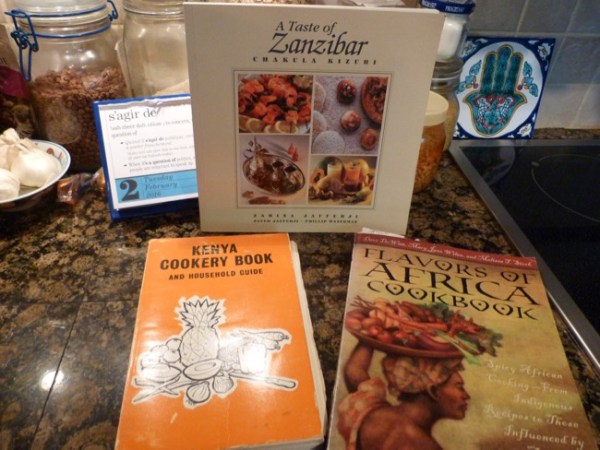
Today I was exploring online, looking for an old African recipe I have for African Gingerbread. This is a really old recipe; what I liked about it is that when you add the baking soda and molasses, it fizzes and bubbles. I looked in all my books, but in my never-ending quest to get rid of, get rid of, get rid of, not to burden myself with too many THINGS, I must have given away that particular book. But as I was looking for the recipe online, the only place I found it . . . was here. On my own blog! Old Fashioned Gingerbread. It makes me grin, thinking of how thrilled this five year old will be when we make old fashioned African gingerbread and it all starts fizzing. Woo HOOOO!
When the homework is done, the fun begins!
Recent Comments
intlxpatr on Shampoo Ginger tigerbutterya0c5ff1d… on Shampoo Ginger intlxpatr on British Soldier Kidnapped, Esc… John on British Soldier Kidnapped, Esc… intlxpatr on British Soldier Kidnapped, Esc… Wikipedia Donate Button

Amazina


Early Voting in Florida


