Americanah and Chimamanda Ngozi Adichie
Rushing from one meeting to another yesterday, I had just an hour – but during that hour, Terry Gross was interviewing one of my favorite authors, Chimamanda Ngozi Adichie, and Chimamanda Ngozi Adichie does GREAT interviews. She is funny, and educated and insightful; she can talk about painful topics and make you laugh and cry with her. That interview was a blessing on my day.
I started reading Chimamanda Ngozi Adichie when I was in Kuwait. A good friend approached me and asked me to form a book club. LOL. This is a friend I can’t say no to. Every introverted bone in my body was screaming “NO! NO!” and I smiled at her and said “Yes.”
God is good. He laughed when I said “yes” and through the book club, introduced me to authors I might never otherwise read. The club was made up of many nationalities, and we read books from everywhere, unforgettable books. We read Chimamanda Ngozi Adichie “Half of a Yellow Sun.” Once you read Chimamanda Ngozi Adichie, there is no going back. I wonder if I will be able to hold out on Americanah until it comes out in paperback?
This is from the National Public Radio website, so you can actually listen to the interview yourself, should you want to get to know this delightful author a little better.
‘Americanah’ Author Explains ‘Learning’ To Be Black In The U.S.

When the novelist Chimamanda Ngozi Adichie was growing up in Nigeria she was not used to being identified by the color of her skin. That changed when she arrived in the United States for college. As a black African in America, Adichie was suddenly confronted with what it meant to be a person of color in the United States. Race as an idea became something that she had to navigate and learn.
The learning process took some time and was episodic. Adichie recalls, for example, an undergraduate class in which the subject of watermelon came up. A student had said something about watermelon to an African-American classmate, who was offended by the comment.
“I remember sitting there thinking, ‘But what’s so bad about watermelons? Because I quite like watermelons,’ ” Adichie tells Fresh Air‘s Terry Gross.
She felt that her African-American classmate was annoyed with her because Adichie didn’t share her anger — but she didn’t have the context to understand why. The history of the trans-Atlantic slave trade was not taught to students in Nigeria. Adichie had yet to learn fully about the history of slavery — and its continuing reverberations — in the U.S.
“Race is such a strange construct,” says Adichie, “because you have to learn what it means to be black in America. So you have to learn that watermelon is supposed to be offensive.”
Adichie is a MacArthur Fellowship winner and author of the novels Purple Hibiscusand Half of A Yellow Sun. Her new novel, Americanah, explores this question of what it means to be black in the U.S., and tells the story of a young Nigerian couple, one of whom leaves for England and the other of whom leaves for America.
The title, she says, is a Nigerian word for those who have been to the U.S. and return with American affectations.
“It’s often used,” she says, “in the context of a kind of gentle mockery.”
Where is Lokoja, Nigeria?
Today the church prays for the diocese of Lokoja, Nigeria. Don’t you just love technology? You can go right to Google Maps and within seconds, you know where Lokoja is, right on the banks of the Niger river, bisecting Nigeria.

The Secret Lives of Baba Segi’s Wives by Lola Shoneyin

I don’t know what it is about summer reading, but now and then I go on a theme-fest; a couple years ago it was Nigerian literature, and, once hooked . . . when my friend who is now living in Lagos recommended The Secret Lives of Baba Segi’s Wives, I ordered it right away, thinking from the title it would be maybe light and sweet and humorous.
From the start, that assumption was blown. This is a direct and edgy Nigeria, darker, rougher and full of family secrets, domestic details and messy relationships.
It is a very Nigerian book – this is a good thing. There are cultural things that are not explained, but it all ends up making sense in the end. There are foods I have never heard of – ekuro with shrimp sauce, asun. There is a rudeness in the way they speak to one another, (“Is this a parking lot?” “Do I look like a parking attendant?”), a crudeness in the constant need to carry small bills for bribes, even on public streets. People speak their minds, with little or no mitigation, depending on the status of the person and their own personal goals and agendas.
At the weekly meeting of wives, the senior wife, Iya Segi, doles out rations of household supplies to the other wives, including chocolate powder and hair conditioner . . . and as the senior wives complain about the new wife thrown in their midst, she says:
“You will trip over in your hate if you are not careful, woman. Your mouth discharges words like diarrhea. Let Bolanle draw on every skill she learned in her university! Let her employ every sparkle of youth! Let her use her fist-full breasts. Listen to me, this is not a world she knows. When she doesn’t find what she came looking for, she will go back to wherever she came from.”
There is a whole other world in that one paragraph – a whole other way of seeing life and expressing thoughts. The culture may be alien, but I thoroughly enjoyed being a tiny mouse in the corner at that meeting – and others – and inside the minds of the wives, of Baba Segi, of the driver – so many good stories, so many points of view, and I learned things from behind those high compound walls and closed and locked doors that I might never otherwise have learned. Alien as it was, for me, this was a very good book, new ways of looking at things, and a great recommendation from my friend in Lagos.
The Festival of BERNARD MIZEKI
(Play the video of the Soweto Gospel Choir as you read this summary from today’s Lectionary Readings How I would love to be able to attend this festival!)
BERNARD MIZEKI
CATECHIST AND MARTYR IN AFRICA (18 JUNE 1896)
Bernard Mizeki was born in Portuguese East Africa (Mozambique) in about 1861. When he was twelve or a little older, he left his home and went to Capetown, South Africa, where for the next ten years he worked as a laborer, living in the slums of Capetown, but (perceiving the disastrous effects of drunkenness on many workers in the slums) firmly refusing to drink alcohol, and remaining largely uncorrupted by his surroundings. After his day’s work, he attended night classes at an Anglican school.
Under the influence of his teachers, from the Society of Saint John the Evangelist (SSJE, an Anglican religious order for men, popularly called the Cowley Fathers), he became a Christian and was baptized on 9 March 1886. Besides the fundamentals of European schooling, he mastered English, French, high Dutch, and at least eight local African languages. In time he would be an invaluable assistant when the Anglican church began translating its sacred texts into African languages.
After graduating from the school, he accompanied Bishop Knight-Bruce to Mashonaland, a tribal area in Southern Rhodesia (now Zimbabwe), to work there as a lay catechist. In 1891 the bishop assigned him to Nhowe, the village of paramount-chief Mangwende, and there he built a mission-complex. He prayed the Anglican hours each day, tended his subsistence garden, studied the local language (which he mastered better than any other foreigner in his day), and cultivated friendships with the villagers. He eventually opened a school, and won the hearts of many of the Mashona through his love for their children.
He moved his mission complex up onto a nearby plateau, next to a grove of trees sacred to the ancestral spirits of the Mashona. Although he had the chief’s permission, he angered the local religious leaders when he cut some of the trees down and carved crosses into others. Although he opposed some local traditional religious customs, Bernard was very attentive to the nuances of the Shona Spirit religion. He developed an approach that built on people’s already monotheistic faith in one God, Mwari, and on their sensitivity to spirit life, while at the same time he forthrightly proclaimed the Christ. Over the next five years (1891-1896), the mission at Nhowe produced an abundance of converts.
Many black African nationalists regarded all missionaries as working for the European colonial governments. During an uprising in 1896, Bernard was warned to flee. He refused, since he did not regard himself as working for anyone but Christ, and he would not desert his converts or his post.
On 18 June 1896, he was fatally speared outside his hut. His wife and a helper went to get food and blankets for him. They later reported that, from a distance, they saw a blinding light on the hillside where he had been lying, and heard a rushing sound, as though of many wings. When they returned to the spot his body had disappeared. The place of his death has become a focus of great devotion for Anglicans and other Christians, and one of the greatest of all Christian festivals in Africa takes place there every year around the feast day that marks the anniversary of his martyrdom, June 18.
Bloggers Create Freedom Friday in Oppressed Eritrea
I heard whispers of this on National Public Radio, and found this write up on The International Business Times website. The message is simple – in a country where even a glance can be interpreted as treason, express your non-support of the government by STAYING AT HOME ON FRIDAY, the day Ethiopians usually go out and visit with friends, gather together and mingle. Ghandi would smile; this is civil expression at it’s most civil 🙂
Let the empty streets speak for you. LOL @ a tyrant making staying at home a crime against the government!
Eritrean bloggers outside of Ethiopia started it, smuggling an old Eritrean phone book out of the country and making calls to acquaintances – and strangers – in Eritrea. People didn’t even have to respond. they could just listen . . . then they developed a robo-call to help them enlarge the number they could reach.
Eritrea is considered one of the continent’s most opaque countries. National elections have not been held in the Horn of Africa country since it gained independence in 1993. Torture, arbitrary detention and severe restrictions on freedom of expression remain routine.
President Isaias Afwerki does not tolerate any independent media, the internet is strictly controlled and Reporters without Borders recently named it 179th out of 179 countries for freedom of expression.
It is illegal to criticise the government, prompting the Eritrean diaspora to set up a campaign to reverse the Arab-style call to take to the streets every Friday by emptying the streets in protest.

“We made phone calls from diaspora to Eritrea,” Meron Estefanos toldIBTimes UK. “We have a phone catalogue and called random numbers every Friday, telling them to stay at home and think about problems in our country.”
The phone calls “give them [Eritreans within the country] an opportunity to protest without risking too much”, according to Freedom Friday’s coordinator in the UK Selam Kidane.
The activists turned to a computerised auto-dialer called robocall to spread hundreds of thousands of taped messages to Eritrean phones. “It is time to restore our liberty and dignity” messages were sent automatically.
In another message, the mother of renowned political prisoner Aster Yohannes recalls the fate of her daughter, who was arrested in 2003 and has disappeared.
After two years, the movement is finally gaining momentum inside the country.
“Now they trust us inside the country, we have our team in Eritrea that puts out posters and leaflets late at night,” Estefanos said.
“The plan now that we have their trust is asking them to go out and demonstrate.”
About 1,500 Eritreans leave their country every month, according to the United Nations, paying up to 30,000 euros ($39,500) each to seek a new life free of grinding poverty and repression.
Earlier this year, Amnesty International put the spotlight on Eritrean asylum-seekers who are kidnapped from Sudanese refugee camps by the local Rashaida tribe, sold to Bedouin criminals in Egypt’s Sinai peninsula and severely abused while they are held for ransom.
One thousand refugees are held captive in the Sinai, according to reports. About 7,000 people in total may have been tortured and 4,000 may have died as a result of the people-trafficking in humans from 2009 to October 2012, according to recent data. A total of 3,000 people disappeared from 2007-11.
First, just pay this Small Fee . . .
LOL, wouldn’t you think he would address this to me by name, instead of beneficiary? And I am willing to bet that his charge of $85.99 is just the beginning . . .
From: Dr. Ngozi Okonjo-Iweala, Finance Minister of The Federal Republic of Nigeria info@fmf.org
FEDERAL MINISTRY OF FINANCE
NATIONAL HOUSE OF ASSEMBLY COMPLEX
SENATE HOUSE – UPPER CHAMBERS WUSE DISTRICT,
ABUJA FCT- NIGERIA
Our Ref: FGN/FMF/STB
Your Ref……………
Dear Beneficiary,
I wish to inform you again that we are not playing over this. I know my reason
for the continuous sending of this notification to you. The fact is that you
can’t seem to trust anyone again over this payment for what you have been in
cantered in the past, but I want you to trust me because I cannot scam you for
$85.99 it is for bank processing of your payment. The fee of $85.99 is for your
service, I did not invent it to defraud you. It is an official bank payment
processing fee and the good part of this is that you will never be disturbed
again over any kind of payment. This is the final as there is no unforeseen fees
and the forms will become effective once we submit your payment application
processing fee and pay the form fee of $85.99 only. I don’t want you to lose
this fund this time because you may never get another such good opportunity
again. The federal government is keen and very determined to pay your overdue
debts, this is not a fluke. I would not want you to lose this fund out of ignorance. I wil
Receiver’s Name: Uzoukwu Cletus
Address: Lagos, Nigeria
Test Question: Fine
Answer: Finest
After sending the money, send all the details of the payment as stated below
direct to this email.
SENDER’S NAME:___________________
SENDER’S ADDRESS:________________
M.T.C.N NUMBER:__________________
Awaiting the payment details as soon as possible.
Yours in service,
Dr. Ngozi Okonjo-Iweala
Finance Minister of Nigeria
The Baboon Coughed
We’ve had three sets of houseguests in a very short time span, and today is our first day of ‘normal.’ We saw our friends off at 0430 (we used to call it oh-dark-hundred) and I couldn’t get back to sleep, so by the grace of God (and I mean that literally) I got up and walked.
I know I need to walk. I’ve always walked. I used to run, but I suffered for it – the knees – and decided I didn’t want to pay that price. But when my sister was here, we decided to take a walk and I said “don’t worry, I walk fast” and she said “I don’t, I am so slow now, my body has to warm up.” Confidently I started – and starting is uphill from my house. Very shortly, I discovered my fast was her slow, and I was HUFFING and puffing, and so embarrassed because I guess it’s been a while since I did this walk . . . but we did it. It felt good. And I was happy for a nice cool morning so I could do it again.
I ran into a neighbor, ignored that she was in her nightgown, we both pretended she was as fully dressed as I, had a brief conversation and she went inside with her newspaper and I carried on. About halfway through my walk, as I puffed along, I heard it.
The baboon coughed.
I could even smell a faint drift of wood burning fire. I could hear the doves. But it was only very briefly, very intangential, and I quickly realized it must have been a dog barking distantly; I could still hear him. For one brief moment I was back in Zambia, and while I love the magic of Zambia, I would not be out for a mile long hike early in the morning while the lions prowl for a last meal before they settle down for their day-long snooze.
We are off this morning to a grand plant sale across the bay in Milton. Symphony tonight. Back to “normal” for Pensacola.
“You’re Not Southern – You’re Arab!”
My mind works in quirky ways, and yesterday as I was setting up for the hands-on Heirloom Feathers workshop with Cindy Needham, one of the good local Pensacola quilters was telling her how you can tell a Southerner from a Northerner.
“If you go to a Southerner’s house, they’ll ask you first thing if you’d like a drink of water, or iced tea or something, but if you go into a Northerner’s house, you can sit there for five hours and they won’t offer you ANYTHING!”
I grinned to myself, no, I have learned to censor these thoughts. But I couldn’t help it.
“You’re not a Southerner,” I am thinking, “You’re ARAB!”
I thought about a long ago trip through Morocco, we have a rental car and on our way from Ouazazarte to Marrakesh, on an isolated stretch of the road, we see a car in trouble. We stop and ask if we can help, if the man would like a lift to the next town. He tells us no, he wants to stay with the car, but asks if we would go to such and such service station and tell his uncle he needs help, and where he is.
Of course.

We drive into town, find the service station, and find the young man’s uncle, who is the owner. He sends help.
Did I mention it was Ramadan? No eating or drinking in public from dawn to dusk?
The owner insisted we come into his house, and seated us in his diwaniyya, and sent in mint tea and luscious almond-filled dates to refresh us. We said “No! No! It’s Ramadan!” but he told us it was his honor. He sat while we drank and ate.
Such enormous hospitality. Such grace. We only stayed a very short time; we still had a long drive, but I’ve never forgotten his hospitality.
Then again, it was Southern Morocco. 🙂 Maybe he was Southern.
Putting TEETH into Anti-Rape Solutions :-)
Thank you, Hayfa, you always find the most amazing articles. What I love about this one is that if everything is where it is supposed to be, nobody gets hurt. Only invasive behavior results in . . . .lets hope excruciating pain 🙂 It also gives an attacker something else to focus on. This invention is a public service.
Rape-aXe: The Anti-Rape Condom
This is so brilliant! An anti-rape female condom invented by Sonette Ehlers.… A South African woman working as a blood technician with the South African Blood Transfusion Service, during which time she met and treated many rape victims. The device, known as The Rape-aXe, is a latex sheath embedded with shafts of sharp, inward-facing microscopic barbs that would be worn by a woman in her vagina like a tampon. If an attacker were to attempt vaginal rape, their penis would enter the latex sheath and be snagged by the barbs, causing the attacker pain during withdrawal and (ideally) giving the victim time to escape. The condom would remain attached to the attacker’s body when he withdrew and could only be removed surgically, which would alert hospital staff and police. This device could assist in the identification and prosecution of rapists.

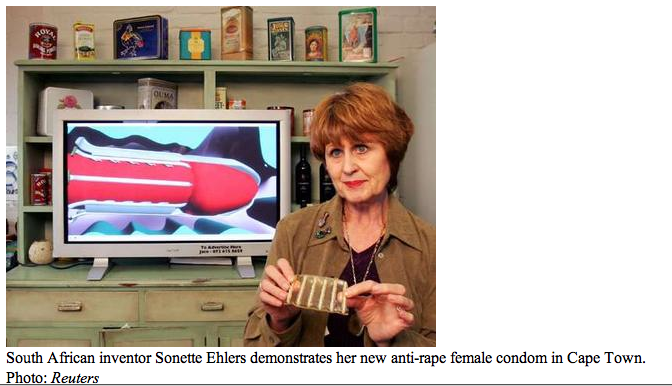
A medieval device built on hatred of men? Or a cheap, easy-to-use invention that could free millions of South African women from fear of rape, in a country with the world’s worst sexual assault record?
Dubbed the “rape trap”, trademarked “Rapex”, the condom-like device bristling with internal hooks designed to snare rapists has re-ignited controversy over South Africa’s alarming rape rate, even before plans for its production were announced in Western Capethis week.
Some say the inventor, Sonette Ehlers, a former medical technician, deserves a medal, others that she needs help.
The device, concealed inside a woman’s body, hooks onto a rapist during penetration and must be surgically removed.
Ms Ehlers said the rape trap would be so painful for a rapist that it would disable him immediately, enabling his victim to escape; but would cause no long-term physical damage and could not injure the woman.
Some women’s activists call the device regressive, putting the onus on women to address a male problem.
Charlene Smith, an anti-rape campaigner, said it “goes back to the concept of chastity belts” and would incite injured rapists to kill their victims.
“We don’t need these nut-case devices by people hoping to make a lot of money out of other women’s fear,” Ms Smith said.
But Ms Ehlers contends that South Africa’s rape problem is so severe women cannot wait for male attitudes to improve.
“I don’t hate men. I love men. I have not got revenge in mind. All I am doing is giving women their power back,” Ms Ehlers said. “I don’t even hate rapists. But I hate the deed with a passion.”
The United Nations says South Africahas the world’s highest per capita rate of reported rapes – 119 per 100,000 people. Analysts say the total, including unreported rapes, could be nine times higher.
Ms Ehlers sees her invention as particularly attractive to poorer black women, because they often walk long distances through unsafe areas to and from work. She foresees women inserting the device as part of a daily security routine.
She said a majority of women surveyed said they were willing to use the device, which will go into production next year and sell for one rand (20 cents).
Ms Ehlers said she was inspired after meeting a traumatised rape victim who told her, “If only I had teeth down there.”
Al Qaeda in Maghreb Spends Last Night in Timbuktu Destroying Ancient Manuscripts
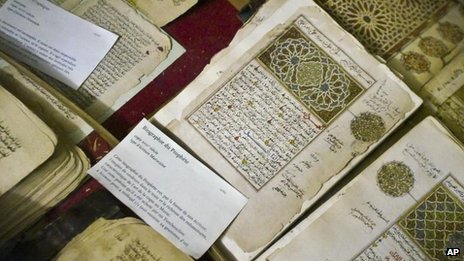
Ignorant militants destroy ancient Islamic documents and writings; from yesterday’s BBC News:
A group of jihadis came knocking at the gate late on Wednesday night last week. But the Ahmed Baba centre in the Malian city of Timbuktu is not the kind of library that would accept visitors after dark.
The Islamist militants tricked the guard and said they were coming to secure the place. But once inside, they ransacked the centre’s reading room.
When historian Abdoulaye Cisse arrived early in the morning, the pile of ashes was still warm.
“They probably spent most of the night in there,” he said.
Dozens of empty handcrafted boxes still litter the floor of the hallway. Ashes haven’t been removed yet either.
A few people come in and out surveying the irreparable damage and lament the remains of a cultural trove kept in Timbuktu for centuries.
Treasure trove of African history
At least 2,000 manuscripts were stored in this centre that was opened in 2009, funded by the South African government.
The project was meant to catalogue and preserve the city’s historical documents, many of which continue to be held by families or smaller libraries.
Another 28,000 were due to be transferred to the Ahmed Baba premises but were instead sent to the capital after al-Qaeda militants arrived in the city last year.
Each box is tagged with a reference number and if the search is properly done, these tags should reveal the full extent of the damage.
It could also reveal how many were simply stolen.
“These fighters know too well how much these papers are valued, it’s a huge wealth that will be impossible to replace,” Mr Cisse told the BBC.
The Institute’s manuscripts date back to the 13th century (file image)
“When I surveyed the reading room, I found about 30 left so I brought them home to secure them,” he said.
The offending texts ranged from history to geography and astronomy, medicine and Islamic law; writings dating back in some cases as far as the 13th Century.
In the reading room, shelves were emptied and the desk equipped with a magnifying glass vandalised.
Named after a saint of the ancient city who wrote many manuscripts himself, the Ahmed Baba centre stands out for its modernity but was designed to echo the famous Timbuktu style of dry-mud walls.
The Islamist militants prepared to flee last week knowing that an assault by the French-led forces on their positions here was imminent.
But in their haste, they took the time to commit one last act of vengeance.
They had sparked worldwide condemnation last year when they destroyed sacred tombs and shrines designated as Unesco World Heritage sites on the pretext that they violated principles of Islamic law.
Timbuktu was a centre of Islamic learning from the 13th to the 17th Centuries
700,000 manuscripts had survived in public libraries and private collections
Books on religion, law, literature and science
Elhadj Djitteye, who used to guide visitors in town, reckons that the fighters linked to al-Qaeda carried out the attack on the library in response to the French military intervention ordered earlier in January by President Francois Hollande.
Noting that the jihadis hadn’t touched the manuscripts in 10 months of occupation, Mr Djitteye sadly comments that they “hit Timbuktu straight at its heart”.
The militants’ destructive parting gesture left many residents feeling that another part of their celebrated city’s history had just been erased.
The people of Timbuktu have been anxious to return to some kind of normal life since the French and Malian troops entered they city and were hailed as “liberators”.
Reminders of the extremists, like the black banners proclaiming sharia at the city gates, are being removed.
But in just under a year, the Islamist militants have inflicted lasting damage on Mali’s most renowned cultural centre. The scars left by Timbuktu’s occupation are likely to take much longer to heal.
• Timbuktu was a centre of Islamic learning from the 13th to the 17th Centuries
700,000 manuscripts survive in public libraries and private collections, books on religion, law, literature and science
• Added to Unesco world heritage list in 1988 for its three mosques and 16 cemeteries and mausoleums
• They played a major role in spreading Islam in West Africa; the oldest dates from 1329
• Islamists destroyed mausoleums after seizing the city
Recent Comments
ExpatAlien on What Country am I Living … intlxpatr on Yellowstone: Old Faithful to C… Michelle on Yellowstone: Old Faithful to C… Cathy on No Grown-Ups in Charge intlxpatr on Waiting for Snow Wikipedia Donate Button

Amazina


Early Voting in Florida


 Here There and Everywhere