The Baboon Coughed
We’ve had three sets of houseguests in a very short time span, and today is our first day of ‘normal.’ We saw our friends off at 0430 (we used to call it oh-dark-hundred) and I couldn’t get back to sleep, so by the grace of God (and I mean that literally) I got up and walked.
I know I need to walk. I’ve always walked. I used to run, but I suffered for it – the knees – and decided I didn’t want to pay that price. But when my sister was here, we decided to take a walk and I said “don’t worry, I walk fast” and she said “I don’t, I am so slow now, my body has to warm up.” Confidently I started – and starting is uphill from my house. Very shortly, I discovered my fast was her slow, and I was HUFFING and puffing, and so embarrassed because I guess it’s been a while since I did this walk . . . but we did it. It felt good. And I was happy for a nice cool morning so I could do it again.
I ran into a neighbor, ignored that she was in her nightgown, we both pretended she was as fully dressed as I, had a brief conversation and she went inside with her newspaper and I carried on. About halfway through my walk, as I puffed along, I heard it.
The baboon coughed.
I could even smell a faint drift of wood burning fire. I could hear the doves. But it was only very briefly, very intangential, and I quickly realized it must have been a dog barking distantly; I could still hear him. For one brief moment I was back in Zambia, and while I love the magic of Zambia, I would not be out for a mile long hike early in the morning while the lions prowl for a last meal before they settle down for their day-long snooze.
We are off this morning to a grand plant sale across the bay in Milton. Symphony tonight. Back to “normal” for Pensacola.
“You’re Not Southern – You’re Arab!”
My mind works in quirky ways, and yesterday as I was setting up for the hands-on Heirloom Feathers workshop with Cindy Needham, one of the good local Pensacola quilters was telling her how you can tell a Southerner from a Northerner.
“If you go to a Southerner’s house, they’ll ask you first thing if you’d like a drink of water, or iced tea or something, but if you go into a Northerner’s house, you can sit there for five hours and they won’t offer you ANYTHING!”
I grinned to myself, no, I have learned to censor these thoughts. But I couldn’t help it.
“You’re not a Southerner,” I am thinking, “You’re ARAB!”
I thought about a long ago trip through Morocco, we have a rental car and on our way from Ouazazarte to Marrakesh, on an isolated stretch of the road, we see a car in trouble. We stop and ask if we can help, if the man would like a lift to the next town. He tells us no, he wants to stay with the car, but asks if we would go to such and such service station and tell his uncle he needs help, and where he is.
Of course.

We drive into town, find the service station, and find the young man’s uncle, who is the owner. He sends help.
Did I mention it was Ramadan? No eating or drinking in public from dawn to dusk?
The owner insisted we come into his house, and seated us in his diwaniyya, and sent in mint tea and luscious almond-filled dates to refresh us. We said “No! No! It’s Ramadan!” but he told us it was his honor. He sat while we drank and ate.
Such enormous hospitality. Such grace. We only stayed a very short time; we still had a long drive, but I’ve never forgotten his hospitality.
Then again, it was Southern Morocco. 🙂 Maybe he was Southern.
Putting TEETH into Anti-Rape Solutions :-)
Thank you, Hayfa, you always find the most amazing articles. What I love about this one is that if everything is where it is supposed to be, nobody gets hurt. Only invasive behavior results in . . . .lets hope excruciating pain 🙂 It also gives an attacker something else to focus on. This invention is a public service.
Rape-aXe: The Anti-Rape Condom
This is so brilliant! An anti-rape female condom invented by Sonette Ehlers.… A South African woman working as a blood technician with the South African Blood Transfusion Service, during which time she met and treated many rape victims. The device, known as The Rape-aXe, is a latex sheath embedded with shafts of sharp, inward-facing microscopic barbs that would be worn by a woman in her vagina like a tampon. If an attacker were to attempt vaginal rape, their penis would enter the latex sheath and be snagged by the barbs, causing the attacker pain during withdrawal and (ideally) giving the victim time to escape. The condom would remain attached to the attacker’s body when he withdrew and could only be removed surgically, which would alert hospital staff and police. This device could assist in the identification and prosecution of rapists.

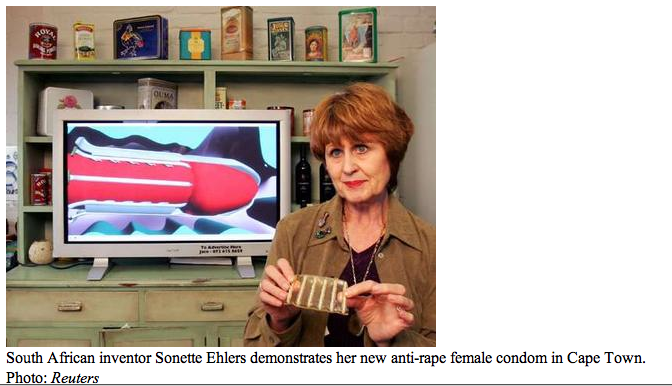
A medieval device built on hatred of men? Or a cheap, easy-to-use invention that could free millions of South African women from fear of rape, in a country with the world’s worst sexual assault record?
Dubbed the “rape trap”, trademarked “Rapex”, the condom-like device bristling with internal hooks designed to snare rapists has re-ignited controversy over South Africa’s alarming rape rate, even before plans for its production were announced in Western Capethis week.
Some say the inventor, Sonette Ehlers, a former medical technician, deserves a medal, others that she needs help.
The device, concealed inside a woman’s body, hooks onto a rapist during penetration and must be surgically removed.
Ms Ehlers said the rape trap would be so painful for a rapist that it would disable him immediately, enabling his victim to escape; but would cause no long-term physical damage and could not injure the woman.
Some women’s activists call the device regressive, putting the onus on women to address a male problem.
Charlene Smith, an anti-rape campaigner, said it “goes back to the concept of chastity belts” and would incite injured rapists to kill their victims.
“We don’t need these nut-case devices by people hoping to make a lot of money out of other women’s fear,” Ms Smith said.
But Ms Ehlers contends that South Africa’s rape problem is so severe women cannot wait for male attitudes to improve.
“I don’t hate men. I love men. I have not got revenge in mind. All I am doing is giving women their power back,” Ms Ehlers said. “I don’t even hate rapists. But I hate the deed with a passion.”
The United Nations says South Africahas the world’s highest per capita rate of reported rapes – 119 per 100,000 people. Analysts say the total, including unreported rapes, could be nine times higher.
Ms Ehlers sees her invention as particularly attractive to poorer black women, because they often walk long distances through unsafe areas to and from work. She foresees women inserting the device as part of a daily security routine.
She said a majority of women surveyed said they were willing to use the device, which will go into production next year and sell for one rand (20 cents).
Ms Ehlers said she was inspired after meeting a traumatised rape victim who told her, “If only I had teeth down there.”
Al Qaeda in Maghreb Spends Last Night in Timbuktu Destroying Ancient Manuscripts
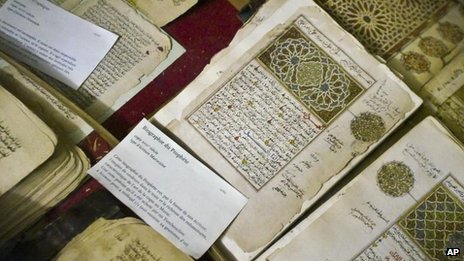
Ignorant militants destroy ancient Islamic documents and writings; from yesterday’s BBC News:
A group of jihadis came knocking at the gate late on Wednesday night last week. But the Ahmed Baba centre in the Malian city of Timbuktu is not the kind of library that would accept visitors after dark.
The Islamist militants tricked the guard and said they were coming to secure the place. But once inside, they ransacked the centre’s reading room.
When historian Abdoulaye Cisse arrived early in the morning, the pile of ashes was still warm.
“They probably spent most of the night in there,” he said.
Dozens of empty handcrafted boxes still litter the floor of the hallway. Ashes haven’t been removed yet either.
A few people come in and out surveying the irreparable damage and lament the remains of a cultural trove kept in Timbuktu for centuries.
Treasure trove of African history
At least 2,000 manuscripts were stored in this centre that was opened in 2009, funded by the South African government.
The project was meant to catalogue and preserve the city’s historical documents, many of which continue to be held by families or smaller libraries.
Another 28,000 were due to be transferred to the Ahmed Baba premises but were instead sent to the capital after al-Qaeda militants arrived in the city last year.
Each box is tagged with a reference number and if the search is properly done, these tags should reveal the full extent of the damage.
It could also reveal how many were simply stolen.
“These fighters know too well how much these papers are valued, it’s a huge wealth that will be impossible to replace,” Mr Cisse told the BBC.
The Institute’s manuscripts date back to the 13th century (file image)
“When I surveyed the reading room, I found about 30 left so I brought them home to secure them,” he said.
The offending texts ranged from history to geography and astronomy, medicine and Islamic law; writings dating back in some cases as far as the 13th Century.
In the reading room, shelves were emptied and the desk equipped with a magnifying glass vandalised.
Named after a saint of the ancient city who wrote many manuscripts himself, the Ahmed Baba centre stands out for its modernity but was designed to echo the famous Timbuktu style of dry-mud walls.
The Islamist militants prepared to flee last week knowing that an assault by the French-led forces on their positions here was imminent.
But in their haste, they took the time to commit one last act of vengeance.
They had sparked worldwide condemnation last year when they destroyed sacred tombs and shrines designated as Unesco World Heritage sites on the pretext that they violated principles of Islamic law.
Timbuktu was a centre of Islamic learning from the 13th to the 17th Centuries
700,000 manuscripts had survived in public libraries and private collections
Books on religion, law, literature and science
Elhadj Djitteye, who used to guide visitors in town, reckons that the fighters linked to al-Qaeda carried out the attack on the library in response to the French military intervention ordered earlier in January by President Francois Hollande.
Noting that the jihadis hadn’t touched the manuscripts in 10 months of occupation, Mr Djitteye sadly comments that they “hit Timbuktu straight at its heart”.
The militants’ destructive parting gesture left many residents feeling that another part of their celebrated city’s history had just been erased.
The people of Timbuktu have been anxious to return to some kind of normal life since the French and Malian troops entered they city and were hailed as “liberators”.
Reminders of the extremists, like the black banners proclaiming sharia at the city gates, are being removed.
But in just under a year, the Islamist militants have inflicted lasting damage on Mali’s most renowned cultural centre. The scars left by Timbuktu’s occupation are likely to take much longer to heal.
• Timbuktu was a centre of Islamic learning from the 13th to the 17th Centuries
700,000 manuscripts survive in public libraries and private collections, books on religion, law, literature and science
• Added to Unesco world heritage list in 1988 for its three mosques and 16 cemeteries and mausoleums
• They played a major role in spreading Islam in West Africa; the oldest dates from 1329
• Islamists destroyed mausoleums after seizing the city
Ansar Din Runs Away From Mali in Disarray After French Air Strikes
Last year, we were honored to have a member of the Algerian Seal team at our table for dinner. Together with the French, they got the job done clearing the rats out of Mali in short time.
From today’s BBC News:
 :
:
Three weeks of French targeted air strikes in northern Mali have left Islamist militants “in disarray”, France’s defence minister has said.
Jean-Yves Le Drian said the jihadists had now scattered, marking a “turning-point” in France’s intervention.
His comments come as the French troops continue to secure Kidal, the last town occupied by militants.
France is preparing to hand over towns it has captured to an African force, which has begun to deploy to Mali.
So far about 2,000 African soldiers, mainly from Chad and Niger, are thought to be on the ground.
It will be the job of the African Union-backed force, the International Support Mission to Mali (Afisma), to root out the al-Qaeda-linked insurgents that have fled into the desert and mountains further north.
Meanwhile, at least two Malian soldiers have been killed when their vehicle hit a landmine south-west of Gao.
‘Tactical withdrawal’
Mr Le Drian said that some militants in Mali and been on a “military adventure and have returned home”.
Others had made a “tactical withdrawal to the Adrar des Ifoghas”, the mountainous region east of Kidal covering some 250,000 sq km (96,525 sq miles), he said.
Although this was now a turning-point for France, he said it did not mean that “the military risks and the fighting has ended”.
He also said he backed the idea of sending a UN peacekeeping force to Mali.
The BBC’s Christian Fraser in Paris says the UN Security Council had previously been uncomfortable about deploying a force under a UN mandate, but support is growing.
Envoys believe it would easier to monitor and prevent human rights abuses if the UN could pick and choose which national contingents to use, he says.
A French army spokesman in Bamako, Lieutenant-Colonel Emmanuel Dosseur, told the BBC French Service that France’s special forces were in Kidal, but the majority of troops were still at the airport.
A heavy sandstorm that had hampered operations on Wednesday was starting to clear, and troops may soon be able to continue their deployment, he said.
Haminy Maiga, who heads the regional assembly in Kidal, said he had witnessed no fighting as French forces entered and two helicopters were patrolling overhead.
Correspondents say the bigger problem is how to manage the concerns of the separatist Tuareg fighters in Kidal – the only city in the north to have a majority ethnic Tuareg population.
Chad’s army is full of experienced desert fighters needed to fight the militants
The secular National Movement for the Liberation of Azawad (MNLA) said its fighters would support the French but would not allow the return of the Malian army, which it accused of “crimes against the civilian population”.
Human rights groups have accused the Malian army of targeting ethnic Tuareg and Arab civilians.
The Tuareg rebels launched the insurgency in October 2011 before falling out with the Islamist militants.
The Islamist fighters extended their control of the vast north of Mali in April 2012, in the wake of a military coup.
An MNLA spokesman told the BBC that its fighters had entered Kidal on Saturday and found no Islamist militants there.
Kidal was until recently under the control of the Ansar Dine Islamist group, which has strong ties to al-Qaeda in the Islamic Maghreb (AQIM).
The Islamic Movement of Azawad (IMA), which recently split from Ansar Dine, had said that it was in control of Kidal.
The IMA, which has Tuareg fighters amongst its members, has also said it rejects “extremism and terrorism” and wants a peaceful solution.
France – the former colonial power in Mali – launched a military operation this month after the Islamist militants appeared to be threatening the south.
Changing Face of the Worlds Families

I had always assumed a two parent family provided the best support for a child. It never occurred to me there may be situations where the single-parent model could focus more resources on the child . . . It doesn’t matter what we believe; the face of families around the world is changing, and we will need to be dealing with the realities.
Marriage is a struggle. Raising children is a struggle. The more help, the better, I think!
The structure of families is changing worldwide, and based on a new report, some children are better off living with one parent than two.
According to the 2013 World Family Map report by non-profit research centre Child Trends, children living in two-parent families did better in school in higher-income countries, but children in lower-income regions did better with one parent.
“In some single parenting examples, resources were controlled by the mother of the household, ensuring these resources went to the well-being of children,” says Laura Lippman, senior program area director, education, and co-investigator of the World Family Map. “It suggests that some single-parent families may not benefit from a second parent who might be taking these resources away.”
Using 10 different data sources and partnering with universities around the world, Child Trends looked at the well-being of families in both low-income and high-income countries and the outcome on their children’s education. Based on the research, two-parent families are becoming less common, marriage rates are falling and a majority of children under 17 still live at home.
Significant Statistics From The Study
Two Parents vs. Single Parent:
DID YOU KNOW? Children in Asia and the Middle East under the age of 18 are more likely to live in two-parent families, compared to other regions in the world. Also, children are more likely to live with one or no parent in the Americas, Europe, Oceania, and Sub-Saharan Africa than other regions, according to the report.
Extended Family:
DID YOU KNOW? Living with extended family, which includes parents and other relatives outside the immediate family, is more common in Asia, the Middle East, South America, Sub-Saharan Africa and not any other part of the world.
Marriage:
DID YOU KNOW? Marriage rates are declining in many regions. Adults are most likely to be married in Africa, Asia and the Middle East.
Childbearing:
DID YOU KNOW? Childbearing rates are also declining, according to the report. The highest fertility rates are in Sub-Saharan Africa — a woman in Nigeria gives birth to an average of 5.5 children.
Living Together:
DID YOU KNOW? There have also been dramatic increases in cohabitation, divorce, and non-marital childbearing in the Americas, Europe, and Oceania over the last four decades, according to the report.
Population:
DID YOU KNOW? In the Americas and Oceania countries, women in these regions were having enough children for the population to replace itself from one generation to the next, or were slightly below these “replacement levels,” according to the report.
Non-Martial Childbearing:
DID YOU KNOW? In South America, over half of all children were born to unmarried mothers — Colombia had the highest rate at 85 per cent.
Poverty:
DID YOU KNOW? The report also looked extensively at rates of children and absolute poverty around the world. Absolute poverty was measured as the percentage of the population living below $1.25 a day. The report found Nigeria had the highest absolute poverty rate at 64 per cent.
Employment:
DID YOU KNOW? Between 45 and 97 per cent of parents polled were employed worldwide, and the highest employment rate was in Asia.
Family Life:
DID YOU KNOW? Between 31 per cent (in Russia) and 74 per cent (in Chile) of adults around the world are completely or very satisfied with their family life.
Household Work:
DID YOU KNOW? Approximately 55 per cent of couples in Russia and 88 per cent of couples in Philippines reported low levels of disagreement around household work.
Eating Together:
DID YOU KNOW? In Italy, 94 per cent of 15-year-old kids eat meals with their families regularly.
Family Structure:
DID YOU KNOW? In a majority of countries polled, respondents felt children were more likely to flourish in a home with a mother and a father. However, in Sweden, only 47 per cent of adults shared this belief compared to 99 per cent in Egypt, suggesting to World Family Map surveyors a more liberal attitude to changing family structures in certain countries.
Pensacola Saturday, January 19th
This was a busy and fun Saturday, starting off with a productive and satisfying meeting for AdventureMan, followed by a chat in my office, during which he drifted off and snoozed for an hour while I culled my iPhoto program. Then we headed for the Fill a Bowl for Manna event, where you pay your $30 entry, pick a hand crafted bowl and proceed to eat soups from a great variety of generous Pensacola supporters. Such a wonderful variety of soups, and also – such a great support from the Pensacola community:
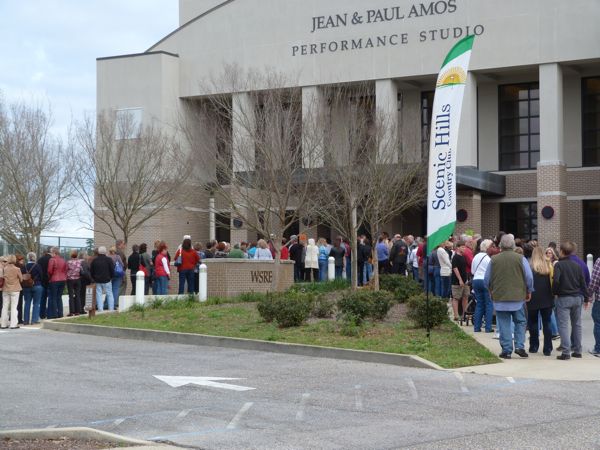
The lines were long, even if you had tickets in advance, but everyone was patient and good humored about waiting their turn.
From soup, we headed downtown to visit the African Art collection on display at the Pensacola Art Museum. First, we had to dodge all the colorful walkers in the Mardi Gras Run, Walk, DRAG with Color, people colored green, gold, and/or purple like the folk in the festival in India, then we had to find a parking place, dodging the police and fire people busy cleaning the streets from the chalk. The water was running green!

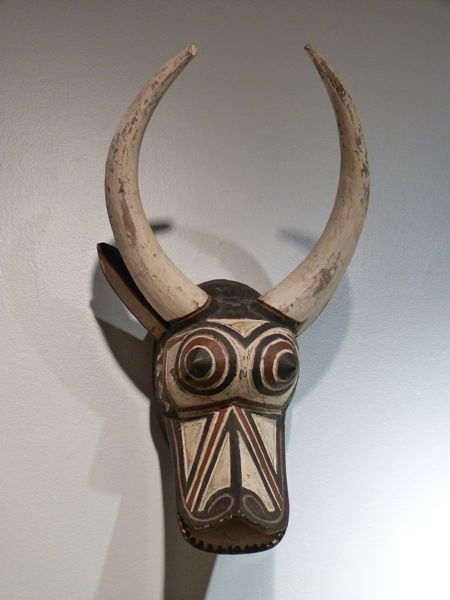
The African Art exhibit was a collection from a family who had lived in Western Africa and brought back fabulous pieces. Truly, the detail and artistry we were able to see close-up just blew us away:
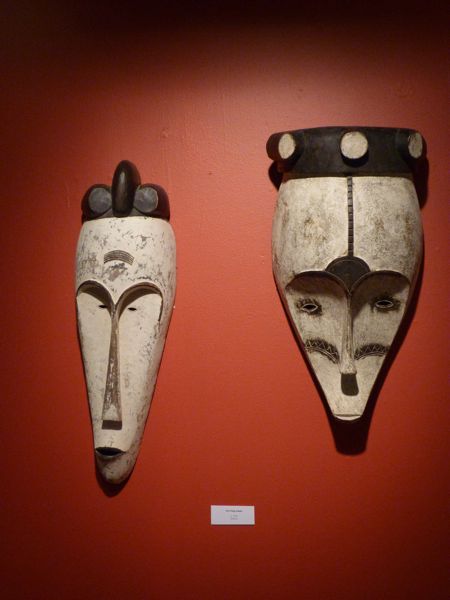
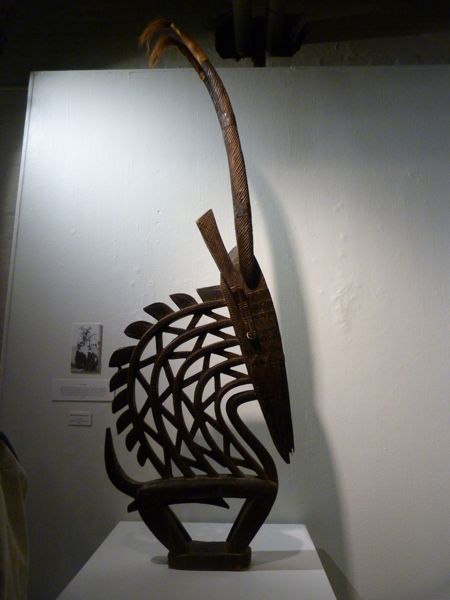
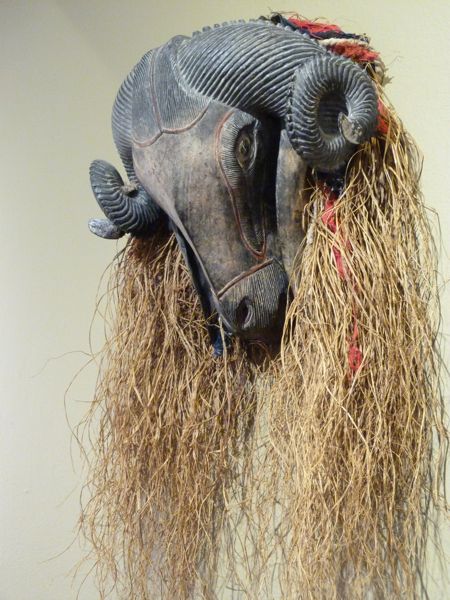
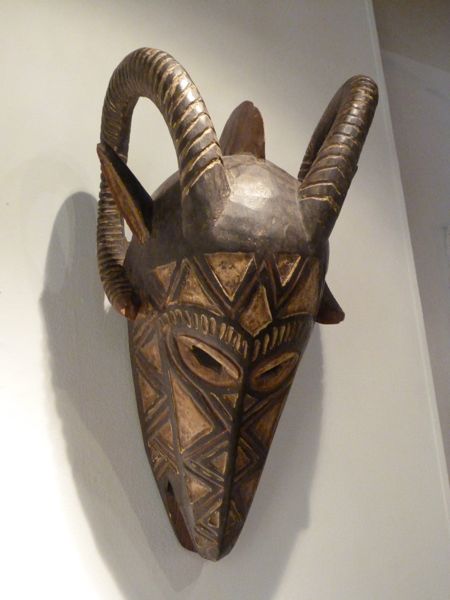
These were so different from the other masks presented, clearly a different tribal group, different aesthetics. I called them the zombie masks for their very grey, formless, chaotic nature, and the black circle eyes:
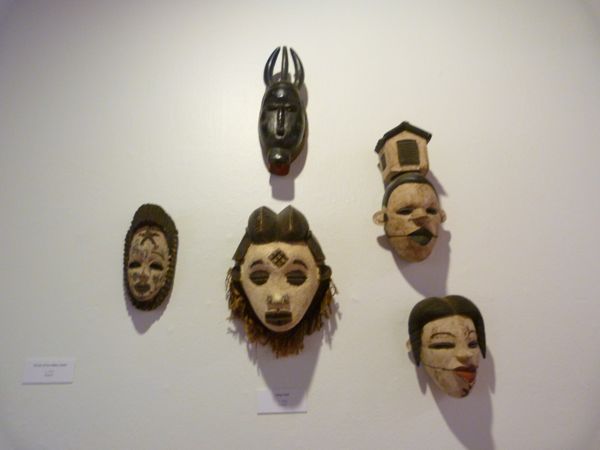
The textiles on the walls were not identified, but we immediately recognized this sizzling textile as identical to a bedspread we had on our bed at the Grumeti Camp when we were there on the Following the Great Migration trip we took with CC Africa, now called And Beyond:

(This is not in the Pensacola Art Museum; this is our bed in the Grumeti Camp, where you can see the bedcover folded at the end; same amazing cloth:)


Late lunch at our favorite go-to local deli, the East Hill Market, and home – a very satisfying day altogether.
French Intercede to Save Mali
Heard yesterday on NPR that France was stepping up to the plate on Mali, found the story on BBC this morning . . . it isn’t easy. It’s like people in the US don’t get news of countries like Mali unless they really seek it out. You can find more stories on Mali and the Tuareg / Al Qaeda alliance tormenting Northern Mali at the BBC link.


The Ansar al Din is imposing in Mali the kind of Islam that the Taliban imposed in Afghanistan – an Islam which forbids music, forbids women to participate in public life, enforced by a group of ignorant, uneducated thugs with weapons. Everything Ansar al Din stands for is contrary to the true nature of Islam.
Go France!
French troops continue operation against Mali Islamists
Mali: Divided nation
French Defence Minister Jean-Yves Le Drian said army units had attacked a column of rebels heading towards the central town of Mopti.
He also revealed that a French pilot had been killed in fighting on Friday.
The French troops deployed on Friday after Mali’s army lost control of a strategically important town.
Mali’s government said its forces had recaptured the town, Konna, after the air strikes, but it was not clear if all Islamist fighters had left the area.
‘Terrorist state’
Armed groups, some linked to al-Qaeda, took control of the whole of northern Mali in April.
They have sought to enforce an extreme interpretation of Islamic law in the area.
Regional and Western governments have expressed growing concern about the security threat from extremists and organised crime.
Mr Le Drian said on Saturday that hundreds of French troops were involved in the military operation in Mali.
The minister said Paris had decided to act urgently to stop the Islamist offensive, which threatened to create “a terrorist state at the doorstep of France and Europe”.
He also revealed that a French pilot was killed in Friday’s fighting – during an air raid to support Mali’s ground troops in the battle for Konna.
“During this intense combat, one of our pilots… was fatally wounded,” the minister said.
Speaking on Friday, French President Francois Hollande said the intervention complied with international law and had been agreed with Malian interim President Dioncounda Traore.
It would last “as long as necessary”, Mr Hollande said.
French officials gave few operational details.
Residents in Mopti, just south of Konna, told the BBC they had seen French troops helping Malian forces prepare for a counter-offensive against the Islamists.
Mr Traore declared a state of emergency across Mali, which he said would remain in place for an initial period of 10 days.
He used a televised address to call on Malians to unite and “free every inch” of the country.
‘Crusader intervention’
The west African bloc Ecowas said it was authorising the immediate deployment of troops to Mali “to help the Malian army defend its territorial integrity”.
UN Secretary-General Ban Ki-moon says the situation in Mali is becoming increasingly volatile
The UN had previously approved plans to send some 3,000 African troops to Mali to recapture the north if no political solution could be found, but that intervention was not expected to happen until September.
French Foreign Minister Laurent Fabius said the aim of the operation was to stop Islamist militants advancing any further.
It was not clear how far the French would go in helping Mali’s government retake territory in the north.
At least seven French hostages are currently being held in the region, and Mr Fabius said France would “do everything” to save them.
A spokesman for al-Qaeda in the Islamic Maghreb (AQIM) said he considered the French operation a “Crusader intervention”, and told France it would be “would be digging the tombs of [its] sons” if the operation continued, according to the Mauritania-based Sahara Media website.
France ruled Mali as a colony until 1960.
This chart is from a Blog called The Moor Next Door:

Recent Comments
intlxpatr on Shampoo Ginger tigerbutterya0c5ff1d… on Shampoo Ginger intlxpatr on British Soldier Kidnapped, Esc… John on British Soldier Kidnapped, Esc… intlxpatr on British Soldier Kidnapped, Esc… Wikipedia Donate Button

Amazina


Early Voting in Florida


