Speaking More Than One Language Delays Alzheimer’s
From AOL Everyday Health:
WEDNESDAY, November 6, 2013 — A small but growing body of research is finding that people who are proficient in multiple languages have a lower risk of cognitive decline. In the largest study to date on the relationship between bilingualism and dementia, researchers from Hyderabad, India, and Edinburgh, Scotland, demonstrated that bilingualism may stave off symptoms of Alzheimer’s disease and other types of dementia for several years. Their study was published in the journal Neurology.
The research team in Hyderabad evaluated 648 people who had dementia symptoms for 6 months to 11 years before enrolling in the study; 391 of the subjects were bilingual. The researchers found those who were bilingual developed dementia on average 4.5 years later than people who spoke only one language. On average, bilinguals developed dementia symptoms by age 65.6 compared with age 61.1 in people who spoke only one language.
“Nowadays, a lot of companies are having expensive brain-training programs, but I’d say bilingualism is very cheap,” said Thomas Bak, MD, a lecturer in human cognitive neuroscience at the University of Edinburgh, and second author on the study. “The crucial thing about bilingualism is that it offers what we say is constant brain training. A bilingual person Is forced to switch to different sounds, words, concepts, grammatical structure, and social norms.”
Dr. Bak’s study demonstrated the impact bilingualism has not only on the progression of Alzheimer’s disease, but also on other types of dementia. Though the majority of patients in the group studied (37 percent) had Alzheimer’s-related dementia, 29.2 percent had vascular dementia, a type caused by reduced blood flow in the brain from stroke. Frontotemporal lobe dementia — from atrophy or shrinkage of certain areas of the brain — accounted for 17.9 percent of the diagnoses. Lewy body dementia, the second most common type of progressive dementia and one that is related to Parkinson’s disease, accounted for 8.5 percent, while 7.4 percent of people in the study were diagnosed with mixed dementia.
The researchers found bilingualism had the most dramatic effect on people who were diagnosed with frontotemporal lobe dementia. Knowing multiple languages delayed dementia symptoms by as much as six years in this group. Individuals with vascular dementia had an average of almost four extra years before dementia symptoms set in. However, individuals who knew three or four languages weren’t protected longer from dementia symptoms than those who were only proficient in two languages.
The More Different the Languages, the Better
The World Health Organization estimates 35.6 million people in the world have dementia, with 7.7 million new cases every year. And in India the problem is expected to grow even more dire. In 2009, the World Alzheimer’s Report projected India will have 10 million dementia patients by the year 2020. This was the impetus behind the new research, said Suvarna Alladi,MD, lead author of the study, which was funded by the Indian Department of Science and Technology.
“Dementia has become a major public health problem in India, and research that explores potentially protective mechanisms is of tremendous importance,” said Dr. Alladi. “Since many people in India can fluently speak two or more languages in their daily life, it’s heartening for us to know that something that we take for granted may protect our brains from developing dementia early.”
Teluga is the official state language in Hyderabad. Natives of the city are often also proficient in Hindi and Dakkhini, which more closely shares roots with English than with Teluga. This raises questions about the brain and “linguistic distance,” said Bak.
“You could argue the more different languages are, the better they are for the brain,” Bak said. “However you can also argue that when you speak languages that are so closely related you have to suppress one.”
Scientists have also become interested in whether cognitive abilities can be retained in similar ways if a person doesn’t learn a second language until later on in life, but there are yet no studies on this topic. However, many researchers, including Bak, speculate that a person who learns a second language later on life could glean similar benefits. “There are theories that would say you need the constant practice,” he said. “The fact that I can swim won’t make me healthy. If I actually go swimming it will make me healthier.”
Exercising the Brain
Numerous studies have found one of the best ways to slow cognitive decline is by mindfully engaging in brain-flexing activities, such as playing Suduko and crossword puzzles or reading books. I-Chant Andrea Chiang, MD, a professor who specializes in language psychology at Quest University Canada in Squamish, B.C., sees very little difference between language learning and any other type of brain exercise. “The brain is a muscle and it needs to be worked out like any other muscle,” said Dr. Chiang. “All those mental activities stimulate the brain and build up a cognitive reserve, even though there may be physical decline.”
Chiang has consulted with Ryan McMunn, who runs BRIC Language Systems headquartered in New York City. McMunn said a number of Alzheimer’s patients have sought out BRIC language classes online to help offset the symptoms of the disease, or are learning a second language because Alzheimer’s runs in the family. McMunn, who is American and lived in China after college, said his grandmother had Alzheimer’s disease, but he wasn’t aware of the research on bilingualism and dementia until after he began learning to speak Mandarin, which he now does fluently.
“Honestly I can’t think of a more fun way of trying to postpone these things,” said McMunn. “Learn any language; it’s a fun thing to do and it allows you to communicate with new people. I look at it as very beneficial.”
Steamer Trunks
I saw this ad in a higher end magazine and felt a bolt of recognition pass through me . . . my Mom had a suitcase, probably from her Mom or grandmother, that looked like this. She stored special fabrics in it for later use. It always smelled like faraway places.
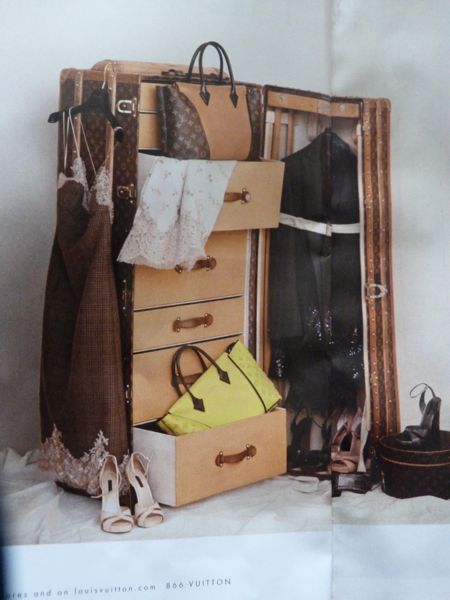
Look at the space! You can pack everything neatly into drawers, you can hang your hanging clothes.
These were for ship travel, where someone would deliver your trunk to the ship and sometimes, even unpack it for you and store the trunk in the hold while you dined and supped your way across the Atlantic – maybe ten to fourteen days. There were no restrictions on numbers of bags, no restrictions on bag size.
Even as a child, going back and forth to university from Germany, we had BIG bags, huge bags we could stuff full. The two bag limit was 77 pounds, but it seems to me that the airline staff always looked the other way. I still get steamed every time I fly a “foreign” (i.e. not an airline I have privileges on) airline and have to pay a baggage fee for even one bag. Stuffed in like sardines, even in business class. Unspeakable food, tinier and tinier restrooms . . . People fighting for space in the overhead bins . . .
Oh my gosh; I am talking like an OLD person.
Dining at Captain Pattie’s, the Best Meal of our Trip
We’d been driving since breakfast, stopping, getting out, maybe hiking a little, taking photos, and we wanted a nice lunch. The weather is gorgeous, even hot, and we head for the Homer spit.
The name Homer Spit just cracks AdventureMan up, even though he knows Spit in this usage means a long, thin, flat beach that goes out into the sea (Definition of spit noun (LAND) from the Cambridge Advanced Learner’s Dictionary & Thesaurus © Cambridge University Press), he still cracks up just like a little boy when he hears it or says it. This is what Homer Spit looks like:
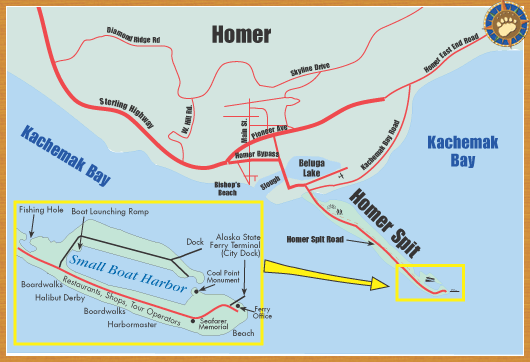
It is actually like four or five miles long, longer than it looks on the maps. While a lot of people hike out there, we drove; we want to continue exploring after we eat.
The nicest restaurant we can see is Captain Patties, and we decide to give it a try.


From the moment we walk in, we are so glad me made this choice. The interior is clean and neat and sunny, there is sea memorabilia on the walls, and the place if filled with people who look like they live here.
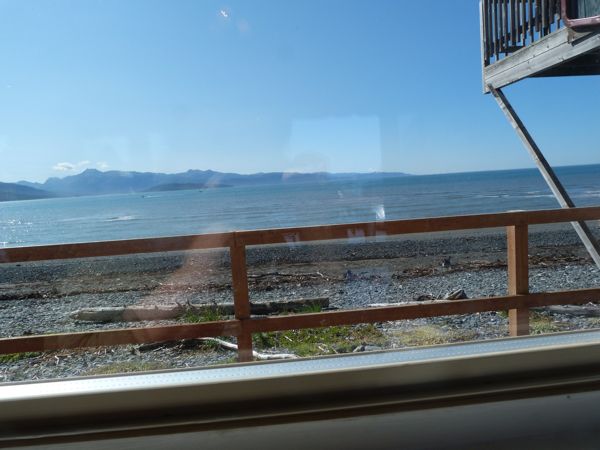
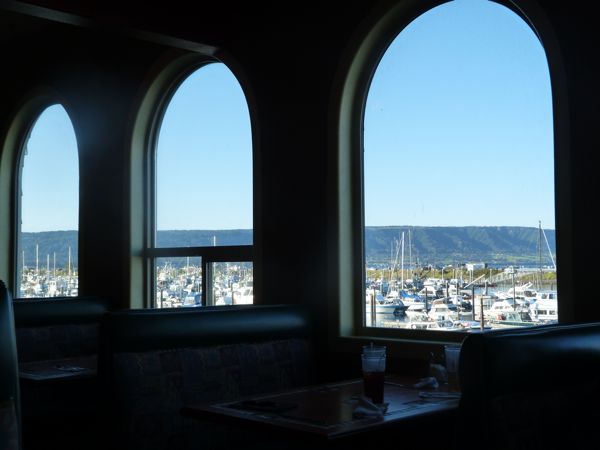
This is the view from Captain Patties:
We love the place, and we love it that they are fine with us each ordering soup and splitting the main dish. We have found that we just can’t eat as much as restaurants want to put on our plates. At home, it is no problem, we ask them to pack it up and we have it for dinner, or lunch another day. We don’t want to waste food, and we don’t want to pack it up, either, so sharing a main dish works for us.
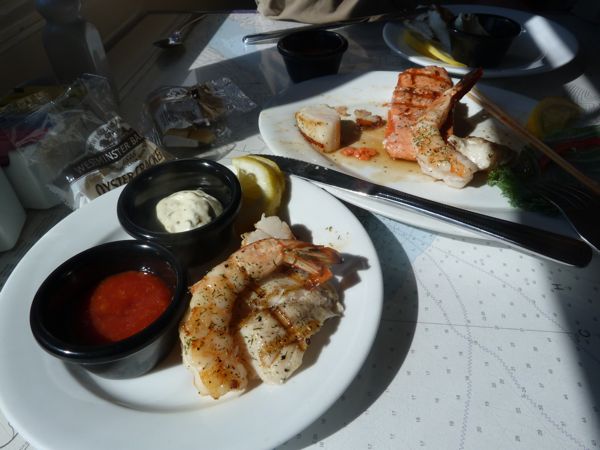
Today we choose seafood chowder – oh man, we’ve been eating chowders everywhere but this one is THE best. And we split a grilled local seafood platter, everything on the plate, the scallops, the shrimp, the salmon and the halibut, all local. It is unbelievably good. It is so simply prepared, no elaborate sauces, and it is so tasty, so good.

On the wall hangs this piece. From our whaling adventures with Captain Alan on the Scania, we know that this is baleen, what the whale uses to screen fish as he ingests them. 🙂

We wanted to go to The Mermaid for dinner, but they were fully booked, right up to closing. We could see people waiting outside at Fat Olives, a lot of people, so we decided we had such a good lunch at Captain Pattie’s that we would go back for dinner. Ha Ha Ha Ha Ha on us. Whoda thunk, but in Homer on a gorgeous Saturday night, you had better have reservations for dinner. We ended up having a nice enough dinner, but nothing special, across the street, wishing we were back at Captain Patties.
Our dinner somewhere else, nice enough, but not the same:
AdventureMan had salad and salmon quesadillas; I had Ceasar salad with grilled salmon:



A few last views of Homer:
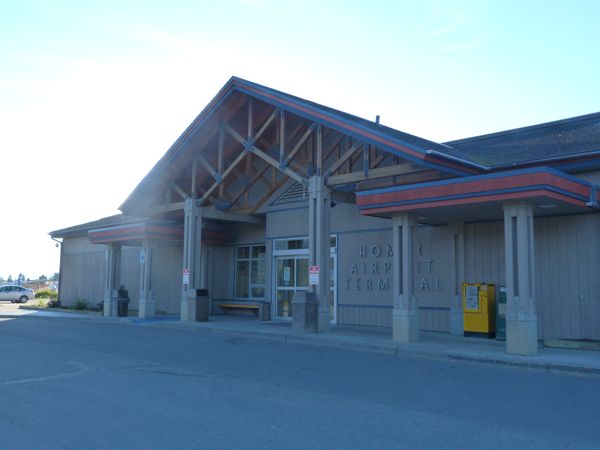
The Homer Airport, cozy and efficient:
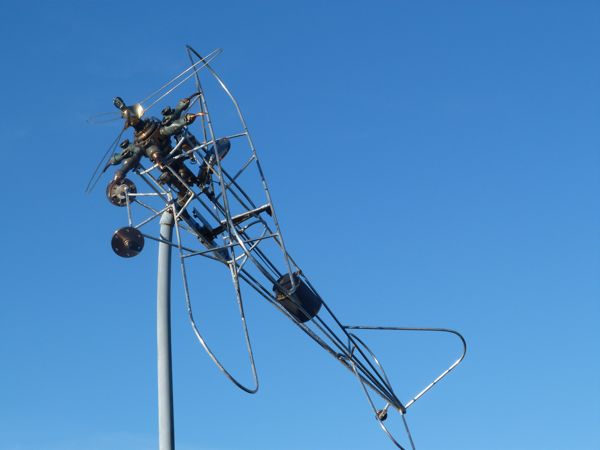
Public art at the airport 🙂
Sign on a property outside of Homer:

One of several thriving community gardens we saw in Homer, full of delicious things to eat. We love it that Pensacola also has good community gardens.

Presenter Ses Condoléances
Some things you do. Some things are hard, and you do them anyway. I always think of them in the formal – pour prendre conge’, respondez, pour rendre petite assistance . . . must do’s, societal niceties, the grease that keeps civilization running, never mind smoothly.
I had to call a friend this morning to tell her how sorry I am that her husband had died. When she came to the phone, I was initially shocked. For months, since her husband’s stroke, she has been subdued and tired, but this morning she sounded happy and energetic.
“He’s free!” she said to me. “”As it says in the Bible, his passing was a breath; if I hadn’t been holding his hand and paying attention, I wouldn’t have known he was gone. It was so easy.” She was joyful. We wept together, for joy. He was free of the burden his life had become.
What I thought was going to be a sad call turned out to be a joyful call. She loves her husband still. They had years and years and children and grandchildren together, and she let him go with joy because he was ready.
Thanks be to God.
No Internet??? No Wi-Fi??? No Phone Service???
No, I have not abandoned you.
When my son asked about communicating with us from Alaska, I confidently assured him “oh, Alaska will be like Africa! Land lines are so expensive to install, there will be cell towers everywhere, and besides, my iPhone is covered everywhere! I can use the internet.”
Oh Pride, Intlxpatr, Pride. You speak whereof you do not know!
Our time in Juneau was a lot of fun. From the moment we arrived, it was just so smooth. The airport is small, like Africa. You can be in and out of the airport in minutes. We picked up our car; it was so easy, the reservation was waiting, and the car is out in the small lot. It is a car a lot like our own and we really like it. Not five minutes later, we are in our room at a nearby hotel, and it is a nice room, and of course it has Wi-Fi, that’s how I sent the earlier entries.
I called an old friend of my Mother’s, a friend I remember well from my childhood, she and my mother would laugh a lot together, and our families travelled together, out on a big old Coast Guard cutter fishing in Alaska, or out to islands where we would pick berries, or out, just out, because it was a beautiful weekend and when the weather is good, Alaskans go outside.
We planned to meet up for coffee, and when we did, she was just like the old days, only older. I laughed and told her I am now older than when I knew her before. She laughed at AdventureMan’s jokes, and she had a beautiful living place near where my family used to live, with a view to die for. It reminded me of Kuwait. I could lose hours looking out her window, if I lived there. Eagles flying by, cruise ships coming in and out, the weather changing on the mountain across the way – it was a magnificent location, and it was all made even better by good coffee, good conversation and a great deal of love based on old relationships.
But we needed to go! We had things we needed to see!
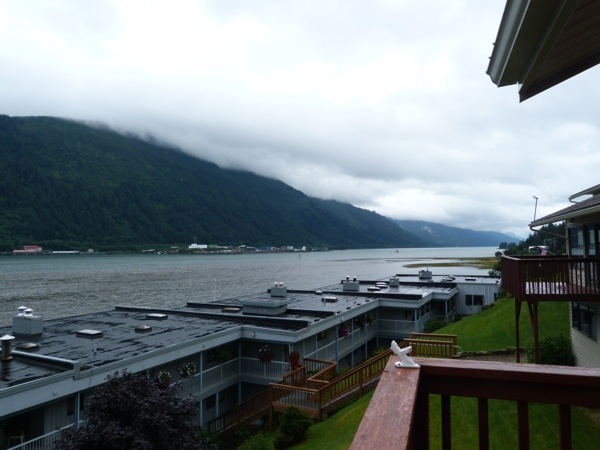
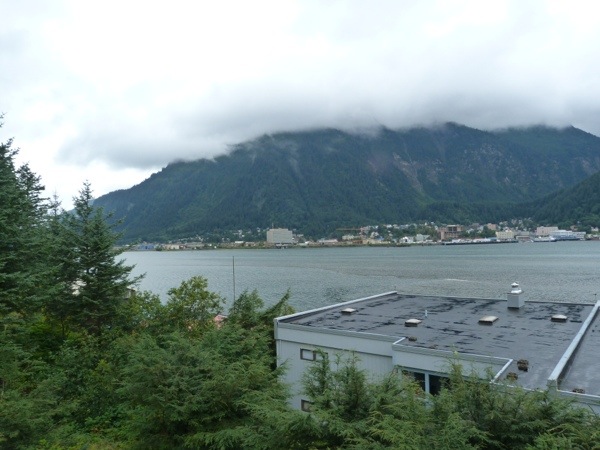
This is the view from our friend’s house in West Juneau:

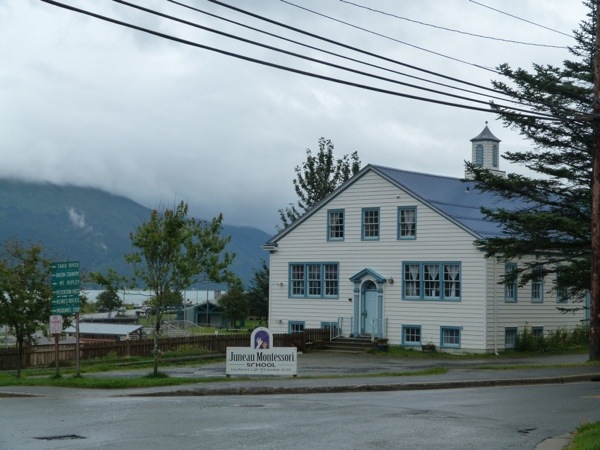
My old school:
Alaskan Indian art, painted over a garage door:

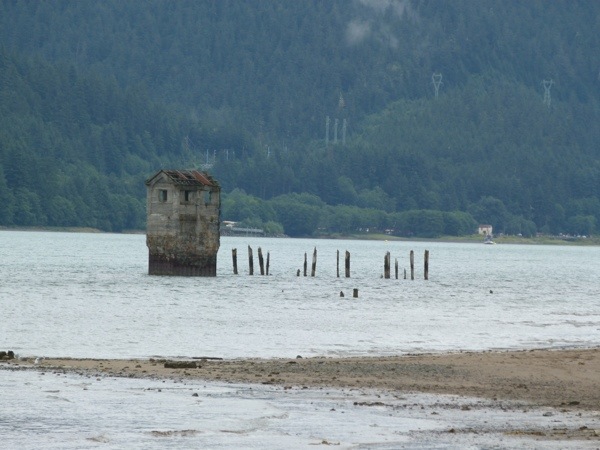
The beach we used to go to, called Sandy Beach. Occasionally a dead walrus would wash up there, causing no end of excitement to us young people.

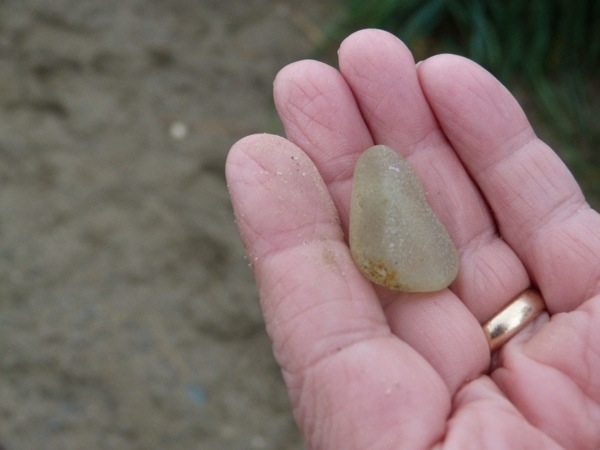
AdventureMan found a piece of the sea glass I love:

I thought this school above was a lot bigger than this . . . . I remember it being a lot bigger . . . LOL!
This is our old house, many many years ago. It used to have a much bigger front yard, before they widened the road. It also seemed farther from the little grocery store near the bridge that my Mom would send me to, but it’s gotten shorter!

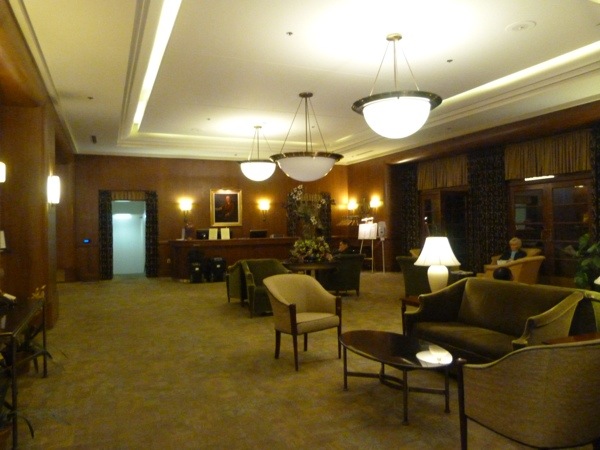
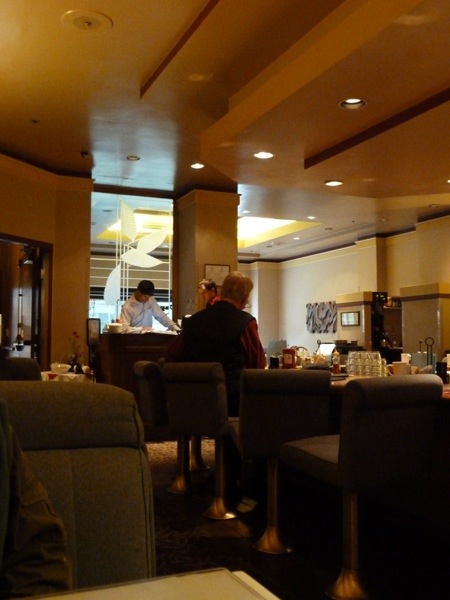
This is the Baranof Hotel, where my parents met. It used to be a very grand hotel, but it is now a Westmark hotel, and while it pretends to still be grand, it is shopworn and tired, and needs a major overhaul to be back in the game. We ate lunch there – to honor my parents meeting – and it was also a very mediocre meal. The very chipper waitress, Holly, tried to make it nice, but the Capitol restaurant needs better lighting and brighter colors. It was very, very dark.


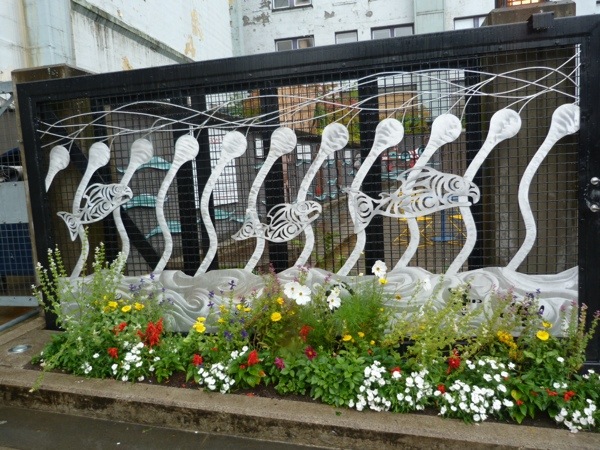
Some public art. Later as we passed the same location we heard guys call out “The police are coming!” and saw them approach three men who looked like maybe they were drinking or drugging.
AdventureMan is so patient with me. When I spotted a quilt shop, he said he was going down the street and to call him when I was finished. 🙂

The best part of the day was picking up our friend for dinner, and hearing her stories. We loved hearing about Juneau in the old days, and hearing her laugh.
For Unto Us a Child is Given . . .

I am hearing those wonderful lines from Handel’s Messiah, because on this wonderful day, just after noon, a new child came into this world, a treasured girl-child, a warrior-princess is born. Thanks be to God, al hamd’allah!
Her Mother’s prayer for her is that she be the child that God created her to be. She hopes her daughter has courage, and a heart for adventure. When we met her, this amazing daughter-in-law, she played rugby, and she went off to France for a year to teach English.
We all pray that she will be healthy, and compassionate, with a heart for others. Courageous and passionate, and a woman of strength who will, like her Father, “give voice to those who have no voices.”
It is taking all our strength not to run to the hospital to visit. We feel very Middle-Eastern at this time; I am remembering my friend who went to Hamad hospital to have her babies. I took her daughters there the next morning, laden with canisters of coffee to serve guests.

“Guests?” I thought to myself. I had NO idea. Our Western idea is to give the new parents and their new baby time to recover from the physical and mental exertion of giving birth, time to bond as a small family unit.
When we got to Hamad Hospital, my friend had a huge suite, like a hotel suite, and her hospital bed was maybe King sized, with a curtain that could be drawn around it. She had a wall of mirrored closets and a seating area for about twenty people. No. I am not kidding.
We got there around seven in the morning, and within fifteen minutes, guests started arriving, all women, of course, come to give congratulations to the new Mom. Each came, greeted the new Mother, sat and drank a couple cups of coffee served by the delighted older daughters, greeted their friends, cousins and new arrivals, and then departed. Waves of guests arrived, and, thank God, waves of re-inforcing coffee pots.
So so different from our own customs, but today, oh, how I would love to fill a canister or two and be at the hospital sooner, rather than later, to greet the parents and to meet my new little lion-hearted grand-daughter, who insisted she would arrive when SHE wanted, LOL, not on schedule.
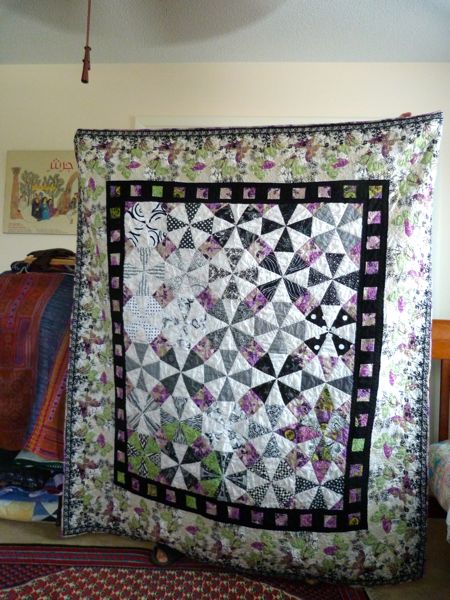
Here is the quilt I made for her:
And here is the guide to the colors; I bought the border five years ago:

When AdventureMan say it, he said “that doesn’t look like a baby quilt” because it is so black and white, but, if you have eyes to see, it isn’t all black and white, it also has shades of purple, fuchsia, and a celery Spring green. I made the center Kaleidoscope pieces with a variety of blacks and whites, because babies LOVE black and white, and it can fascinate them and calm them.
I call it “I See Things Differently” because no, it doesn’t look like a baby quilt, but it is very much a baby quilt, it just doesn’t meet our cultural expectations. The longer I live, the less I meet any one’s expectations, LOL!
Thanks be to God! Thanks be to God for the safe delivery of this precious baby!
God Laughs; Life’s Craziness
One of my favorite Psalms is Psalm 2, which advises us to humbly submit to the will of Almighty God or suffer the consequences of our own actions. I’ve heard God laughing all week, sometimes at me, sometimes with me.
Psalm 2
1 Why do the nations conspire,
and the peoples plot in vain?
2 The kings of the earth set themselves,
and the rulers take counsel together,
against the Lord and his anointed, saying,
3 ‘Let us burst their bonds asunder,
and cast their cords from us.’
4 He who sits in the heavens laughs;
the Lord has them in derision.
5 Then he will speak to them in his wrath,
and terrify them in his fury, saying,
6 ‘I have set my king on Zion, my holy hill.’
7 I will tell of the decree of the Lord:
He said to me, ‘You are my son;
today I have begotten you.
8 Ask of me, and I will make the nations your heritage,
and the ends of the earth your possession.
9 You shall break them with a rod of iron,
and dash them in pieces like a potter’s vessel.’
10 Now therefore, O kings, be wise;
be warned, O rulers of the earth.
11 Serve the Lord with fear,
with trembling 12kiss his feet,*
or he will be angry, and you will perish in the way;
for his wrath is quickly kindled.
Happy are all who take refuge in him.
I’m a planner. I figure out what I want, and then I figure out how to get it. When we decided we wanted to take a trip to Alaska, we booked – and paid – a year in advance to get the kind of room we wanted. We also planned to buy a new car, and started saving for that, being pay-cash kind of people.
Then, early in the year we discovered we were going to become grandparents to a granddaughter! She would arrive shortly after we get back from our Alaska trip.
This week, God laughed. The doctors told our son and his wife that she needed to go on bedrest, and that this baby will be coming early. All the grandparents have been helping with childcare through the summer, now we just ratcheted it up a notch.
Do you know why God gives children to YOUNG parents? LOL, a three year old has SO much energy! So much curiousity! We have such a good time with him and when at the end of the day, we return him to his parents – we need a nap!
We are also trying to pack and prepare for our trip, get the Qatari Cat prepared for the cat hotel, get the guest suite prepared for the people who will stay while we are gone, and oh yes, finish up the purchase of that new car.
I had thought the first week in August would be a snooze, isn’t it always? Those long, hot humid days hit Pensacola, often one of those violent and emotional thunderstorms that clears the air in the late afternoon, lazy day after lazy day, right?

Not this year. This year was fly to Seattle for my Mom’s 90th birthday celebration, fly back, take care of our grandson for a week, do whatever we can to help out our son and his wife while she is on bed rest, buy and sell two cars, do our normal volunteer work – oh, and we had scheduled two meetings at our house, so we had to be presentable, and have some delicious things available. I could hear God laughing.

In the midst of all this, we are healthy. We have a good roof over our heads. We have the means to get a new car and travel to Seattle for Mom’s birthday. We pre-paid much of the Alaska vacation. Our little grandson is happy, and strong, and articulate, and fun to be around. Our son and his wife are wonderful, loving parents, and hard workers, and are preparing for this sweet new arrival. God laughs, and we thank him for his abundant blessings, and his abundant patience with us thinking we have any control over the months that come. We pray for the safe and healthy arrival of this little granddaughter who may arrive while we are gone, for a safe delivery, and a speedy recovery for her mother, and for strength and courage for her father, our son, who is a valiant man. We welcome your prayers.
Breath of Fresh Air in Seattle
Miss me?
I’ve been in Seattle for a truly grand event, my Mother’s 90th Birthday. She was queen for almost a week, with visitors and well wishers and a smashing party with friends and family and faces she has known and loved for years – many many people.
When I arrived in Seattle it was cool and cloudy and everyone told me how sad it was that I had missed the glorious weather they have had for weeks. Coming in from the airport I was shocked to see all the scorched grass; it looked more like California than green green Seattle.
I wasn’t sad to miss the warm sunshine at all. I have all of that I need in Pensacola. What I loved, from the moment I arrived, was the fresh air.
Seattle smells good. Seattle smells like mown grass, and flowers, lush flowers everywhere. Youcan drive with your windows open. I slept with my window open, and when it got COLD in the middle of the night, I used a BLANKET! This is the best luxury for me, cool weather, fresh air, cool breezes, even a little thunder and lightning and rain.
The days were warm and sunny, and the nights were cool and fresh. I was in heaven.
It wasn’t that I forgot about you – I have all kinds of material – but blogging with the iPad just doesn’t work for me. It’s fine for picking up e-mail and checking the news and playing a game or two, but it isn’t a real computer, with real capabilities. If blogging gets to technical, I’m not going to do it, life is too short. I love WordPress for making life so easy, making it so easy to put in all the photos I want, easy easy easy. I just had too much going on, and didn’t have time to fiddle. The iPad just doesn’t do it for me. I wish I had a computer small enough to just stuff in my purse like the iPad, I wish I didn’t have to pull the computer out of my purse, like the iPad. The iPad is convenient, better than slogging a lot of books on the plane with me, but . . . What I really want is an iPad sized computer . . .
Home again, on the flight in the pilots must have mentioned the heat and humidity in Pensacola six times. Ahhh . . . .for those sweet cool breezes and cool nights . . .
Touched the Hem of His Garment
Today’s meditation from Forward Day by Day touches on one of my very favorite stories – and its opposite. It’s all about the power of belief. The woman, suffering from bleeding, would have lived a terrible life, considered unclean, untouchable, and trying everything to be cured without success. Just a touch – one touch – and her illness is gone. Jesus is astonished and tells her that her faith has made her well.
In contrast, the people in his own village are skeptical. How can good ole Jesus, son of Mary and that carpenter, how can he be anything special? In the face of such callous disbelief, Jesus can do little.
SATURDAY, July 27
Mark 6:1-13. And he could do no deed of power there, except that he laid his hands on a few sick people and cured them.
What a contrast, in just a few verses. Yesterday the bleeding woman merely touched Jesus’ garment, and Jesus’ power streamed into her. Today he is home, and those who watched him grow up ask, “Just who do you think you are?” and the Son of God is stopped in his tracks, like Superman when he is exposed to kryptonite.
My field education rector preached on this passage a year ago, and I was spellbound by his ending. He asked, “If Jesus came to All Saints, would he be able to do deeds of power?” Then the rector got even more personal, asking, “If Jesus came to you, would he be able to deeds of power?”
Oh, how I hope so. I’m not sure how to have the faith that allows Jesus to perform deeds of power, but I can see what kind of behavior does. It is hopeful, brave actions that seem to open the way for Jesus to work; and it is arrogant, fear-based behavior that seems to block the way.
Lord, teach us not to fear the change you bring. Teach us to reach out to touch your garment.
When my Mother was still living on her own, there was a revolving guest room, and my sister left a CD for me there, as she departed and I arrived, which contained the song above. I want it sung at my funeral. It is a succinct statement of faith; it is the song of the bleeding woman who believes and is cured, and nothing is ever the same.
You Are Not My Friend
I Have a pet peeve. I may have even ranted about this before, but it makes my blood boil.
From time to time, I will get a call from a person working at a financial institution. Or it may be a message on my machine, saying I need to call them about an account. They start out all collegial and friendly, then they want to give me financial advice.
Excuse me? You “noticed” we have money sitting in X account that could be working harder? Mind your own business! If you are going to take a percentage for rolling my money from X to Y, if you are going to take a fee for this service – then this is not friendly advice. Don’t pretend to be my friend.
AdventureMan laughed out loud once when I told the man to annotate our file NEVER to call with financial advice, that I still have all my marbles and I know what I am doing. Every now and then if he wants to make me laugh, he will fake this high voice and say “I still have all my marbles!” It never fails to crack me up; I don’t get angry often, but when I do, I say the most amazingly hilarious things.
I think what makes me outraged is that I still DO have my marbles, and AdventureMan and I have worked hard to make sound financial decisions. We decided long ago that no one cares about our money the way we do, and that we would make our own decisions. We ask for input – we get answers online, we read reviews and analyses, we ask questions of friends we respect. We make informed decisions. One of the secrets to growing investment money and holding on to it is to choose wisely and to minimize trading.
Most of these calls take advantage of people feeling inadequate when it comes to money management, especially the elderly and lonely. They make it seem like the target has a new and caring friend, a knowledgeable friend, who only wants to help. The new friend builds trust, until the target invests in the recommended product, and then . . . huh – they don’t hear from their new friend again, or not for a long while, when the friend has another idea for their money.
You are not my friend. I don’t want your great new ideas about where I should move my money; I understand that this is your job and that there is something in this for you. What you are talking about is an opportunity – it’s like cotton candy, all puffy and pretty but full of air. I know you wouldn’t be calling me if there were not something in this for you. Don’t call me. You are not my friend.
🙂 And I still have all my marbles 🙂
Recent Comments
intlxpatr on Shampoo Ginger tigerbutterya0c5ff1d… on Shampoo Ginger intlxpatr on British Soldier Kidnapped, Esc… John on British Soldier Kidnapped, Esc… intlxpatr on British Soldier Kidnapped, Esc… Wikipedia Donate Button

Amazina


Early Voting in Florida


