Wealth and Inequality in America
Horrifying
Benedryl / Diphenhydramine Linked to Delirium and Alzheimer’s
One of the big impacts of being long term expats is that as you move from country to country, you also move from doctor to doctor. We managed by getting most of our health care while back in the US, but for those things that can’t be scheduled, we had to see local doctors. No one followed our cases. We knew we were paying a price, and determined that it would be a priority when we retired to find good health care. We were determined to find a doctor who would be a partner in keeping us fit and healthy.
We found a really great doctor, a young guy who really keeps up with things. He gave us complete exams, then started us on rounds of other exams, those annoying tests like colonoscopies, mammograms, lung function, etc.
We’re doing well. To my great surprise, however, he told me at our last visit that I needed to give up my nightly Benedryl capsule.
I’ve always been a light sleeper. I took this news with dismay, but I gave up Benedryl. I was afraid I wouldn’t be able to sleep, but I find I sleep just fine without it. It took some time to make the adjustment; Benedryl had helped me bridge those wakeful times between sleep cycles. Now, I sleep differently, but I sleep.
It occurred to me that I never looked it up online, so this morning I did. This is from a US News and World Report article in 2011:

By Steven Reinberg
HealthDay Reporter
THURSDAY, June 4 (HealthDay News) –Older people taking common over-the-counter drugs for pain, cold symptoms or help with sleep may increase their risk for cognitive impairment, including delirium, University of Indiana researchers report.
These drugs include Benadryl, Dramamine, Excedrin PM, Nytol, Sominex, Tylenol PM and Unisom.
All of these over-the-counter (OTC) drugs contain benadryl (diphenhydramine), a molecule that blocks the neurotransmitter acetylcholine. Acetylcholine is essential for normal functioning of the central and peripheral nervous systems, the researchers explained.
“Before taking any medication prescribed by your doctor or an OTC medication, make sure there is no negative impact of this medication on your brain,” said lead researcher Dr. Malaz Boustani.
His group analyzed data from 27 prior studies on the relationship between anticholinergic effects and brain function, as well as looking into anecdotal data. The team found a consistent link between anticholinergic effects and cognitive impairment in older adults.
“Any OTC medication with the term ‘PM’ will indicate the presence of benadryl, which is bad for the brain,” Boustani concluded.
He noted that the effects of benadryl can add up, so the more medications you take that contain benadryl the worse it may be for cognition. “There is a relationship with the number of medications and the burden on your aging brain,” the researcher said.
People aged 65 and older who take these medications also run the risk of developing delirium, Boustani said. Delirium is a decline in attention-focus, perception and cognition, or “acute brain failure,” as Boustani calls it. Delirium typically increases the odds of dying or being institutionalized, he said.
In addition, taking these medications for 90 days or more may triple your risk of developing Alzheimer’s disease, Boustani said.
Given the risks, older adults should look for drugs that don’t contain benadryl, he said.
“A lot of these medications are not recognized for these side effects,” he contended. “It’s time for the FDA to start taking this negative impact of these medications on the aging brain seriously.”
The report is published in the May online issue of the Journal of Clinical Interventions in Aging.
According to Boustani, researchers in brain pharmacoepidemiology at Indiana University’s Center for Aging Research is conducting a study of 4,000 older adults to see if the long-term use of medications with anticholinergic effects is associated with the development of severe cognitive impairment, such as Alzheimer’s disease.
Dr. Clinton Wright, an associate professor of neurology at the Miller School of Medicine at the University of Miami, agreed that more study is needed to assess the effects of these drugs on the brain.
“These findings don’t surprise me at all,” Wright said. “People tend not to think of their OTC medications as medication, but any medication that has anticholinergic effects can affect people’s cognition.”
Wright believes the drugs should carry a warning of this potential side effect.
Deborah G. Bolding, a spokeswoman for GlaxoSmithKline, the maker of Sominex, defended the product and said it complies with all current FDA regulations. However, she would not comment specifically on whether diphenhydramine is associated with an increased risk of delirium in older adults.
“Sominex is a mild sleep aid designed to help individuals through periods of nervous tension or stress, which are accompanied by sleeplessness. It has been proven safe and effective in medical tests when taken as directed, and has been safely used by millions of satisfied customers,” Bolding said.
“For all formulations, Sominex’s active ingredient is diphenhydramine hydrochloride. This is marketed under a final FDA monograph as an over-the-counter sleep aid,” she added.
Petrella’s Italian Cafe on 9 Mile Road in Pensacola
One of the reasons AdventureMan and I have been married almost 40 years is that we agree on some very irrational basics – like nothing says romance on Valentine’s Day like Italian food. He had recently been to Petrella’s and suggested I might like it – so off we went, on the worst day of the year to try to get in someplace without a reservation. I remembered all our Valentine’s Day dinners in Kuwait, trying to get in someplace, anyplace, Italian was out of the question, fully booked. We usually ended up bribing someone to let us have an early dinner, promising to be out before our later-eating Kuwaiti Valentines diners arrived; they would never even know they had shared their reservation with us.

We were in luck. Although every table in Petrella’s was taken, within five minutes one group left and we got their booth. AdventureMan had truly nailed this one; this is a neighborhood eatery, full of people who have been eating at Petrella’s for a long time. There were lots of couples, like us, but also many groups of four, many working people having their daily lunch, and a very large table of women affiliated in some way. We speculated, maybe church? Maybe a retirement home? Maybe a club?

Petrella’s took me back to my childhood, where Italian food was “foreign” food and very exotic. People didn’t eat out so much. The very most special restaurants were steak restaurants, or clubs. Even pizza was new, not uncommon; there were frozen pizzas and home-made pizza dough, but it wasn’t the normal American kind of food – meat, potatoes, veg. It was kind of “spicy.” Yes, I can hear you laughing, but things were different, eating out was not a daily or even a weekly event, eating out was something you did maybe once a month. Even then, it was sometimes, hamburgers! Dairy Queen was about the fastest-food there was and there were no McDonalds or Burger King chains, no Kentucky Fried Chicken. There was A&W Hamburgers; there were ice-cream and soda bars, and of course, in Seattle, there was Chinese and Japanese foods.
Petrella’s is comfortable. The salads and the dishes they served are the dishes Italian restaurants have been serving for a hundred years. The lunch specials are all under $8.00, and they all come with salad and garlic bread. They take it for granted you are going to need a box to take home the excess; portions are large. We also had our lunches for dinner 🙂

This was AdventureMan’s main course, the Baked Spaghetti:

and here was mine, Petrella’s Famous Marsala (with shrimp):

It was comfort food. Nothing fancy or unexpected, but good, honest ingredients, crafted well. It’s a kind of food that calls you back again and again when you want a good reliable meal. I know we will be going back, and we will probably take family and friends, it’s that kind of place.

They have an excellent website, with their complete menu.
Ten Strategies to Avoid Alzheimer’s Disease
I’m always watching myself for any sign of cognitive slippage. I had two dear aunts who became barmy, one in her sixties, and one not until her eighties. Thank you, Hayfa, for this great article:
UCLA on Alzheimer’s Disease – young or old should read
Food for Thought
“The idea that Alzheimer’s is entirely genetic and unpreventable is perhaps the greatest misconception about the disease,” says Gary Small, M.D., director of the UCLA Centeron Aging. Researchers now know that Alzheimer’s, like heart disease and cancer, develops over decades and can be influenced by lifestyle factors including cholesterol, blood pressure, obesity, depression, education, nutrition, sleep and mental, physical and social activity.The big news: Mountains of research reveals that simple things you do every day might cut your odds of losing your mind to Alzheimer’s.In search of scientific ways to delay and outlive Alzheimer’s and other dementias, I tracked down thousands of studies and interviewed dozens of experts. The results in a new book: 100 Simple Things You Can Do to Prevent Alzheimer’s and Age-Related Memory Loss
Here are 10 strategies I found most surprising.
1. Have coffee. In an amazing flip-flop, coffee is the new brain tonic. A large European study showed that drinking three to five cups of coffee a day in midlife cut Alzheimer’s risk 65% in late life. University of South Florida researcher Gary Arendash credits caffeine: He says it reduces dementia-causing amyloid in animal brains. Others credit coffee’s antioxidants. So drink up, Arendash advises, unless your doctor says you shouldn’t.
2. Floss. Oddly, the health of your teeth and gums can help predict dementia. University of Southern California research found that having periodontal disease before age 35 quadrupled the odds of dementia years later. Older people with tooth and gum disease score lower on memory and cognition tests, other studies show. Experts speculate that inflammation in diseased mouths migrates to the brain.
3. Google. Doing an online search can stimulate your aging brain even more than reading a book, says UCLA’s Gary Small, who used brain MRIs to prove it. The biggest surprise: Novice Internet surfers, ages 55 to 78, activated key memory and learning centers in the brain after only a week of Web surfing for an hour a day.
4. Grow new brain cells. Impossible, scientists used to say. Now it’s believed that thousands of brain cells are born daily. The trick is to keep the newborns alive. What works: aerobic exercise (such as a brisk 30-minute walk every day), strenuous mental activity, eating salmon and other fatty fish, and avoiding obesity, chronic stress, sleep deprivation, heavy drinking and vitamin B deficiency. Drink apple juice. Apple juice can push production of the “memory chemical” acetylcholine; that’s the way the popular Alzheimer’s drug Aricept works, says Thomas Shea, Ph.D., of the University of Massachusetts. He was surprised that old mice given apple juice did better on learning and memory tests than mice that received water. A dose for humans: 16 ounces, or two to three apples a day.
5. Protect your head. Blows to the head, even mild ones early in life, increase odds of dementia years later. Pro football players have 19 times the typical rate of memory-related diseases. Alzheimer’s is four times more common in elderly who suffer a head injury, Columbia University finds. Accidental falls doubled an older person’s odds of dementia five years later in another study. Wear seat belts and helmets, fall-proof your house, and don’t take risks.
6. Meditate. Brain scans show that people who meditate regularly have less cognitive decline and brain shrinkage – a classic sign of Alzheimer’s – as they age. Andrew Newberg of the University of Pennsylvania School of Medicine says yoga meditation of 12 minutes a day for two months improved blood flow and cognitive functioning in seniors with memory problems.
7. Take Vitamin D. A “severe deficiency” of vitamin D boosts older Americans’ risk of cognitive impairment 394%, an alarming study by England’s University of Exeter finds. And most Americans lack vitamin D. Experts recommend a daily dose of 800 IU to 2,000 IU of vitamin D3.
8. Fill your brain. It’s called “cognitive reserve.” A rich accumulation of life experiences – education, marriage, socializing, a stimulating job, language skills, having a purpose in life, physical activity and mentally demanding leisure activities – makes your brain better able to tolerate plaques and tangles. You can even have significant Alzheimer’s pathology and no symptoms of dementia if you have high cognitive reserve, says David Bennett, M.D., of Chicago’s Rush University Medical Center.
9. Avoid infection. Astonishing new evidence ties Alzheimer’s to cold sores, gastric ulcers, Lyme disease, pneumonia and the flu. Ruth Itzhaki, Ph.D., of the University of Manchester in England estimates the cold-sore herpes simplex virus is incriminated in 60% of Alzheimer’s cases. The theory: Infections trigger excessive beta amyloid “gunk” that kills brain cells. Proof is still lacking, but why not avoid common infections and take appropriate vaccines, antibiotics and antiviral agents?
What to Drink for Good Memory: A great way to keep your aging memory sharp and avoid Alzheimer’s is to drink the right stuff.
a. Tops: Juice. A glass of any fruit or vegetable juice three times a week slashed Alzheimer’s odds 76% in Vanderbilt University research. Epecially protective:blueberry, grape and apple juice, say other studies.
b. Tea: Only a cup of black or green tea a week cut rates of cognitive decline in older people by 37%, reports the Alzheimer’s Association. Only brewed tea works. Skip bottled tea, which is devoid of antioxidants.
c. Caffeine beverages. Surprisingly, caffeine fights memory loss and Alzheimer’s, suggest dozens of studies. Best sources: coffee (one Alzheimer’s researcher drinks five cups a day), tea and chocolate. Beware caffeine if you are pregnant, have high blood pressure, insomnia or anxiety.
d. Red wine: If you drink alcohol, a little red wine is most apt to benefit your aging brain. It’s high in antioxidants. Limit it to one daily glass for women, two for men. Excessive alcohol, notably binge drinking, brings on Alzheimer’s.
e. Two to avoid: Sugary soft drinks, especially those sweetened with high fructose corn syrup. They make lab animals dumb. Water with high copper content also can up your odds of Alzheimer’s. Use a water filter that removes excess minerals.
Ways to Save Your Kids from Alzheimer’s:
· Now, Alzheimer’s isn’t just a disease that starts in old age. What happens to your child’s brain seems to have a dramatic impact on his or her likelihood of Alzheimer’s many decades later.
· Here are five things you can do now to help save your child from Alzheimer’s and memory loss later in life, according to the latest research. Prevent head blows: Insist your child wear a helmet during biking, skating, skiing, baseball, football, hockey, and all contact sports. A major blow as well as tiny repetitive unnoticed concussions can cause damage, leading to memory loss and Alzheimer’s years later.
· Encourage language skills: A teenage girl who is a superior writer is eight times more likely to escape Alzheimer’s in late life than a teen with poor linguistic skills. Teaching young children to be fluent in two or more languages makes them less vulnerable to Alzheimer’s.
· Insist your child go to college: Education is a powerful Alzheimer’s deterrent . The more years of formal schooling, the lower the odds. Most Alzheimer’s prone: teenage drop outs. For each year of education, your risk of dementia drops 11%, says a recent University of Cambridge study.
· Provide stimulation: Keep your child’s brain busy with physical, mental and social activities and novel experiences. All these contribute to a bigger, better functioning brain with more so-called ‘cognitive reserve.’ High cognitive reserve protects against memory decline and Alzheimer’s.
· Spare the junk food: Lab animals raised on berries, spinach and high omega-3 fish have great memories in old age. Those overfed sugar, especially high fructose in soft drinks, saturated fat and trans fats become overweight and diabetic, with smaller brains and impaired memories as they age, a prelude to Alzheimer’s.
Stitching Together A Move?
I had a troubling dream which woke me early this morning and I couldn’t get back to sleep. I dreamed I was working on a very large quilt, and I had promised to hand quilt it. I remember seeing it was not made as a usual quilt is made, with a top and a bottom, and a layer of batting (wadding) in between, but of 12 – 13 layers of cotton cloth, a very difficult quilting challenge, and it seems to me that the quilt was like 15 feet by 15 feet, a huge quilt, a size I have never even seen done. I remember having accepted to quilt a very complicated pattern, and as I awoke, I was stitching and stitching and stitching, hand stitch after hand stitch, but feeling utterly defeated and overwhelmed at the task I was facing.
I am confounded. In terms of quilting, I will never be caught up, but it doesn’t bother me, I just keep on. I finish most quilts; I do just fine. I don’t have any project deadlines, I don’t have any feeling of urgency on completing any of my quilts. I very rarely do any hand quilting; machine quilting gets the job done and hand quilting is hard on my hands and fingers.
My life, too, in this so-called retirement, is orderly. I take on what I can take on and complete the task. I don’t feel like I am behind in anything. I keep up with things. I feel no urgency.
So where did this dream come from?
I believe God calls to us in many ways (“Let he who has ears listen!”), through his word, through the voices and actions of Godly people, through a book one might be reading, through a friend, or a homeless person, or even through a dream. Being who I am, I prefer a clear message; interpretation is so fraught with personal prejudices, so filtered by what we know, by our particular dogma or belief system. I am praying now for clarity, and for the meaning of this dream to be made understandable so that I might know what I am needed to do . . . If I am meant to keep chipping away at something, please, let me do it with a joyful attitude, not this feeling of being faced with an overwhelming task.

And as I go through the categories,getting ready to post this entry, choosing those words that best apply, I see “Moving” and I have to laugh; moving is that huge quilt, that elephant that one can only eat one bite at a time, that many layered monstrosity, and it has been three years since I have moved. Three years living in one country, one city, in one house. It may be that the dream is one of those anxiety dreams like your college exam dreams, a dream that is no longer relevant but a hangover from another time, another life. My subconscious is getting ready for a move, feeling overdue, LOL.
Sun Setting Over the Bayou
I love winter. I love the cool temperatures; I feel so much more energetic. I get things done.
I’m in my office, and I can smell tomatoes roasting downstairs; AdventureMan has found a new recipe for a Shrimp and Avocado Soup. He is using freshly picked tomatoes given us by our daughter-in-law’s Dad, so fresh, so tasty, and the roasting is intensifying the flavors. He is happy; he has found passion in cooking up new tastes; one night a week he does dinner and from time to time when he is inspired he also cooks up dinners to share with our son and his family.
I’ve gone off duty. I’ve been working all day, following my passion, listening to NPR and a guest talking about happiness. Happiness, she says, is enjoying the process, living in the right now. High points like Christmas and weddings are but a moment; the true secret of happiness is learning to appreciate the daily life.
For me, the right now is gathering colors. I love colors, and I can see minute differences in shades and colorings, so this is precise and demanding work, gathering the colors, sorting them so once I start using them I can find them quickly. This is just a fraction of the colors I will be using; the colors of the sea:

I have a good collection, but never enough. This time I especially need a good selection of the lighter shallow-water colors:

At this time of the year, I can see the bayou through gaps in the trees that have lost their leaves. The sun is setting; sparkling in through our windows, and it’s the most light we’ve had all day. Even so, the light is fading fast, and I can no longer reliably sort one shade too close to another. Time to go “off duty.” I’ve saved the newspaper as my reward for working hard all day. Time to enjoy the setting sun, sparkling off the glimpse of bayou.

“Watch Out For those Christians”
AdventureMan and I knowingly make bad choices every now an then, and Chow Time is one of them. We haven’t been for months, ever since the nearby Mediterranean Plus shut its doors because of the competition from Chow Time, it broke our hearts. But today, AdventureMan just had a hankering for Chow Time, and it’s fresh oyster day, so we went.
We had hit the early service at our church, 0800, so we had been home, changed, AdventureMan hit the garden and I hit the Christmas decor, taking it all down, which I do superstitiously since my Chinese friend told me the way I come into the new year is the way I will spend my new year, so you need to have everything done, EVERYTHING, so that your new year will be prosperous and easy and not full of tasks left undone. You have to have your bills all paid and money in your pocket and a clean clean and organized house.
Oh aaarrgh. It’s a lot of pressure to get it all done by New Year’s Eve. But we had accomplished a lot by noonish, and AdventureMan was hungry – STARVING! I like Chow Time, too, because you can have whatever you want, in the amount you want it. I like tiny bites of bad things, and I try to make myself focus on eating good things.
So I am thinking about my strategy when I see an older woman with a walker, the kind with a seat in it, so she has her plate on the seat and she is very carefully and sedately making her way along the buffet stations, but there are well-dressed crowds of people politely pushing in front of her, all around her. These are no-make-up, long skirt, long hair kinds of people, and they are all sitting together in very nice clothes at several tables in one area, and unbidden, the thought comes to me “Oh! Watch out for those Christians!”
And then I have to laugh, because of course, I am one of THEM. We all think we are so good in our own way, but don’t get between these Christians and the buffet, or, even if you are elderly and pushing your plate on a walker, you might get run-over by these good Christian folk!
I am telling you this, knowing that I have my own weakness. I can be perfectly polite at a buffet, I can patiently allow others to push in front, or rush to get all the crab legs – I’m not going to starve. I think of our Kuwaiti friend who would jokingly tell his wife “have you never seen food before?” He told us it was something Kuwaiti parents would say to their children, teaching them to be polite.
My weakness is airports, airplanes, air travel. Partly it comes from growing up in Europe, where even if seats were assigned, everyone just rushed on the plane and sat where they wanted. It was hilarious, but if you are from a culture where people think seat assignment means something, it is also kind of frustrating. If you didn’t edge your way onto the plane, you got a rotten seat, like the middle seat, where you have to sit stiffly so your shoulders don’t bump someone else’s.
These days it is even worse. Even if you have an assigned seat, with all the people afraid to pay a baggage charge, they are heaving these hefty bags on board, and overhead space is first-come, first served. Those late on the plane have difficulty finding a place in the overhead bins.
So here is the dilemma. Not even a dilemma, we all KNOW what the right answer is. Do you politely let others go ahead? Do we courteously allow those who are disabled, or accompanied by young children, or having trouble walking, do we courteously allow them to board first, with no grumbling?
I still remember being Platinum, getting to board first, getting frequent upgrades, getting all the perks . . . being treated “special.” It’s kind of addictive, being treated as if you are special.
I contrast that with what we KNOW to be true, that the first will be last, and that those who serve others, who wait upon others, who allow others to be preferred – those are the ones who will inherit the kingdom of heaven.
So as I sit in our little booth at Chow Time, I wonder if I show the face of Christ by my behavior, and I cringe a little at all the instincts in me that still want to be first. Even if I step back and allow the lady with the walker to go ahead, I still have my failures in other areas of my life, areas where I step up rather than step back. Food for a new year’s resolution . . . .
Music Brings Alzheimer’s Patients Into the Moment
I saw this video over the Christmas holiday, and I can’t forget it. I know one of the reasons I love water aerobics is that they play all this rock music of my generation, and it gets us working hard, some even sing along, belting out the lyrics, LLOOLLL, I’m sure we look ridiculous, but oh, we have a great time and it makes exercise time pass more quickly.
This video shows the dramatic effect familiar music has on Alzheimer’s patients, bringing them out of their fog, however briefly, and animating them once again:
Take the Test :-) Simple Sitting Test Predicts Long Life
Do you remember doing this as a child? I remember doing it, maybe for some Red Cross Swimming class. We could all do it. . . So after I watched the video, I had to try it again. I can get down with no problem – 5 points. Getting up, I needed to use my knee: 4 points. I’m happy with that score, and happy I can still get up and down off the floor 🙂
So my question is this – many people who can’t do it the first time, can do it if they practice. So if you practice, and get good at it, have you lengthened your life? Have your improved your probability of living longer?
Simple Sit Test Predicts Long Life
By Crystal Phend, Senior Staff Writer, MedPage Today
Published: December 13, 2012
Reviewed by Zalman S. Agus, MD; Emeritus Professor, Perelman School of Medicine at the University of Pennsylvania and Dorothy Caputo, MA, BSN, RN, Nurse Planner
Action Points
This study evaluated the association between the ability to sit and rise from the floor with and without support and all-cause mortality in adults age 51 to 80.
There was a significant association between the use of more support to sit and rise from the floor and increasing all-cause mortality.
How well middle-age and older adults can get up off the floor may predict their chances of long-term survival.
Each additional support needed to get to and rise from a sitting position on the floor — knee, hands, etc. — was associated with a 21% lower chance of survival over about 6 years of follow-up in a trial online in the European Journal of Preventive Cardiology.
The survival odds differed by 5.44-fold between the highest and lowest scorers on the sit-rise test after adjustment for age, sex, and body mass index, Claudio Gil Soares de Araújo, PhD, of Gama Filho University and Clinimex in Rio de Janeiro, and colleagues reported.
Ability to rise from the floor reflects muscle strength, coordination, balance, and flexibility needed for getting up out of a chair, bending over to pick up an item, and various other daily activities and is also tied to risk of falls, they explained.
“Application of a simple and safe assessment tool such as sit-rise test…in general health examinations could add relevant information regarding functional capabilities and outcomes in non-hospitalized adults,” the group wrote.
Other functional tests are commonly used, such as chair-to-stand and gait speed, but the floor-to stand test has the advantage of requiring no equipment and minimal space and time, they pointed out.
The retrospective study included all 2,002 individuals ages 51 to 80 evaluated with the test at a single center from 1997 through 2011, excluding competitive athletes and those with relevant musculoskeletal problems.
The test was administered on a nonslip surface, with individuals instructed to try to sit on the floor and then get back up without worrying about speed and using the least support they felt necessary.
A maximum of 10 points was possible, 5 for sitting and 5 for rising without any supports. Each support (hand, forearm, knee, side of leg, or hand on the knee) used took away 1 point; and participants could lose an additional 0.5 points for an unsteady performance.
Over the median 6.3 years of follow-up for mortality in state vital status registries, nearly 8% of the cohort died.
Sit-rise test scores tended to be poorer at older ages, but the association between all-cause mortality and score persisted with adjustment for age as well as sex and body mass index.
The hazard ratios compared with the highest-scoring, 8-to 10-point group were (all statistically significant):
5.44 for lowest scores (0 to 3 points)
3.44 for scores of 3.5 to 5.5
1.84 for scores of 6 to 7.5
That translated to a 3-year shorter life expectancy for the lowest versus highest scoring groups.
The researchers noted that no adverse events, such as injury from slips or falls, have occurred during the test over a 14-year experience at the center.
They cautioned that the study didn’t control for physical activity patterns, subclinical degeneration, or recent unreported injuries.
Other limitations were the predominantly white, high socioeconomic status population studied, which may limit generalizability, and the single center design.
Comfort Food: Corn Bread and Chili
While I was cleaning the kitchen and waiting for the last batch of cookies to bake, I whipped up a batch of corn bread for AdventureMan – no use in wasting a hot oven! It is a perfect, cold day in Pensacola. Perfect I say, because it really really is NOT fun baking Christmas cookies – or anything else – in a hot, humid kitchen. How did our grandmother’s and great great’s do it, especially in those voluminous dresses and no air conditioning??
The secret to truly great cornbread is to cook it in a cast iron skillet. You put the skillet in the oven until it is very hot, you take it out (using a pot holder, of course), melt a little butter in the pan, then pour the batter in. It will sizzle, and form a delicious crust. Pop the skillet back into the oven and in 22 minutes (at 425°F) your cornbread will be finished, with a toasty crust. If you want to guild the lily, you can swirl a pat of butter over the top, too.
AdventureMan dunks his corn bread in a glass of milk, which I find totally disgusting, but reminds him of when he was a little boy. It’s just a custom, I know, but I can’t look.

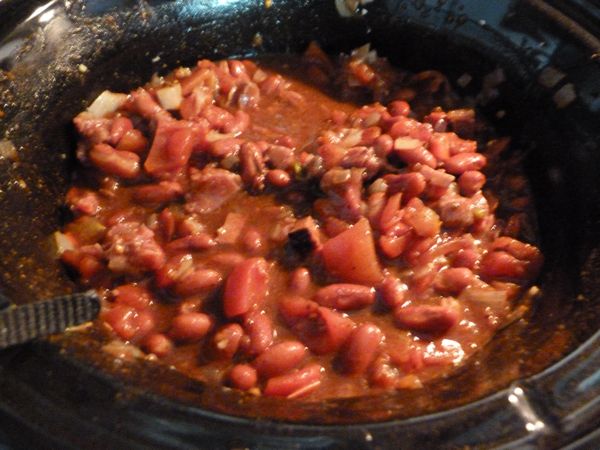
We have a pot of chili brewing, with the last of our home grown tomatoes:
The Qatari Cat is following AdventureMan around, telling him to lie down so they can take a snooze together . . . I think it worked. I can hear them both sleeping . . .

Recent Comments
ExpatAlien on What Country am I Living … intlxpatr on Yellowstone: Old Faithful to C… Michelle on Yellowstone: Old Faithful to C… Cathy on No Grown-Ups in Charge intlxpatr on Waiting for Snow Wikipedia Donate Button

Amazina


Early Voting in Florida


 Here There and Everywhere