Tinker Tailor Soldier Spy

We couldn’t wait. We saw the earlier version of Tinker Tailor Soldier Spy, you know, the one with Alec Guiness, and we couldn’t wait to see this new version, with Gary Oldman playing the Smiley role. He was awesome.
The LeCarre’ books featuring George Smiley are grim and grey, and the opening captures that exactly. The entire movie has a bureaucratic, institutional bleakness, with all the power plays, the petty snobberies, the jockeying for position that these bureaucracies seem to nurture. The only times in the movie when there is color and life is the annual bureau party, once done entirely in Russian, once in French.
The movie is faithful to the book, which I think I need to go back and read once again. It all seems so historical now.
One of the things we noticed was that the theatre was utterly quiet as the movie progressed. A lot of the action is in the mind, figuring things out, and trying not to get caught, so the suspense is of the subtle kind, not the car-crashing and jumping off buildings kind. It was as if the entire theatre were holding its breath; noticeable because of its rarity.
We were oddly jangled as we left the theatre, and over dinner we talked about how we never thought we would be obsolescent, but the Cold War has passed; the soldiers of today weren’t even alive when the Berlin Wall came down and the Iron Curtain parted and the cars flowed east. Life goes on.
There were several quotes, one that made us laugh was spies talking about recruiting other nationalities “You can hire an Arab but you can’t buy ’em.”
The Day I Might Have Died
“I have a photo you might want.” my Mom said, rummaging under the bed in the office, where I am sleeping while I have a working holiday here in Seattle, running errands and helping her with things she can no longer do easily for herself. I have two sisters living here who take good care of Mom, and I want to do some small part, too.
She pulled out an envelope and looked through it.
“No, not this one, but you might want this one,” and she handed me this photo.

I know to you it looks like a very strange photo; it looks like a very strange photo to me, too. Old photo, probably taken with some kind of brownie box camera, you cannot tell anything, it looks misty and indistinct.
It was taken at an airport ‘lake,’ like a water retention pond, in Juneau, Alaska, when I was around three. In Juneau, the lakes and ponds might stay very cold the entire summer, but these man-made lakes were fairly shallow, and might warm up a little when the temperatures reached the 70’s (F), like in July or August.
What I remember is dropping off, but not being afraid. I was under water, but my eyes were open, and the colors were beautiful and I was just watching the play of color and light, and I just kind of bobbed along.
My aunt tells me that she saw me drop out of sight and not return. She ran out into the water, found me, and pulled me to the shore. She saved my life. Later, when I was grown, she told me the old Chinese adage that if you save a person’s life you are responsible for them as long as you – or they – live. I always felt a special connection to that sweet aunt.
I wonder now if my memory is as I have always remembered it? I can still see the green and gold flickering, just as clearly as when it was happening. I can remember the shock of being grabbed, and hustled to shore, and fussed over, as everyone wanted to make sure I was OK. I remember having to stay on the blanket for what seemed like a lifetime, and then only being allowed to play in the very shallow water. And I wonder if I remember it all, or if I have heard the story so many times that I just think I remember it?
I love this photo. I love the indistinct nature, and mistiness. It is a metaphor for my memory of that day, and I am delighted that a photo exists.
My First Chevy – the Full Ad
Thank you, Hayfa. We’ve ween this ad on TV, and it is always moving, but it is totally cool to be able to see the whole story. I love this ad!
Shoulder Ouch!
I have a new muscle I didn’t know I had. It relates to my left shoulder, but it is in my back.
Monday we did a strenuous routine in aqua aerobics. Mostly, I can sail through the routines, but this was stepped up a little, and we used the weights a lot. I must have gotten carried away. I woke up this morning, and ouch! It was a bad surprise.
I know there is no cure. For me, normally, it takes heat and going easy for a while. I know it will pass, but oh, in the meantime, I am moving gingerly. You don’t know how much you use a muscle until it betrays you.
A Visit to Cajun Country in Louisiana
I guess I might have mentioned a time or two that I read an author named James Lee Burke. I remember the very first book I read – A Morning For Flamingos. I remember where I found it – the US Forces library on Lindsay Air Station. I remember it was late winter in Germany, the time when you think Spring will never come, that it will be grim and grey and cold for the rest of your life. I sought escape, which Mysteries/Detective novels provide, but I never expected poetry. From the very first page of A Morning for Flamingos, I was spellbound. While his novels have some horrific violence in them, and his detective Dave Robicheaux is a recovering alcoholic with some seriously self-destructive issues, you can sort of skim through the bad parts; there will be more poetry soon.
He is one of the few authors I will buy in hard cover.
I’ve been waiting. I wanted to see New Iberia, but I had to find a time when all the universal factors would line up – AdventureMan would be in the same country as me, the weather would be cool enough that travel would be enjoyable, and there was a low likelihood of running into a lot of tourists. The stars aligned, and off we went, a mere five hours away, to Cajun Louisiana.
We drove to New Orleans, first, visiting the welcome station to pick up brochures and figure out what we wanted to see and where we wanted to stay.

The welcome center was clean and well stocked, lots of bathrooms available for the visitors, lots of visitors, and ladies behind the counters full of first hand information about where we should go, where we should eat and where we might stay.
I have a thing about bridges. I had an accident on a bridge once, and I’m still a little nervous about bridges. This is the kind of bridge I hate:

This southernmost part of Louisiana is lowland, and there are bridges everywhere. Some of them are bridges like I have never seen anywhere else:

We arrived in the middle of the sugar cane harvest. I didn’t know what fields of sugar cane looked like; now I do:

There were big huge carts full of cane, all going to be processed on the same day they were cut:

All this time we were looking at sugar cane, we were getting hungrier and hungrier, but it was Sunday, and a lot of places were already closed, if they had been open at all. We finally found a restaurant in New Iberia, Pelicans, where I shocked my husband by ordering the vegetable plate – but it was all deep fried vegetables; asparagus, green beans, broccoli and carrots. He had a BBQ sandwich.

I think we were the only tourists in the place. The bar was full; the restaurant was empty, except for us.



We wanted to find someplace really fun to stay, full of character, and I had been looking at some cabins in Breaux Bridge. When we got ready to check them out, we discovered that the people who ran it were gone! There was a phone number, which we called, and the very kind owner called back and told us to go take a look, and which cabins were available.
You know, things just aren’t the way they used to be. I remember my Mom and Dad’s house, the first one they bought. The closet in the Master bedroom was only about 4 feet by 3 feet deep, with one bar and with a shelf. People had fewer clothes then, even in Alaska, where they also had heavy coats and ski pants and stuff. Bathrooms were small, only what was necessary, not like the spa-bathrooms people want now (me included.)
These cabins were cute. They were built right out over the bayou, and you could fish off your own balcony, each cabin separate and free standing. The place was clean. It was also really small, with small beds and small bathrooms. I don’t have asthma, but there was a musty smell, and I was worried I wouldn’t be able to breathe. We also like a good mattress, so we can sleep well. I looked at AdventureMan, who was looking at me. We were both on the same track; we couldn’t stay there. I called the lady back. “The cabins are really nice,” I said, “But we’re old and have allergies. We can’t stay here.” My husband was looking at me in a mixture of horror and hysteria. As we got in the car, his shoulders were shaking. He put a quiver in his voice (my voice did NOT quiver) and started saying “We’re o-o-o-o-ld, and we . . .” We were both rolling with laughter. I just didn’t know what else to say. We used to stay in places like this, but now we put a higher value on sleep.
We headed for a tried and true Marriott – actually, two of them – in Lafayette, only to discover that there was an oil and gas conference starting this week and there were NO rooms at the Marriott. We headed back toward New Iberia and settled into a Hampton Inn – nice, clean, roomy, and no character, we could have been in Seattle or Pennsylvania, but we could breathe.
“How Was Your Day?”
We were all standing in line, a very long line, at Pensacola’s Greek Festival at The Annunciation Greek Orthodox Church when my son asked how our day was. (AdventureMan and the Happy Baby were off exploring.)
“Oh, it was GREAT!” I enthused. “Time passes so much faster when you’re retired and you spend your time having fun!”
“So what did you do?” he asked.
“Oh! We went to water aerobics, and stopped by the bank to cash a check so we would have money for the weekend. Then your Dad vacuumed so I can mop the floors tomorrow, while I cleaned upstairs, dusted, did the bathrooms, etc. At lunch we went to Chow Time, and drove down here to check out parking, and then I had a quilting meeting this afternoon, and then we met you!”
As I finished, their faces were somewhere between blank and confused . . . and I realized my idea of fun was a relative thing.
Here is what is fun. Fun is getting to CHOOSE when you vacuum or mop the floors, or wipe down the blinds, or clean the bathrooms. Fun is having the time to do it even on a weekday, not having to scramble on Sundays to get it all done, like we used to. Fun is not having gobs of money, but having enough that we can go to the bank and take some out when we need it for the weekend. Fun is meeting up with our son and his wife and our grandson because our schedule isn’t full with business meetings, and working late at the office. Fun is having groups we belong to because we really want to.
The truth is, in many ways, we are busier than we ever have been, but it is busy-ness of our own choosing.
Fun is even babysitting your grandson when he gets sick, just because you can, or helping carry him around a big festival, taking turns, so everyone gets to eat. It’s fun because we can, and because this is what we have chosen.
EnviroGirl and I picked up the dinners while AdventureMan and L&O Man scouted for seats in the tent so we could sit and eat dinner – moussaka, chicken, lamb, all kinds of specialities. There was also a very long dessert line – this festival is all about the food, and the music and dancing. I’ve taken some photos for you, but once we had the food, I didn’t get a chance to get any more photos. We only had to stand in line about thirty minutes; although there is a huge crowd, there is also a system, and they get people in and through the serving lines very efficiently.






Spoiling Your Grandchildren
I found this today on AOL’s What to Expect:
When Grandparents Spoil Your Little One

Question:
“My parents are constantly spoiling my toddler — they’re always giving him treats and toys and sometimes they even let him skip naptime, which I pay for later. What’s a polite way to ask them to stop?”
Grandparents have been spoiling their grandbabies forever, and the reason is pretty simple — it makes them happy. Your parents and in-laws have done the heavy lifting raising you and your partner, and now — no surprise — they want to enjoy the fun parts of parenting. That’s why they’re so willing to indulge your sweetie when he begs for a scoop of ice cream for snack, one more story before bedtime, or a new toy. And they’re not alone: One recent study found that grandparents in this country spend a staggering $50 billion annually on their grandkids.
Still, all that generosity doesn’t get them off the hook. After all, they don’t have to suffer the consequences of plying your toddler with cotton candy or depriving him of z’s — you’re the one who has to deal with your cranky critter when their visit’s over. Also, if you’re choosing a grandparent as a relative caregiver, you want to make sure your child-care philosophy is still (somewhat) in practice when you leave your little one in Mom Mom’s arms. So how can you keep grandparents from spoiling your sweetie too much and get them to show respect for the rules you’ve worked so hard to set? Here’s how:
Enlist their help. Simply asking your parents to stop the spoiling probably won’t get you very far. Instead, find a quiet time to talk — preferably when your tot is out of the room — and make them feel part of the solution, not the problem. Acknowledge that you totally get that they like to indulge their grandchild, but you need to set a few ground rules. Then ask for their input. For example, if you’re peeved that your parents don’t think twice about the unhealthy snacks they serve, you can say that the dentist has noticed some tooth decay, and you all need to come up with a sound plan for taking good care of your tot’s teeth.
Let a few things go… If the grandparents’ spoiling is relatively minor — e.g., your mom slips your toddler a dollar every time she stops by — rethink whether it’s really worth making a fuss over (especially if they live far away and don’t see the grandkids all that often). After all, if they respect your most sacred limits (no scary or violent TV shows), you should be prepared to be flexible on a few things, too.
…but don’t compromise on health and safety. If your parents’ or in-laws’ treats include toddler choking hazards like hard candy or popcorn or they’re lax about buckling him up in the car seat or stroller, speak up. If necessary, print out articles, cite a higher authority (the pediatrician), and then lay down the law: No more treats at their house or no more rides in their car until they agree to take safety seriously.
What happens at Grandma’s, stays at Grandma’s. In addition to your anti-spoiling efforts, explain to your child that there are different rules at Grandma and Grandpa’s house, and that’s okay. Even little kids can begin to realize that staying up late or eating sugary cereals at breakfast is a special, only-at-Grandma’s-house treat that they shouldn’t expect at home.
Quarantine the loot. If your home is overflowing with the goodies your sweetie scores after visiting Grandma and Grandpa, tell your parents (and in-laws) that from now on, the stuff they buy has to stay at their house. Once the clutter starts to pile up there, they might understand your complaints and shut down the swag wagon.
Get tough. If your parents still aren’t getting the message after several (respectful) conversations, take a firmer tone. Tell them their behavior is causing chaos at home — and it’s harder to settle your sweetie down after every visit. You might also remind them that they had rules when they were raising you and now it’s your turn to set them.
Here’s to the joys of grandparents,

LOL, I wonder if our son will read it!
Secrets to a LONG Marriage
Read this article and weep, and be sure you have a group of wild girlfriends. 🙂
I found it this morning in AOL News Huffpost:
The Fine Line Between Marriage and Divorce
Iris Krasnow, Author, The Secret Lives of Wives: Women Share What It Really Takes To Stay Married
I’m just coming off 200 interviews and two years of listening to mature wives reflect on — or moan about — how they are managing to stick it out in long marriages. Scenes from their relationships that range from 15 to 70 years are woven together in my new book, The Secret Lives of Wives: Women Share What It Really Takes To Stay Married coming out in early October.
I’ve been married for 23 years during which my husband and I have raised four sons, and have had plenty of rocking and rolling in our relationship. From my own experiences, and from the dozens of sagas unloaded into my tape recorder, I am constantly reminded of the eggshell-thin line that separates loving from loathing. I know that staying married can mean plates flying across kitchens, tears soaking pillows and emailing old boyfriends at 3 a.m.
I thought nothing could shock me about what really goes on behind closed doors between two people working hard to make it “til death do us part” — without killing someone first. After all, I have heard every brand of twisted love story — swinging, adultery, spouses coming out as gay after 30 years together, threesomes, fist fights in restaurants, even the tale of a husband discovered to be having sex with a sheep, documented in a photograph discovered by his wife in his nightstand drawer.
But in piecing together this latest book I have been surprised at some of the revelations. I’m not as ruffled by the tawdry tales of farm animals or one I heard from a 55-year-old wife about screwing a perfectly sculpted landscaper while her doctor husband was lecturing on vein surgery in another country. My biggest shock is how many outwardly cheerful women who have been married forever think about divorce if not weekly, at least once a month.
How’s this for a statistic? Of the 200 plus women interviewed and woven into The Secret Lives of Wives, I can count on one hand those who have never considered splitting up. It was no surprise that Beth often considered leaving her husband. He routinely told her she was fat and ugly, and when they fought in the car he would pull over and shove her out the door. Who could blame Shauna for her many consults with a divorce lawyer? She’s the wife of the traveling doctor, a man who hasn’t initiated sex since their honeymoon 30 years ago. Her secret is that she has it both ways: an intact family and a ten-year affair with a hard-bodied lover, who does her landscaping for free.
The biggest shocker is the number of wives in stable unions who frequently contemplate fleeing their marriages. These are not abused wives; they are women with nice husbands who give them orgasms and jewelry and stability. Yet many of these settled midlife women admitted they were slightly jealous of Tipper Gore who gets to have a fresh start after 40 years of matrimony with the same guy. While many speculated about whether one of the Gores fell in love with someone else, my instincts without talking to either of them is that perhaps they are a lot like other couples portrayed in the book. Maybe they were simply sick of being around each other. And maybe one or both of them finally couldn’t take it any more.
Who stays married and who doesn’t is a question not always about commitment or deep abiding love — it’s about endurance.
I have found in my collection of wives who remain in long running marriages that the majority of them share these common traits: They have the guts and determination to stick it out, no matter what. And their laments about their marriages aren’t because of anything serious. It’s the subtle nuances of living with one person in one house for a very long time that grates at the soul, that causes a simmering malaise. It’s the grind of the ordinary that drives people into thinking, “Is this all there is? I want more. I want adventure. I want change.”
Who wouldn’t want changes with the current statistics on lifespan? Women in their 80s and 90s are the fastest growing segment of the aging population which means that many of us wives could easily hit our 50th wedding anniversaries and beyond. That’s a hell of a long time to sustain one love affair, particularly when empty nest hits and it’s only you and the husband with no cushion of kids as a buffer.
There are three strategies that have worked the best with the women I interviewed. The happiest wives have a sense of purpose and passion in work and causes outside of the home. Wives who counted on a spouse for fulfillment and sustenance were often angry and lonely. And the happiest wives don’t spend a whole lot of time with their husbands. My chapter called Separate Summers is filled with women who take their own vacations, take their own summers, take charge of their own lives. Couples who allow each other to grow separately are the ones with the best chance of growing together and staying together.
Finally, the wives with the highest marital satisfaction have a tight circle of wild women friends with whom to drink, travel and vent about their husbands.
Yes, my work on this book has been quite surprising and enlightening. I now know that acceptance of mediocrity in a marriage relationship is more prevalent that you would imagine. I know that sometimes the only reason women stay with a spouse is because they have divorced friends who may have more sex than they do with new husbands but they also have cranky step-kids who hate them. Other women stay in lackluster marriages because they don’t want to give up their swanky lifestyles, and divorce is expensive, really expensive. We know from our friends who are pushed to the edge and do call it quits that the grass isn’t always greener, there are parched patches on both sides of the fence.
But most women told me they stay married simply because they like their marriages more than they dislike them, even if much of the time it’s 51 percent “like” to 49 percent “dislike.”
Iris Krasnow is a bestselling author and an assistant professor in the School of Communication at American University. Connect with her on: http://www.iriskrasnow.com
Anne Enright: The Gathering
What is it with my problem with Man Booker Award winners? The last one I remember is White Tiger, which we read in our Kuwait book group, and I hated. Actually, it was the main character I hated . . . and possibly that is what is happening with me and The Gathering, now that I think about it.

We meet Veronica, Irish, from a large Irish family, as she learns of the death of her brother Liam. Through claiming the body, preparing for the funeral, the funeral and the aftermath, we are there with Veronica as she whines and complains, as she disparages her family members while ignoring her own husband and family, and she drinks too much. She gets up at noon, and stays up all night, avoiding her husband. Her language is frightful, and her sexual episodes are crude and explicit . . . offensive, but maybe it is the utter distraught nature of a woman in the throes of the deepest grief?
Slowly, slowly, the story unfolds. For me, I was never sure what was truth and what was imagination, in terms of the story. Were the children abused, molested, neglected? Or are these the creative imaginings of a troubled woman? There seems to be a thread of insanity in the family – can we trust that she is a reliable narrator?
As little as I liked the main character – hmmmm, that seems to be a problem I am having a lot right now, or at least I’ve had a run of main characters I don’t like very well – I finished this book. I’m glad I read it so that I can talk about it if it comes up in a discussion, but it did not inspire or elevate me in any way, and I didn’t even feel a lot of compassion for the narrator.
Emily Arsenault: In Search of the Rose Notes
I think I got this book because I saw some of my book-loving friends on Good Reads reading it. When I started reading it, I thought, “Hmmm, big print, short chapters and the main character is a pre-teen, hmmm, this has the feel of a teen-book,” but by then it was too late, I was already hooked, so I read the whole book and I am glad I did.
So the writing is not all that complex. I actually like teen books because teens and twenties deal so much with making moral choices. They are at that wonderful age when they think about things and decides what matters to them. There are many of those I would rather hang around than people my own age who want to talk about shopping or shoes or aches and pains.
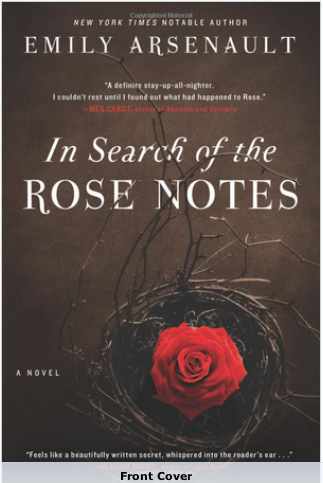
(You can find this book at Amazon.com)
Nora hangs out a lot with Charlotte, her best friend, while her single mother works full time. Charlotte is bossy, but never boring, as they explore the pre-teen world together. They have a babysitter, Rose, who watches over them and keeps them out of trouble. Until one day Rose disappears.
The book switches back and forth from these pre-teen experiences to a later time, maybe 15 years later, when Rose’s body is unearthed, and once again Nora experiences a lot of feelings she had buried. I loved the depiction of high school, where so many kids are suicidal, and life is cruel. High school just isn’t a kind place, even for those who look like they are having a great time.
At the same time, there were some good relationships, and you get to look back with Nora at people who were kind, but you were too absorbed in your own feelings to notice. It’s a complex world, and we get to go back and explore it once again through Nora’s eyes.
I’m glad I read it. This book did not change my life, but it is a great book for people who either are younger, or who like younger people, as I do.
Recent Comments
Kitchen on Isiais: Winding Down intlxpatr on Shampoo Ginger tigerbutterya0c5ff1d… on Shampoo Ginger intlxpatr on British Soldier Kidnapped, Esc… John on British Soldier Kidnapped, Esc… Wikipedia Donate Button

Amazina


Early Voting in Florida


