The Value of the Trivial
“Be sure to use your full name, First, maiden and married, on your quilt labels,” our presenter instructed us.
Oh-oh. I’ve been lucky just to get labels on my quilts, and I haven’t used my maiden name at all.
“Years from now, if someone is trying to track you as a quilter, it will help to have your maiden name to distinguish you from other quilters who may have similar names,” she continued.
OK. So now I will include my maiden name. (For my Moslem friends, it is our custom to take our husband’s names when we marry. Some women don’t, but even now, the majority do. I know, I know, it seems backward to you, it is irrational, it is just the way it is. We also don’t have marriage contracts.)
At lunch with a long-time friend this week, she mentioned she still has her mother’s diaries. I suggested she offer them to a major university near where my friend grew up, to their historical collection, and my friend said “oh, it’s just daily weather, who’s sick, stuff like that.”
Stuff like that is just exactly what historians treasure. When I was at university, I worked for a time in the copying department of the library, and I specialized in the historical collections, many of which were from people who came west. The papers were fascinating – letters home, lists of supplies they asked to have sent West, to-do lists, old photos. The scraps of paper you and I throw away – there in the Northwest collection.
They become valuable, at least for historical research, for writing period fiction, for medical research – because we do throw them away, and so few survive.
Keeping up with this blog has become more problematic. I just don’t have the time in my life I used to have. My life is interesting to me, but now that I am no longer living in exotic locations, I don’t believe I am so interesting to others. My internal debate is whether or not to continue. I would let it go in a heartbeat and not miss the time, but . . . I think I would miss your feedback.
I’m not writing this for you. I’m sort of writing more for my own record-keeping, it’s why I include news articles and scraps of daily life (not my own) and all the oddities and irrationalities that catch my eye. I love having a place to store it all (this blog) and I love your comments, which can sometimes completely turn me around in point of view; you give me perspectives I hadn’t considered.
The point of all this is the ephemeral nature of our daily lives, and the records of our lives. There are things worth keeping.
I wish someone in Kuwait were doing oral histories on the older people who were living there ‘before oil’.
As Bad as the Rest of Us
I laughed out loud while listening to my NPR station, WUWF in Pensacola. The interview was on Talk of the Nation, Science Friday, and if you click on the blue type, it will take you to the 12 minute interview. I laughed because he starts out telling us that we’re all pretty much the same, and that people who live longer have some tiny genetic differences.
I think of how hard we work to live long and prosper, how we try to control our fat foods, our salt, how we try to exercise more and to live faith-filled lives, all of which have been shown to correlate with longer lives. Only 7% of the long-lived people studied claimed a spiritual foundation. One 95 year old woman continued to be a heavy smoker. A good portion of the long-lived women did not have children. Men who survived to a ripe old age, they tell us, tend to be in much better shape than the women.
My grandmother lived to 105, and I have always wondered if I would be one of those who also lived long. Author Nir Barzilai discusses his study of people who live long lives and tells us that counter to popular wisdom, most of them had the same bad habits the rest of us had – many smoked, right up into their old age, drank, and ate sugary and fatty foods.
“We humans age at different rates,” the author states, and those who live long have good genetics – particularly a high HDL, the good cholesterol.
Now they are studying the particulars of the genes to further unlock the secrets to longevity.
AdventureMan and I love these Toyota commercials about older people and social networking 🙂
Statistics Anomaly
Yesterday, I had over two thousand hits on the blog, after a year of sliding statistics, which I attribute to being less interesting now that I no longer live in exotic locations, post the Kuwait sunrise (I used to have a loyal clientele of Kuwaiti students off at university who loved seeing the sunrise in Kuwait every day), and that blogging is not so new and exciting. I’m not blogging as conscientiously as I used to – I don’t have the time I used to have.
This morning, as I check the blog, I can see I have almost as many hits by nine this morning as I had yesterday. It makes me smile – here is what the most hit-upon posts are:

Ramadan is coming! Ramadan Mubarak, Ramadan Kareem to all those waiting so eagerly for Ramadan to begin.
Last night we had a big dinner for my Mom’s birthday, and got to hear a shred of conversation I wanted to share with you. I was sitting next to an old family friend, famous for asking questions that will start a conversation that could last the rest of the evening, and across the table was Little Diamond, my niece, actually now Professor Diamond. 🙂 If we were German, we would call her Professor Doctor Diamond 🙂
Our friend asked her what had surprised her the most about teaching on the college level and she answered that as she is teaching her culture classes, she brought up plural marriages, and it was simply a non-issue. She said there are a couple of shows, Sister-Wives and Big Love, and all the kids have seen them and know what plural marriage is all about – at least in the United States. She said it was a big change, that plural marriage used to be a hot topic, but now, not-so-much. It was fascinating.
Waking Up Cold
I shivered as I woke up; about a thousand gulls screaming past, up from the water, circling the town, loudly gossiping. It is a shiver of delight – I can sleep with the window open, no air conditioning needed, and the morning air is very cool. I am in heaven, also called Seattle.
It is so totally different coming in from Pensacola. As I showered the night before, I was thinking “about now I would be landing in Amsterdam, with several hours wait for my next flight. Being able to sleep in my own bed, get up early in the morning, five minutes to the airport, a breezy check-in and then a bare half day of traveling – so easy.”
Er . . . almost. I still trip the full inspection triggers, and got the complete pat down yesterday. The TSS lady was very professional, although much more thorough than ever before. It is annoying, but on the level of swatting a mosquito away; one minute later you’ve forgotten all about it.
Flight leaves late out of Pensacola, I have to RUN in Atlanta to make my connection, but it’s good to get some aerobic exercise in the middle of a long day of flying. 🙂 Unfortunately, my bag doesn’t make it, so when I reach Seattle they tell me it will come in on the next flight and they will deliver it. After all these years of back and forth, I have learned to have a nightgown and a change of clothes with me, and there are stores where I can pick up mascara and small things I need short-term. The bag arrives in the early evening, so all is well.
As I entered the Seattle airport from the A-concourse, I had a big grin. Where am I? This looks so much like Doha; there is a roundabout near the airport with the same collection of water gourds:

Seattle is cool and beautiful, and has rolled out a sunny day for my arrival. It’s always a thrill to see the Seattle skyline, and even more of a thrill when the roads are dry:

I pick up lunch on my way to my Mom’s, Ivar’s, as is our tradition, oh yummmm – halibut and chips for Mom, and a Salmon Ceasar for me.
I guess I’m a little more tired than I thought – it was an early flight. I grab a quick nap, and I feel like myself again. Mom and I head out shopping – we have a week of errands and appointments ahead of us, and some fun stuff too. Mom turns 88 this week – something to celebrate!
An Old Dented Bucket
THIS IS NOT MY STORY. 🙂 This is from my long time friend Kit Kat who passed it along to me and I loved it so much I want to share it with you:
THE OLD DENTED BUCKET
Our house was directly across the street from the clinic entrance of
Johns Hopkins Hospital in Baltimore . We lived downstairs and rented
the upstairs rooms to out-patients at the clinic.
One summer evening as I was fixing supper, there was a knock at the
door. I opened it to see a truly awful looking man. “Why, he’s hardly
taller than my 8-year-old,” I thought as I stared at the stooped,
shriveled body. But the appalling thing was his face, lopsided from
swelling, red and raw.
Yet his voice was pleasant as he said, “Good evening. I’ve come to
see if you’ve a room for just one night. I came for a treatment this
morning from the eastern shore, and there’s no bus ’til morning.”
He told me he’d been hunting for a room since noon but with no
success, no one seemed to have a room. “I guess it’s my face …. I
know it looks terrible, but my doctor says with a few more treatments
..”
For a moment I hesitated, but his next words convinced me: “I could
sleep in this rocking chair on the porch. My bus leaves early in the
morning.”
I told him we would find him a bed, but to rest on the porch.. I went
inside and finished getting supper. When we were ready, I asked the old
man if he would join us. “No, thank you. I have plenty.” And he held
up a brown paper bag.
When I had finished the dishes, I went out on the porch to talk with
him a few minutes. It didn’t take a long time to see that this old man
had an oversized heart crowded into that tiny body. He told me he
fished for a living to support his daughter, her 5 children, and her
husband, who was hopelessly crippled from a back injury.
He didn’t tell it by way of complaint; in fact, every other sentence
was preface with a thanks to God for a blessing. He was grateful that
no pain accompanied his disease, which was apparently a form of skin
cancer. He thanked God for giving him the strength to keep going…
At bedtime, we put a camp cot in the children’s room for him. When I
got up in the morning, the bed linens were neatly folded and the little
man was out on the porch.
He refused breakfast, but just before he left for his bus, haltingly,
as if asking a great favor, he said, “Could I please come back and stay
the next time I have a treatment? I won’t put you out a bit. I can
sleep fine in a chair.” He paused a moment and then added, “Your
children made me feel at home. Grownups are bothered by my face, but
children don’t seem to mind.”
I told him he was welcome to come again.
And, on his next trip, he arrived a little after 7 in the morning. As a
gift, he brought a big fish and a quart of the largest oysters I had
ever seen! He said he had shucked them that morning before he left so
that they’d be nice and fresh. I knew his bus left at 4:00 a.m. And I
wondered what time he had to get up in order to do this for us.
In the years he came to stay overnight with us, there was never a time
that he did not bring us fish or oysters or vegetables from his garden.
Other times we received packages in the mail, always by special
delivery; fish and oysters packed in a box of fresh young spinach or
kale, every leaf carefully washed. Knowing that he must walk 3 miles to
mail these, and knowing how little money he had made the gifts doubly
precious.
When I received these little remembrances, I often thought of a
comment our next-door neighbor made after he left that first morning.
“Did you keep that awful looking man last night? I turned him away!
You can lose roomers by putting up such people!”
Maybe we did lose roomers once or twice. But, oh!, if only they could
have known him, perhaps their illnesses would have been easier to bear.
I know our family always will be grateful to have known him; from him
we learned what it was to accept the bad without complaint and the good
with gratitude to God.
Recently I was visiting a friend, who has a greenhouse, as she showed
me her flowers, we came to the most beautiful one of all, a golden
chrysanthemum, bursting with blooms. But to my great surprise, it was
growing in an old dented, rusty bucket. I thought to myself, “If this
were my plant, I’d put it in the loveliest container I had!”
My friend changed my mind. “I ran short of pots,” she explained, “and
knowing how beautiful this one would be, I thought it wouldn’t mind
starting out in this old pail. It’s just for a little while, till I can
put it out in the garden.”
She must have wondered why I laughed so delightedly, but I was
imagining just such a scene in heaven.
“Here’s an especially beautiful one,” God might have said when he came
to the soul of the sweet old fisherman. “He won’t mind starting in this
small body.”
All this happened long ago – and now, in God’s garden, how tall this
lovely soul must stand.
The LORD does not look at the things man looks at. Man looks at the
outward appearance, but the LORD looks at the heart.” (1 Samuel 16:7b)
Monday Night Blues at Five Sisters Blues Cafe in Pensacola
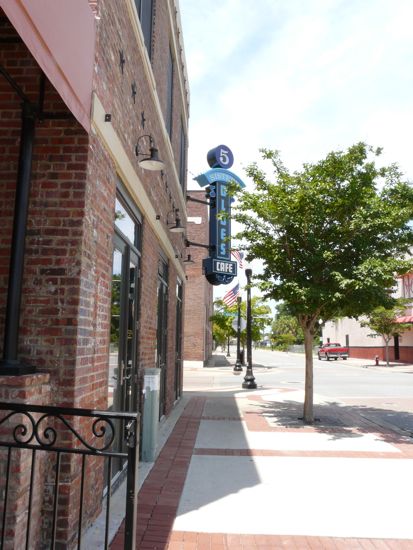
We kept wanting to go to Five Sisters Blues Cafe – everyone tells us it is a really fun place with great food – but it takes us a while to find it. I’m printing the Google map for you; it is at the corner of Belmont and DeVilliers. Not that hard to find if you know Pensacola, but we are still learning Pensacola.
Five Sisters exterior:

“Where’ve you been?” our waitress, Lisa, asked as we were seated. We must have looked goofy, we’ve never been there before, so we said, “this is our first time” and she laughed and said “I know that! I haven’t seen you before! We’ve been open a year! Where’ve you been?”
We just laughed, she had really caught us off guard. The place was packed, on a Wednesday afternoon, people all around us eating giant salads, plates heaped with fried chicken, everything we saw coming out to the tables looked delicious. Lisa brought us iced-tea, and I lost my heart, look, REAL mint in the tea, just like home . . .

We were overwhelmed. There is a lot going on in the restaurant, people laughing, art works on the walls, a new menu to peruse and we don’t know what we want. We finally decide to share the sampler platter with two fried green tomatoes, 4 crab cakes and 4 shrimp, which came with three very tasty sauces – WOW. Wowed right off the top:

AdventureMan even said, in wonder “This crab cake really tastes like crab with a C!” and it was. You know, the other kind, that calls itself crab, but is really flavored Alaskan pollock, and not crab at all? This was real crab, and it tasted crabby. Yummm.
AdventureMan had a vegetable platter. Now this is Southern cooking at it’s best, so don’t expect ‘vegetable’ to be Vegan. Even Mac and Cheese qualifies as a vegetable, and beans usually have some pork to flavor them, etc. He said the entire plate was delicious.
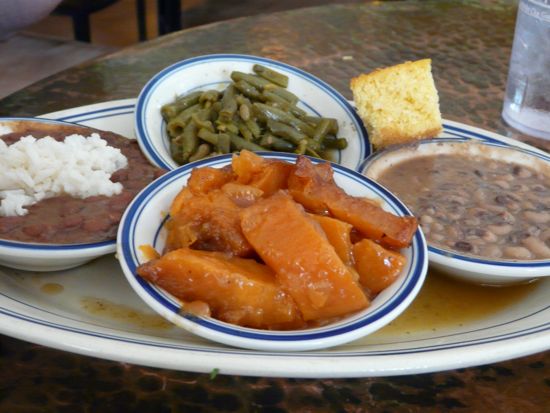
I tried something I had never had before, catish over grits. I never thought I liked grits until our daughter-in-laws stepmother (I know, I know, it sounds complicated, and it is another thing we have in common with people all over the world; we all have complicated relationships) made Smoked Gouda Grits one night with her Barbecued Shrimp and a whole new world opened up to me. Wooo HOOO. Anyway, I didn’t eat all the grits; the catfish was filling, but this dish knocked my socks off and I don’t think I could duplicate it, so I’m just going to have to go back to Five Sisters every time I get a craving for it:

If we are what we eat, we are becoming very Southern. 🙂
Lisa, the waitress, was a lot of fun, helpful in making recommendations, quick when we asked for anything, and she told us about an upcoming special jazz night that we really needed to attend. OK. That sounded like fun.

Lisa was right. It was really fun. We walked in, early, and every table was taken. There was a Jazz Society of Pensacola membership table at the entrance, and the lady just laughed and said “Look! There are lots of chairs empty, just go to a table and ask if you can join them.”
Hmm. We’re actually used to that, living in Germany all those years, but I didn’t know you could do that here. 🙂 We ended up at a table with another couple, and as we chatted, we had a really good time with them. They were so gracious and welcoming to people they had never met and who aren’t even members (yet) of the Jazz Society. We laughed a lot. He told us that they didn’t have a lot of rules, but that when things got lively, no oxygen machines were allowed on the dance floor because they might explode, LLOOLLL!
This place was ROCKIN’. People were dancing between the tables, people from young to old, just having a great time listening to some very very good music. Within an hour, there were no empty seats at all, some people were standing, and others were eating out on the covered patio. It was raining (rain in Pensacola during a drought is a good thing) and the evening was called Monday Night Blues. How cool is that? The atmosphere was perfect.
Of course we had dinner. AdventureMan had BBQ on Red Beans and Rice and I had the Shrimp Basket. No Mom, I did not eat the French Fries.


I did eat ONE of the hushpuppies. I could not resist. 😉
Five Sisters Blues Cafe is just a really fun place, immaculately clean, great food and great service. We can’t wait to go back again.
Red Robin – YUMMMMM
“I think I need a hamburger,” I said to AdventureMan as we were tucking in to bed. I can’t even remember the last time I had a hamburger, but I think it was in April, 2010, at the Red Robin in Pensacola.
Red Robin . . . YUMMM. One of the best ad campaigns in history, in my mind. Pure repetition, a little humor to re-inforce the memory, all positive. Anywhere you go in America, you can say “Red Robin” and someone will say “Yummm.”
I have a personal relationship with Red Robin. When I was a student at the University of Washington, long, long ago, the Red Robin was very near the university, near enough we could walk, even, and even though it was a bar, they weren’t very strict about carding people, and oh, they had the best burgers. It was pure comfort food. They also had a wonderful deck, so on the rare and beautiful spring days when final exams were coming and we just needed to blow off some steam, the Red Robin was one of the places we headed.
It wasn’t like the Red Robin chain. It was the original, and it was a little seedy. Here is what the original Red Robin looked like:

Yep. . . a little stoned.
Here is what he looks like now, he cleaned up good, LOL!
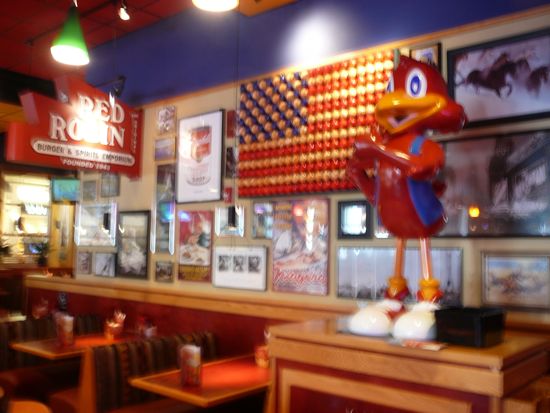
There were old wood floors, not the shiny kind of good wood floor, but the old fashioned cheap kind, sort of spongy when you walked on them, and usually covered with stuff that had been spilled. No, not exactly your family kind of place, it was a college student kind of place.
So for my once-in-more-than-a-year hamburger, we went to Red Robin.

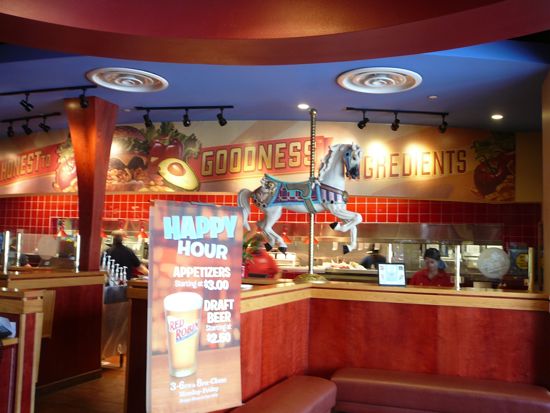
Compare that to the original:
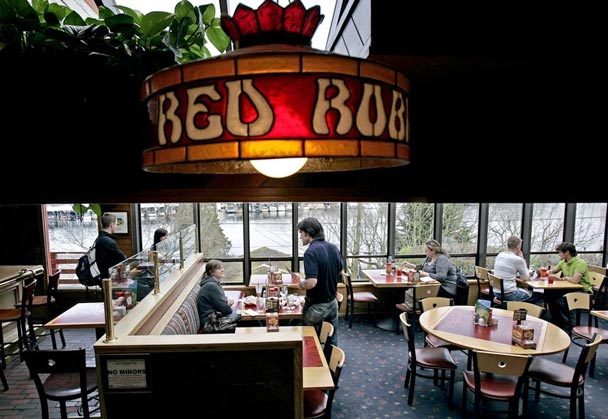
And here was my peppercorn burger:

It was YUMMMMM. Now, I won’t need another burger until September 2012 or so. 🙂
Sadly, as I was looking for some photos of the original Red Robin, I learned that they closed down the original on March 21, 2010. So sad, but I suspect it just didn’t suit the image of the new, family oriented Red Robins, more than 400 of them around the USA. But they still serve a good burger.
Atlanta: Ethiopian Adventure and Macy’s
One last entry from our recent trip, a happy ending to a happy trip. This is how sweet my husband is to me.
We find Pensacola a very comfortable place to be, and have only found two things lacking. There is no Macy’s, and I do like Macy’s. There are no Ethiopian restaurants, (remember, I just read Cutting for Stone) and we like Ethiopian food. We know Atlanta has both, so we plotted our return trip with a just-enough-time-for-Ethiopian-food-and-shopping.
Isn’t life funny and wonderful? We know Atlanta has Ethiopian restaurants – several – because an almost-niece who has worked in Ethiopia lives in Atlanta, and could recommend several. Using the handy iPhone, we found a Marriott Residence Inn hidden away in a quiet neighborhood near Macy’s and not far from the Queen of Sheba. Although the hotel was full, they had a wonderful room for us, with a view of downtown Atlanta:

We found the phone number for the Queen of Sheba, called – and they were open for lunch!

When we got to the plaza where the Queen of Sheba was located, we just laughed. We were back in Kuwait!
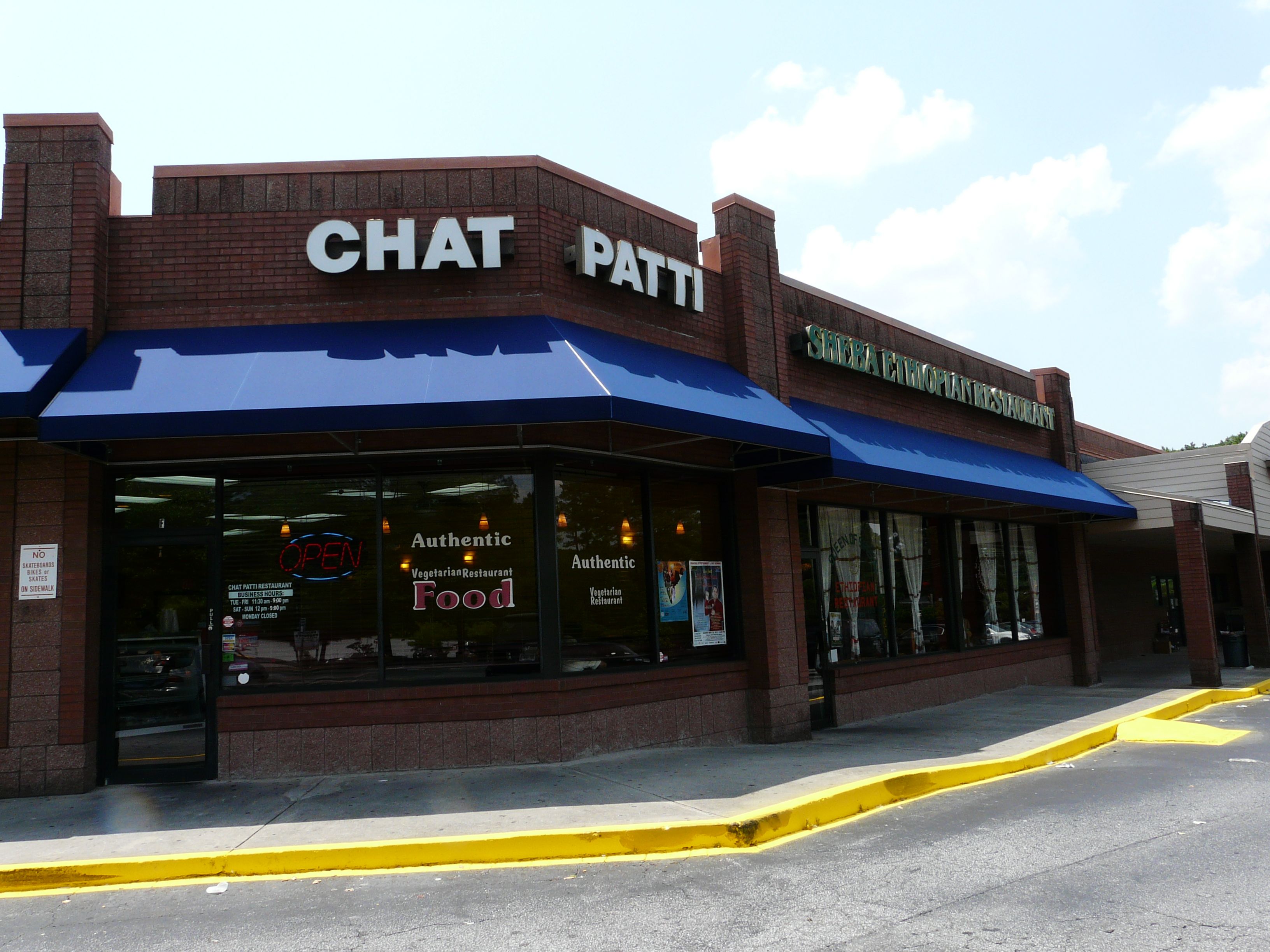
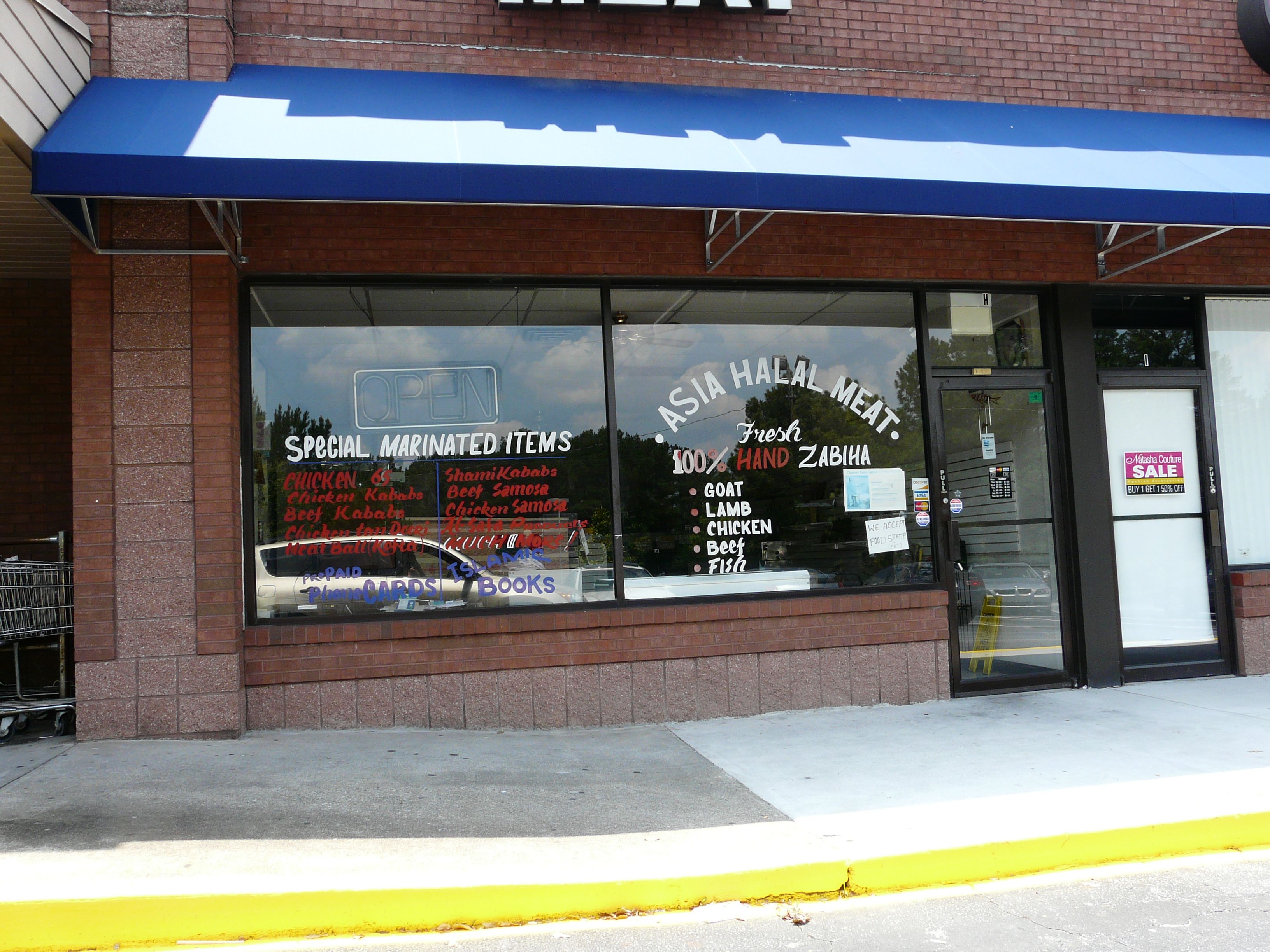


And here is what the Queen of Sheba looks like from the outside:

Inside, daytime, the atmosphere is serene:


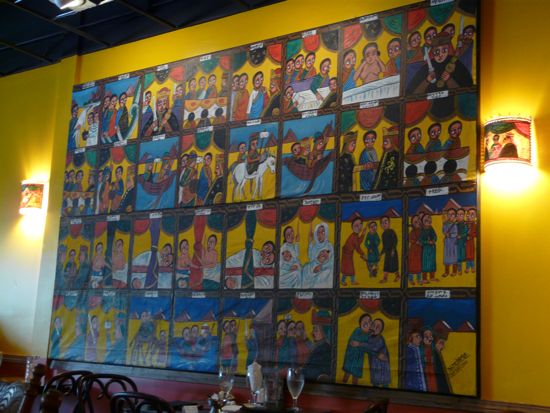
Nights and weekends, they have jazz and lively evenings:


We ordered the Vegetarian mix, a variety of Ethiopian vegetable/legume based dishes, a variety of tastes and heat, served on Injera, the large, pancake-like bread. When it came, it was beautiful, and it tasted as good as it looked. They gave us a tray of extra injera, and we ate almost all of it!


It was so good. SO good. We decided we would go back for dinner, after shopping. AdventureMan took me to Macy’s, and only called me twice in the hours I was looking and trying on.
Here’s the problem. I have a style, but I am terrified someone is going to recommend me for What Not to Wear, so I try to find a couple little things now and then to update my look. I have a tactic: take armsfull of clothes into the dressing room. Try on quickly. You usually can tell immediately.
Here is what you hear. “No.” “Oh, NO!” “No” “No” “No” “Hmmm, maybe” “no” “Holy Smokes, NO!” “Hmmm, maybe” etc. Then I try on the maybes, and out of twenty or thirty items, I might come out with one or two. Some young styles are just too young, some skirts just too short, some camis just too revealing. I don’t want to be one of those pathetic older women trying to be hot, I just want to look decently attractive, that’s the goal.
Meeting up hours later with AdventureMan (I know, I know, I owe him big time for this) we laugh to discover we are neither of us hungry for dinner. We decide to go back to the hotel, but dinner time comes and we are still so full from lunch that we can’t consider dinner. Even though the dishes were vegetarian, that injera must have swelled in our bellies. We can’t eat another bite!
A Different Kind of Sadly Hilarious
I was just checking if there might be anything on TV tonight worth watching, and I got caught watching – in horror and fascination – Rock Pop and Do-Wop, on National Public Television.

Horrified – because these 60’s and 70’s bands are playing to full concert houses full of people who look OLD like my parents – oh wait – they look like me! Horrors! The music still makes me feel like a teenager! All these people in the audience are looking like true believers, singing along with the songs, getting up and dancing, like they can’t resist the music. No dignity! They are acting like teenagers! Horrors! I still know all the words, even to songs I don’t even remember any more, once they play the first few notes, I know all the words!
Hilarious, because these acts have to strain a little to hit all the notes, but most of them have had eye-lifts, and some of them can even still dance. They can still rock the songs, and they are totally wowing the audience. The hair styles – so awful they are almost cool again. It’s just wrong to have OLD people singing these young love songs.
Poison Ivy! One Fine Day! Blue Moon! I Only Have Eyes for You! Step-by-Step! This Magic Moment! Only You! Twilight Time! The Great Pretender! (Holy Smokes!The audience is going crazy!)
The costumes – oh my heavens. I remember when my high school BF was in a band and my father was horrified by his turquoise blue band jacket, and now . . . I can sort of see what he meant. Pretty awful, but oh – what fun. I remember the fights over whether we should be listening to this music, the Beatles, the Rolling Stones, the bad boys of rock. They all look so innocent a hundred years later.
There is a part of me that is still 12 years old, listening to this music, and there is a part of me watching me watch the program that is horrified at my fascination.
Sadly Hilarious
Peaches, sweet, juicy peaches are coming into season, and I couldn’t resist making up a peach crisp for a lunch I am giving today. Since I was making one, I made several, some smaller ones to give away. Dropped one off with a friend, then went by to see our son and his wife and Baby Q, the Happy Baby.
As I walked in, Happy Baby came running, screeching happy sounds, so happy to see . . . me? No, he ran right by me, did not want my hug, he was looking for AdventureMan. As I stood with my arms open to hug him, he was desperately looking out the window, looking for the fun guy who really matters. I didn’t know whether to laugh or cry; I wanted that hug all for myself, but it is truly hilarious how much he loves AdventureMan, and how he watched and watched and watched out the window, hoping he was coming, too. The longer he watched, the funnier it got.
Later in the evening, we both went by, so Happy Baby got some time with his “Ga Ga”and then, guess what, I also got my hug once he had had his special time with his Grandpa. 🙂
Recent Comments
intlxpatr on Shampoo Ginger tigerbutterya0c5ff1d… on Shampoo Ginger intlxpatr on British Soldier Kidnapped, Esc… John on British Soldier Kidnapped, Esc… intlxpatr on British Soldier Kidnapped, Esc… Wikipedia Donate Button

Amazina


Early Voting in Florida


