Red Robin – YUMMMMM
“I think I need a hamburger,” I said to AdventureMan as we were tucking in to bed. I can’t even remember the last time I had a hamburger, but I think it was in April, 2010, at the Red Robin in Pensacola.
Red Robin . . . YUMMM. One of the best ad campaigns in history, in my mind. Pure repetition, a little humor to re-inforce the memory, all positive. Anywhere you go in America, you can say “Red Robin” and someone will say “Yummm.”
I have a personal relationship with Red Robin. When I was a student at the University of Washington, long, long ago, the Red Robin was very near the university, near enough we could walk, even, and even though it was a bar, they weren’t very strict about carding people, and oh, they had the best burgers. It was pure comfort food. They also had a wonderful deck, so on the rare and beautiful spring days when final exams were coming and we just needed to blow off some steam, the Red Robin was one of the places we headed.
It wasn’t like the Red Robin chain. It was the original, and it was a little seedy. Here is what the original Red Robin looked like:

Yep. . . a little stoned.
Here is what he looks like now, he cleaned up good, LOL!

There were old wood floors, not the shiny kind of good wood floor, but the old fashioned cheap kind, sort of spongy when you walked on them, and usually covered with stuff that had been spilled. No, not exactly your family kind of place, it was a college student kind of place.
So for my once-in-more-than-a-year hamburger, we went to Red Robin.


Compare that to the original:

And here was my peppercorn burger:

It was YUMMMMM. Now, I won’t need another burger until September 2012 or so. 🙂
Sadly, as I was looking for some photos of the original Red Robin, I learned that they closed down the original on March 21, 2010. So sad, but I suspect it just didn’t suit the image of the new, family oriented Red Robins, more than 400 of them around the USA. But they still serve a good burger.
Atlanta: Ethiopian Adventure and Macy’s
One last entry from our recent trip, a happy ending to a happy trip. This is how sweet my husband is to me.
We find Pensacola a very comfortable place to be, and have only found two things lacking. There is no Macy’s, and I do like Macy’s. There are no Ethiopian restaurants, (remember, I just read Cutting for Stone) and we like Ethiopian food. We know Atlanta has both, so we plotted our return trip with a just-enough-time-for-Ethiopian-food-and-shopping.
Isn’t life funny and wonderful? We know Atlanta has Ethiopian restaurants – several – because an almost-niece who has worked in Ethiopia lives in Atlanta, and could recommend several. Using the handy iPhone, we found a Marriott Residence Inn hidden away in a quiet neighborhood near Macy’s and not far from the Queen of Sheba. Although the hotel was full, they had a wonderful room for us, with a view of downtown Atlanta:

We found the phone number for the Queen of Sheba, called – and they were open for lunch!

When we got to the plaza where the Queen of Sheba was located, we just laughed. We were back in Kuwait!
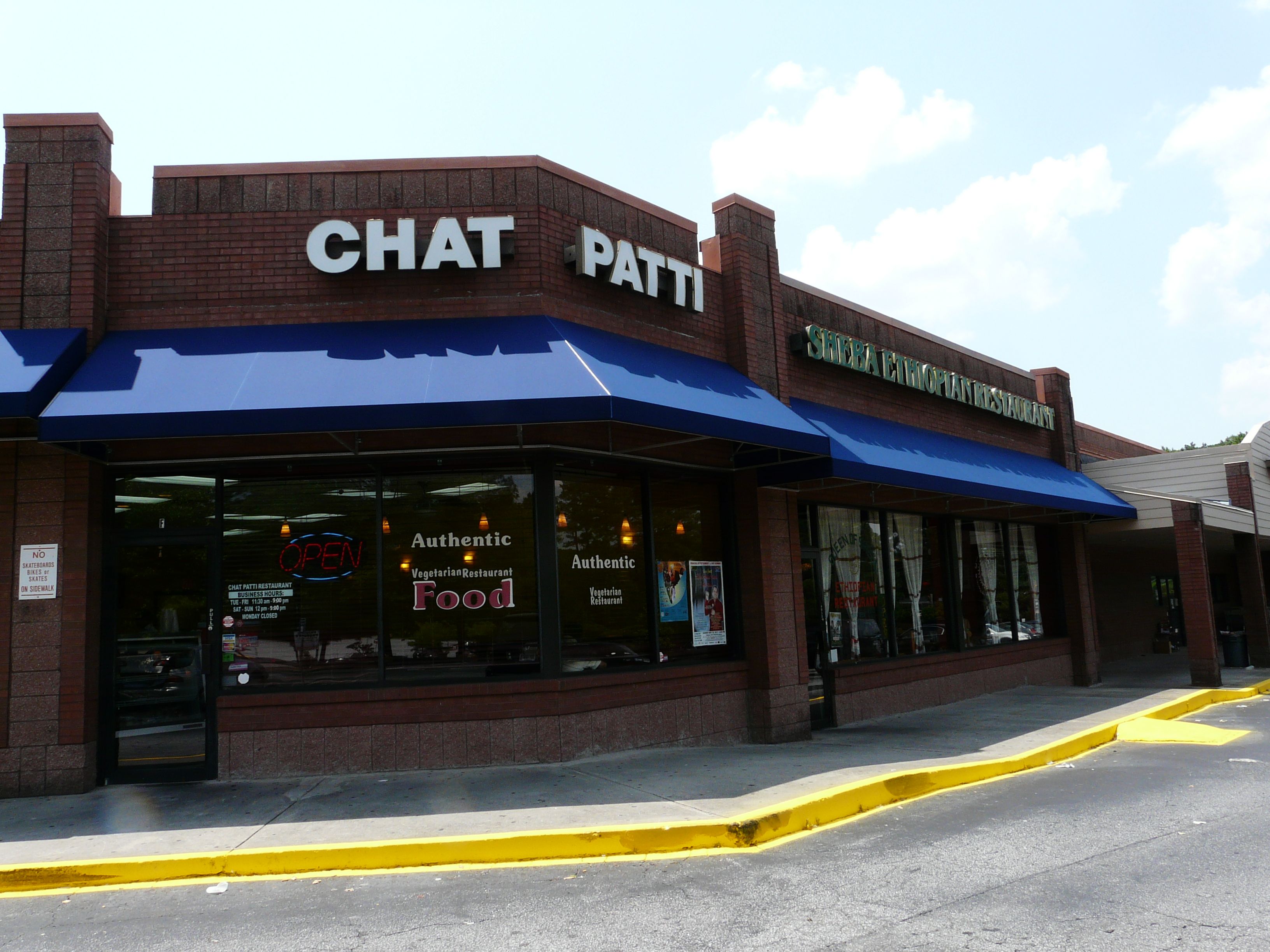



And here is what the Queen of Sheba looks like from the outside:

Inside, daytime, the atmosphere is serene:



Nights and weekends, they have jazz and lively evenings:


We ordered the Vegetarian mix, a variety of Ethiopian vegetable/legume based dishes, a variety of tastes and heat, served on Injera, the large, pancake-like bread. When it came, it was beautiful, and it tasted as good as it looked. They gave us a tray of extra injera, and we ate almost all of it!


It was so good. SO good. We decided we would go back for dinner, after shopping. AdventureMan took me to Macy’s, and only called me twice in the hours I was looking and trying on.
Here’s the problem. I have a style, but I am terrified someone is going to recommend me for What Not to Wear, so I try to find a couple little things now and then to update my look. I have a tactic: take armsfull of clothes into the dressing room. Try on quickly. You usually can tell immediately.
Here is what you hear. “No.” “Oh, NO!” “No” “No” “No” “Hmmm, maybe” “no” “Holy Smokes, NO!” “Hmmm, maybe” etc. Then I try on the maybes, and out of twenty or thirty items, I might come out with one or two. Some young styles are just too young, some skirts just too short, some camis just too revealing. I don’t want to be one of those pathetic older women trying to be hot, I just want to look decently attractive, that’s the goal.
Meeting up hours later with AdventureMan (I know, I know, I owe him big time for this) we laugh to discover we are neither of us hungry for dinner. We decide to go back to the hotel, but dinner time comes and we are still so full from lunch that we can’t consider dinner. Even though the dishes were vegetarian, that injera must have swelled in our bellies. We can’t eat another bite!
A Different Kind of Sadly Hilarious
I was just checking if there might be anything on TV tonight worth watching, and I got caught watching – in horror and fascination – Rock Pop and Do-Wop, on National Public Television.

Horrified – because these 60’s and 70’s bands are playing to full concert houses full of people who look OLD like my parents – oh wait – they look like me! Horrors! The music still makes me feel like a teenager! All these people in the audience are looking like true believers, singing along with the songs, getting up and dancing, like they can’t resist the music. No dignity! They are acting like teenagers! Horrors! I still know all the words, even to songs I don’t even remember any more, once they play the first few notes, I know all the words!
Hilarious, because these acts have to strain a little to hit all the notes, but most of them have had eye-lifts, and some of them can even still dance. They can still rock the songs, and they are totally wowing the audience. The hair styles – so awful they are almost cool again. It’s just wrong to have OLD people singing these young love songs.
Poison Ivy! One Fine Day! Blue Moon! I Only Have Eyes for You! Step-by-Step! This Magic Moment! Only You! Twilight Time! The Great Pretender! (Holy Smokes!The audience is going crazy!)
The costumes – oh my heavens. I remember when my high school BF was in a band and my father was horrified by his turquoise blue band jacket, and now . . . I can sort of see what he meant. Pretty awful, but oh – what fun. I remember the fights over whether we should be listening to this music, the Beatles, the Rolling Stones, the bad boys of rock. They all look so innocent a hundred years later.
There is a part of me that is still 12 years old, listening to this music, and there is a part of me watching me watch the program that is horrified at my fascination.
Sadly Hilarious
Peaches, sweet, juicy peaches are coming into season, and I couldn’t resist making up a peach crisp for a lunch I am giving today. Since I was making one, I made several, some smaller ones to give away. Dropped one off with a friend, then went by to see our son and his wife and Baby Q, the Happy Baby.
As I walked in, Happy Baby came running, screeching happy sounds, so happy to see . . . me? No, he ran right by me, did not want my hug, he was looking for AdventureMan. As I stood with my arms open to hug him, he was desperately looking out the window, looking for the fun guy who really matters. I didn’t know whether to laugh or cry; I wanted that hug all for myself, but it is truly hilarious how much he loves AdventureMan, and how he watched and watched and watched out the window, hoping he was coming, too. The longer he watched, the funnier it got.
Later in the evening, we both went by, so Happy Baby got some time with his “Ga Ga”and then, guess what, I also got my hug once he had had his special time with his Grandpa. 🙂
Dancing and Drinks
Yesterday was our 38 year wedding anniversary, and it was a great day. Last night, we went for dancing and drinks.
LOL.
Our dance class at the YMCA . . . and this month we started the waltz, which we already know how to do, but now we are learning some extras, like turns. It is barely air conditioned in the gym, if at all, so dancing is EXERCISE in the heat we are experiencing – record highs – this year.
And drinks – don’t McDonald’s smoothies count? I totally love the Wild Berry, and I try to tell myself it might even be healthy, it might even have berries, and I try not to think about the sugar. It is only now and then I have one, AdventureMan too, so our anniversary was celebrated in style. Our style, LOL, not exactly the high life, but it works for us.
Elderly Women Prime Targets for Cons
Found this fascinating article this morning on AOL News/finance There was a time when I worked with transitional homeless people, helping them to find ways to re-enter the mainstream. A percentage of them didn’t want to enter the mainstream, they didn’t like rules, and they were looking for an easier way. One of the paths was by being part of the elder-worker force. I would watch them take a job and then work their way into a position of dominance in an elderly person’s life. Partly, the elderly were lonely, and thrived on the new attention, and interpreted it as caring.
Then would come the sob stories. School starting and not enough money to buy shoes and books for the children. A broken-down car, and funds needed to get it fixed so she can get to her job. Once it starts, it never ends.
The key to prevention is staying engaged with friends, neighbors and family who are paying attention, and can give perspective to this new relationship. The one question I asked is “if there were not money involved, would this relationship exist?”
Elder Abuse: How to Protect Grandma From Con Men and Thieves
By Sheryl Nance-Nash Posted 9:00AM 06/03/11 Retirement, People, MetLife
See full article from DailyFinance: http://srph.it/lXHooJ
Who would pick the pocket of your grandma or grandpa? Apparently, any number of people. Older Americans are losing $2.9 billion annually to elder financial abuse, a 12% increase from the $2.6 billion estimated in 2008, according to The MetLife Study of Elder Financial Abuse: Crimes of Occasion, Desperation, and Predation Against America’s Elders, released Wednesday.
According to the study, 51% of these abusers are strangers, but 34% of the perpetrators were family, friends and neighbors. As for “trusted advisers,” exploitation from the business sector accounted for 12% of reported cases. Medicare and Medicaid fraud accounts for 4% of reported cases. As a subset, the percentage of robberies and crimes classified as “scams perpetrated by strangers” increased from 9% to 28% from 2008 to 2010.
Who’s on the top of the target list? Women. The study, produced by the MetLife (MET) Mature Market Institute in collaboration with the National Committee for the Prevention of Elder Abuse and the Center for Gerontology at Virginia Polytechnic Institute, shows women were nearly twice as likely to be victims of elder financial abuse as men.
Also prime for the picking were people between the ages of 80 and 89 who lived alone and required some help with either health care or home maintenance. Primarily, men were the menace: Nearly 60% of perpetrators were males, mostly between ages 30 and 59.
Predators lie in wait, watching: In the most common scenarios, strangers targeted victims who were out shopping, driving or managing the financial affairs, and often looked for particular flags of vulnerability like handicapped tags on cars, canes or displays of confusion. Crimes included cons, purse snatchings and associated physical assaults.
But that even those closest to an elderly person can give in to temptation or desperation. In cases involving a person known to the victim, trusted helpers like caretakers, handymen, friends, “sweethearts,” children, lawyers and others seized upon opportunities to forge checks, steal credit cards, pilfer bank accounts, transfer assets and generally decimate elders’ finances, the study revealed. The holidays apparently bring out the worst in people: At that time of year, overall dollar losses due to family and friends were higher than any other category.
Married to the Con Job
People can get quite creative with abuse. One unusual method — caregivers secretly marrying their elderly charges, says Susan Slater-Jansen, an attorney at Kurzman Eisenberg Corbin & Lever.
There have been numerous lawsuits over cases in which a caregiver married a mentally incapacitated older patient and the patient’s family didn’t learn about it until after the patient had died. Once a person is dead, it’s too late — in all but three states, you can’t void a marriage if one spouse has died, says Slater-Jansen. To help lower the odds of such a thing happening to your parent, adult children should make sure they receive duplicate monthly statements from all bank and brokerage accounts; install nanny cams; carefully and thoroughly check references for all caregivers; visit parents often, both while the caregiver is there and when they are not; and discuss with your parents the treatment they are receiving from caregivers.
If you discover such a fraudulent marriage has taken place, act quickly to get it annulled.
After the parent dies, heirs can sue to recover money from the “spouse.” More and more, courts have found ways to deny spouses if the marriage was fraudulent, says Slater-Jansen.
“The most flagrant abuse is perpetrated on the elder by the hired caregiver, neighbor, or ‘new’ friend,” warns Karen Maarse Fitzgerald, a principal in her own elder law practice. “A simple power of attorney signed by the elder can give to the “agent” broad and sweeping powers over the elder’s life savings. I have seen bank accounts drained within days, the money and perpetrator vanishing to another country.”
Protection Yourself and Your Relatives
The worst forms of elder abuse go beyond money: There can be physical abuse and sexual violence as well. “The vigilance of friends and family can help protect elders from those who are predatory, which may, unfortunately, include strangers or even other loved ones,” said Sandra Timmermann, Ed.D., director of the MetLife Mature Market Institute, in a prepared statement.
What can the elderly do to protect themselves? Among the guidance offered by the report’s authors:
“Stay active and engage with others; socialize with your family members and friends. Avoid isolation, as it can lead to loneliness, depression, and make you more vulnerable to financial abuse or exploitation.”
“Use direct deposit for Social Security and other payments to prevent mail theft. Sign your own checks whenever possible.”
“Stay organized and keep important papers and legal documents in a safe, secure location.”
“Review your legal documents (i.e., wills, trusts, and power of attorney), as well as other important documents (i.e., insurance policies) at least annually, to make certain they continue to represent your wishes.”
Ted Sarenski, who chairs the American Institute of Certified Public Accountants’ Elder Planning Task Force, would add to that list. His tips:
Subscribe to national and state Do Not Call lists;
Keep Social Security cards in a safe place;
Remove mail promptly from the mailbox;
Shred all confidential and financial information prior to discarding.
“Consider allowing the bank to send a duplicate copy of your bank statement to a trusted family member,” advises attorney Andrew Stoltmann, who has a large client base of seniors. “Usually, most financial elder exploitation cases are only reported or discovered six to 12 months after the initial losses have occurred.”
Elders whose sight is failing are at even greater risk because they may rely upon the very person who is stealing from them to ensure that their financial transactions are in order, says Stoltmann. “An independent pair of eyes that is able to review bank statements every 30 days will be able to catch suspicious activities in the early stages and cut it off. This is crucial.”
Advance Planning Can Help Dodge Dangers
When you are the responsible caregiver, know too, that your prudence can go a long way in preventing financial abuse.
Have some tough conversations. You need to know whether there is a will or a durable power of attorney, and where such documents are. Does your parent have a living will? If so, does it give you clarity about what your loved one’s wishes are? A health care power of attorney would permit a trusted individual make medical decisions if your elderly relative was unable to.
It’s important not to wait until the eleventh hour to have these talks. Ideally, those documents should be drawn up when your relative is of sound mind and body. It’s not a bad idea either, to have a trusted adviser, not only know where the documents are kept, but be able to get to them if needed.
Beware of the appearance on the scene of the “trusted new friend.” If mom and dad have a neighbor, caregiver or other outsider who is suddenly their best pal, running errands, going to the bank, and generally being around all the time when they never were before, it can be a warning sign that someone is taking advantage, warns Sarenski.
“Elder financial abuse invariably results in losses of human rights and dignity,” said Karen A. Roberto, Ph.D., director of the Center for Gerontology, at Virginia Polytechnic Institute. ” Despite growing public awareness from a parade of high-profile financial abuse victims, it remains under reported, under-recognized, and under-prosecuted. The 2010 Passage of the Elder Justice Act may bring more attention and resources to this crime leading to prevention among the expanding older population.”
The bottom line, says Maarse Fitzgerald: “Protect elders from isolation, which allows the perpetrators to take control of our elder’s lives.”
See full article from DailyFinance: http://srph.it/lXHooJ
Did you Tell Him We’re Going Dancing?

I was laughing as I heard AdventureMan talking with his Saudi friend, making a time when they could get together. I knew he had called about tonight.
“Did you tell him we were going dancing?” I laughed as I asked him.
“Uhhh . . . no,” he said.
This is new to us. We are taking dancing lessons, ballroom dancing, at the YMCA. We both had those lessons you take in eighth grade, but we’ve forgotten most of what we learned. I don’t care about going dancing, or fancy dresses, or competitions. I don’t even watch dance stuff on TV; I just don’t care that much. These classes are something we’ve wanted to do for a long time, and it really takes us out of our comfort zones.
We really are having fun. The first lesson – not so much. It is hard work! It doesn’t come naturally, it comes with PRACTICE! Lots of PRACTICE! It’s like fencing lessons, or horseback riding, or karate, or gymnastics – After a while, your body knows what to do, but at the beginning, it can be a little excruciating. As for AdventureMan and I, we mess up a lot, but we laugh a lot too. We are getting better, but best of all we are having a lot of fun. These kinds of things rewire your brains; it may not be easy, but it is good for us.
And I am still laughing, thinking of AdventureMan not telling his friend that he was going dancing with his wife, LOL!
AdventureMan’s New Adventure: Cinco de Mayo
When he ‘retired,’ AdventureMan chose Thursdays as his day to cook. It’s worked out well. Recently, he has perfected Naan, baked on our grill. We’ve had it several times – it just tastes so good, fresh off the grill, and he bastes it with either olive oil and garlic, or olive oil and sesame seeds. Oh, yummmmmm.
“I’m feeling stressed,” he admitted yesterday morning. “It’s my day to cook and I don’t have any ideas.”
“It’s also Cinco de Mayo,” I said, and that was all I had to say, he was off and running.
All I can say is BRAVO. BRAVO, AdventureMan, Cinco de Mayo was a taste treat. They were fabulous.
He found his recipe on AllRecipes.com, and made it pretty much just as they said to make it, serving it with a small bowl of home-made pico de gallo and a small bowl of sour cream. Oh YUMMMM. This is the recipe he used:

Pico de Gallo Chicken Quesadillas
By: Tony Cortez
Ingredients
2 tomatoes, diced
1 onion, finely chopped
2 limes, juiced
2 tablespoons chopped fresh cilantro
1 jalapeno pepper, seeded and minced
salt and pepper to taste
2 tablespoons olive oil, divided
2 skinless, boneless chicken breast halves – cut into strips
1/2 onion, thinly sliced
1 green bell pepper, thinly sliced
2 cloves garlic, minced
4 (12 inch) flour tortillas
1 cup shredded Monterey Jack cheese
1/4 cup sour cream, for topping
Directions
In a small bowl, combine tomatoes, onion, lime juice, cilantro, jalapeno, salt and pepper. Set aside. (This is the pico de gallo)
In a large skillet, heat 1 tablespoon olive oil. Add chicken and saute until cooked through and juices run clear. Remove chicken from skillet and set aside.
Put the remaining 1 tablespoon of olive oil in the hot skillet and saute the sliced onion and green pepper until tender. Stir in the minced garlic and saute until the aroma is strong. Mix in half of the pico de gallo and chicken breast meat. Set aside; keep warm.
In a heavy skillet, heat one flour tortilla. Spread 1/4 cup shredded cheese on the tortilla and top with 1/2 the chicken mixture. Sprinkle another 1/4 cup cheese over the chicken and top with another tortilla. When bottom tortilla is lightly brown and cheese has started to melt, flip quesadilla and cook on the opposite side. Remove quesadilla from skillet and cut into quarters.
Repeat with remaining ingredients. Serve quesadillas with sour cream and remaining pico de gallo.
I’ve never seen him so happy as he has been the last couple months.
Early Signs of Alzheimer’s Disease
I’m at the age where we start worrying we are coming down with Alzheimer’s if we forget a name, or why we went up the stairs. Here are the official guidelines to things that indicate onset of this insidious disease from Everyday Health:
Caregiving in Early Alzheimer’s Disease
By Chris Iliades, MD
Medically reviewed by Pat F. Bass III, MD, MS, MPH
A caregiver’s role often starts with the diagnosis of early-stage Alzheimer’s disease. At this juncture, it’s important to deal with both long-term planning and with immediate medical and psychological issues in order to make life as normal as possible for your loved one. To begin, it’s helpful to become familiar with some of the more common symptoms of early, or Stage I, Alzheimer’s disease. These often include:
Misplacing items and/or storing them in odd places. A person with Stage I Alzheimer’s, for instance, may put things in strange places, like a wallet in the freezer.
Repeating the same phrase or story, completely unaware of the repetition and having difficulty finding the right words when talking.
Resisting decisions, even of the simplest sort.
Taking longer with routine chores and becoming upset if something unexpected occurs.
Forgetting to eat, eating only one kind of food, or eating all the time.
Neglecting hygiene and wearing the same clothes day after day, and insisting they are clean.
Becoming obsessive about checking, searching, or hoarding things of no value.
Lisa Gwyther, MSW, the director of the family support program at Duke University Medical Center, in Durham, N.C, notes that depression is also very common in early Alzheimer’s. “A depression that comes on later in life, especially in someone without a prior history of depression, is often the first symptom of Alzheimer’s,” she says. Once the diagnosis of Alzheimer’s disease has been made, it is a difficult time for the person and the family. In addition to feeling depressed, the person with early Alzheimer’s may go through periods of anger, fear, and anxiety.
What Can Family, Friends, and Caregivers Do to Help?
There are a number of measures that can be taken to help a loved one cope better with the challenges presented by early Alzheimer’s disease.
Get a complete medical evaluation.
The first step in caring for a loved one with Alzheimer’s disease is to make sure the diagnosis is accurate. Some possible treatments depend on a precise diagnosis, and your health care provider may recommend a number of tests. Because people with early Alzheimer’s are often not aware of their own forgetfulness and can get quite adept at hiding it from others, family members and caregivers can help the doctor take a good medical history. The doctor will do a functional status assessment to determine if it is safe for the person to live alone, drive a car, or do their own finances. “The ability to do financial calculations is lost early in Alzheimer’s disease. The person may pay bills twice or neglect to pay bills and get themselves in a financial mess. A trusted family member and financial advisor can be a big help at this point,” says Gwyther. Finally, your doctor may recommend a number of possible treatments or referral to an Alzheimer’s specialist.
Don’t shut the person with early Alzheimer’s out.
“One of the most common mistakes that family and caregivers make is to marginalize the person with Alzheimer’s. As time goes on, the family and the caregivers will have to take over more and more decisions for the person. But in the beginning, let them participate as much as possible,” says Gwyther.
Help the person with early Alzheimer’s stay active and healthy.
Research shows that social and mental activity may slow the progression of the disease. A diet high in natural fats such as fish, nuts, and olive oil can help too. Vitamins such as B, C, and E have all been recommended for early Alzheimer’s disease.
Provide a stable environment.
People with early Alzheimer’s do better if their day is very structured. Help them by creating routines around eating, bathing, and sleeping. Keep the environment familiar by making sure things stay in their usual places. Avoid surprises and confusion as much as possible. Sometimes the most helpful thing to do is to just be nearby.
You can also help by getting help.
Contact one of the many national organizations that help with Alzheimer’s care. Most of these organizations will have a local chapter near you. The Alzheimer’s Disease Education & Referral Center, the Alzheimer’s Association, Children of Aging Parents, Eldercare Locator, and Family Caregiver Alliance are all nationwide, nonprofit organizations that offer information and services for Alzheimer’s disease caregivers.
Finally, remember that although it now possible to slow down the progression of Alzheimer’s disease, it can’t yet be stopped. As a family member, friend, or caregiver, you can be a tremendous asset to the person with early Alzheimer’s by being an advocate, as well as supportive and available. While someone with Alzheimer’s may not be able to show or express it, they always feel your affection and compassion.
Recent Comments
Kitchen on Isiais: Winding Down intlxpatr on Shampoo Ginger tigerbutterya0c5ff1d… on Shampoo Ginger intlxpatr on British Soldier Kidnapped, Esc… John on British Soldier Kidnapped, Esc… Wikipedia Donate Button

Amazina


Early Voting in Florida


